

We scored more than 30 belt squat machines across 5 quality categories and picked the 6 most worthy of your money.
I’ve spent 2 decades coaching and running my own commercial gym, and I’ve watched every one of these machines arrive on the market. The team ran my picks through our weighted scoring, so this is data and owner reports, not one bloke’s gut call.
The goal was simple: split belt squats by how they load your body, not by brand, so you land on the right type of machine first and the right product second.
Let’s see if we did a good job…
Editor's note · updated June 15, 2026
We rebuilt this guide for 2026 and rebuilt the rankings with it.
What changed:
- The cable Rogue Monster Rhino stays #1 overall. It pulls you straight down like a real squat and does far more than squats. Nothing else here matches it for versatility.
- The Titan SquatMax-MD is the new pick for squat form and glutes. Titan now builds this vertical-pull free-weight machine under licence, so the design the research favours is finally on an affiliate program we use.
- We added a rack-attachment slot. The REP Belt Squat bolts to a power rack and is the most space-honest pick for a real home gym.
- Line of pull is now the heaviest scored criterion. A vertical or cable pull spares your spine and works the glutes. A lever pulls you forward, which loads the quads and nags the knees.
The old Bells of Steel 2.0 budget pick is out for now. It’s showing as unavailable, so we’ve held it pending a restock and re-slotted the field around the Titan lever for value.
Related
We’ve bolted belt squats next to every kind of kit over the years. For the rack most of these mount onto, see our best squat rack picks. If you want one machine that does the lot, read our best all-in-one home gym guide.
Compare the best belt squat machines
This table shows all 6 picks side by side. Scores come from our weighted rating, which we explain in the testing section below.
 Titan SquatMax-MD
Check price
Titan SquatMax-MD
Check price
|
 REP Belt Squat
Check price
REP Belt Squat
Check price
|
 Titan Belt Squat
Check price
Titan Belt Squat
Check price
|
 Sorinex Belt Squat
Check price
Sorinex Belt Squat
Check price
|
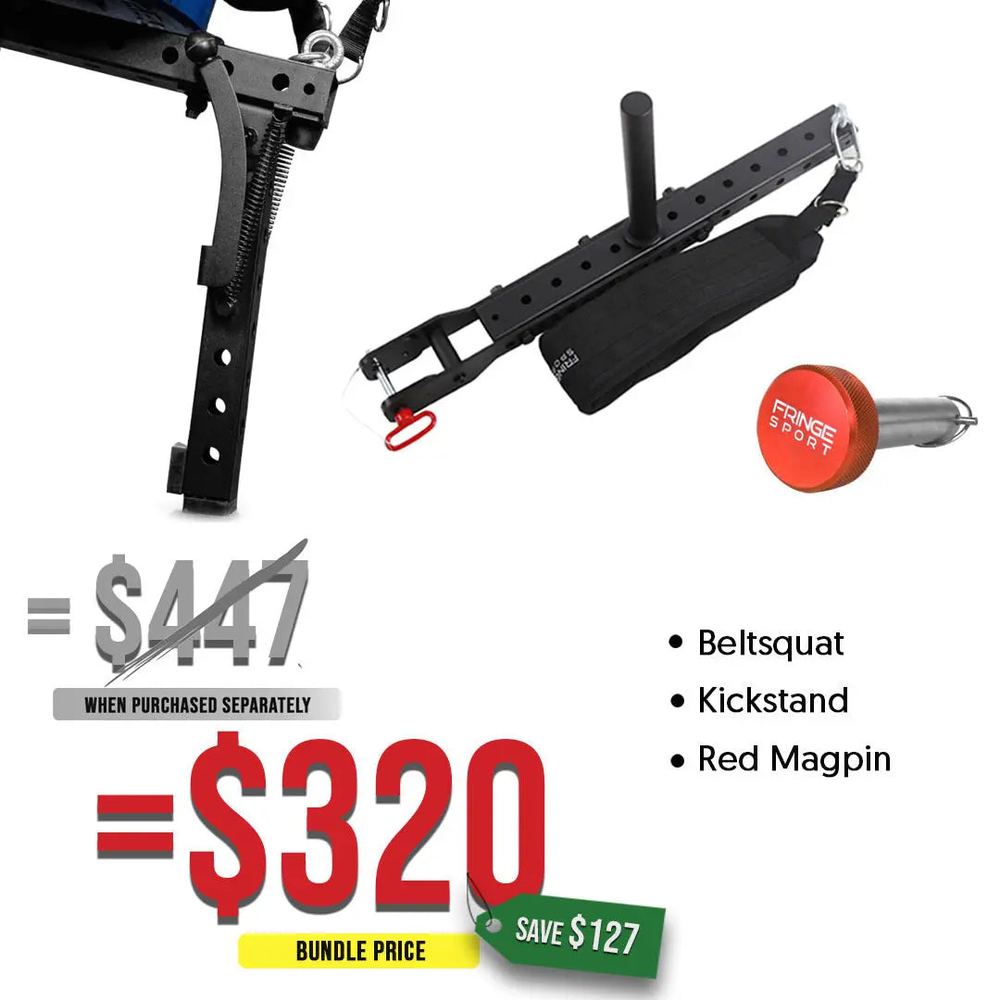 Fringe Mammoth
Check price
Fringe Mammoth
Check price
|
||
|---|---|---|---|---|---|---|
| Best for | Overall | Squat form & glutes | Rack attachment | Value | Premium | Cheap & compact |
| Rating | ||||||
| Mechanics | 92% | 95% | 90% | 74% | 90% | 76% |
| Versatility | 96% | 90% | 72% | 70% | 94% | 66% |
| Build & capacity | 94% | 86% | 84% | 85% | 96% | 80% |
| Footprint | 53″ × 60.5″ | 45″ × 41″ | Rack-mounted | 83″ × 54″ | 48″ × 48″ | Rack-mounted |
| Value | 74% | 82% | 90% | 92% | 56% | 93% |
| Price tier | $$$ | $$ | $ | $$ | $$$$ | $ |
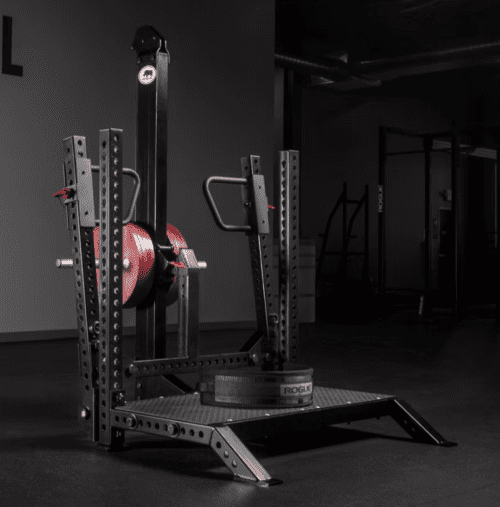 Rogue Monster Rhino
Our testing and selection process
How we assess belt squat machines
We run every machine roundup through the same 5 steps:
- We start as the buyer. Most of our team has bolted a belt squat to a rack or wheeled a standalone into a corner. My own gym has cycled through cable, lever, and free-weight units over 2 decades.
- We research wide. We pull specs, warranty terms, biomechanics studies, and owner feedback on as many machines as we can find, more than 30 this time, into one spreadsheet.
- We score each machine with our weighted system. Data decides the ranking, not brand loyalty.
- We split the field by type and format, because a cable standalone and a lever attachment do the job in very different ways.
- We get hands-on where we can and lean on the SHG community for the rest.
You can read more in our review guidelines.
How we score belt squat machines
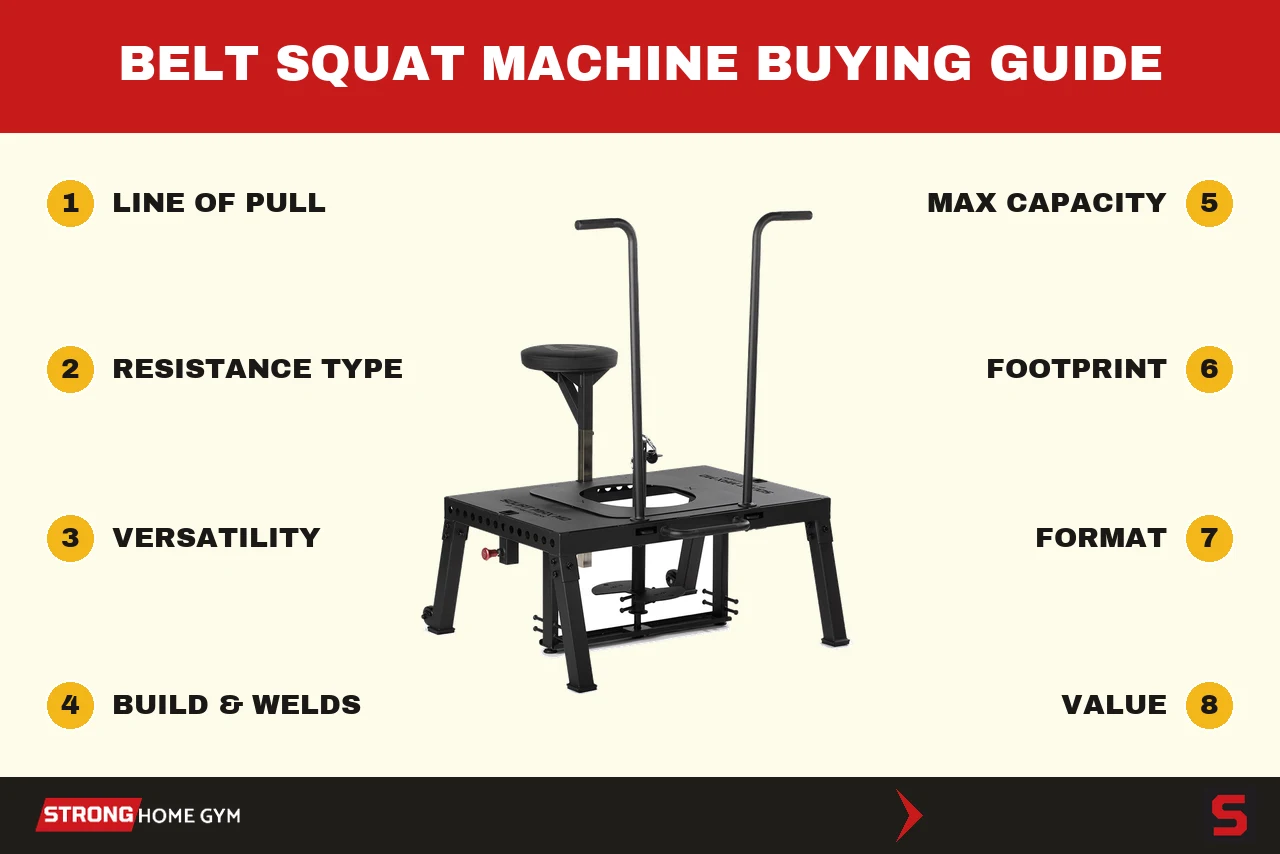
Here’s what feeds the score and how much each part counts.
We grouped it into 5 chunks:
- Mechanics and line of pull (30%) - vertical or cable spares the spine and hits the glutes. A lever pulls you forward.
- Versatility (20%) - how much the machine does beyond a plain belt squat.
- Build and capacity (20%) - steel gauge, welds, max load, and the warranty behind it.
- Footprint and format (10%) - standalone, rack drop-in, or attachment, and the ceiling height a tall lifter needs.
- Value (20%) - quality against price, the metric that levels the field.
Mechanics and line of pull (30%)
Here is the same lifter under both pull types, with the force arrow telling the whole story.
This is the criterion that decides whether a belt squat helps your body or nags it.
Get this one wrong and the rest barely matters.
Line of pull comes down to:
- A vertical or cable pull that runs straight down through your hips, so you stay upright like a real squat
- A lever arm pulls you forward as you descend, shifting load to the quads and the knees
- A 1-to-1 ratio, so the weight you load is the weight you lift
Versatility (20%)
Here is what one strong unit can unlock beyond the squat itself.
A belt squat that only belt squats is a one-trick machine.
The best units here double as cable stations, hip-thrust rigs, or row platforms. That’s more lifts per square foot of gym, which matters when floor space is the real budget.
Build and capacity (20%)
Here is what we look at on the frame, and why the spec sheet does not always tell the truth.
A belt squat carries heavy plates and takes a beating, so the steel has to be honest.
We read the gauge, the weld finish, and the listed capacity. We also check the loadable horn length, because you can run out of horn before you run out of rated capacity, especially on thick bumper plates.
Footprint and format (10%)
Here are the three formats drawn to the same scale, so the floor cost is plain.
The right format depends on your gym, not on which is best in the abstract.
A standalone goes where you want but eats floor. A rack drop-in or attachment uses kit you already own, which is the space-honest move for most home gyms. Tall lifters should also mind platform height against the ceiling.
Value (20%)
We weigh quality against price and reward the machine that gives you the most squat for the money.
In plain terms…
A premium cable unit can be worth three of a cheap lever if it spares your knees for a decade. But a solid lever standalone at a fraction of the price is the smarter buy for a squatter on a budget.
Which belt squat machine type is right for you?
There are three ways a belt squat loads your body, and the type matters more than the brand.
That’s the short answer. The longer one is that your space and your knees decide for you.
Cable machines run the weight up a tower on a cable, so the pull is vertical and you can step off to row or curl. Free-weight vertical machines hang the plates on a pin straight under your hips, the closest feel to a barbell squat. Lever machines swing the load on an arm, which is simple and cheap but pulls you forward at the bottom.
My tip: if your knees or lower back have a history, steer clear of the cheap levers. A vertical or cable pull is worth the extra outlay.
Use the finder below to land on the right type, then jump to our pick in that slot.
Find your belt squat type in 3 questions
Tell us about your space and your priority. We'll match you to the type and our top pick in it.
-
1 What space do you have?
-
2 What matters most?
-
3 What's the budget like?
Find the perfect belt squat machine for you
Best overall | Best for squat form | Best rack attachment | Best value | Best premium | Best cheap
Here’s how the six machines rank on our overall score:
Rogue Monster Rhino
Best Overall Belt Squat MachineQuick specs
- Type - Cable, 1-to-1 ratio
- Footprint - 53″ × 60.5″
- Frame - 3×3″ arms, 3×6″ trolley tower
- Loadable - 15.75″ horns
- Format - Standalone or rack drop-in
Summary of experience, tests & opinions
What I like
- The cable pull runs dead straight down, so I stay upright through the bottom of the rep instead of being tipped forward like a lever does.
- You load what you lift. There’s no lever maths to second-guess, which I appreciate when I’m chasing a number.
What could be better
- Rogue wants it bolted down for the off-platform cable work, and not everyone can drill a garage floor.
- The platform is on the small side, so wide-stance and footwork drills feel cramped.
Pros & cons
Pros
- Vertical cable pull and a 1-to-1 ratio load the legs like a real squat without taxing the spine.
- Steps off to row, curl, and pull so it doubles as a cable station, the most versatile type here.
- Standalone or rack drop-in lets you save floor space by mounting it to a rack you own.
Cons
- Premium price sits well above the lever standalones.
- Small platform limits wide-stance and sport-specific footwork.
Read more about the Rogue Monster Rhino
The Rhino wins because it solves the two problems a belt squat exists to solve, and then keeps going. The cable runs the load straight up a tower, so the pull on your hips is vertical. You squat down into it the way you’d squat under a bar, with no forward tip and nothing leaning on your lower back.
It’s also the only machine here that earns its floor space twice. Step off the platform, clip a handle on, and you’re rowing, curling, or pulling like you’ve got a cable station in the corner. Unless you own an all-in-one, nothing else in a home gym does as much from one frame.
The honest knocks are price and the platform. It costs what a Rogue costs, and the platform suits squats more than footwork drills. If versatility isn’t your thing and you only want the purest squat feel, the Titan SquatMax-MD edges it on form alone.
It runs away with the versatility score on the cable design alone:
Bottom line
The Rogue Monster Rhino is the best belt squat machine for most people because it gets the mechanics right and then does far more than squats. The vertical cable pull spares your spine, the 1-to-1 ratio keeps the maths honest, and the cable station hiding inside it earns back the price over time. You pay a premium, but you’re buying two machines in one frame.
The Rogue Monster Rhino might be for you if… you have the floor space and want the most capable, spine-friendly belt squat going.
It’s not for you if… you’re tight on budget or floor. Look at the REP Belt Squat or the Titan lever instead.
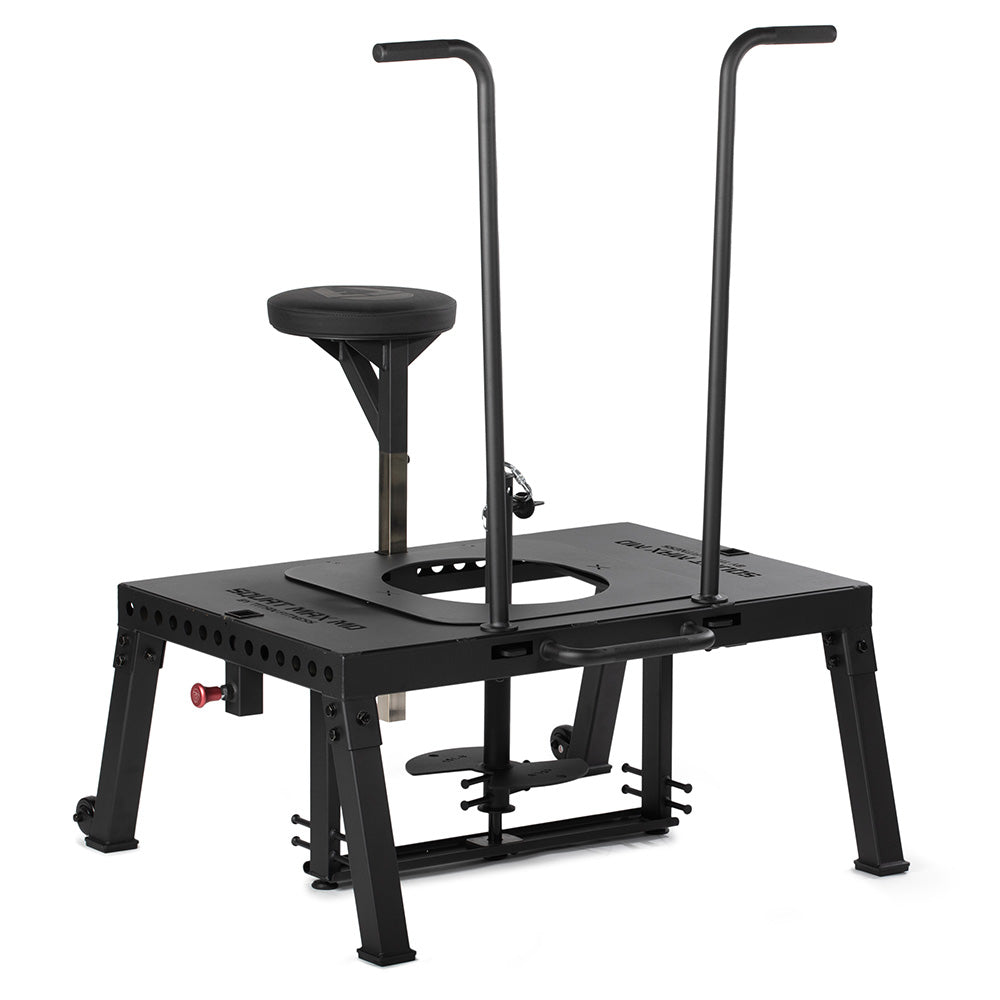
Titan SquatMax-MD
Best for Squat Form & GlutesQuick specs
- Type - Vertical free-weight
- Platform - 45″ W × 41″ D, 20″ tall
- Pull - Loading pin under the hips
- Extras - Wheels, handle, padded seat
- Format - Standalone
Summary of experience, tests & opinions
What I like
- The pull is dead vertical, so the glutes do the work a lever would farm out to the quads. You feel it the next morning in the right place.
- Titan’s version finally added wheels and a handle, so it isn’t the armour-walk-it-into-the-corner chore the original was.
What could be better
- The platform stands 20 inches tall, so at 6 foot 2 you’re squatting near the ceiling in a low garage.
- The incline pad that unlocks rows on the original may not fit Titan’s build, so confirm before you bank on seal rows.
Pros & cons
Pros
- True vertical pull straight under the hips, the design the research favours for glute activation.
- Free-weight feel that mimics a barbell squat more closely than cable or lever.
- Built-in extras including wheels, a handle, a padded box-squat seat, and pull-pins.
Cons
- Tall platform can be a ceiling problem for tall lifters in a low room.
- Incline-pad fit is unconfirmed on the Titan build, which limits the row attachments.
Read more about the Titan SquatMax-MD
If your one goal is to squat, this is the machine. The plates hang on a loading pin that sits directly beneath your hips, so the resistance runs straight down. You descend into the hole the way you would under a barbell, upright and balanced, with the glutes carrying the load.
That vertical line is the whole argument. A lever swings the load on an arm, which drags you forward at the bottom and shifts the work to your quads. The research our team leans on shows more glute activation on a vertical pull, and you feel exactly that the day after.
The reason it sits just behind the Rhino is space and reach, not mechanics. The platform is tall, which catches taller lifters in a low garage, and the row attachments are less certain on Titan’s licensed build than on the original. For pure squat quality, though, nothing here beats it.
It tops the field on mechanics, the heaviest-weighted criterion we score:
Bottom line
The Titan SquatMax-MD is the pick when squat form is the point. The vertical pull mimics a barbell more closely than anything else here, the glutes do the work they should, and Titan’s licensed build fixed the original’s worst habits with wheels, a handle, and a padded seat. Mind the platform height if you’re tall, but on mechanics it’s the best on this list.
The Titan SquatMax-MD might be for you if… you want the most squat-like feel and the best glute work from a belt squat.
It’s not for you if… you’re a tall lifter in a low room, or you want cable versatility. The Rogue Monster Rhino covers that.
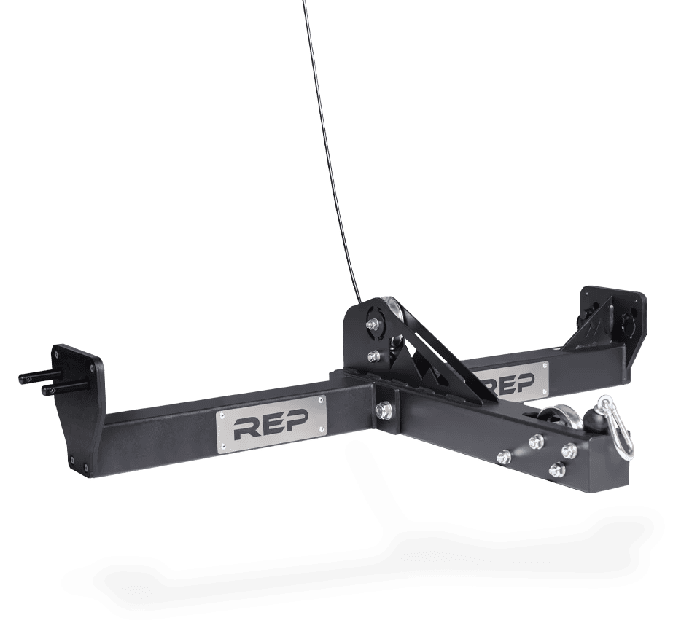
REP Belt Squat
Best Rack AttachmentQuick specs
- Type - Rack attachment, 1-to-1
- Fits - REP PR-4000 / PR-5000 V2
- Needs - A lat tower to anchor
- Capacity - 600 lb · 11-ga steel
- Weight - 41 lb
Summary of experience, tests & opinions
What I like
- It takes up no floor at all. The whole thing lives on the rack, so the gym looks the same after you fit it.
- The 1-to-1 ratio means the weight on the horns is the weight on your hips, no lever fudging.
What could be better
- It needs a lat tower to anchor the resistance, so the rack has to be specced for it before this works.
- It only fits REP’s own PR-4000 and PR-5000 V2 racks, so other brands are out.
Pros & cons
Pros
- Adds zero footprint by living on a rack you already own.
- 1-to-1 resistance on 11-gauge steel with a 600 lb capacity.
- The cheapest spine-friendly option here, well under any standalone.
Cons
- Needs the lat tower to anchor, so the rack must be set up for it.
- REP racks only, fitting the PR-4000 and PR-5000 V2.
Read more about the REP Belt Squat
For a real home gym, this is the honest answer. Most of us don’t have a spare corner for a standalone, but plenty of us own a power rack with dead space on it. The REP attachment turns that rack into a belt squat without costing a single extra square foot.
The mechanics hold up too. It runs a 1-to-1 ratio, so what you load is what you lift, and the pull stays close to vertical. That puts it well ahead of the cheap levers on knee and spine load, which is why it scores so well on footprint and value at once.
The catches are about fit, not feel. It needs a lat tower fitted to anchor the resistance, and it only bolts to REP’s PR-4000 and PR-5000 V2 racks. Check both boxes and you’ve got the most space-efficient belt squat on this list. If you run a different rack, the Fringe Sport Mammoth is the more universal attachment.
It leads the field on footprint, exactly where a rack attachment should:
Bottom line
The REP Belt Squat is the pick for the lifter who owns a REP rack and won’t sacrifice floor space. It runs a true 1-to-1 ratio on solid steel, costs a fraction of any standalone, and disappears into the rack when you’re not using it. Just confirm you have a PR-4000 or PR-5000 V2 with a lat tower before you order.
The REP Belt Squat might be for you if… you own a REP rack and want a spine-friendly belt squat with no extra footprint.
It’s not for you if… you run a different rack or want a standalone. Look at the Fringe Sport Mammoth or the Titan lever.
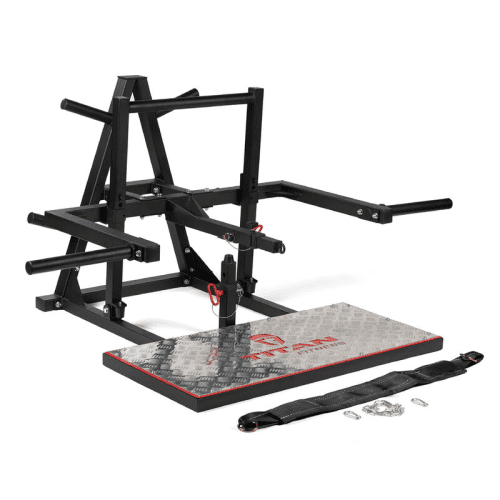
Titan Belt Squat Machine
Best Value Belt Squat MachineQuick specs
- Type - Plate-loaded lever
- Footprint - 83″ W × 54″ D
- Footplate - 37.25″ × 23.5″ diamond-plate
- Sleeves - 16.5″ loadable each side
- Capacity - 1,000 lb · 232 lb machine
Summary of experience, tests & opinions
What I like
- The capacity is daft for the money. You’ll plateau as a lifter long before you out-load this frame.
- The diamond-plate footplate grips well and shrugs off chalk and grit, where a smooth plate gets slick.
What could be better
- It’s light at 232 lb, so without weight parked on the storage posts it can shift on explosive reps.
- The included belt is thin and digs into the hips once the plates stack up.
Pros & cons
Pros
- Standalone for a budget price, the cheapest way into a dedicated machine.
- 1,000 lb capacity on a frame that costs a fraction of the premium units.
- Storage posts balance the machine and keep your spare plates to hand.
Cons
- Lever pull tips you forward at the bottom, nagging sensitive knees and lower backs.
- Thin belt wants an upgrade once you start lifting heavy.
Read more about the Titan Belt Squat Machine
When the budget is the deciding factor, this is the standalone to buy. Titan is one of the few cheap names you can trust, and this frame proves it. A genuine 1,000 lb capacity for a price that wouldn’t cover the shipping on some premium machines is the headline, and the diamond-plate platform is a nicer touch than the price suggests.
It scores where it should, on value, and gives ground where the cheap lever design always does. The arm swings the load forward as you sink, so you’re pulled out of a vertical squat and the quads pick up the slack. For a healthy lifter chasing leg work, that’s a fair trade. For dodgy knees, it isn’t.
The other honest notes are weight and the belt. At 232 lb it can creep on explosive reps until you park plates on the storage posts, and the included belt is thin enough that you’ll want a better one before long. Neither is a dealbreaker at this price.
It leads on value, which is the only chart a budget pick needs to win:
Bottom line
The Titan Belt Squat Machine is the value play, a standalone with a four-figure capacity at a price that leaves money for plates. The lever pull means it isn’t the gentlest on your knees, and the belt wants upgrading, but for a healthy lifter who wants a dedicated machine without the premium outlay, nothing here gives you more for less.
The Titan Belt Squat Machine might be for you if… you want a standalone on a budget and your knees and back are sound.
It’s not for you if… you’ve a history of knee or back trouble. A vertical pull like the Titan SquatMax-MD or the REP attachment treats you better.
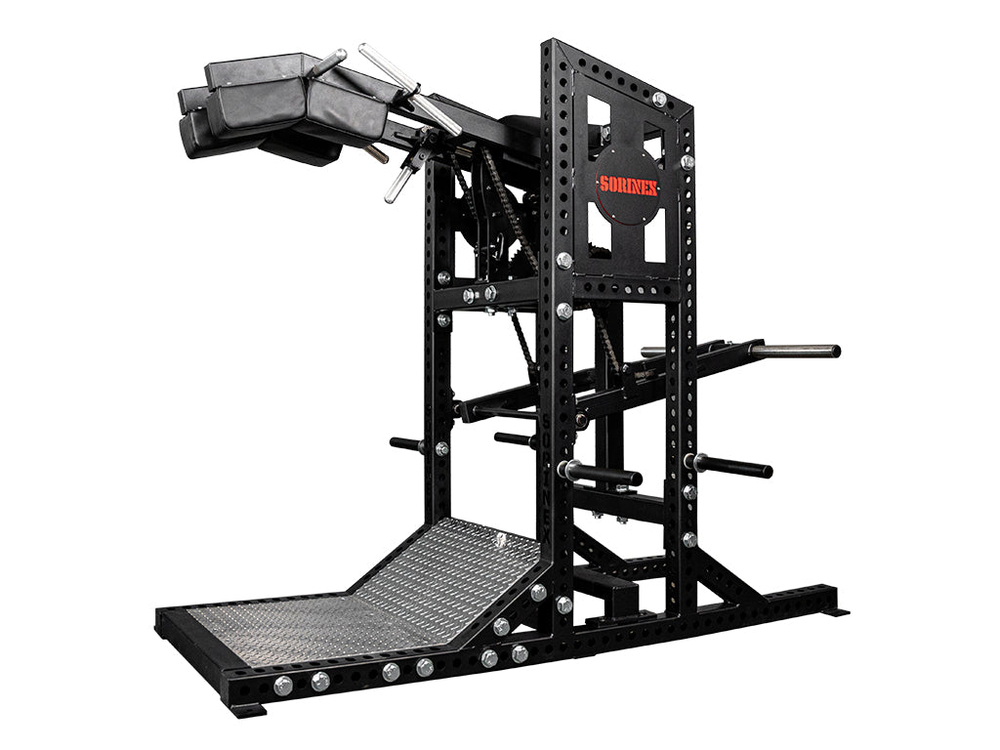
Sorinex Belt Squat
Best Premium Belt Squat MachineQuick specs
- Type - Plate-loaded standalone
- Footprint - 48″ × 48″ × 96″
- Steel - 11-gauge
- Machine weight - 275 lb
- Made in - USA
Summary of experience, tests & opinions
What I like
- It’s built like commercial kit. The 11-gauge steel and the welds feel like they’ll outlast the building.
- The Sorinex attachment range is deep, so the machine grows with you instead of capping out.
What could be better
- It’s huge and heavy at 275 lb, so it claims a serious chunk of floor and isn’t moving once it’s down.
- The price is steep, which is why it scores low on value despite topping the build chart.
Pros & cons
Pros
- Heaviest steel here at 11-gauge, with a commercial-grade build and finish.
- Deep attachment ecosystem that extends the machine well beyond squats.
- Made in the USA with the warranty and support a premium brand brings.
Cons
- Large footprint that eats floor most home gyms can’t spare.
- Premium price that puts it out of reach for most budgets.
Read more about the Sorinex Belt Squat
If money isn’t the constraint, this is the machine to lust after. Sorinex builds for college and pro weight rooms, and this belt squat carries that DNA. The 11-gauge steel, the weld finish, and the sheer mass put it at the top of our build chart, ahead of everything else here.
The mechanics are sound and the versatility is genuine. It’s one of the broadest platforms on the list once you add Sorinex’s attachments, so it stretches well past a plain belt squat. Our team rates it among the premier belt squats made, full stop.
The reason it lands mid-table overall is the two things a home gym actually has to weigh: space and money. It’s big, it’s heavy, and it costs what commercial kit costs. Score it on build alone and it wins. Score it on value, and the Rogue Monster Rhino does most of the job for less.
It tops the field on build and capacity, exactly as a premium machine should:
Bottom line
The Sorinex Belt Squat is the money-no-object pick, commercial-grade steel and a deep attachment range in one frame. It tops our build chart and holds its own on mechanics and versatility. The footprint and the price are the trade, so it’s the machine for the lifter with the room and the budget to match. Everyone else gets most of the way there for less with the Rogue Monster Rhino.
The Sorinex Belt Squat might be for you if… you want the best-built machine here and have the floor and budget for it.
It’s not for you if… space or money is tight. The Rogue Monster Rhino is the smarter spend for a home gym.
Fringe Sport Mammoth Belt Squat
Best Cheap & CompactQuick specs
- Type - Lever rack attachment
- Mount - Power rack upright
- Arc - Long lever, near-flat path
- Format - Rack attachment
- Price - Lowest here
Summary of experience, tests & opinions
What I like
- The long lever is the clever bit. It flattens the arc so the pull feels closer to vertical than a short-arm attachment.
- It costs the least here and bolts to almost any upright, so it’s the easy first belt squat.
What could be better
- It’s still a lever, so there’s a forward pull at the bottom, just less of one than the short-arm rivals.
- It does one job. There’s no cable station or row work hiding inside it.
Pros & cons
Pros
- Cheapest pick here by a clear margin, the low-risk way to try belt squats.
- Long lever arc keeps the movement closer to vertical than most attachments.
- Universal mount bolts to a standard power rack upright.
Cons
- Lever pull still tips you forward at the bottom of the rep.
- Squats only, with none of the extra lifts the standalones offer.
Read more about the Fringe Sport Mammoth Belt Squat
Want into belt squats for the least money? Start here. It’s a lever attachment that bolts to a power rack upright, so it costs little, stores flat, and asks nothing of your floor. For a first machine or a tight budget, it’s hard to argue with.
The detail that lifts it above the cheap pack is the lever length. A short arm swings the load through a steep arc that yanks you forward hard. The Mammoth’s long arm flattens that arc, so the pull stays closer to vertical and the movement feels more like a real squat than the price would suggest.
It’s still a lever, so be honest about that. You’ll feel some forward pull at the bottom, and it only belt squats, where the standalones row and curl too. But on value and footprint it sits right at the top, which is exactly what a cheap attachment should do. If you run a REP rack, the REP Belt Squat is the 1-to-1 upgrade worth the extra.
It sits near the top on value, where a budget attachment belongs:
Bottom line
The Fringe Sport Mammoth is the cheapest honest belt squat here, a lever attachment that bolts to a rack and barely touches your budget or your floor. The long lever keeps the arc flatter than most attachments, which is the reason it’s our cheap pick over the short-arm crowd. It only squats, and it’s still a lever, but for a first machine that’s a fair deal.
The Fringe Sport Mammoth might be for you if… you want the cheapest way to belt squat and you own a power rack.
It’s not for you if… you want a 1-to-1 pull or extra lifts. The REP Belt Squat or the Rogue Monster Rhino deliver those.
Other belt squat machines worth knowing
The field thins out fast past our six. A few machines are good but don’t earn a main slot for a home gym, usually on price or niche.
- Pit Shark is solid in every area and best in none. It’s a popular commercial unit, but it costs premium money for mid versatility, and the studies our team leans on showed it activating less muscle than the vertical and cable designs.
- EliteFTS makes a capable cable belt squat with a bigger platform and bold colours. The build is there, but the price runs ahead of the features for most home gyms.
- Westside ATP is the industry classic the Rhino descends from. It’s more versatile than the Rhino but takes roughly twice the space and money, and it’s hard to find new.
- Matt Wenning is an excellent lever machine that breaks the cheap-lever mould, but it costs about three times a budget standalone, which is too much for most homes.
Best belt squat machine FAQs
Does a belt squat machine work?
Yes, a belt squat machine works, and it’s a great way to load your legs hard without loading your spine. It hangs the weight from your hips, so your lower back and upper body stay out of it. The catch is the type. A vertical or cable machine like the Rogue Monster Rhino pulls you straight down like a real squat. A lever pulls you forward, which works but nags the knees.
Are belt squats better than barbell squats?
Belt squats aren’t better than barbell squats, but they’re a brilliant complement and sometimes a replacement. They take the load off your spine and upper body, so they’re ideal for high-volume leg work, for training around a back injury, or for anyone whose squat is limited by their lower back rather than their legs. A vertical-pull machine like the Titan SquatMax-MD comes closest to the barbell feel.
What muscles does a belt squat work?
A belt squat works the quads, glutes, and hamstrings, much like a back squat, but with far less load on the spine. The line of pull shifts the emphasis. A vertical pull, like the Titan SquatMax-MD, keeps the torso upright and recruits more glute. A lever pull tips you forward and shifts the work toward the quads.
Do you need a special rack for a belt squat attachment?
Yes, most belt squat attachments fit one rack family, so check before you buy. The REP Belt Squat fits REP’s PR-4000 and PR-5000 V2 racks and needs a lat tower to anchor. The Fringe Sport Mammoth is the more universal lever attachment for a standard upright. If you don’t own a rack, a standalone like the Titan Belt Squat Machine is the simpler route.
How much weight can you lift on a belt squat machine?
How much you can lift depends on the ratio and the loadable horn length, not just the rated capacity. A 1-to-1 machine like the Rogue Monster Rhino lifts exactly what you load. A lever often gives a mechanical advantage, so you lift less than the plates suggest. Watch the horn length too, since thick bumper plates can fill the sleeves before you hit the spec capacity.
The bottom line
Two decades of squatting on, coaching with, and wheeling around belt squat machines, and this guide is the short version of what stuck.
For most home gyms with the floor space, the Rogue Monster Rhino is the best belt squat machine you can buy. The vertical cable pull spares your spine, and it doubles as a cable station. If pure squat form is the goal, the Titan SquatMax-MD loads the glutes like a barbell.
Short on floor? The REP Belt Squat bolts to a REP rack for no extra footprint. On a budget, the Titan Belt Squat Machine is the cheapest solid standalone, and the Fringe Sport Mammoth is the cheapest attachment. With the room and the money, the Sorinex Belt Squat is the best-built of the lot.
- Skip back to the comparison table to see all 6 side by side.
- Bookmark this page. We keep it updated as stock and picks change.
Stay strong and smart.
