

We scored more than 40 Bowflex home gyms across 4 quality categories and picked the 6 most worthy of your money.
I run a commercial gym and have put cable-and-rod machines through years of real training, so these picks come from our weighted scoring and hands-on use, not a quick read of the spec sheets.
The aim was simple: find the Bowflex machines that give you the most strength training for your space and your budget, and flag the ones that are really cardio in disguise.
Let’s see how they stacked up…
Editor's note · updated July 2, 2026
We rebuilt this guide for 2026 around one big change: BowFlex Inc. went bankrupt in March 2024, and Johnson Health Tech bought the brand that April.
What changed:
- The lineup survived the sale. Almost every home gym carried over. The Xtreme 2SE, Revolution, Xceed, PR3000, PR1000 and Body Tower are all still sold new, so nothing here is a dead listing.
- The Xtreme 2SE keeps the top spot. No new flagship launched under the new owner, and nothing we scored beats it for value and versatility, so it stays our pick for most home lifters. The Revolution stays the premium choice.
- We added the Xceed. It is the current mid-tier Power Rod gym and belongs on the list.
- We cut the two cardio machines. The old version ranked a treadmill and an elliptical. Neither is a home gym, so they no longer take ranked slots. We cover them briefly after the picks.
Related
If you are still mapping out the room, start with our guide to building a home gym, then round it out with the best weight benches and a set of adjustable dumbbells for the work a cable gym cannot do.
Compare the best Bowflex home gym machines
 Revolution
Check price
Revolution
Check price
|
 Xceed
Check price
Xceed
Check price
|
 PR3000
Check price
PR3000
Check price
|
 PR1000
Check price
PR1000
Check price
|
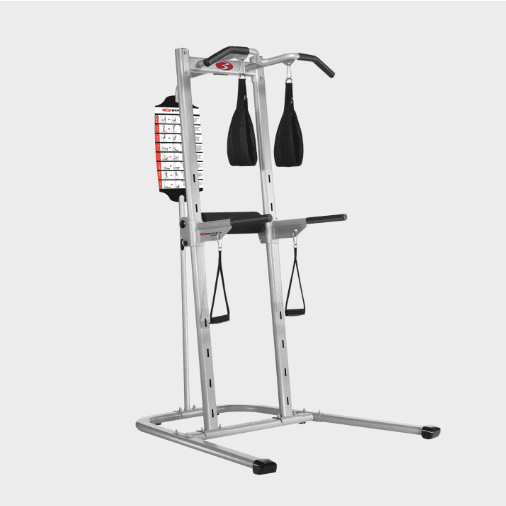 Body Tower
Check price
Body Tower
Check price
|
||
|---|---|---|---|---|---|---|
| Best for | Overall | Premium | Compact all-rounder | No-fuss cable gym | Budget | Bodyweight |
| Rating (*) | ||||||
| Resistance & strength | 85% | 93% | 78% | 74% | 70% | 55% |
| Exercise range | 84% | 90% | 80% | 74% | 68% | 60% |
| Build & footprint | 80% | 72% | 82% | 84% | 78% | 82% |
| Value | 86% | 55% | 80% | 76% | 88% | 88% |
| Resistance type | Power Rod | SpiraFlex | Power Rod | Power Rod | Power Rod | Bodyweight |
| #Exercises | 70+ | 100+ | 65+ | 50+ | 25+ | 19+ |
| Max resistance (lbs) | 210 (up to 410) | 220 (up to 600) | 210 (up to 310) | 210 (up to 310) | 210 | Bodyweight |
| Footprint (sq ft) | 21.5 | 25.3 | ~18 | 11.9 | 22.2 | 17.4 |
| Warranty | 7 yr frame, 5 yr rods | 10 yr | Limited (frame + rods) | 1 yr frame, 7 yr rods | 5 yr rods, 1 yr frame | 1 yr |
| Price | $$ | $$$ | $$ | $$ | $ | $ |
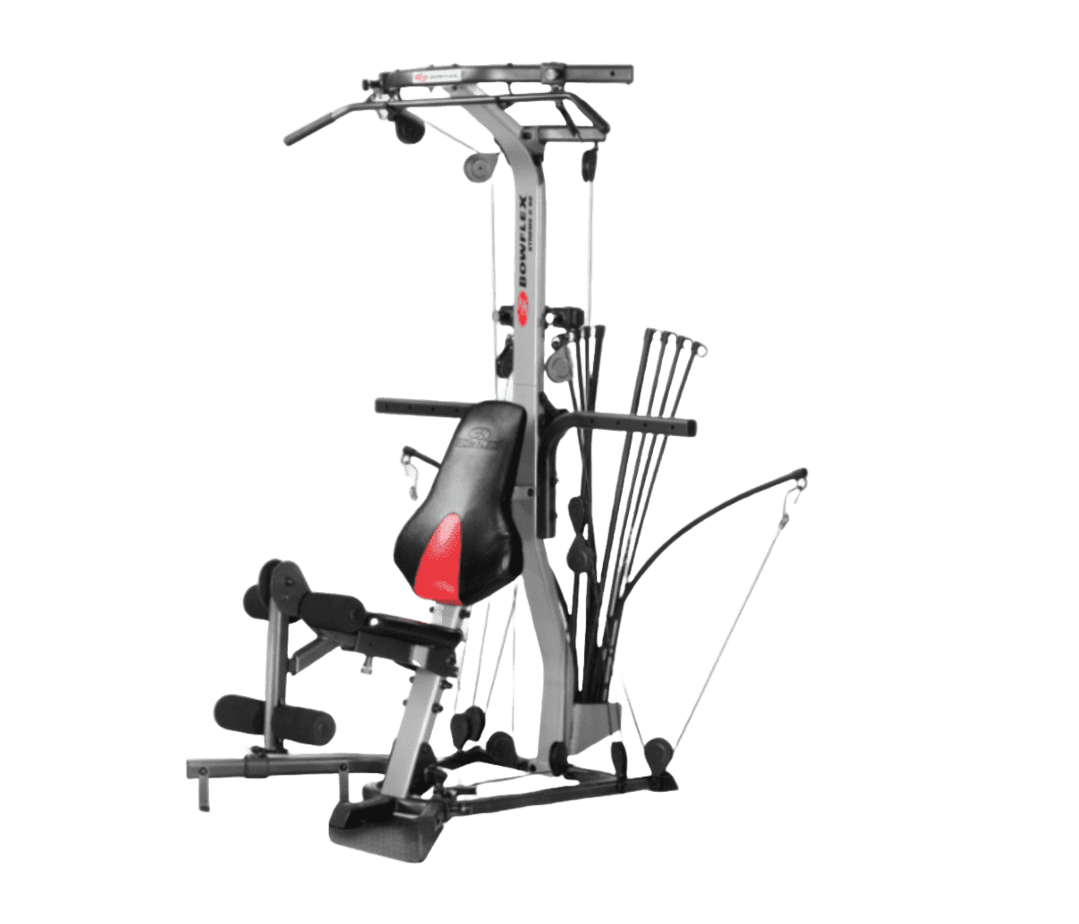 Bowflex Xtreme 2SE
Our testing and selection process
How we assess Bowflex home gyms
We run every Bowflex roundup through the same 5 steps:
- We start as the buyer. I own a commercial gym and train on cable-and-rod machines most weeks, so I know what a Power Rod stack should feel like when it is worth the money.
- We research wide. We pull resistance systems, exercise counts, frame specs, footprints, warranty terms and owner feedback on as many Bowflex home gyms as we can find, more than 40 this time, into one spreadsheet.
- We score each machine with our weighted system. Data decides the ranking, not brand loyalty or whatever happens to be on offer.
- We split the field by job, because a full-body cable gym and a bodyweight tower get bought for very different reasons.
- We get hands-on where we can and lean on the SHG community for the rest.
You can read more about the process in our review guidelines.
How we score Bowflex home gyms
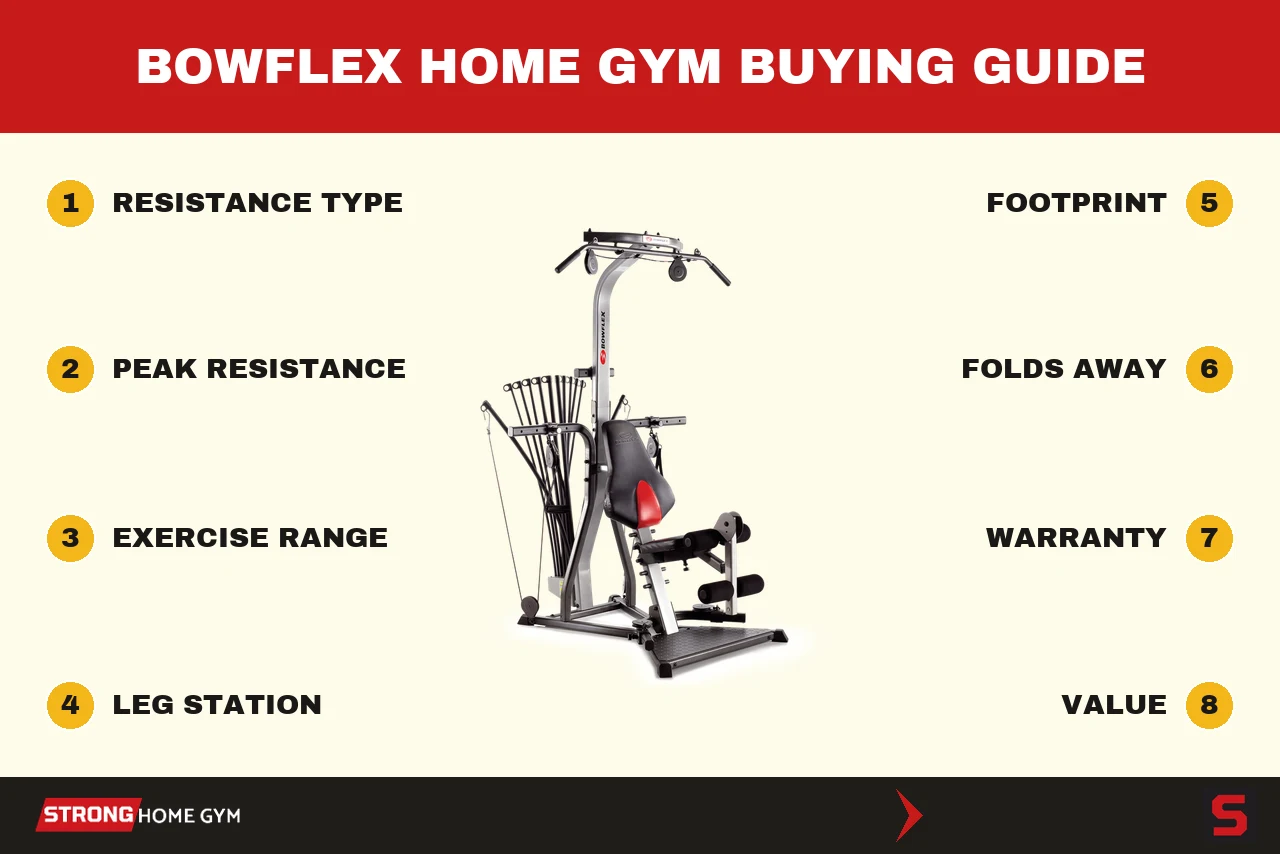
Choosing a Bowflex is not about the machine with the longest exercise list. It is about the one that fits your room, matches your strength goal, and still challenges you a year in.
We grouped it into four weighted factors:
- Resistance and strength (35%) - how much load it gives you, how the resistance feels, and how far you can push before you outgrow it.
- Exercise range and versatility (25%) - how many movements it covers, how well it trains legs, and how fast you move between exercises.
- Build and footprint (25%) - frame quality, whether it folds, and how much floor it eats.
- Value (15%) - what you actually get for the tier you pay.
Resistance and strength (35%)
This leads the score because resistance is the whole reason you buy a strength machine. We look at the peak load, whether you can upgrade it, and how the resistance behaves through the rep.
The two systems feel different. Power Rods bend to load you, and the tension climbs toward lockout, so the hardest part sits at the top of the movement. SpiraFlex, on the Revolution, holds even resistance the whole way, closer to a cable stack. A machine that scales to 410 or 600 pounds earns more here than one fixed at 210, because a beginner turns into an intermediate faster than they expect.
Exercise range and versatility (25%)
A home gym has to keep you interested. We count the exercises each machine supports, but we weight the useful ones harder: a proper leg station and a squat option matter more than five near-identical arm angles.
At the top, the Revolution and the Xtreme 2SE cover the whole body without a cable change. The PR1000 keeps the essentials and little else. Where a machine lets you swap movements fast, without stopping to re-route a cable, it climbs here, because friction between sets is what kills a home session.
Build and footprint (25%)
A Bowflex has to earn its floor space. We score the frame, the seat and cable quality, whether the machine folds, and the real footprint once the bench is out and you are moving.
Some of these fold flat against a wall. Others need a permanent patch of room with clearance on every side. The PR1000’s bench swings vertical when you are done, so it clears out of a shared room. The Revolution never really disappears. We reward the machines that give you a full workout without asking for a dedicated studio.
Value (15%)
Value is quality-adjusted, not just the sticker. A cheap machine that covers your goals can be smarter money than a premium one you use at half its ceiling. We weight it lightest because with a Bowflex the strength system and the space it takes should lead the decision, and price falls out of that.
Find the perfect Bowflex home gym for you
Overall | Premium | Compact all-rounder | No-fuss cable gym | Budget | Bodyweight
Here’s how the six machines stack up on our overall score:
Bowflex Xtreme 2SE
Best OverallQuick specs
- Power Rod resistance, 210 lb, upgradeable to 410 lb
- 70+ exercises, no cable changes
- All-in-one steel frame, roughly 21.5 sq ft
- Squat station, lat and squat bars included
The Bowflex that gets the most right for the most people: strong Power Rod resistance, a full-body exercise range, and a no-change cable system, without swallowing the room or the budget.
Summary of experience, tests & opinions
What I like
- The no-change cable layout is the thing you feel most. You move from a press to a row to a curl without stopping to re-thread anything, so a session actually flows instead of stalling between sets.
- The Power Rod tension is smooth and honest right through the rep. No jerk off the floor, no dead spot, just resistance that climbs as you drive to lockout.
- It feels planted under load for a machine this size. The seat is comfortable enough for long sessions and the cable routing makes upper-body work intuitive from the first workout.
What I don’t
- You map out a movement zone the first week. The frame is compact but the usable space with the bench out is bigger than the footprint number suggests, so plan the clearance.
- Heavy leg and back specialists will feel the ceiling. Even upgraded to 410 pounds, the Power Rod curve loads differently from a loaded barbell, and a strong lifter notices.
Pros & cons
Pros
- 70+ exercises cover the whole body with room to keep it fresh.
- 210 lb of Power Rod resistance, upgradeable to 310 or 410 as you get stronger.
- No-change cable system for fast transitions between movements.
- Squat station plus lat and squat bars included in the box.
Cons
- No horizontal bench included, so no flat pressing position out of the box.
Read more about the Bowflex Xtreme 2SE
This is the one we point most people to, and it is not a close call. It sits in the sweet spot where resistance, exercise range and price all land at “plenty” without any of them tipping into “too much to justify.”
The Power Rod system is the heart of it. You start at 210 pounds, which already covers a beginner and most of an intermediate’s training, and you can bolt on rods to reach 310 or 410 later. You buy the frame once and grow the resistance into it.
Buy it if
- You want one machine that trains the whole body and will still challenge you in a year.
- You value flowing through a session over squeezing out the last few pounds of load.
- You have a spare-room corner rather than a dedicated studio.
Skip it if
- You already move heavy loads on a barbell and want to keep progressing on big lifts.
- Even money is no object and you want the smoothest resistance going, in which case the Revolution is your machine.
Where does the Quick Change system matter? On a busy evening when you have thirty minutes. There is no bar to load, no plate to fetch, no cable to unhook, so the friction that talks you out of training at home mostly disappears. Steve, our certified PT, rates that convenience as the real reason home machines get used rather than dust-gathered.
It is not perfect. There is no flat bench in the box, and if your training revolves around heavy squats and rows you will eventually want more than the rods give. For most people building general strength and staying lean, that day is a long way off.
It leads the overall score across every machine we scored:
Bottom line
The Xtreme 2SE is our top pick for three reasons:
-
Resistance you can grow into. Start at 210 pounds and climb to 410 without buying a new machine.
-
It flows. The no-change cable system means a session moves, which is what keeps a home gym in use.
-
It fits real homes. Full-body training in a spare-room footprint, at a fair mid-tier price.
It might be for you if… you want one machine that does nearly everything and will not be outgrown for years.
It’s not for you if… you already lift heavy on a barbell, or you want the smoothest resistance at any price. Look at the Revolution.
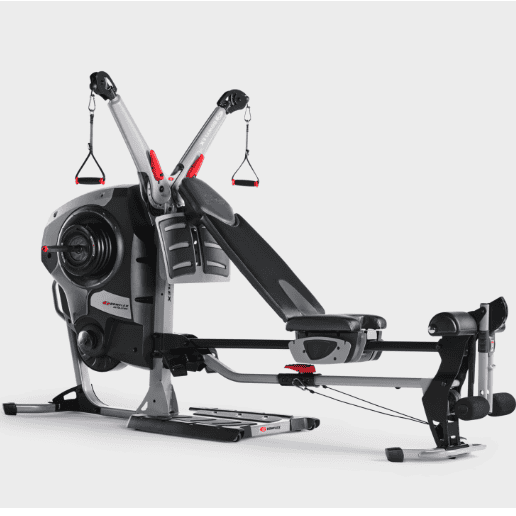
Bowflex Revolution
Premium PickQuick specs
- SpiraFlex resistance, 220 lb, upgradeable to 600 lb
- 100+ exercises, 400+ variations
- Folding bench, horizontal and vertical modes
- Largest footprint here, roughly 25.3 sq ft
The top of the Bowflex tree: astronaut-developed SpiraFlex resistance that stays smooth the whole way through, the highest load ceiling, and more movement patterns than anything else here.
Summary of experience, tests & opinions
What I like
- SpiraFlex is the smoothest resistance in the range. There is no stiff end-of-rep backlash you get from rods or bands, so every rep feels linear and controlled from start to finish.
- The load ceiling is in a different league. Scaled up to 600 pounds, it is the one Bowflex a genuinely strong lifter can keep progressing on without hitting a wall.
- The bench folds and the machine works in both horizontal and vertical positions, which opens up movement angles the Power Rod gyms cannot reach.
What I don’t
- It never gets small. Even with the bench folded it holds the biggest footprint in this guide, so it wants a room it can mostly keep to itself.
- More moving parts means more to look after. The SpiraFlex packs occasionally want attention to stay calibrated, and replacements are dearer than a spare rod.
Pros & cons
Pros
- SpiraFlex resistance stays even through the full range of motion.
- Up to 600 lb, the highest ceiling of any Bowflex.
- 100+ exercises and 400+ variations, the widest range here.
- Folding bench and dual horizontal/vertical modes.
Cons
- Premium price, by some distance the dearest pick.
- Big footprint and more upkeep than a rod machine.
Read more about the Bowflex Revolution
If budget is not the deciding factor, this is the Bowflex we would point you to. It does everything the Xtreme does and then keeps going, both in how much it loads you and in how the load feels.
The difference is SpiraFlex. It was developed to keep astronauts strong without gravity, and it works by spooling a resistance element rather than bending a rod. The upshot for you is even tension the whole way through the rep, closer to a commercial cable stack than anything else Bowflex makes.
That matters more than it sounds. Power Rods pile most of their resistance onto the back half of the movement.
The catch is spelled out in two scores: value and footprint. It costs a lot more than the Xtreme, and it never really tucks away. You are paying for the resistance quality and the ceiling, so the machine only makes sense if you will actually use them.
Who is that? A stronger lifter who wants to keep gaining at home, or anyone who has tried rod resistance and wants something smoother. If that is you, nothing else in the lineup comes close.
It runs away with our resistance and strength score:
Bottom line
The Revolution sits at the top of the Bowflex line for a reason: the smoothest resistance, the highest ceiling, and the widest exercise range. You pay a premium and give up floor space for it.
It might be for you if… you want muscle-building headroom and silky resistance, and the price and footprint do not scare you.
It’s not for you if… you want the best all-round value or you are tight on room. The Xtreme 2SE does most of the job for far less.
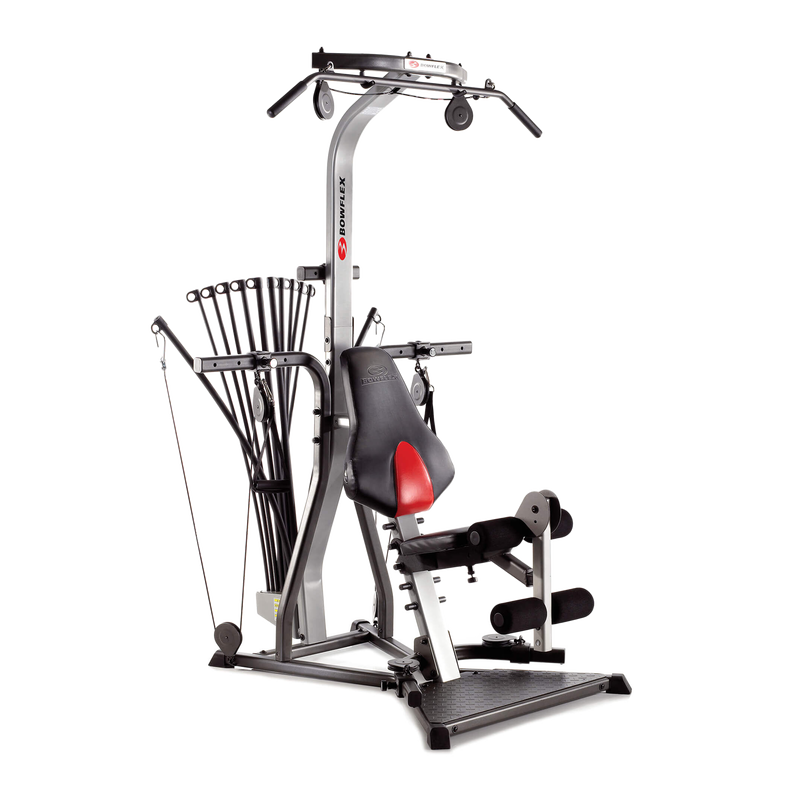
Bowflex Xceed
Compact All-RounderQuick specs
- Power Rod resistance, 210 lb, upgradeable to 310 lb
- 65+ exercises, integrated lat tower
- Leg extension and squat station included
- Compact frame, roughly 18 sq ft, about 157 lb
The current mid-tier Power Rod gym: a near-full exercise range and a proper lat tower squeezed into a frame small enough for a shared room.
Summary of experience, tests & opinions
What I like
- It fits where a bigger gym cannot. The frame is genuinely compact for a machine with a lat tower and a squat station, so it slots into a room the Xtreme would crowd.
- The angled lat bar earns its place. Back and shoulder work feels direct rather than an afterthought, which is not always true of mid-tier home gyms.
- Assembled it is on the lighter side, so shuffling it a foot to vacuum behind it is a one-person job.
What I don’t
- The resistance tops out sooner. Upgraded, it reaches 310 pounds rather than the Xtreme’s 410, so a fast progresser meets the ceiling earlier.
- It leans vertical. The pressing is done from a more upright position, and lifters who want a flat bench feel will notice the difference.
Pros & cons
Pros
- 65+ exercises across a full-body range.
- Integrated lat tower with an angled bar for back and shoulders.
- Leg extension and squat station built in.
- Compact, lighter frame for its capability.
Cons
- 310 lb resistance ceiling, below the Xtreme and Revolution.
- No fold-flat option, so the footprint is fixed.
Read more about the Bowflex Xceed
The Xceed is the machine that got added to this guide, and it fills a real gap. It is the current mid-tier Power Rod gym, sitting a rung below the Xtreme on resistance but ahead of the PR-series on exercise range.
The pitch is capability per square foot. You get a lat tower, a leg station and a squat option in a frame that measures compact by home gym standards. For a spare bedroom or a shared garage, that combination is rarer than it should be.
Here is how it lines up against the two Power Rod machines either side of it:
| PR3000 | Xceed | Xtreme 2SE | |
|---|---|---|---|
| Exercises | 50+ | 65+ | 70+ |
| Max resistance | 310 lb | 310 lb | 410 lb |
| Footprint | Smallest | Compact | Larger |
| Best for | No-fuss basics | Range in a small room | Growing into more load |
The trade is the ceiling. Stopping at 310 pounds is fine for most people for a long time, but if you know you are a fast progresser, the Xtreme’s extra headroom is worth the extra space it asks for.
Buy the Xceed when the room is the constraint and you still want a real, full-body Power Rod gym rather than a stripped-back one.
Among the compact Power Rod gyms, it holds a strong build and footprint score:
Bottom line
The Xceed is the pick when space is the problem to solve. It packs a lat tower, a leg station and a near-full exercise range into a compact, current-production frame, one step below the Xtreme on load.
It might be for you if… you want a full Power Rod gym but the room is tight.
It’s not for you if… you are a fast progresser who wants the highest ceiling, or you want the smallest possible footprint. See the Xtreme 2SE or the PR3000.
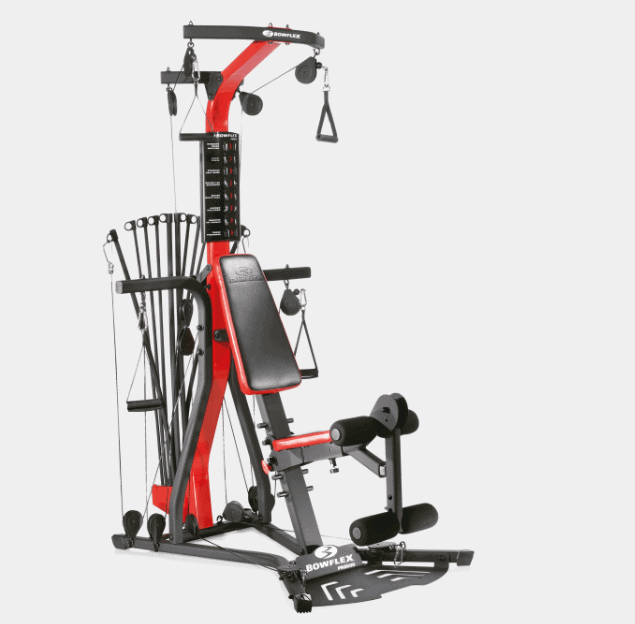
Bowflex PR3000
No-Fuss PickQuick specs
- Power Rod resistance, 210 lb, upgradeable to 310 lb
- 50+ exercises, no cable changes
- Removable seat and leg attachment for squats
- Smallest footprint here, roughly 11.9 sq ft
The plain, get-on-with-it Bowflex: a stable cable gym with no cable changes and the smallest footprint in the lineup, built for people who want to train rather than fiddle.
Summary of experience, tests & opinions
What I like
- Setup fuss is close to zero. No cables to re-route, no fiddly presets, so a new lifter or someone easing back in can start training on day one without a manual open on the floor.
- The frame feels planted through curls and presses. Heavy-duty steel, no wobble that we could provoke even with the rods stacked up.
- You can pull the seat and leg attachment off, which frees the base for a more natural standing squat than most machines this size allow.
What I don’t
- It does not fold. The footprint is tiny, but what is out stays out, so it wants a corner it can keep rather than a room it shares by day.
- Seat and arm positions barely adjust. Very tall or very short users end up shuffling to find form rather than dialling the machine to them.
Pros & cons
Pros
- 50+ exercises on a stable, no-change cable system.
- 210 lb resistance, upgradeable to 310 lb.
- Removable seat and leg attachment for standing squats.
- Smallest floor footprint of any machine here.
Cons
- Does not fold for storage like the PR1000.
- Limited seat and arm adjustment for outlier heights.
Read more about the Bowflex PR3000
Some people do not want features. They want to walk up, grab a cable and train. The PR3000 is built for exactly that person.
The no-change cable system is the core of it. You move down your list of exercises without stopping to unhook and re-route, which keeps a session moving and keeps the machine simple enough that nobody in the house is confused by it.
That simplicity is why it suits a specific crowd:
- Beginners who want to learn the movements without setup getting in the way.
- Returners and older lifters who value a stable frame and a low fuss ceiling over maximum load.
- Small-corner homes where the tiny footprint matters more than the ability to fold it flat.
The honest limits are the resistance ceiling and the adjustability. It reaches 310 pounds upgraded, which is plenty for the people it is aimed at and short for a strong lifter. The seat does not move much, so outliers at either end of the height range compromise a little on form.
For a no-nonsense full-body cable gym in the least floor space here, though, it is hard to argue with.
It takes the top spot on our build and footprint score:
Bottom line
The PR3000 is simplicity done well: a stable cable gym, no cable changes, and the smallest footprint here. The ceiling and the fixed positions are the compromise for that plainness.
It might be for you if… you want to train without fuss in the least floor space, especially as a beginner or a returner.
It’s not for you if… you need to fold it away, or you want more exercises and a higher ceiling. The PR1000 folds, the Xceed covers more.
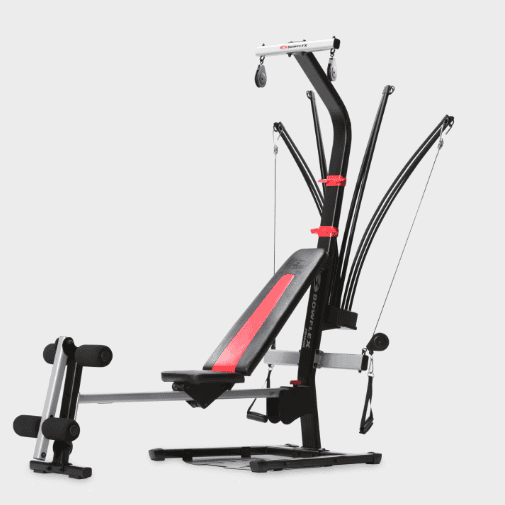
Bowflex PR1000
Budget PickQuick specs
- Power Rod resistance, 210 lb
- 25+ exercises, built-in rowing station
- Vertical folding bench for storage
- Footprint roughly 22.2 sq ft, about 131 lb
The way into the Bowflex range: classic Power Rod resistance, a fold-away bench and a rowing station, at the lowest price here. The starter machine that still teaches the movements.
Summary of experience, tests & opinions
What I like
- The bench folds vertical when you are done, so the machine clears out of a shared room in a way most home gyms cannot. For a spare bedroom that has other jobs, that is the whole appeal.
- The rowing station is a genuine bonus at this price. Slide the seat and you get a cardio and back movement most budget machines leave out entirely.
- There is a media rack for a phone or tablet, which sounds trivial until you are following a workout on a wet evening.
What I don’t
- The exercise list is short. It covers the essentials and stops, so anyone who likes variety will feel the edges of it within a few months.
- The resistance is fixed at 210 pounds with no upgrade path, so a steady progresser meets the ceiling and cannot move it.
Pros & cons
Pros
- Lowest price of any Bowflex home gym here.
- Vertical folding bench for easy storage.
- Built-in rowing station for aerobic work.
- Media rack for phone or tablet.
Cons
- Only 25+ exercises, the narrowest range in the guide.
- Fixed 210 lb resistance with no upgrade option.
Read more about the Bowflex PR1000
If money is the constraint, this is where you start. The PR1000 is the entry point to the Power Rod family, and it gives you the core of the experience for the least outlay.
You get 210 pounds of the same Power Rod feel the pricier machines use, a bench that folds up out of the way, and a rowing station for a bit of cardio and back work. For a first home gym, or for someone who is not sure they will stick with it, that is a sensible amount of machine to risk.
The compromises are the ones you would expect at the bottom of the range. The exercise list is the shortest here, and the 210-pound resistance is fixed, so there is no adding rods later. A committed lifter will outgrow it, and that is fine: it is a first machine, not a last one.
Treat it as the on-ramp. Learn the movements, build the habit, and if the habit sticks you will know exactly which of the bigger machines to step up to.
On value, only the Body Tower keeps pace with it:
Bottom line
The PR1000 is the budget on-ramp: real Power Rod resistance, a folding bench and a rowing station for the least money. The short exercise list and fixed resistance are the price of that.
It might be for you if… you are starting out, on a tight budget, or short on permanent space.
It’s not for you if… you want room to progress or a wider exercise range. Step up to the Xtreme 2SE.
Bowflex Body Tower
Bodyweight PickQuick specs
- Bodyweight resistance, no rods
- 19+ exercises: dips, pull-ups, rows, leg raises
- 7 adjustment levels, hand grips and sling straps
- Compact footprint, roughly 17.4 sq ft
The odd one out, and proud of it: a compact calisthenics tower for dips, pull-ups and rows, for people who would rather master their own bodyweight than load a cable.
Summary of experience, tests & opinions
What I like
- It barely wobbles. We ran kipping pull-ups on it and the frame stayed put, which is not a given at this price for a tower you hang your whole weight from.
- The adjustable dip bars open up more than the spec implies. Move them and you unlock row and leg-raise variations that a fixed tower cannot reach.
- It goes together without a workshop. Basic tools, an afternoon, and the hand grips and sling straps come in the box rather than as an upsell.
What I don’t
- There is no resistance beyond your own bodyweight, so once dips and pull-ups get easy your only progression is reps or a weight belt you buy separately.
- The steel is on the lighter side. It holds for normal training, but heavier users leaning into a hard set will feel a touch of flex.
Pros & cons
Pros
- Easy to assemble with basic tools.
- Sturdy through pull-ups and dips.
- 7 adjustment levels for varied dip and row angles.
- Hand grips and sling straps included.
Cons
- No added resistance beyond bodyweight.
- Lighter frame that can flex under heavier users.
Read more about the Bowflex Body Tower
This is the pick that does not belong with the others, and that is the point. It has no rods, no cables and no resistance stack. It is a calisthenics tower, and it earns its slot for the people who want that instead of a machine.
The job it does, it does well. Dips, pull-ups, rows and leg raises are the backbone of bodyweight strength, and the adjustable bars let you angle them in ways a basic power tower cannot. Steve uses bodyweight progressions with plenty of clients, and a stable tower is all most of them need for a serious upper-body session.
Buy it if
- You want to build upper-body strength with your own bodyweight, not a cable stack.
- Space and budget are both tight and you want the most training per square foot.
- You like dips, pull-ups and rows as the core of your week.
Skip it if
- You want progressive loading for legs and pressing, where a Power Rod gym wins outright.
- You are a heavier lifter who wants a beefier frame for hard, ballistic sets.
The ceiling is obvious: your bodyweight is the load, so heavy leg and pressing work is off the table without adding a dip belt yourself. That is why it sits bottom of the overall table. It is not competing with the cable gyms; it is doing a different job for a different lifter.
For a minimalist setup, or as a cheap, compact addition next to a rack, it is a lot of bodyweight training for very little floor.
On value it ties right at the top of the lineup:
Bottom line
The Body Tower is the bodyweight answer in a strength lineup: a stable, compact tower for dips, pull-ups and rows at a low price. No added resistance is the trade, and for its buyer that is no trade at all.
It might be for you if… you train calisthenics and want a sturdy tower that fits anywhere.
It’s not for you if… you want progressive loading for legs and pressing. A Power Rod gym like the Xtreme 2SE is the move.
Power Rods, SpiraFlex and who a Bowflex is for
A Bowflex home gym trades plates and a stack for a resistance system built into the frame. There is nothing to load and nothing to drop, which is the whole reason these machines suit a house rather than a garage platform. Two systems do the work, and knowing the difference is most of the buying decision.
Power Rods
Composite rods that bend as you pull. The more rods you engage, the more resistance you get, and the tension climbs toward the end of each rep. They are cheap to make, easy to live with, and cover almost everyone. The Xtreme 2SE, Xceed, PR3000 and PR1000 all use them.
SpiraFlex
Developed to keep astronauts strong in orbit, SpiraFlex spools a resistance element to give even tension the whole way through the movement, closer to a cable stack. It feels smoother, scales higher, and costs more. Only the Revolution uses it.
Who should buy one
Beginners, returners and anyone chasing general strength and tone in a small space are the core buyers, and they are well served. The honest limit is at the top. Power Rods cap around 410 pounds and SpiraFlex around 600, and both load a rep differently from a barbell. If you already move serious weight on the big lifts, a Bowflex will feel light, and you are better off with a rack and plates. For everyone building toward that point, it is a genuinely good way to train at home. We dig into the trade-offs in our look at whether Bowflex machines actually work.
Other Bowflex machines we considered
The cardio machines. Bowflex still sells the T16 Treadmill and the Max Total 16 elliptical, and both are decent at what they do. Neither is a home gym, though, so they do not belong in a strength roundup. If you want running or low-impact intervals rather than resistance training, they are worth a look on their own terms, just not as a way to build strength.
The discontinued models. The bankruptcy and sale cleared out part of the old catalogue. The HVT and the Blaze are gone, and the Revolution XP and FT variants were dropped in favour of the original Revolution, which is still sold. If you see one of the discontinued machines listed cheap, check it is new stock with a valid warranty before you buy, because support on retired models is a gamble.
The rest of the Power Rod history. Bowflex has released dozens of home gyms over the years, from the old Motivator and Sport up through various Xtreme and PR revisions. Most have been folded into the current six, which is why the lineup above is shorter and cleaner than it once was. There is no hidden gem missing here, just older versions of the machines we already recommend.
The bottom line
If you want one Bowflex and no special reason to buy otherwise, get the Xtreme 2SE. It has resistance you can grow into, a full exercise range, a no-change cable system that keeps you training, and a fair mid-tier price. For most home lifters, that is the decision made.
From there it comes down to your situation. Money no object and chasing the smoothest resistance with the highest ceiling? The Revolution is the top of the range. Tight on room but still want a full Power Rod gym? The Xceed fits where the others crowd. Want the least fuss in the least floor space? The PR3000. Starting out on a budget? The PR1000 folds away and costs the least. Training calisthenics instead? The Body Tower is your machine.
Whichever you pick, the reassuring news post-sale is that all six are still made and still sold new under Johnson Health Tech, warranty included. Buy the one that matches your goal and your space, and skip the cardio machines unless cardio is what you are actually after.
If you want to compare Bowflex against the wider field, our best all-in-one home gym guide puts these machines up against every rival worth considering.
Bowflex home gym FAQs
Are Bowflex home gyms worth it?
For the right lifter, yes. A Bowflex packs full-body strength training into a corner of a spare room, with no plates to load and nothing to drop on the floor. It suits beginners, returners and anyone chasing tone and general strength at home. Where it struggles is at the top end: the Power Rod ceiling tops out around 410 pounds, so a strong barbell lifter will outgrow it. Match the machine to your goal and it earns its keep.
Is Bowflex still in business?
Yes. BowFlex Inc. filed for bankruptcy in March 2024, and Johnson Health Tech bought the brand and its assets that April. The home gym lineup carried over almost intact. The Xtreme 2SE, Revolution, Xceed, PR3000, PR1000 and Body Tower are all still sold new through bowflex.com, so buying one now is no different from before, warranty included.
Bowflex Power Rods vs SpiraFlex: what is the difference?
Power Rods are composite rods that bend to create resistance. They get harder toward the end of each rep, so tension builds as you lock out. SpiraFlex, used on the Revolution, was developed for astronauts and gives even resistance through the whole range of motion, more like a cable stack. Power Rod machines cost less and cover most people. SpiraFlex feels smoother and scales higher, at a premium price.
Can you build muscle with a Bowflex?
You can, within limits. Bowflex machines put a muscle under tension, and tension with progression is what drives growth, so beginners and intermediates see real gains. The catch is the ceiling. Most Power Rod machines cap around 310 to 410 pounds, and the resistance curve differs from free weights. If you already move heavy loads on a barbell, you will plateau. For everyone building toward that point, it works.
Do Bowflex Power Rods wear out?
Slowly, if at all. The composite rods are rated for years of regular use, and Bowflex backs them with a multi-year warranty separate from the frame. Owner reports across our community show the odd rod softening after heavy long-term use, which shifts the feel more than the safety. Rods are replaceable and sold individually, so a tired one is a cheap fix, not a dead machine.
Which Bowflex home gym is best for a beginner?
The PR1000 for a tight budget, or the Xtreme 2SE if you can stretch. The PR1000 folds away, has a rowing station and gives you the core movements to learn form on. The Xtreme 2SE adds more exercises, more resistance and a no-change cable system you will not outgrow as fast. Both use the same Power Rod feel, so the choice is really about space and how far you plan to progress.
