

We scored more than 60 dip bars and stations across our quality categories and picked the 7 most worthy of your money.
I’ve spent 2 decades coaching and running my own commercial gym, and I’ve put a client on just about every kind of dip station made. The team ran my picks through our weighted scoring, so this is data and owner reports, not one trainer’s gut call.
The goal was simple: split dip bars by the way you actually train with them, not by brand, so you land on the right type first and the right product second.
Let’s see if we did a good job…
Editor's note · updated June 12, 2026
We rebuilt this guide for 2026 and rebuilt the rankings with it.
What changed:
- The Xmark 500 holds the #1 overall spot. It’s a complete free-standing station that nails grip width, height, and stability for the money, so most buyers need nothing else.
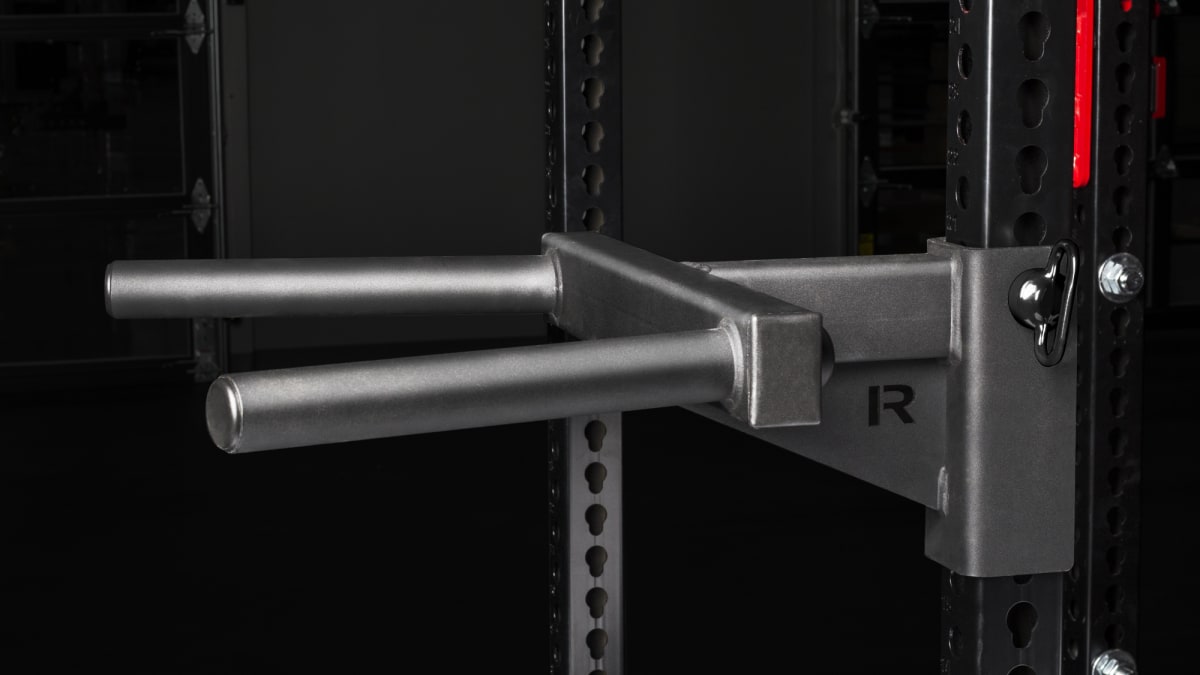
- The Rogue Monster Matador is our rack-mounted pick. The old PRx “ONE 2x3” and “Profile PRO 3x3” cards are gone. PRx now sells a single 3x3 dip attachment, and it’s sold out as of writing, so the in-stock Rogue leads this slot.
- We dropped the discontinued Fringe foldable wall-mount. The small-space slot now goes to the REP dip attachment, which bolts to a rack instead of the wall.
- Grip width and grip diameter are scored hard. A bar that’s the wrong width for your shoulders, or too thin to hold, is the fault that ruins a station regardless of its steel.
The Titan Dip Stand stays as the cheap free-standing pick. It’s on backorder at the moment, so check the ship date before you buy.
Related
We’ve built dip work into hundreds of training plans. If you’d rather hang a dip attachment off your existing cage, see our best squat rack picks for the rack to bolt it to. For the rings and bars that round out a bodyweight setup, read our best gymnastics rings guide.
Compare the best dip bars
This table shows all 7 picks side by side. Scores come from our weighted rating, which we explain in the testing section below.
 Rogue Matador
Check price
Rogue Matador
Check price
|
 Titan Dip Stand
Check price
Titan Dip Stand
Check price
|
 Dripex Station
Check price
Dripex Station
Check price
|
 REP Dip Attachment
Check price
REP Dip Attachment
Check price
|
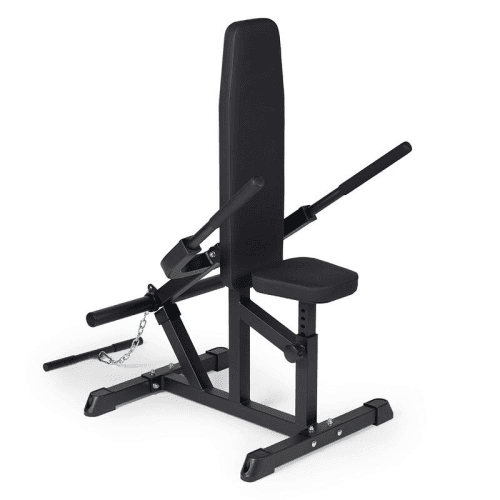 Titan Seated Dip
Check price
Titan Seated Dip
Check price
|
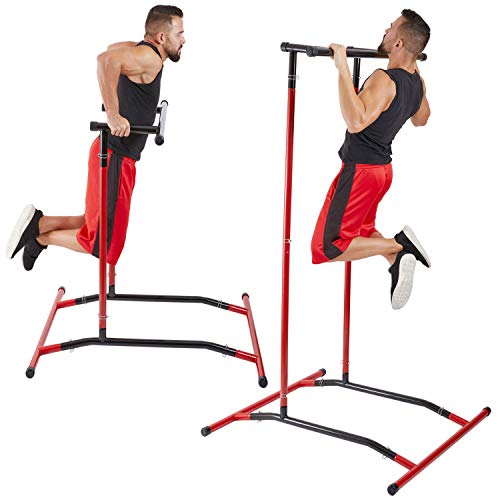 GoBeast Stand
Check price
GoBeast Stand
Check price
|
||
|---|---|---|---|---|---|---|---|
| Best for | Overall | Rack-mounted | Budget | Calisthenics | Small space | Assisted | Portable |
| Rating | |||||||
| Quality | 88% | 95% | 76% | 78% | 88% | 80% | 70% |
| Versatility | 88% | 80% | 74% | 90% | 80% | 78% | 84% |
| Brand & reviews | 90% | 94% | 82% | 76% | 86% | 80% | 78% |
| Grip width | 21–23″ angled | 17.75–24.75″ | 24.5″ fixed | 13–19″ each bar | 27″ max | Fixed wide | Fixed |
| Mount | Free-standing | 3x3″ rack | Free-standing | Free-standing | REP 4000/5000 rack | Free-standing | Free-standing |
| Value | 94% | 74% | 95% | 84% | 82% | 86% | 88% |
| Price tier | $$ | $$$ | $ | $ | $$ | $$ | $ |
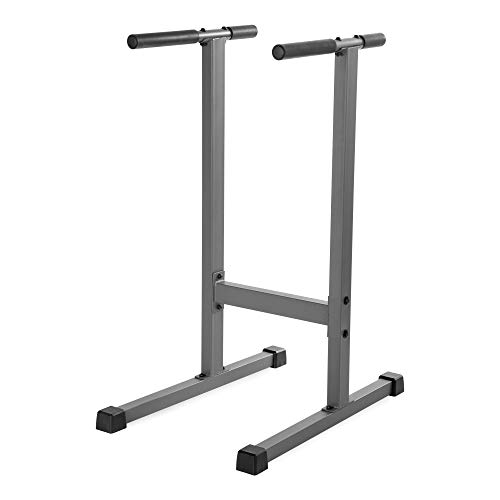 Xmark 500
Our testing and selection process
How we assess dip bars
We run every dip roundup through the same 5 steps:
- We start as the buyer. Most of our team owns or has coached on a dip station. My own gym has cycled through free-standing stands, rack attachments, and assisted machines over 2 decades.
- We research wide. We pull specs, warranty terms, and owner feedback on as many stations as we can find, more than 60 this time, into one spreadsheet.
- We score each one with our weighted system. Data decides the ranking, not brand loyalty.
- We split the field by type, because a free-standing stand and a rack attachment solve different problems.
- We get hands-on where we can and lean on the SHG community for the rest.
You can read more in our review guidelines.
How we score dip bars
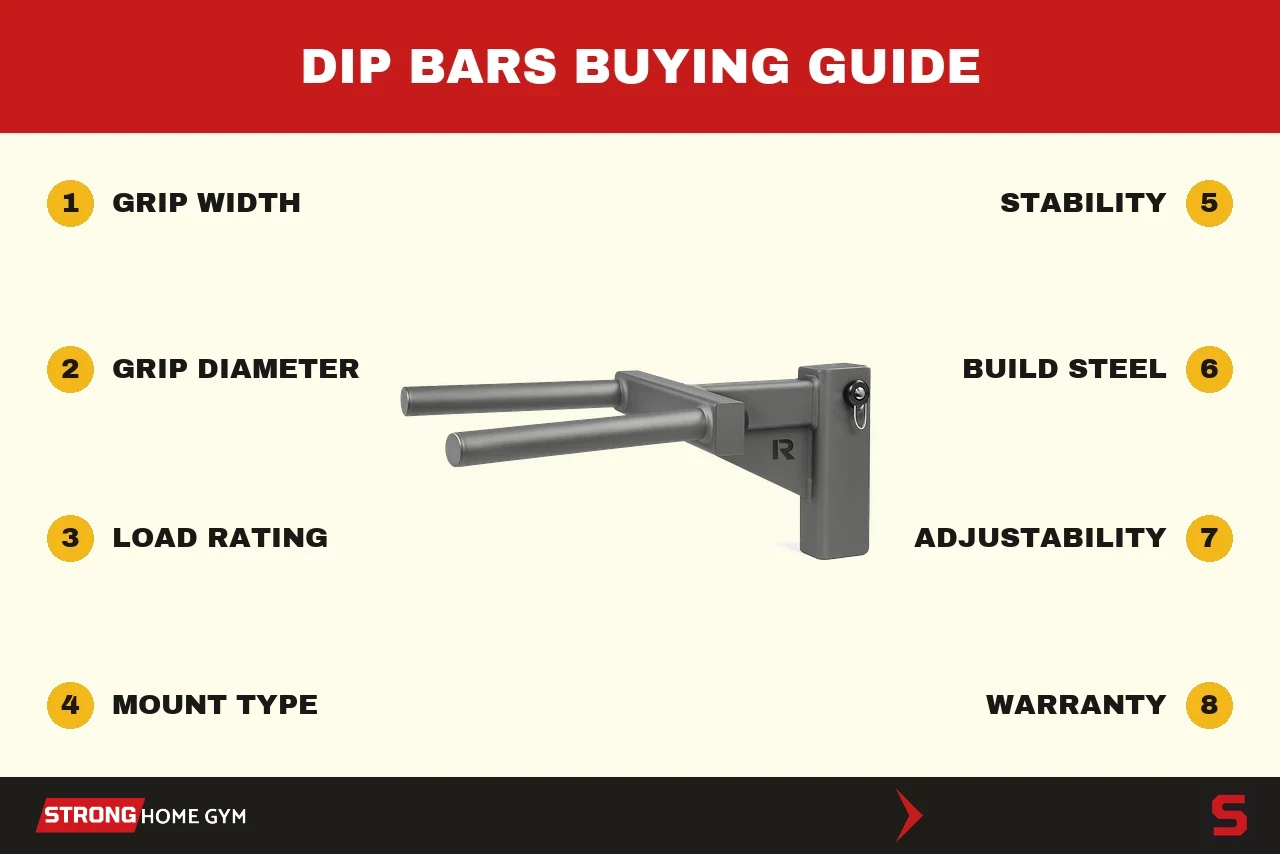
Here’s what feeds the score and how much each part counts.
We grouped it into 4 chunks:
- Quality (35%) - the steel gauge, the welds, the grip diameter, and the finish.
- Versatility (15%) - how many body types and goals the station serves.
- Brand & reviews (15%) - warranty terms and what owners report over time.
- Value (35%) - what you pay for the build you get, the metric that levels the field.
Quality of a dip station (35%)
- Grip width and angle (12%) - bars should sit a touch wider than your shoulders. Too wide and your strength leaks into stabilising. The single most common reason a dip station feels wrong is the spacing, not the steel.
- Grip diameter (8%) - thicker bars spread pressure across the palm. We look for 1.5 to 2 inches.
- Steel and welds (15%) - frame gauge, clean welds, and rubber feet that protect the floor.
Versatility (15%)
A dip station earns versatility points when it fits more than one body and one goal.
A fixed-width bar that suits a wide frame can be useless to a narrow one.
Versatility comes down to:
- Adjustable width or height, where the design allows it
- Headroom for tall lifters doing full leg-extended dips
- Whether the station also does leg raises, push-ups, or pull-ups
Brand & reviews (15%)
We read the warranty small print and the owner threads.
- Warranty terms - a lifetime warranty on a welded station is the brand backing its steel.
- Owner reports - we track longevity, wobble, and stock issues across our community.
Value (35%)
We weigh build quality against price and reward the stations that punch above their tier.
In plain terms…
A station that matches a premium build at half the price wins on value. That’s where the smart-money picks hide, and why our overall pick isn’t the dearest one here.
Which type of dip station should you buy?
Buy the type that fits your floor and your rack before you shop a brand. There are four that matter for a home gym, and they barely compete with each other.
A free-standing stand needs no rack and no wall holes. It’s the default for most people and the easiest to set up. A rack-mounted attachment bolts to a power rack you already own, so it costs less and saves all the floor space. A calisthenics parallel bar sits low and adjustable for skill work. An assisted machine lets a beginner build up to a full dip with control.
That’s the short answer. The longer one is that your space and your goal decide for you.
My tip: if you own a power rack, price up the attachment first. It’s the cheapest honest way into dips and it gives up no floor.
Use the finder below to land on the right type, then jump to our pick in that slot.
Find your dip type in 3 questions
Tell us about your space and your goal. We'll match you to the dip type and our top pick in that type.
-
1 What space do you have?
-
2 What are you training for?
-
3 What's the budget like?
Find the perfect dip station for you
Best overall | Best rack-mounted | Best budget | Best for calisthenics | Best small space | Best assisted | Best portable
Here’s how the seven stations rank on our overall score:
Xmark 500
Best Overall Dip StationQuick specs
- Frame - 2×3″ angled steel uprights
- Footprint - 35.5″ L × 23″ W × 53″ H
- Capacity - 500 lb
- Grip - 2″ cushioned, 21–23″ wide
- Type - Free-standing
Summary of experience, tests & opinions
What I like
- The bars angle inward, so you pick the width that loads your shoulder least. Most stands fix you to one spacing and hope it fits.
- The grips are genuinely oversized. On a heavy weighted set the pressure spreads across the palm instead of digging a line into it.
What could be better
- At just under 40 inches tall, a lifter over 6 foot 2 may catch their feet on full leg-extended dips. That’s true of any fixed stand.
- The instructions are thin and the included tools are worse. Have your own Allen keys ready.
Pros & cons
Pros
- Angled 21–23″ grips let you settle on the width that suits your frame, the thing most stands get wrong.
- 2-inch cushioned bars carry a weighted dip without biting into the hand.
- 500 lb frame in a compact footprint that stays planted under a forward lean.
Cons
- Fixed height suits most, but caps the very tall on full-extension reps.
- Sparse hardware means assembly leans on your own tools.
Read more about the Xmark 500
A dip station lives or dies on its grip width, and this is the only stand here that lets you choose. The bars taper inward, so a narrow frame grips close and a wide one grips out. That single feature solves the complaint behind most returned dip stands.
The build holds up its end too. Two-by-three steel uprights, oversized cushioned grips, and a footprint tight enough for a corner but wide enough to stay put when you lean forward into a chest-focused dip. None of it is flashy. All of it works.
The honest limit is the fixed height. At just under 40 inches the bars suit the great majority, but a very tall lifter doing leg-extended dips will want more clearance. An adjustable stand trades some stability to fix that.
It leads the field on value, matching pricier stands for a fraction of the outlay:
Bottom line
The Xmark 500 wins because it solves the problem that ruins most dip stands, the wrong grip width, and pairs that with a solid frame at a fair price. It isn’t the tallest or the dearest, and it doesn’t need to be. For the lifter who wants a complete station that just fits, this is the one.
The Xmark 500 might be for you if… you want a free-standing station and you’d rather choose your grip width than accept one.
It’s not for you if… you own a rack and want to save floor space, or you’re over 6 foot 2. Look at the Rogue Monster Matador or an adjustable stand instead.
Rogue Monster Matador
Best Rack-Mounted Dip BarQuick specs
- Material - 7-gauge steel, welded
- Grip - 1⅞″ angled, 17.75–24.75″
- Fits - Rogue Monster 3x3″ uprights
- Weight - 27 lb
- Made in - USA
Summary of experience, tests & opinions
What I like
- The grip spacing slides from 17.75 to 24.75 inches before you lock it down, so it fits a narrow and a broad frame off the same part.
- Mounted on a rack it has no flex at all. A welded attachment on heavy steel feels different to any free-standing stand under a weighted set.
What could be better
- It only fits Rogue Monster 3x3 uprights. On a different brand of rack it won’t bolt up.
- You need the rack first. As a standalone purchase it makes no sense.
Pros & cons
Pros
- 7-gauge welded steel with the rigidity only a rack mount gives, even on heavy weighted dips.
- Wide spacing range that suits most shoulder widths from one attachment.
- No floor space used and no wall holes, since it lives on the rack.
Cons
- Monster 3x3 only, so it’s tied to a Rogue rack with the right upright.
- Rogue premium makes it the priciest pick per use here.
Read more about the Rogue Monster Matador
A rack attachment is the smart buy when you already own a cage. You skip the whole frame of a free-standing stand and pay only for the bars, and they bolt to steel that doesn’t budge. For a weighted-dip lifter that rigidity is the draw.
This is Rogue’s take, and it’s built like the rest of their Monster line. Seven-gauge steel, clean welds, and grips that slide across a wide spacing range before you anchor them. Lock it where your shoulders want it and the part disappears into the rack.
The catch is fit. This is a Monster-series piece, so it wants Rogue 3x3 uprights. On the right rack it’s superb. On the wrong one it won’t mount, so check your upright size first. The PRx 3x3 dip station is the obvious rival here, but it’s sold out as of writing, which is why Rogue leads the slot.
It tops our quality score outright, on steel gauge and weld finish alone:
Bottom line
The Rogue Monster Matador is the pick for the rack owner who wants the best-built dips on the page. Seven-gauge steel, a wide spacing range, and no floor given up, all backed by Rogue. It costs the most per use and only fits a Monster 3x3 rack, so confirm your uprights before you commit.
The Rogue Monster Matador might be for you if… you run a Rogue Monster 3x3 rack and you load your dips heavy.
It’s not for you if… you have no rack or a different brand of cage. The Xmark 500 stands alone, and the REP attachment fits REP racks.
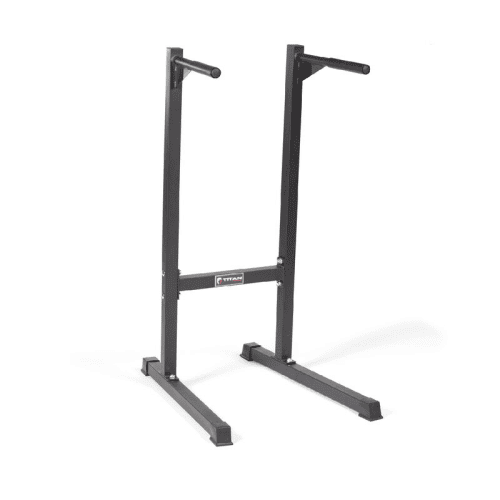
Titan Dip Stand
Best Budget Dip StationQuick specs
- Frame - Powder-coated steel
- Footprint - 51″ H × 27.25″ W × 36″ D
- Grip spacing - 24.5″ fixed
- Capacity - 500 lb
- Weight - 40 lb
Summary of experience, tests & opinions
What I like
- It’s tall, which the cheap stands rarely are. There’s room for a full dip without tucking your legs.
- The wide stance feet keep it planted. For the price, the stability is more than you’d expect.
What could be better
- The grips are fixed at 24.5 inches, which is wide. A smaller frame will feel it spread the load into the shoulders.
- The padding and the welds are where the budget shows. Both are fine, neither is nice.
Pros & cons
Pros
- Tall frame gives full-dip clearance the cheap stands skip.
- 500 lb capacity on a wide, stable base.
- Lowest outlay of any free-standing pick here.
Cons
- Fixed 24.5″ grips run wide for a narrow frame.
- Basic finish on padding and welds, in line with the price.
Read more about the Titan Dip Stand
Not every gym needs a premium stand. If you want a free-standing station and you’re watching the budget, this Titan does the core job for the least money on the page.
The headline is the height. Cheap dip stands tend to be short, which forces a tall lifter to tuck their knees. This one clears that, so you get a full range without contortions. The 500 lb frame and wide feet keep it steady, which is the other thing budget stands often miss.
The trade-off is the fixed grip width. At 24.5 inches the bars sit wide, so a narrow-shouldered lifter loses some push to stabilising. If that’s you, the Xmark’s angled grips are worth the step up. One housekeeping note: it’s on backorder at the moment, so check the ship date before you order.
It runs away with the value chart, which is the only place a budget pick should lead:
Bottom line
The Titan Dip Stand is the smart budget buy if its 24.5-inch spacing suits your frame. It’s tall, it’s stable, and it costs a fraction of a premium station. The padding and welds are basic, but for a first dip station or a spare, they do the job. Mind the backorder before you click.
The Titan Dip Stand might be for you if… you want a cheap free-standing station and you’re average or broad through the shoulders.
It’s not for you if… you’re narrow-framed or you want adjustable grips. The Xmark 500 or the Dripex station fit those better.
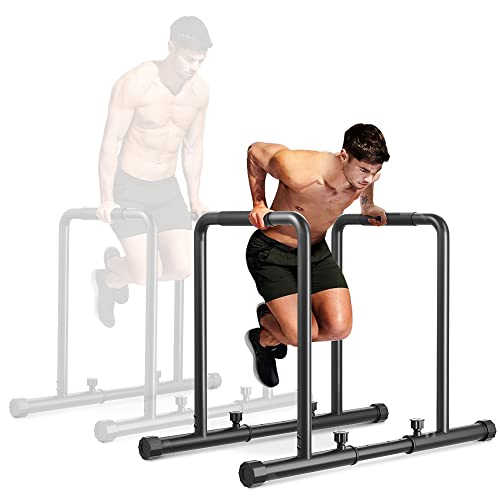
Dripex Station
Best Calisthenics Dip BarsQuick specs
- Frame - Heavy-duty steel
- Width - 35–41″ adjustable
- Height - 30.7–35.4″ adjustable
- Capacity - 1,100 lb
- Stabilisers - Twin safety connectors
Summary of experience, tests & opinions
What I like
- The width and height both adjust, so you dial in the spacing for a strict dip or open it out for L-sits and skill work.
- The 1,100 lb rating is the tell that separates it from the lookalikes. It means a thicker frame and far less wobble.
What could be better
- The bars are thinner than the listing photos suggest. On long sets I’d add a towel or a grip sleeve.
- With heavy use over time you may see a little twist in the frame. It’s the nature of an adjustable design.
Pros & cons
Pros
- Width and height both adjust for strict dips, L-sits, and parallette skills.
- 1,100 lb frame that’s far thicker than the Amazon lookalikes it resembles.
- Low, wide stance that suits calisthenics movement around the bars.
Cons
- Thinner bars than the photos imply, so add padding for high reps.
- Some frame twist possible over heavy long-term use.
Read more about the Dripex Station
Calisthenics asks different things of a dip bar. You want it low, you want it adjustable, and you want it stable enough to hold a slow eccentric or an L-sit. A fixed strength stand can’t flex to all that. This one can.
The frame is the reason it’s here. A wall of near-identical stations sit on Amazon, and most cap out around 400 lb. This Dripex is rated to 1,100, which in practice means thicker tube and less wobble when you shift your weight forward. Capacity is really a proxy for stability at this end of the market.
The honest knocks are the bar thickness and a little frame twist over years of hard use. Neither is a deal-breaker for skill work. Wrap the bars if your hands want more, and you’ve a versatile base for calisthenics that costs little.
It leads the field on versatility, the criterion that matters most for skill work:
Bottom line
The Dripex Station is the calisthenics pick because it adjusts where the strength stands stay fixed, and it backs that with a frame far thicker than its lookalikes. The bars want a wrap for long sets, but as an adjustable base for skill work at a low price, it’s hard to fault.
The Dripex Station might be for you if… you train calisthenics and want to adjust width and height for skill work.
It’s not for you if… you only do strict weighted dips and want zero flex. The Xmark 500 or Rogue Matador suit pure strength better.
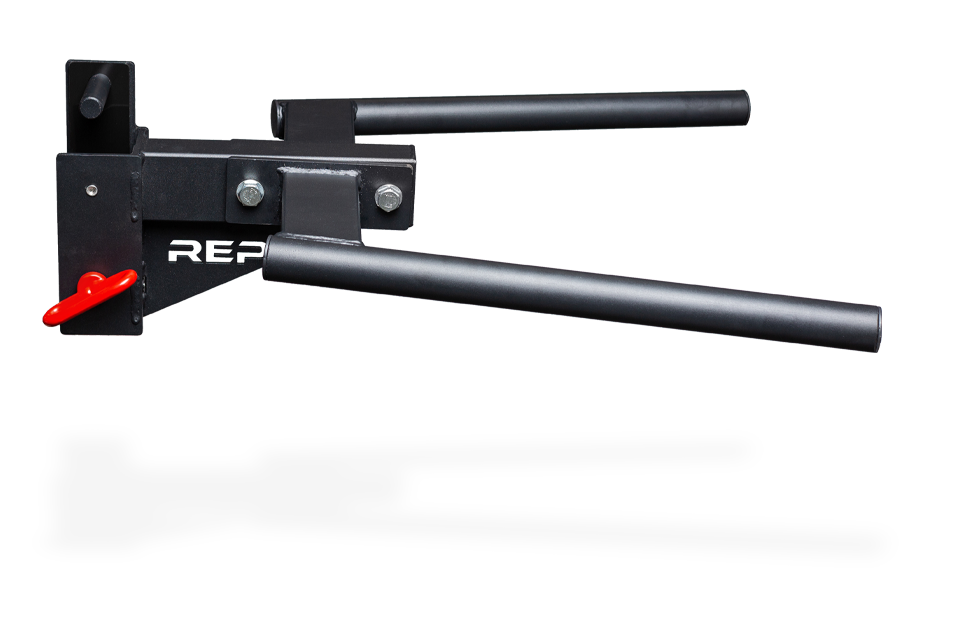
REP Dip Attachment
Best Compact Rack AttachmentQuick specs
- Material - 4- and 11-gauge steel
- Capacity - 400 lb
- Width - 27″ maximum
- Fits - REP PR-4000 / PR-5000 racks
- Mount - Pins in like a J-cup
Summary of experience, tests & opinions
What I like
- It mounts like a J-cup and anchors with a pin, so it’s on and off the rack in seconds without tools.
- Lifted off, it stores flat against an upright. In a small gym that tidiness is the whole point.
What could be better
- It’s a REP 4000/5000-series part, so it won’t fit a Rogue or a budget rack.
- The 27-inch width is the maximum, not adjustable, so check it suits your span.
Pros & cons
Pros
- Pins in like a J-cup for tool-free mounting in seconds.
- 4- and 11-gauge steel that holds a 400 lb rated load without complaint.
- Stores flat against the upright, giving up no floor or wall space.
Cons
- REP 4000/5000 only, so it’s tied to a REP rack.
- Fixed 27″ width that won’t narrow for a smaller frame.
Read more about the REP Dip Attachment
When your whole gym is built around one rack, the tidiest dip option bolts to it. This REP attachment pins into the upright holes the way a J-cup does, anchors with a pin, and turns spare rack space into a dip station with no extra footprint.
The convenience is the draw. It goes on and comes off in seconds with no tools, and when it’s off it sits flat against the upright instead of in a corner. For a garage gym where every square foot is spoken for, that matters more than a spec sheet.
The trade-off is the same as any rack part: it fits one family of racks. This wants a REP PR-4000 or PR-5000. On that rack it’s a clean, sturdy, low-cost way into dips. On anything else it won’t seat, so check your rack first.
It sits among the top of the field on quality, level with the premium picks on build:
Bottom line
The REP Dip Attachment is the move for a small gym built on a REP rack. It mounts like a J-cup, holds a real load on 4- and 11-gauge steel, and tucks away flat when you’re done. It only fits REP 4000/5000 racks, so confirm yours before you buy. If it fits, it’s the tidiest dip solution here.
The REP Dip Attachment might be for you if… you own a REP PR-4000 or PR-5000 rack and you’re tight on floor space.
It’s not for you if… you run a Rogue or budget rack, or you have no rack at all. The Rogue Matador and Xmark 500 cover those.
Titan Plate-Loaded Seated Dip Machine
Best Assisted Dip StationQuick specs
- Type - Seated plate-loaded dip + curl
- Footprint - 27″ W × 30″ D × 51″ H
- User capacity - 300 lb
- Plate sleeves - 2 × 11″ loadable
- Includes - Bar + chain + carabiners
Summary of experience, tests & opinions
What I like
- The load is set by the plates, so you can start light and add a little each week. That’s how you actually reach a first full dip.
- Seated and guided, it takes the shoulder strain out of the movement, which suits anyone coming back from a tweak.
What could be better
- It needs clear space to load and unload plates, so the real footprint is bigger than the frame.
- The handles sit wide, which a smaller user may find a stretch.
Pros & cons
Pros
- Plate-loaded resistance lets a beginner scale up to a full dip in small steps.
- Seated and guided path that’s kinder to the shoulder than a free dip.
- Doubles as a curl station for more from one footprint.
Cons
- Loading space needed around it, beyond the frame footprint.
- Wide handles that can stretch a smaller user.
Read more about the Titan Plate-Loaded Seated Dip Machine
A free dip is all-or-nothing. You either have the strength or you don’t, and there’s no halfway. A plate-loaded seated machine fixes that by letting you set the resistance, so you start at a weight you can move and add to it as you grow.
That makes it the tool for two groups. A beginner uses it to build the pressing strength for a first unassisted dip. An experienced lifter uses it to push past a plateau or run high-volume work without taxing the shoulder. The seated, guided path keeps the joint happy through both.
The honest cost is space. The frame is compact, but you need room around it to slide plates on and off, so budget more than the footprint suggests. Handle width runs wide too. Neither undoes the value of controlled, scalable dip strength.
It holds its own on value, well clear of the dearer assisted machines:
Bottom line
The Titan Plate-Loaded Seated Dip Machine is the pick for building dip strength under control. It scales the load with plates, guides a shoulder-friendly path, and throws in a curl station, all at a price well under the selectorised machines. Just leave room to load the plates and it earns its corner.
The Titan machine might be for you if… you’re working toward a first full dip or rehabbing a cranky shoulder.
It’s not for you if… you already grind out weighted dips and want the real movement. The Xmark 500 or Rogue Matador are the stations for that.
GoBeast Stand
Best Portable Dip StandQuick specs
- Type - Portable pull-up + dip + push-up
- Base - 117 cm × 113 cm
- Height - 8 ft (compact 1.3 m)
- Capacity - 240–300 lb
- Weight - 50 lb · carry bag
Summary of experience, tests & opinions
What I like
- It genuinely packs into a bag, which nothing else here does. For a trip or a shared space, that’s the whole pitch.
- One frame covers dips, pull-ups, and push-ups, so it earns its keep when you can only bring one thing.
What could be better
- It’s less stable than any welded stand, so I keep the load sensible and skip the heavy chains.
- Width and height are fixed, and the paint chips with travel. It’s a road tool, not a daily driver.
Pros & cons
Pros
- Packs to a carry bag, the only truly portable pick here.
- Three jobs in one, covering dips, pull-ups, and push-ups.
- Quick to assemble and strip down between sessions.
Cons
- Less stable than a welded station, so keep the load moderate.
- Fixed width and height with paint that chips on the road.
Read more about the GoBeast Stand
Every other pick here assumes you have a dedicated spot. This one doesn’t. It’s the answer for the lifter who travels, shares a space, or has no room for a permanent station, and it folds into a bag when you’re done.
The trick is that it does three things. Dips, pull-ups, and push-ups all run off the one frame, so when you can only carry a single piece of kit, this is the one that covers the most ground. Setup and teardown are quick enough that you’ll actually bother.
The catch is stability. A folding stand can’t match a welded one, so I keep the weight moderate and leave the heavy weighted dips for a fixed station. The width and height are fixed and the paint chips with travel. None of that matters for what this is, a portable second station, not your main one.
It scores well on value for what a travel station should cost:
Bottom line
The GoBeast Stand is the travel pick, full stop. It folds into a bag, sets up fast, and handles dips, pull-ups, and push-ups when you can only bring one thing. It’s not as steady as a welded station and the finish chips, but as a portable second station it does exactly its job.
The GoBeast Stand might be for you if… you travel, share a space, or need a station that packs away.
It’s not for you if… you want a stable daily driver for heavy weighted dips. The Xmark 500 or Titan Dip Stand are sturdier at home.
How to choose a dip station
The finder above sorts you by type. This section explains the why behind it, so you can sanity-check the call.
Type comes first
Pick the type before the brand. The four that matter for a home gym are free-standing, rack-mounted, calisthenics, and assisted.
- Free-standing is the default. No rack, no wall holes, set it down and train.
- Rack-mounted saves all the floor space and costs less, but needs the right rack.
- Calisthenics bars sit low and adjust, built for skill work over pure strength.
- Assisted machines scale the load, so a beginner can build to a full dip.
My tip: own a rack already? Price the attachment first. It’s the cheapest honest way into dips.
Grip width and angle
Bars should sit a touch wider than your shoulders. Too narrow and your elbows flare. Too wide and your strength leaks into holding yourself steady instead of pressing up.
To find your number, measure from your elbow to your fingertips with the palm open, then add an inch or two. That’s your ballpark spacing. Angled or adjustable bars, like the Xmark’s, let you tune it; fixed bars only work if their one width happens to suit you.
Grip diameter
A thicker bar spreads pressure across the whole palm instead of cutting a line into it. Aim for 1.5 to 2 inches. On weighted or to-failure sets, that difference decides whether your hands give out before your chest does. A thin bar can be saved with a towel or a grip sleeve, but it’s a patch, not a fix.
Frame, steel, and feet
A dip station is steel tube and welds, so build is mostly gauge and weld quality. Look for an 11 to 14-gauge frame, clean welds, and rubber feet that protect the floor. Below the budget tier, the welds and coating are where corners get cut, which is why the premium rack attachments feel a class above.
Capacity and stability
Read the weight rating as a stability number, not a literal limit. You’re never going to test 1,100 lb. But a station rated that high uses thicker tube, so it wobbles less when you shift forward into a chest dip. Anything over 400 lb is plenty; the higher numbers buy steadiness, not headroom.
Footprint and warranty
Only go free-standing if you can spare a clear six square feet. A seated machine looks compact but needs loading room around it, and a rack attachment gives up no floor at all. On warranty, expect a lifetime cover on a premium welded station; a year is fine on a budget or travel pick. Titan is the exception worth knowing, since it backs everything with a blanket one-year policy regardless of build.
Best dip bars FAQs
How high should dip bars be?
Dip bars should be between 3 and 5 feet high. The lower limit matters more. To find your minimum, get into a dip position, measure from your hands to the bottom of your knees, and add half a foot. A tall lifter who wants full leg-extended dips should look for a tall stand like the Titan Dip Stand or an adjustable one.
Which dip bars should I buy?
Buy by type. For chest and triceps strength, a free-standing station like the Xmark 500 is the default. If you own a power rack, a rack attachment costs less and saves the floor. For calisthenics, get adjustable bars like the Dripex. To build up to a first dip, a seated plate-loaded machine lets you scale the load.
Are dip bars effective?
Yes, dip bars are effective, as long as the spacing suits you. Dips drive more triceps activation than bench dips, and they ask less of the shoulder than many pressing variations because the joint travels through less extension. The key is grip width: too wide and you lose force to stabilising, so pick bars that fit your frame like the Xmark 500.
What is the best grip width for dip bars?
The best grip width is a touch wider than your shoulders. Measure from your elbow to your open fingertips and add an inch or two for your ballpark. Bars much wider than that push the load into the shoulders, which is the most common reason a dip station feels wrong. Angled or adjustable bars let you tune the width to your own frame.
How much weight can dip bars hold?
A dip bar can hold 300 to 1,100-plus pounds. The median is around 500, like the Titan Dip Stand. Read the figure as a stability rating rather than a hard ceiling: a higher number means thicker tube and less wobble, which is why calisthenics bars like the Dripex carry the highest ratings.
The bottom line
Two decades of putting clients on dip stations, and this guide is the short version of what stuck.
For most home gyms, the Xmark 500 is the best dip station you can buy. It’s a complete free-standing unit that gets the grip width right and stays stable, all for a fair price. If you own a 3x3 rack, the Rogue Monster Matador brings heavier steel and gives up no floor.
On a budget, the Titan Dip Stand is tall and steady for the least money. Training calisthenics? The Dripex adjusts for skill work. Tight on space with a REP rack, the REP attachment tucks away flat. Building up to a first dip, the Titan seated machine scales the load. And for the road, the GoBeast folds into a bag.
- Skip back to the comparison table to see all 7 side by side.
- Bookmark this page. We keep it updated as stock and picks change.
Stay strong and smart.
