

We scored 94 dip belts across five categories and picked the seven worth your money.
Bodyweight dips stop building strength at some point and start being cardio. Hanging a plate off your hips is the cheapest fix in the gym, and a dip belt is how you do it.
I have built home gyms for over a decade, and the team scored every pick the same way, so this is data rather than one person’s favourite.
The aim was simple: work out which belts hold, which ones hurt after three sets, and which chain you need.
Let’s see how they stacked up.
Related
We have been loading dips and pull-ups in this gym for years. If you still need something to dip on, start with our guide to the best dip bars here, and if you would rather spread the load across your torso than hang it off your hips, look at our top picks for the best weight vest.
Compare the best dip belts
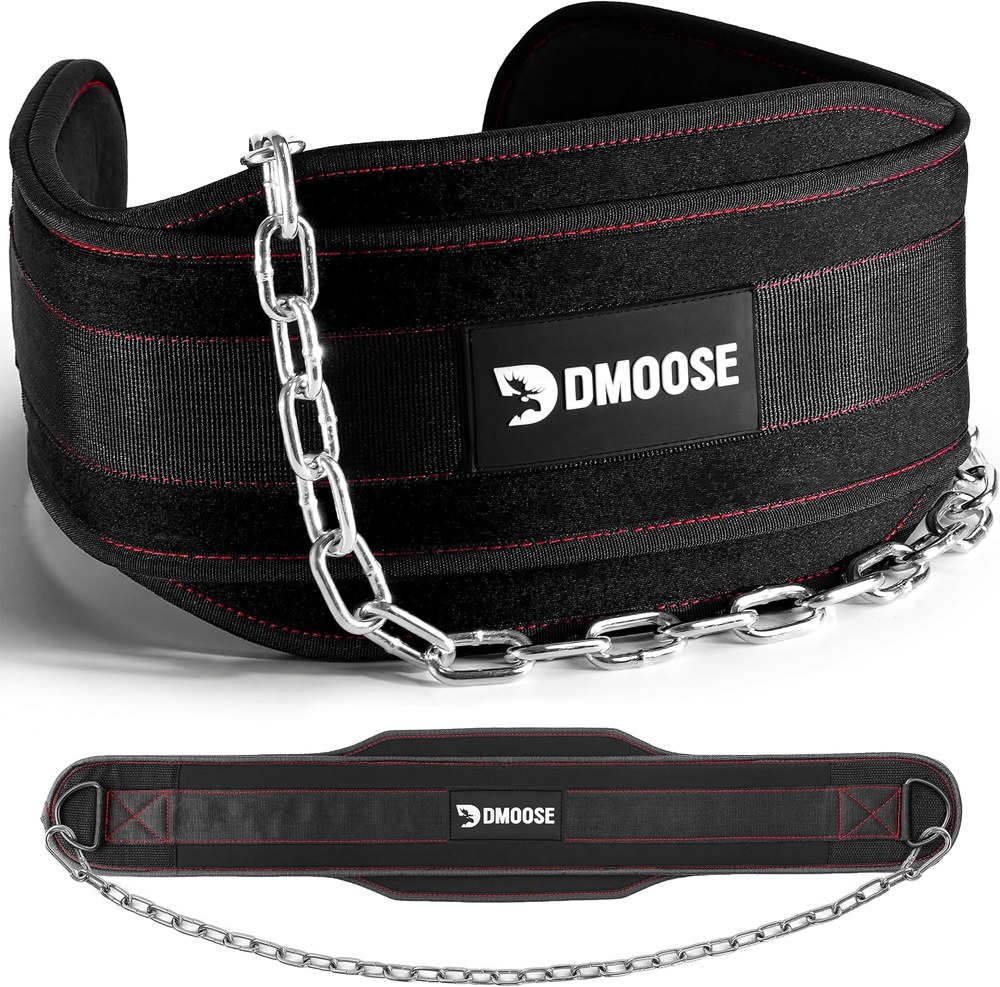 DMoose
Check price
DMoose
Check price
|
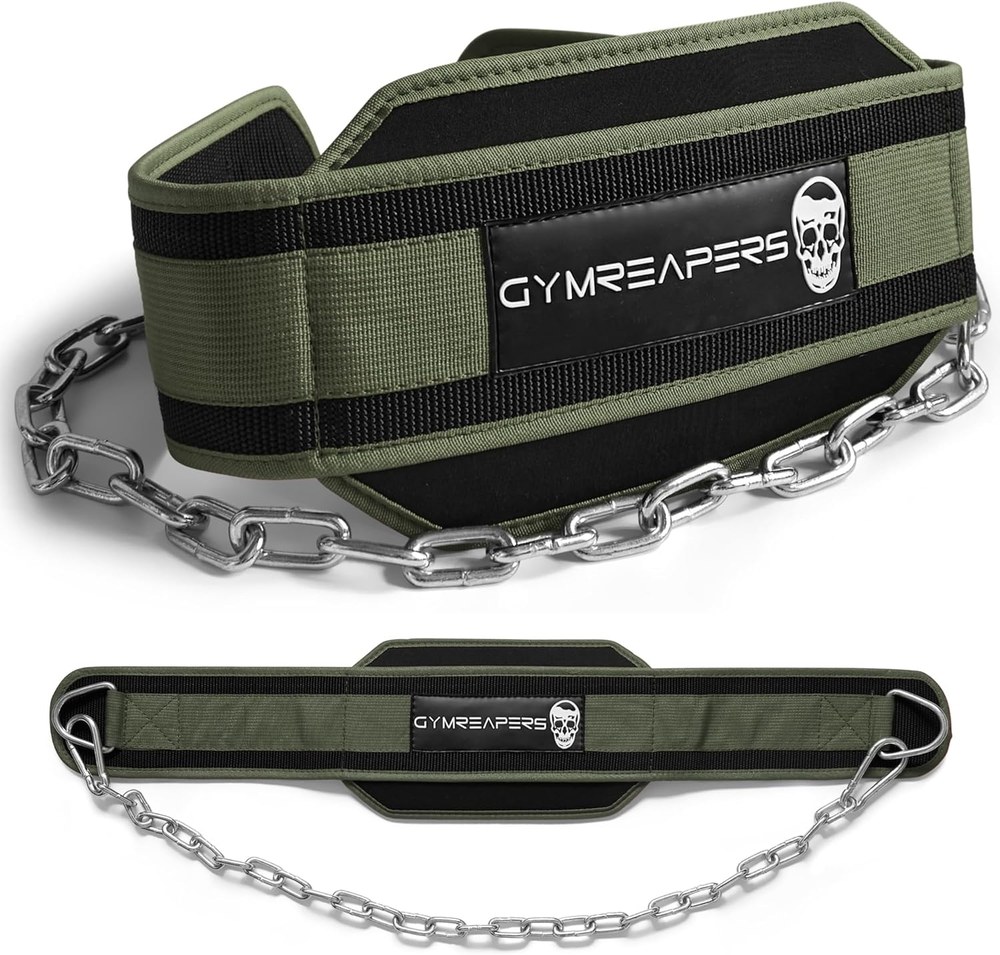 Gymreapers
Check price
Gymreapers
Check price
|
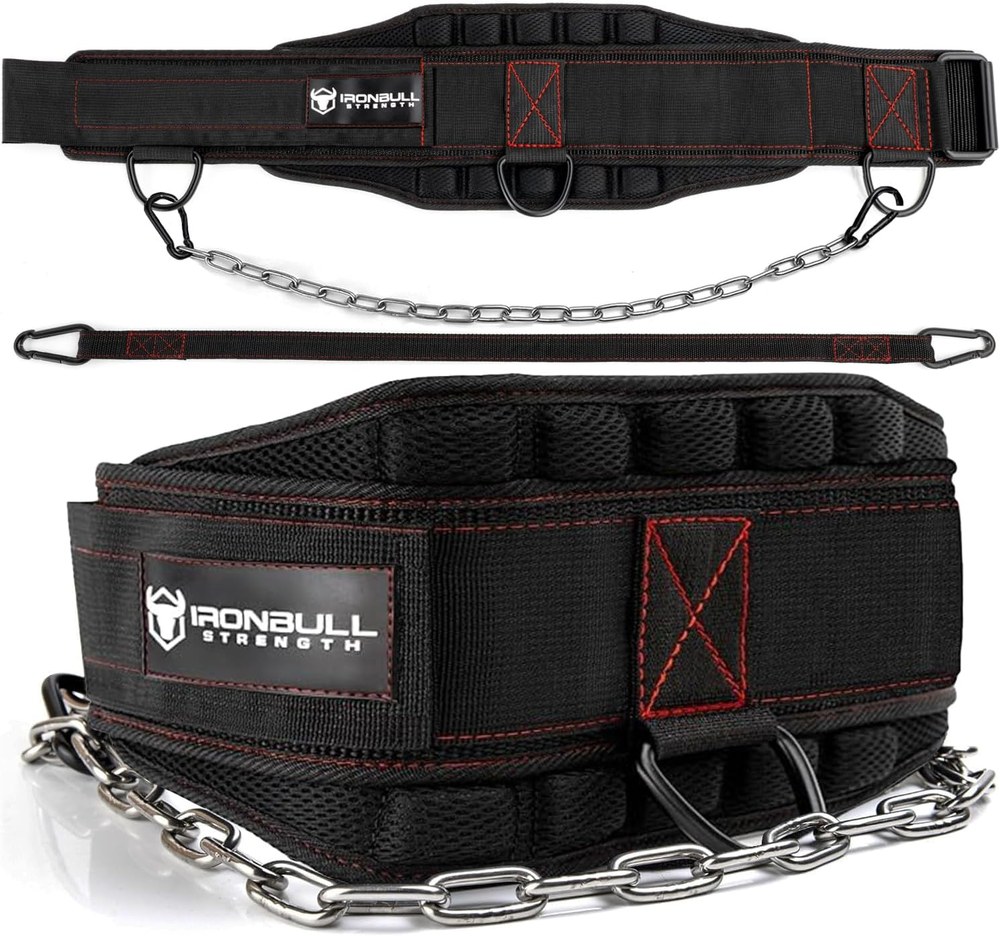 Iron Bull V2
Check price
Iron Bull V2
Check price
|
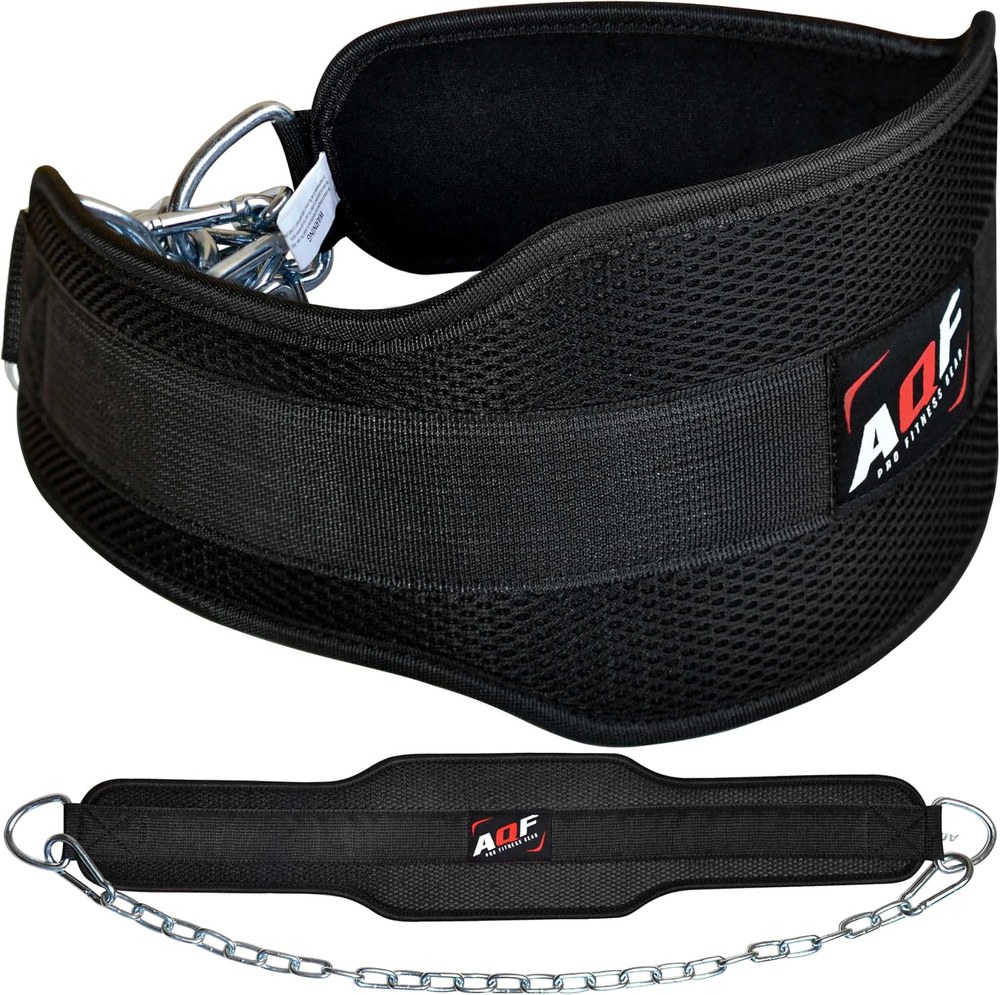 AQF
Check price
AQF
Check price
|
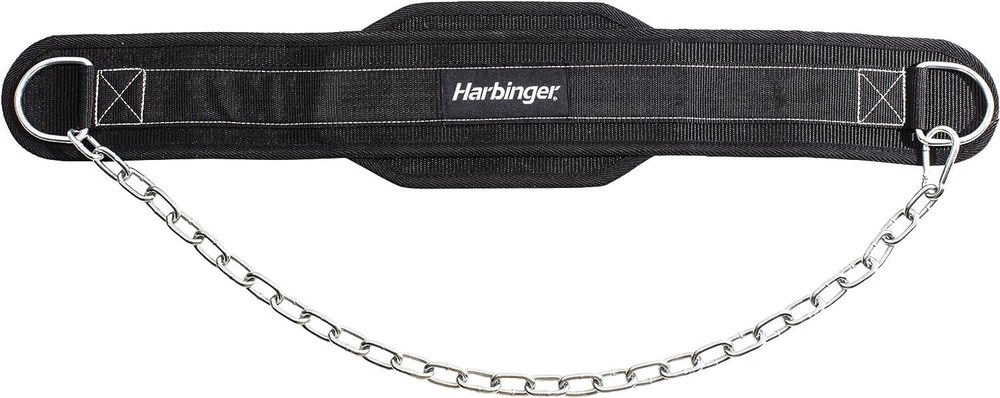 Harbinger
Check price
Harbinger
Check price
|
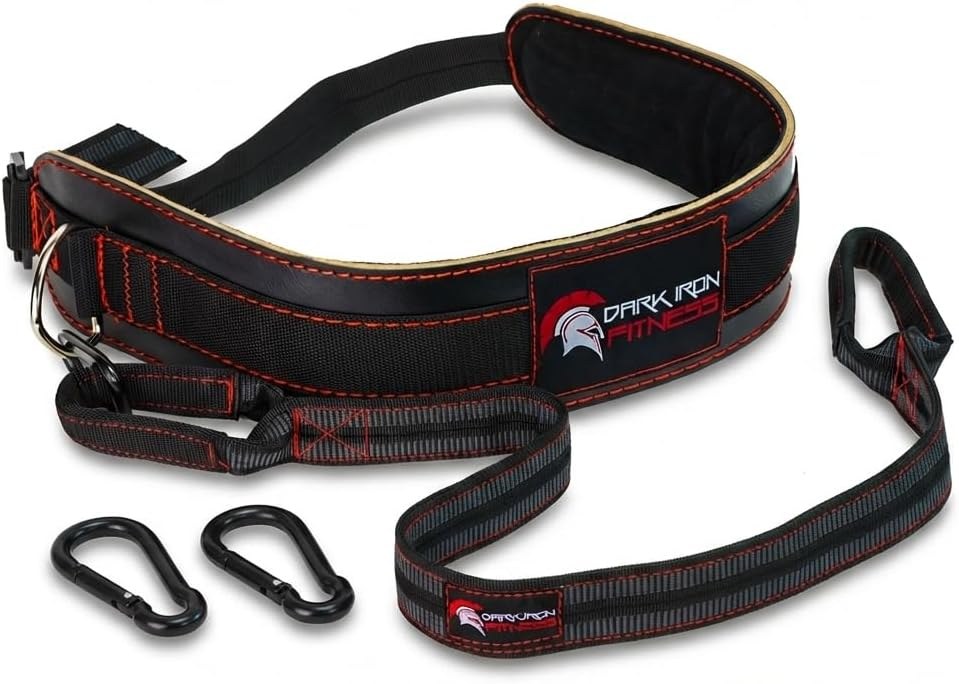 Dark Iron
Check price
Dark Iron
Check price
|
||
|---|---|---|---|---|---|---|---|
| Best for | Overall | Value | All-rounder | Heavy loading | Budget | Classic | Leather |
| Rating (*) | |||||||
| Build & hardware | 99% | 84% | 89% | 87% | 77% | 79% | 87% |
| Comfort under load | 86% | 86% | 88% | 93% | 80% | 85% | 75% |
| Versatility | 80% | 92% | 85% | 79% | 87% | 74% | 83% |
| Reputation & reviews | 97% | 89% | 93% | 83% | 92% | 89% | 86% |
| Value for money | 82% | 94% | 86% | 77% | 97% | 81% | 69% |
| Attachment | 30" chain | 36" chain | Steel chain | Chain + strap | 36" chain | 30" chain | 40" strap |
| Belt material | Nylon | Neoprene | Padded nylon | Reinforced nylon | Neoprene | Polypropylene | Leather |
| Tested capacity | 29,400 lb | Not published | Not published | Not published | Not published | Not published | Not published |
| Belt squat ready | No | Yes | Borderline | Yes | Yes | No | Yes |
| Price | $$$ | $ | $$ | $$ | $ | $$ | $$$ |
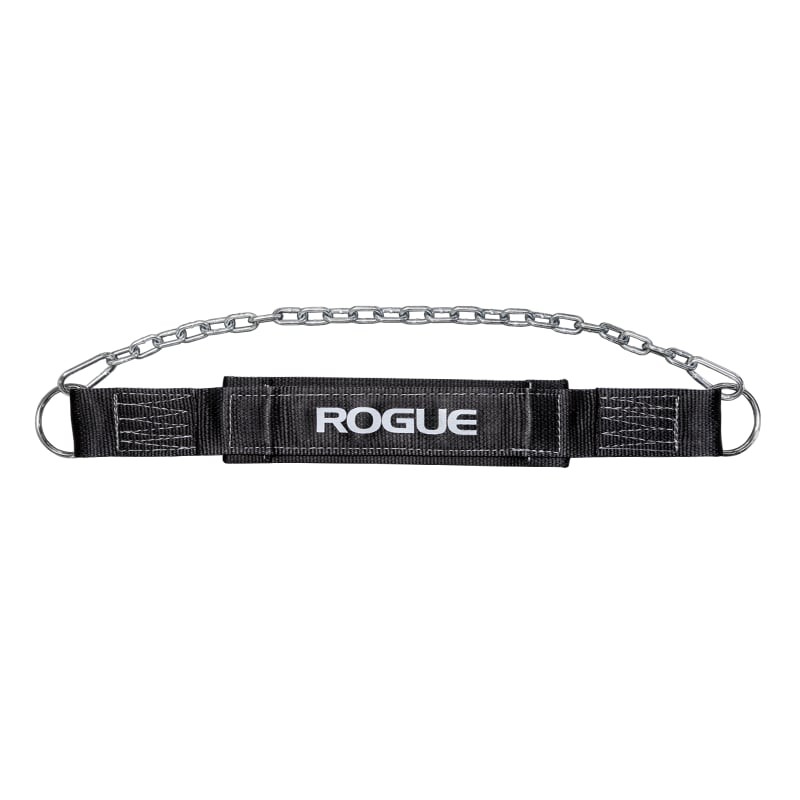 Rogue Dip Belt
Our testing and selection process
How we assess the dip belts
We always use a 5 step process in our reviews:
- We start as the buyer. Most of our team have bought and worn out dip belts before, and I have hung plates off my hips in this gym for years.
- We do a ton of research, collecting information on as many belts as possible and putting it into a spreadsheet.
- We rate each belt using our exclusive weighted rating system, explained in the section below.
- We use data to decide our top picks rather than personal bias toward brands.
- We get our hands on as many of the top picks as possible. Our community is great at helping with this.
You can read more about this process in our review guidelines.
How we test and score the dip belts
Below is an overview of how we reached the score and ranked the belts.
Specifically, it lists the factors in the rating formula and their gravity (how important they are).
I grouped them into five chunks for simplicity:
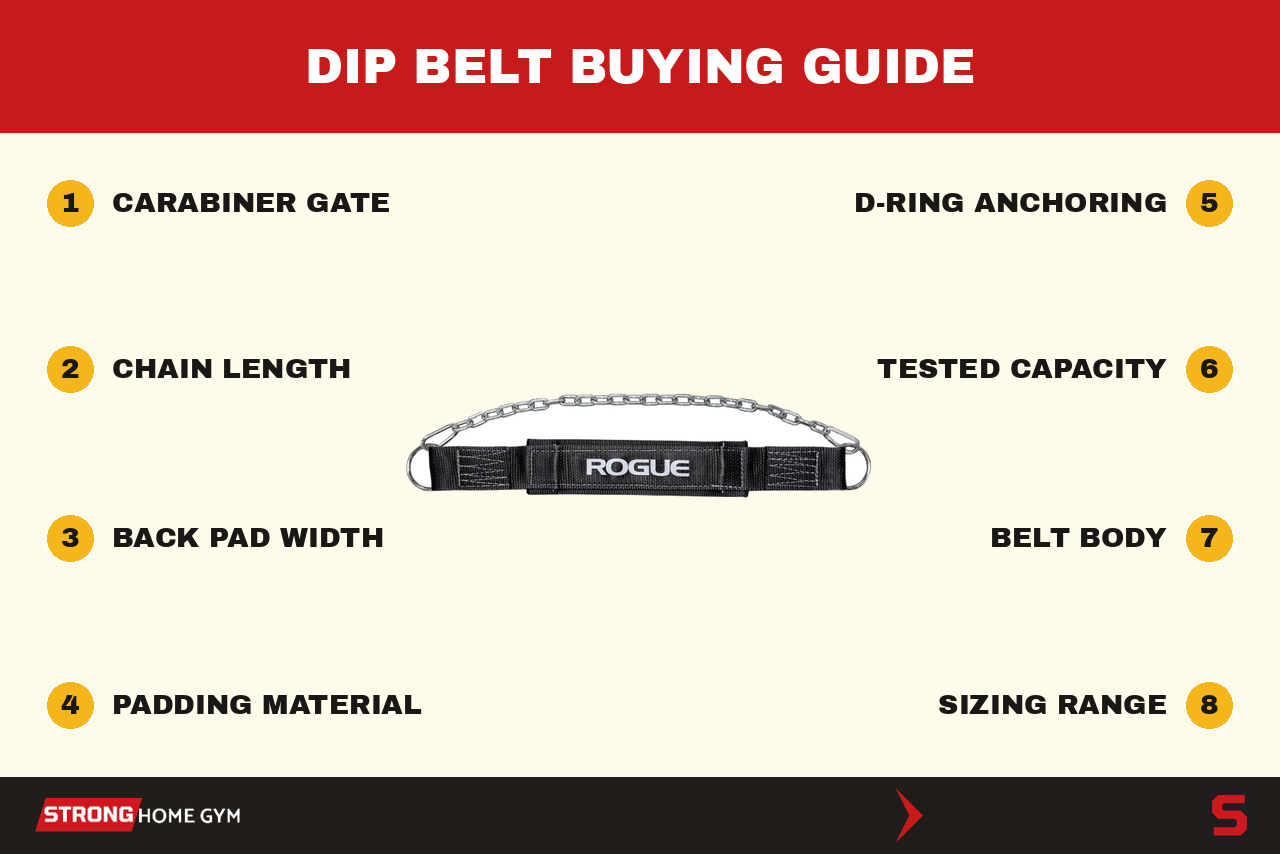
- Build and hardware (38%) - the belt body, the stitching, the D-rings, the carabiner gates and the chain.
- Comfort under load (22%) - pad width, padding material, and where the weight actually sits once it gets heavy.
- Versatility (12%) - chain length, which exercises it covers, and how well it fits different bodies.
- Reputation and reviews (10%) - what owners report over time, and how the brand handles it when something goes wrong.
- Value for money (18%) - what you get for the outlay, without rewarding cheap belts that are cheap for a reason.
Build and hardware (38%)
Here is the thing nobody tells you when you buy your first belt: the belt is almost never what breaks.
The nylon or leather body is wildly overbuilt on every belt worth buying. What actually fails is the connection. A cheap carabiner with a sprung gate can twist open under a shock load, a thin chain link can deform, and a D-ring stitched on with a single line of thread will eventually pull through.
So this is where most of our score sits. We look for locking or screw-gate carabiners, chain rated well past anything you would hang on it, and D-rings anchored into the belt body rather than tacked onto it.
| Steel chain | Nylon strap | Rope / daisy chain | |
|---|---|---|---|
| Weight of the hardware | Heaviest | Light | Lightest, about a fifth of chain |
| Height adjustment | One link at a time | Fixed loops | Anywhere you want it |
| On your skin and kit | Pinches thighs, chews clothing | Kind | Kind, and silent |
| Outdoor durability | Shrugs off anything | Good | Abrades over years |
| What you will actually find in the US | Nearly everything | A handful | Mostly imported |
My tip: if a listing shouts a huge capacity number in the product title and the brand publishes nothing else about how they got it, treat the number as marketing. One belt we looked at claims 800 lb in its title and has a few dozen ratings behind it.
Comfort under load (22%)
Comfort barely matters at 20 lb. At 100 lb it is the whole game.
The mistake almost everyone makes is buying for how plush the padding feels in your hands. Soft neoprene squashes flat under a stack of plates, and once it does, the edge of the belt is what is left pressing into your iliac crest. Leather does the opposite: firmer out of the box, but it holds its shape when the load arrives.
Pad width matters more than padding thickness. A 5 inch back panel funnels the load into a narrow band across your lower back. A 7 inch panel spreads the same weight across noticeably more area, and you feel that difference by the third working set.
Versatility (12%)
Versatility on a dip belt comes down almost entirely to one number that every roundup lists and nobody explains: chain length.
The chain decides what you can train:
- Dips and pull-ups, average height lifter: 30 inches is fine
- Dips and pull-ups, taller than about 5 foot 10: you want more
- Belt squats: 34 to 36 inches minimum, or the plates hit the floor before you hit depth
- Loading a single small plate: a longer chain gives you room to clamp it between your feet
My tip: if you are not sure, buy the longer chain. A long chain shortens easily by taking another wrap through the plate. A short one never gets longer.
Reputation and reviews (10%)
This group is about what happens after the honeymoon.
We weight current owner satisfaction, how that satisfaction has trended over the years the product has been on sale, and what the brand does when a buckle or a stitch line lets go. A belt with a thousand happy reviews and no replacement policy scores worse than one with fewer reviews and a brand that posts you a new one.
Value for money (18%)
We build a price tower and reward the belts that deliver the same job for less.
In other words…
We are looking for the belts where you are paying for stitching and hardware rather than for a logo. That cuts both ways: a budget belt that skimps on the carabiner does not score well just because it is cheap.
Find the perfect dip belt for you
Best overall | Best value | Best all-rounder | Best for heavy loading | Best budget | Best classic | Best leather
Here is how the seven belts stack up on our overall score:
Rogue Dip Belt
Best OverallQuick specs
- 3” heavy-duty nylon, rated 29,400 lb
- 4” wide back panel
- 30” length of 1/4” steel chain
- Two locking steel carabiners
The only belt here with a load rating that came from the manufacturer’s own testing rather than a listing title, and the hardware backs it up.
Summary of experience, tests & opinions
What I like
- Clipping in feels different from every other belt on this list. The gates screw shut, so there is no moment of glancing down mid-set to check nothing has crept open.
- The body folds back on itself to form the ring loops rather than having rings sewn on. You can see the load path with your own eyes, which is oddly reassuring when you are about to hang a plate off it.
What I don’t
- The interior seams are substantial, and past about 100 lb they make themselves known against your hips. This is the one genuine comfort complaint, and it comes from owners rather than from me being picky.
- Thirty inches of chain is short. I have caught the plates on the floor coming out of the bottom of a belt squat more than once.
Pros & cons
Pros
- Rated at 29,400 lb from Rogue’s own load testing, the only published test figure in the category.
- Locking carabiners rather than sprung gates, on both ends.
- Made in the USA with the warranty and support record that comes with it.
Cons
- The 30 inch chain rules out comfortable belt squats.
- Premium tier, and roughly double what the value picks cost.
Read more about the Rogue Dip Belt
Buy this one if you plan to get genuinely strong on dips.
The reason it wins is not the headline number. Nobody is hanging 29,400 lb off their hips. It wins because that number exists at all: Rogue tested the thing and published the result, while five of the six belts below it publish no capacity figure whatsoever and the seventh puts one in its product title with no method behind it. When the object in question is suspending a stack of iron from your pelvis over a concrete floor, I would rather have the tested one.
The build follows the same logic. Instead of stitching D-rings onto a strap, the belt folds onto itself to create the ring loops, then runs a zigzag stitch across the full width so the load spreads across every thread rather than pulling on one seam. The carabiners screw shut.
That is the whole pitch.
- You intend to work up past 100 lb on dips or pull-ups
- You want the hardware question closed permanently
- You buy once and keep things for a decade
- Belt squats are part of your programme (chain is too short)
- You are loading 25 to 50 lb and always will be
- You want the most belt for the money (that is the DMoose)
Where it loses points is honest and worth knowing. Those thick interior seams that make the belt so strong are the same seams owners report digging in once the load gets heavy, which is a slightly awkward trade for a belt aimed at heavy lifters. Wearing it a little lower on the hip bones rather than up on the waist takes most of it away. The short chain has no workaround.
Side by side with the DMoose, this is the safety-and-longevity buy against the value buy. The DMoose does the same job for most people at a fraction of the outlay and gives you six more inches of chain.
Its lead is in the build column:
Bottom line
The Rogue Dip Belt is the top-rated belt for 3 main reasons:
-
It is the only one with a tested rating. Rogue load tested it to 29,400 lb and published the figure. Everyone else is quiet or quoting a listing title.
-
The hardware is a tier above. Screw-gate carabiners and a folded, zigzag-stitched ring loop instead of sewn-on D-rings.
-
It is built to outlive the gym around it. Made in the USA, with the support record to match.
It might be for you if… you are working toward genuinely heavy dips and want to stop thinking about whether the kit will hold.
It’s not for you if… you want belt squats in your programme, where the short chain is a real limitation and the DMoose is the better buy.
DMoose Fitness Dip Belt
Best ValueQuick specs
- Neoprene and nylon, padded back panel
- 36” steel chain
- Steel chain and carabiner hardware
- 4.6 stars from over 7,400 ratings
The most-reviewed belt in the category, and the long chain gives it a use case the top pick cannot cover.
Summary of experience, tests & opinions
What worked
- The extra chain changes what the belt is for. Six inches does not sound like much until you are at the bottom of a belt squat and the plates are still clear of the floor.
- Loading is quicker than you expect, because there is enough slack to feed the chain through a plate without wrestling it.
What didn’t
- The neoprene is generous and soft, which is lovely for the first two sets and then compresses down to almost nothing once you are into the heavy work.
- It is bulkier than the leather and nylon belts, so it takes up more room in a gym bag than it should.
Pros & cons
Pros
- 36 inch chain, long enough for belt squats and tall lifters.
- The largest owner-review base in the category by a wide margin.
- Padded back panel and a price tier below almost everything here.
Cons
- No published capacity figure of any kind.
- Neoprene padding flattens under heavy plates.
Read more about the DMoose Fitness Dip Belt
This is the belt most people reading this should actually buy.
That is not a backhanded compliment. If you are loading somewhere between 25 and 90 lb on dips and chin-ups, which covers the overwhelming majority of home gym lifters, nothing about the Rogue’s tested rating or screw-gate carabiners changes your training. What does change your training is having enough chain to belt squat, and paying a fraction of the price.
The volume of owner feedback is worth dwelling on. Over seven thousand ratings is more than double any other belt here, and it has held a steady score across years on sale rather than a spike of early reviews. That is the closest thing to long-term durability data this category offers.
| DMoose | Rogue | |
|---|---|---|
| Chain | 36 in | 30 in |
| Belt squats | Yes | Not comfortably |
| Tested capacity | None published | 29,400 lb |
| Carabiner | Sprung gate | Screw lock |
| Price tier | $ | $$$ |
The neoprene is the honest weak spot. It is thick and soft, and under a couple of plates it packs down until you are feeling the belt edge rather than the padding. If you know you are heading for heavy singles, the Iron Bull holds up better under the same load.
It tops the lineup on versatility, and the chain is why:
Bottom line
The belt to buy if you want the job done properly without the premium outlay. The long chain covers belt squats that the top pick cannot, and seven thousand owners have already stress-tested it for you.
It might be for you if… you are loading moderate weight, want belt squats on the menu, and would rather spend the difference on plates.
It’s not for you if… you are chasing heavy singles, where the neoprene packs down and the Iron Bull is the better fit.
Gymreapers Dip Belt
Best All-RounderQuick specs
- Heavy-duty padded nylon body
- Steel chain with carabiner
- 4.7 stars from over 2,200 ratings
- One-year replacement policy
Better hardware than the budget belts and a proper replacement policy, without the premium tier outlay.
Summary of experience, tests & opinions
Where it shines
- The stitching is the giveaway. Every stress point is doubled back on itself, and after a year in a bag it still looks like nothing has moved.
- Gymreapers actually answer their emails. Our community rates their replacement handling above every other accessory brand in this price bracket, and that has been consistent across straps and wraps too.
Where it falls short
- The chain sits in an awkward middle length. Fine for dips and pull-ups, tight for belt squats if you are tall.
- It arrives stiff and takes a couple of sessions before the padding shapes to you.
Pros & cons
Pros
- 4.7 star average across more than 2,200 ratings.
- One-year replacement policy that owners report being honoured without a fight.
- Reinforced stitching at every load point.
Cons
- No published capacity figure.
- Chain length is not generous enough for comfortable belt squats.
Read more about the Gymreapers Dip Belt
The pick for anyone who wants to stop researching.
Gymreapers occupy a specific space in the accessory market: not the cheapest, not the most technical, but consistently the safest bet in the category. We reached the same conclusion when scoring lifting straps and wrist wraps, and the reason is always the same. The build quality is a genuine step above the budget tier, and when something does go wrong, the brand fixes it rather than pointing you at a returns portal.
For a dip belt specifically, that support record matters more than it sounds. Hardware failures on belts are rare but not unheard of, and the belts that fail are almost never the ones with a replacement policy behind them.
Where it lands relative to the others is straightforward. It is better made than the AQF and the Harbinger, cheaper than the Rogue and the Dark Iron, and gives up the long chain that makes the DMoose more versatile. If belt squats are not on your list, that trade is easy.
| AQF | Gymreapers | Rogue | |
|---|---|---|---|
| Hardware grade | Sprung clip | Steel carabiner | Screw lock |
| If it breaks | You buy another | One-year replacement | Rogue support |
| Belt squats | Yes | Tight | No |
| Price tier | $ | $$ | $$$ |
Buy it if you want a belt you will not think about again. Skip it if you want the longest chain or the lowest price, because two picks here beat it on each.
Its case is built on the hardware:
Bottom line
Buy the Gymreapers if you want the low-risk option and the price gap to the Rogue matters to you. Skip it if belt squats are in your programme.
Iron Bull Advanced Dip Belt V2
Best for Heavy LoadingQuick specs
- Wide reinforced back panel
- Reinforced chain attachment points
- Steel chain with nylon strap option
- 4.5 stars from over 1,300 ratings
The widest back panel here, which is exactly what stops heavy plates biting into your hip bones on set three.
Summary of experience, tests & opinions
The wins
- The width is the point. Where a narrow belt concentrates the load into a band across your lower back, this spreads it wide enough that heavy sets stop being a race against discomfort.
- The attachment points are reinforced separately from the main body panel, so the load is not hanging off the same stitching that holds the belt together.
The downsides
- All that panel is overkill if you are training with one plate. It feels like wearing a weightlifting belt to do curls.
- Owner ratings sit a fraction below the rest of the shortlist, mostly on sizing rather than build.
Pros & cons
Pros
- Widest back panel in the lineup, and the best comfort score as a result.
- Reinforced, separately anchored chain attachment points.
- Chain and nylon strap options in one belt.
Cons
- Lowest owner rating of the seven picks.
- Bulky and unnecessary for light or moderate loading.
Read more about the Iron Bull Advanced Dip Belt V2
If your hips are the thing that ends your sets rather than your chest or your back, this is the fix.
The mechanism is simple and it is the one thing the buying guide above keeps coming back to. Load divided by area equals pressure. Every belt here is strong enough; only a couple of them are wide enough to keep 100 lb comfortable across five working sets, and this is the widest of them.
The trade is bulk. This is not a belt you throw in a bag for a session at a commercial gym, and at light loads you will wonder what all the material is for. There is also a sizing quirk worth knowing: like most belts here it comes in one size, and a lot of the middling reviews come from narrower lifters finding it rides wide rather than from anything breaking.
It leads the lineup on the one thing it was designed for:
Bottom line
The specialist. If you already own a belt and the problem is your hips rather than the hardware, this is the upgrade that fixes it.
It might be for you if… you load heavy for multiple sets and comfort is what limits you.
It’s not for you if… you train light or you want one belt that also travels well, where the Gymreapers is the more sensible pick.
AQF Dip Belt
Best BudgetQuick specs
- Neoprene padded back support
- 36” steel chain
- 4.8 stars from over 3,300 ratings
- Steel chain and clip hardware
The highest-rated belt on this list is also the cheapest, and it still has a chain long enough for belt squats.
Summary of experience, tests & opinions
What’s good
- Nothing about using it feels like a compromise until you go heavy. For a first belt, that is exactly the right place for the compromise to be.
- It has held a 4.8 average across more than three thousand owners, which is a higher score than belts costing three times as much.
What’s not
- The clip is the weak point. It is a sprung gate rather than a locking one, and it is the part I would replace first.
- Padding is thin next to the wide-panel belts, so heavy sets get uncomfortable sooner.
Pros & cons
Pros
- Highest owner rating in the lineup at 4.8 stars.
- 36 inch chain, so belt squats are on the table.
- The lowest price tier here by a clear margin.
Cons
- Sprung-gate clip rather than a locking carabiner.
- Thin padding compared to the wide-panel picks.
Read more about the AQF Dip Belt
The right answer if you are not yet sure you will stick with weighted dips.
There is a real argument for starting here rather than with the Rogue. A dip belt is one of those bits of kit people buy with big plans and then use twice, and finding that out cheaply is not a bad outcome. If you do stick with it, the AQF will carry you comfortably through your first year of loading, and by then you will know exactly which of the belts above you want.
What you are giving up is hardware. That sprung clip is genuinely the component I would want to upgrade before loading anything serious, and a replacement screw-gate carabiner from a climbing shop costs very little and solves it entirely.
AQF’s own walkthrough covers the loading sequence and the common setup mistakes, and it is worth two minutes before your first session:
The point about keeping the belt snug on the hips rather than slouched at the waist is the single most useful thing in it, and it is the fix for most complaints about belts digging in.
Buy it if you are new to weighted work and want to find out cheaply. Skip it if you already know you are going heavy.
Value is where it wins outright:
Bottom line
The cheapest sensible way into weighted dips, and the highest-rated belt here into the bargain. Upgrade the clip and it punches well above its tier.
Harbinger Polypropylene Dip Belt
Best ClassicQuick specs
- Polypropylene body that moulds with use
- Wide contoured back pad
- 30” steel chain
- 4.7 stars from over 2,900 ratings
The belt that has been hanging in gym bags for twenty years, and the wide contoured pad is the reason it is still there.
Summary of experience, tests & opinions
Where it earns its place
- Polypropylene does something neoprene does not: it takes the shape of your hips over the first few weeks and then stays there. Steve, our certified PT, has had clients using the same one for years.
- The contoured pad is cut to sit on the hips rather than the waist, which quietly solves the problem most people blame on padding.
Where it limits you
- Thirty inches of chain puts belt squats out of reach, same as the top pick.
- It has never been updated. What you get is exactly what gyms were buying two decades ago, hardware included.
Pros & cons
Pros
- Wide contoured back pad that moulds to you with use.
- 4.7 stars across nearly 3,000 ratings and a very long track record.
- Steel chain and carabiner rather than a plastic clip.
Cons
- No published capacity figure.
- 30 inch chain limits it to dips and pull-ups.
Read more about the Harbinger Polypropylene Dip Belt
Longevity is the whole argument here.
Most accessory brands refresh a product every couple of years, add a colourway and call it a V2. This belt has stayed the same because it did not need changing, and the review base reflects that: nearly three thousand ratings accumulated slowly across a very long time on sale, holding a high average throughout. That pattern is much harder to fake than a burst of early reviews.
Polypropylene is the interesting bit. It starts firmer than neoprene and softens into the shape of your hips over a few weeks, which means it gets more comfortable with use instead of less. Neoprene goes the other way.
Where it falls down is the same place the Rogue does. That 30 inch chain caps what you can do with it, and unlike the Rogue there is no tested capacity figure to justify choosing it anyway.
Buy it if you want the proven option and only train dips and pull-ups. Skip it if you want a belt that grows with your programme.
It holds up well on the long-term owner picture:
Bottom line
A known quantity that has outlasted most of its competition. Worth choosing for the contoured pad, but only if the short chain suits how you train.
It might be for you if… you want the belt gyms have trusted for two decades and you only load dips and pull-ups.
It’s not for you if… belt squats are on the menu, where the DMoose or the AQF give you the chain for it.
Dark Iron Fitness Leather Dip Belt
Best LeatherQuick specs
- Full-grain leather with reinforced stitching
- 40” nylon strap
- Compact profile, no bulk
- 4.6 stars from over 2,600 ratings
Leather holds its shape when neoprene has already squashed flat, and the 40 inch strap is the longest attachment here.
Summary of experience, tests & opinions
What’s smart
- A strap instead of a chain means silence. No rattle on every rep and nothing metal swinging into your shins on the way down.
- It packs down far smaller than the padded belts, which matters more than you would think if the belt lives in a bag.
What’s awkward
- Leather needs breaking in. The first few sessions it is stiff and unforgiving in a way neoprene never is.
- There is no padding to speak of, so it relies entirely on the leather sitting flat. Get the position wrong and you will know about it.
Pros & cons
Pros
- Full-grain leather with reinforced stitching, and it holds its shape under load.
- 40 inch strap, the longest attachment in the lineup.
- Compact and quiet, with no chain rattle.
Cons
- Priciest of the Amazon picks and the lowest value score here.
- Firm and unpadded, so it needs breaking in.
Read more about the Dark Iron Fitness Leather Dip Belt
The one to buy if you have already decided you dislike neoprene.
The case for leather rests on a single behaviour: it does not compress. Every foam-padded belt on this list feels better than this one in the shop and worse than it under three plates, because foam packs down to nothing and leather does not. If your complaint about your current belt is that it felt great for a month and then started biting, this is the answer.
| Leather | Neoprene | |
|---|---|---|
| Out of the box | Stiff | Plush |
| Under heavy plates | Holds its shape | Packs flat |
| After a year | Moulded to you | Compressed |
| Best suited to | Heavy, low-rep sets | Moderate loads, longer sets |
The strap is the other reason to look at it. Forty inches is the longest attachment on this list, and because it is webbing rather than chain there is no rattle and nothing swinging into your shins at the bottom of a dip.
It scores low on value because it costs as much as the Rogue without the tested rating, and low on comfort because there is no padding. Both are fair. This is a preference buy, and if the preference is yours it is a good one.
It sits level with the Iron Bull on build, behind only the Rogue and the Gymreapers:
Bottom line
Buy it for the material and the silence, not for the value. If you already know foam padding annoys you, this is the belt that stops the annoyance.
How we created this list of best dip belts
Here are our criteria on how we picked these dip belts, and how we valued each criterion when making decisions:
- Build and hardware (38%)
- Comfort under load (22%)
- Versatility (12%)
- Reputation and reviews (10%)
- Value for money (18%)
You can find out all about our selection process here.
Other dip belts we tested - close-but-no-cigar
- GORNATION Premium Dip Belt - an excellent rope belt rated to four figures, but it is EU-based and awkward enough to buy in the US that we could not recommend it over the Rogue.
- MPDS Streetlifting Dip Belt - competition-grade rope system with the same buying problem. If you compete in streetlifting you already know about it.
- Rip Toned Dip Belt - a perfectly good padded neoprene belt that is simply beaten on rating and review volume by the AQF.
- Seektop Dip Belt - cheap and well liked, but thinner through the back panel than the AQF at much the same money.
- Zokani Dip Belt - the headline capacity claim lives in the product title and has a few dozen ratings behind it. That is not evidence.
- Eric Flag Dip Belt - a good rope belt for calisthenics with no sensible US retail route.
Dip belt FAQs
How much weight can a dip belt hold?
Far more than you will ever hang on it, but the number on the listing is rarely the number that matters.
The belt body is almost never what fails. The carabiner gate and the chain are the weak links, which is why a locking gate and a rating from real load testing tell you more than a big figure in a product title.
The Rogue publishes 29,400 lb from its own testing. Most other brands publish nothing at all.
Chain, strap or rope: which dip belt should I get?
Chain, if you train in a home gym. It is what almost every belt sold in the US ships with, and it shrugs off abuse.
Rope or a daisy chain is the better system on paper: roughly a fifth of the weight of steel, silent, and adjustable to any length rather than jumping a whole link at a time.
The catch is availability. Rope belts are mostly imported, which is why six of our seven picks use a chain.
Why does my dip belt dig into my hips?
Usually position and pad width rather than the amount of padding.
Sit the belt on your hips rather than slouched around your waist, and make sure the load hangs dead centre instead of drifting to one side. Past about 100 lb, a wider back panel spreads the same weight over more area, which is what the Iron Bull is built for.
Soft neoprene feels plush in the shop and squashes flat under heavy plates, which is exactly when the belt edge starts to bite.
Can you use a dip belt for belt squats?
Dip belt or weight vest: which is better?
They solve different problems.
A belt loads far heavier and adjusts in plate increments, which makes it the right tool for building strength on dips and pull-ups. A vest spreads a lighter load across your torso and stays out of the way, so it suits higher-rep work and conditioning.
Most people who train seriously end up owning both. Our weight vest guide covers the other side of that.
What weight should I start with on a dip belt?
Lighter than you think.
One small plate is plenty for the first few sessions, because hanging weight changes how the movement feels long before it changes how hard it is.
Once you can hit clean sets of eight to ten with that, start adding in small jumps. Going straight to a heavy plate is how people discover their shoulders were not ready.
The bottom line
For most lifters going properly heavy, the Rogue Dip Belt is the one to buy. It is the only belt here with a load rating from real testing, the carabiners lock rather than spring, and the ring loops are folded into the belt body rather than stitched on.
Just know that its 30 inch chain rules out belt squats.
If that matters, or if the premium tier does not appeal, the DMoose is the belt most people should genuinely own: longer chain, a fraction of the outlay, and seven thousand owners behind it. Want the low-risk middle ground with a real replacement policy? That is the Gymreapers. Hips giving out before your chest does? The Iron Bull. Just starting out? The AQF costs little and rates highest of the lot.
There are two things to do now:
- If you want to give the belts another look, click here to skip back to the table.
- If you want to put a pin in it, bookmark this page and come back. We keep it updated, fresh, and relevant.
Stay strong.
