

We scored 73 free-standing pull-up bars across four categories and picked the five most worth your money.
I have trained on these in spare rooms where drilling a wall wasn’t an option, and a good one genuinely replaces a mounted bar. The team ran every unit here through our weighted scoring, so these picks come from data and owner reports, not one lifter’s hunch.
The aim was simple: find the units that stay planted under a hard rep, do more than just pull-ups where it counts, and earn their footprint at a fair price.
Let’s see how they stacked up…
Editor's note · updated June 22, 2026
We rebuilt this guide for 2026 and re-rated the field with it.
What changed:
- The Rogue MIL Station holds the top spot as the one true premium free-standing unit here: military-grade build, a stable wide base, and no fixings needed.
- The budget tier is Amazon-led, because that’s where the value free-standing units live. We’ve kept the rack, portable, foldable and tower picks that earn their place.
- A note on the new calisthenics racks. The most-hyped 2026 free-standing racks (Gravity Fitness, Baseblocks) are excellent but sold direct with no affiliate programme we use yet, so they’re flagged in “Other we considered” rather than ranked. If you want a full dip-and-knee-raise tower instead, see our best power towers.
Related
Free-standing isn’t the only route. If you have a solid wall or ceiling, our best wall-mounted pull-up bars hold more and take less floor. For a full dip-and-knee-raise station, see the best power towers, and for a barbell setup that includes a pull-up bar, the best squat stands.
Compare the best free-standing pull-up bars
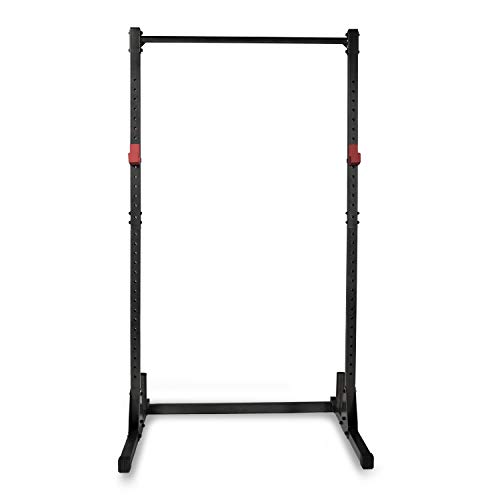 CAP FM-905Q
Check price
CAP FM-905Q
Check price
|
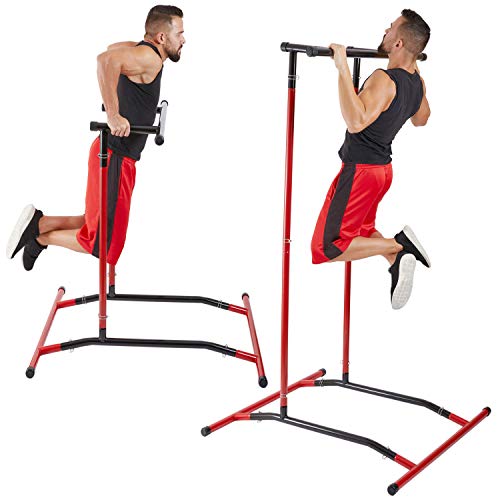 GoBeast Station
Check price
GoBeast Station
Check price
|
 Khanh Trinh
Check price
Khanh Trinh
Check price
|
 Sportsroyals Tower
Check price
Sportsroyals Tower
Check price
|
||
|---|---|---|---|---|---|
| Best for | Overall | Value rack | Portable | Foldable / tall | Budget tower |
| Rating (*) | |||||
| Build & stability | 94% | 82% | 76% | 80% | 76% |
| Capability | 88% | 84% | 88% | 80% | 86% |
| Footprint & portability | 74% | 80% | 92% | 86% | 82% |
| Value | 80% | 88% | 84% | 84% | 88% |
| Price | $$ | $ | $ | $ | $ |
| Type | Station | Rack | Portable | Foldable | Tower |
| Stations | Pull-up | Pull-up + rack | Pull-up / dip / push-up | Pull-up | Pull-up / dip / knee-raise |
| Foldable | No | No | Yes | Yes | No |
| Made in USA | Yes | No | No | No | No |
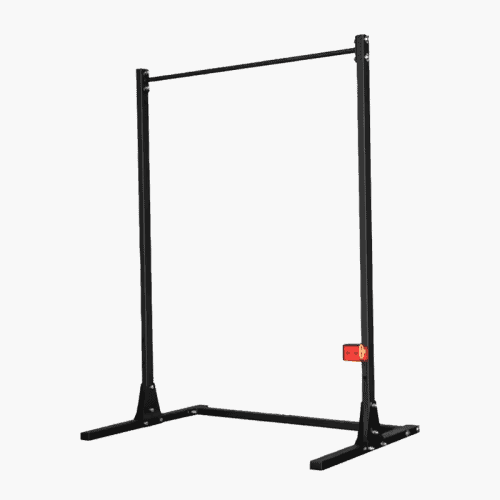 Rogue MIL Station
Our testing and selection process
How we assess free-standing pull-up bars
We run every free-standing pull-up bar roundup through the same five steps:
- We start as the buyer. Most of our team has used a free-standing unit when drilling a wall wasn’t possible, so we know which ones wobble and which don’t.
- We research wide. We pull base size, steel, capacity, stations and footprint, plus owner feedback, on as many units as we can find, 73 this time, into one spreadsheet.
- We score each unit with our weighted system. Data decides the ranking, not brand loyalty.
- We split the field by job, because a premium station, a portable bar and a budget tower are bought for very different needs.
- We get hands-on where we can and lean on the SHG community for the rest.
You can read more about the process in our review guidelines.
How we score free-standing pull-up bars
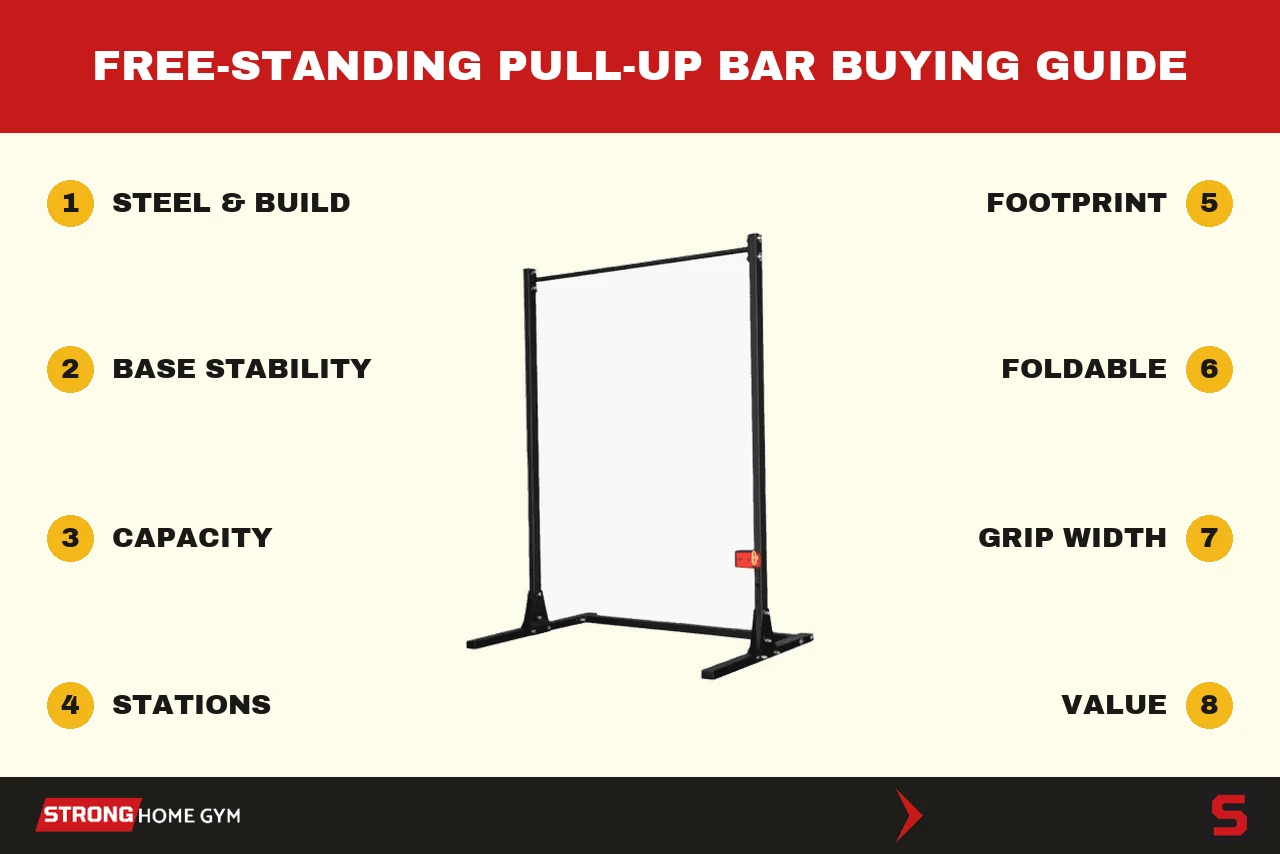
Here is what feeds the score and how much each part counts. Build and stability lead, because a free-standing unit has nothing but its own base holding it down.
We grouped it into four weighted factors:
- Build & stability (30%) - steel, base width and weight, and how planted it stays under a moving rep.
- Capability (25%) - whether it adds dips, push-ups or other stations, plus grip options.
- Footprint & portability (20%) - the floor it takes, and whether it folds or moves.
- Value (25%) - what you actually get for the money.
Build & stability (30%)
This carries the most weight, and stability is the whole reason. A wall bar borrows your house for support; a free-standing unit has only its base, so when that base is wide and heavy it stays put, and when it’s narrow and light it sways.
The danger sign is a tall, slim tower on a small footprint. The higher you go and the narrower the base, the more a hard or kipping rep wants to rock it. A broad base, low weight down low, and the option to sandbag or bolt the feet are what separate a unit you trust from one you brace against.
Capability (25%)
A bare pull-up bar does one job. Many free-standing units use their frame to add a dip station, push-up handles or knee-raise pads, which turns one footprint into a small bodyweight gym. We score how much genuine extra training each one adds.
The catch is not to pay for stations you won’t use. A dip cage is genuinely useful; a wobbly add-on you never touch just makes the unit taller and less stable. We reward extras that actually work rather than a long feature list.
Footprint & portability (20%)
A free-standing unit lives on your floor, so its size and whether it moves matter more than for a mounted bar. We weigh the footprint against how easily it folds, breaks down or wheels away.
Some units bolt together as a permanent fixture; others fold flat or pack into a bag between sessions. A shared room that doubles as something else rewards a foldable or portable unit, even at a small cost in rigidity.
Value (25%)
We build a quality-adjusted picture of price. Free-standing units span from cheap Amazon towers to premium stations, so the question is how much solid, stable training you get for the spend. A well-judged budget unit that stays planted can score as well here as a premium one.
Find the perfect free-standing pull-up bar for you
Overall | Value rack | Portable | Foldable | Budget tower
Here is how the five units stack up on our overall score:
Rogue MIL Pull-Up Station
Best OverallQuick specs
- 48” × 67” footprint, USA-made
- 1.25” bar with ACFT step
- Wide, heavy free-standing base
- No fixings required
The one true premium free-standing unit here: a military-grade station that stays rock-solid with nothing bolted down.
Summary of experience, tests & opinions
What I like
- It’s the only unit here I’d trust to kip on. The base is wide and heavy enough that hard, swinging reps don’t rock it, which is rare without bolting down.
- The build is full Rogue, designed around the army’s fitness test, so it shrugs off abuse that would loosen a budget tower over time.
- No drilling, no fixings, just set it down and train. For a renter or anyone who can’t touch the walls, that’s the whole appeal.
What I don’t
- The 48 by 67 inch base is a big, permanent footprint. It doesn’t fold or pack away, so it claims its floor for good.
- It’s the priciest pick here by a distance, and it’s a pull-up station first, so you’re paying for build rather than a stack of extra dip and push-up attachments.
Pros & cons
Pros
- Rock-solid with no fixings - the only unit here steady enough to kip on unbolted.
- Military-grade Rogue build designed for hard, repeated use.
- Wide, heavy base that stays planted on dynamic reps.
Cons
- Large, permanent footprint that doesn’t fold.
- Premium price, and fewer bolt-on stations than the budget towers.
Read more about the Rogue MIL Station
This is the unit for the person who wants a mounted bar without drilling a hole.
Most free-standing bars ask you to accept a bit of wobble as the price of not bolting in. The MIL doesn’t. Its base is wide and heavy enough that it behaves like a fixed bar, which is exactly why it’s the only one here I’d happily kip on.
Picture the buyer it’s built for. You rent, or your walls are dot-and-dab with no solid stud where you need one, and you’ve talked yourself out of a bar twice because the free-standing options all looked like they’d tip.
The person who should skip it is just as clear. If you want something cheap, something that folds into a cupboard, or a frame stacked with dip and push-up handles, this isn’t it.
The closest comparison here is the CAP FM-905Q, the other unit you buy for a planted base rather than portability. The CAP gets there with a wide four-post footprint and the bonus of barbell uprights. The MIL gets there with heavier steel and an engineered counterbalance, and it simply feels in a different league under a hard rep.
That’s the gap our team kept coming back to.
Now the lived detail a spec sheet hides. Owners in the SHG community keep telling us the same thing: at 48 by 67 inches it eats more floor than the listing suggests once you’ve left room to swing, and the assembly hardware wants a proper re-torque after the first week as the joints settle. After that it stays dead silent. No creak, no shimmy.
The bar height and ACFT step are pitched for full-stretch hangs and leg tucks rather than dips or push-ups, so know what you’re buying it to do.
The honest trade is footprint and price. It won’t fold away, and it costs well above the budget tier. Buy it because you want a bar you’ll never think twice about, rather than for the longest feature list.
On build and stability, nothing here is close:
Bottom line
The Rogue MIL Station is the premium pick: mounted-bar stability with no fixings, built to military standard. The big footprint and price are the trade.
The MIL might be for you if… you want a free-standing bar as solid as a mounted one and you can’t or won’t drill.
It’s not for you if… you want something cheap, foldable, or loaded with dip and push-up stations. The Amazon picks below cover those.
CAP FM-905Q Power Rack
Best Value RackQuick specs
- 46” W × 50” D × 85” H
- Full free-standing rack frame
- Pull-up bar plus rack uprights
- Budget price
The most structure for the money: a full free-standing rack that gives you a stable pull-up bar and barbell uprights for a budget price.
Summary of experience, tests & opinions
What I like
- You get a four-post frame for tower money. That footprint makes the pull-up bar genuinely steady, where a tall narrow tower at the same price would sway.
- The rack uprights mean it doubles for light squats and presses, so it’s more of a gym than a bar.
- It’s a lot of steel for the spend, and it assembles into something that feels planted on the floor.
What I don’t
- It’s a budget rack, so the steel and the J-hooks are basic. I wouldn’t load the uprights anywhere near a serious rack’s weights.
- At 85 inches tall and a full rack footprint, it needs the ceiling height and the floor space, which defeats the point if you wanted something small.
Pros & cons
Pros
- Full rack frame for tower money - far steadier than a slim tower.
- Pull-up bar plus uprights for light squats and presses.
- Strong value for the amount of steel you get.
Cons
- Basic budget build; not for heavy barbell loads.
- Tall and full-footprint, so it needs the space.
Read more about the CAP FM-905Q
This is the most rack you can buy for tower money.
For roughly the price of a tall pull-up tower you get a four-post frame, and that wider footprint is what makes the bar feel planted instead of tippy. It’s the closest thing here to the Rogue MIL’s steadiness at a fraction of the cost. It suits the lifter quietly outgrowing a plain pull-up bar, who wants to chin but also fancies resting a barbell across something for light squats and presses.
Who should skip it? Anyone tight on space.
At 85 inches on a full rack footprint, a low garage or small spare room will fight you.
The head-to-head with the Rogue MIL is honest: it’s the better-built, steadier unit, no argument. But it’s pull-up only and costs several times more, where the CAP answers a different question, most structure for the least outlay.
That’s the trade in a sentence.
The lived detail is assembly. It ships as a big box of tube and bolts, takes a patient hour or two, and the pre-drilled holes can need a nudge to line up. Plan an evening, and snug every bolt before you load it.
Two more things owners flag. It isn’t wall-bolted, so the frame wants a plate or two on the base for heavier pull-ups, and the basic J-hooks suit light squats and presses only.
One owner reported it still going strong after two-plus years, which is reassuring for steel at this price.
On value, it leads the field:
Bottom line
The CAP FM-905Q is the value pick: a whole free-standing rack for tower money, so the pull-up bar stays steady and you get uprights too. Basic steel and a big footprint are the trade.
The CAP might be for you if… you want maximum structure and stability for the least money and you have the space.
It’s not for you if… you want something small or you’ll load the uprights heavy. A slimmer pick or a proper rack suits better.
GoBeast Bar and Dip Station
Best PortableQuick specs
- Portable pull-up + dip + push-up
- 8 ft tall, packs down to ~1.3 m
- Tool-free assembly
- Breaks down for transport
The take-it-anywhere pick: a pull-up, dip and push-up station that breaks down small enough to move room to room or pack in the car.
Summary of experience, tests & opinions
What I like
- The breakdown is the whole point and it delivers. No tools, packs to about 1.3 metres, so I’ve moved it between rooms and thrown it in the car for the park.
- For one portable frame you get pull-ups, dips and push-up handles, which is a lot of bodyweight training in a bag.
- Set up properly it’s stable enough for strict work, and the tall 8-foot height suits taller lifters who clip lower bars.
What I don’t
- It’s portable, so it can’t match a heavy fixed unit for rock-solid feel. On hard kips you notice it’s a knockdown frame.
- The many joints that make it portable are also the parts to keep an eye on; they want the odd check to stay tight.
Pros & cons
Pros
- Tool-free breakdown to ~1.3 m - the most genuinely portable pick here.
- Pull-up, dip and push-up stations in one frame.
- Tall 8-foot height suits taller users.
Cons
- Knockdown frame, so less solid than a fixed unit on hard reps.
- The many joints need the occasional tighten.
Read more about the GoBeast Station
This is the unit for someone who needs the bar to move.
Where everything else here claims a permanent spot, the GoBeast assembles without tools and packs down to roughly 1.3 metres, so it travels between rooms, out to the garden, or into the car. For renters, small flats or anyone who trains in more than one place, that flexibility is the whole pitch. Picture the space it’s made for: a living room that’s a gym for forty minutes and a living room again after.
Skip it if you’ll set a bar up once and never move it, or you want heavy weighted dips week after week. For a fixed garage corner the CAP rack gives more solidity per pound.
The natural rival is the Khanh Trinh, since both fold away rather than bolting down. They split cleanly. The Khanh Trinh stays a one-job pull-up bar built tall for big lifters, while the GoBeast trades a little height for genuine dip and push-up stations and a smaller packed size.
Three movements in a bag, this one.
The detail owners flag to us in the SHG community is honest and useful. The tool-free pins and joints are the whole magic, but they’re also the thing to watch. A quick wiggle-and-tighten before a session keeps it tracking true, and the feet can skate on slick laminate, so a thin mat under it kills the last bit of shuffle.
Do that and strict reps feel reassuringly solid.
The trade is the one you’d expect. A knockdown frame can’t feel as planted as the fixed Rogue MIL or the CAP rack, so don’t expect mounted-bar solidity from a unit built to fold away. It’s tall too, so check your ceiling clearance before you commit a spot.
On footprint and portability, it tops the list:
Bottom line
The GoBeast is the portable pick: pull-ups, dips and push-ups in a frame that packs to 1.3 metres with no tools. A slightly softer feel on hard reps is the trade.
The GoBeast might be for you if… you want to move the bar between rooms or take it with you, and you want dips and push-ups too.
It’s not for you if… you want the most planted unit for heavy kipping. The Rogue MIL or CAP are steadier.
Khanh Trinh Pull-Up Bar
Best Foldable / TallQuick specs
- Foldable free-standing frame
- Adjustable, extra-tall height
- Wide stance for stability
- Folds down between sessions
The pick for tall users and shared rooms: an extra-tall foldable bar that clears the floor when you’re done and suits bigger lifters.
Summary of experience, tests & opinions
What I like
- The height genuinely solves a problem. Tall lifters who tuck their knees on every other bar can hang and do full leg raises here, which almost nothing else at this price allows.
- It folds down between sessions, so a shared room gets its floor back.
- The wide stance keeps it reasonably steady for a foldable unit, better than the slim towers.
What I don’t
- It’s a pull-up bar first, so there are no dip or push-up stations like the GoBeast or the towers offer.
- A folding frame is never going to feel as solid as the fixed Rogue, and you trade a little rigidity for the pack-away.
Pros & cons
Pros
- Extra-tall height - suits very tall lifters and full hanging leg raises.
- Folds down to clear a shared room.
- Wide stance for decent foldable stability.
Cons
- Pull-up only, no dip or push-up stations.
- A folding frame trades some rigidity for the pack-away.
Read more about the Khanh Trinh
This is the bar to buy if the others are too short for you.
Plenty of free-standing units leave a tall lifter tucking their knees to clear the floor, and the Khanh Trinh fixes that with extra height, so you can hang fully and do proper leg raises. If you’re six foot three and every bar has you bending your knees to keep your toes off the carpet, you know the frustration. This is the rare free-standing unit built tall enough to hang at full stretch and swing into a real hanging leg raise.
It’s also the pick for a room that does a second job, since it folds down after and gives the floor back.
Who should walk past it? Anyone who wants dips and push-ups built in, and anyone of average height who’d rather spend the money on stations. The fairest head-to-head is with the GoBeast, the other fold-away pick: the GoBeast wins on movement variety and a tiny packed size, while the Khanh Trinh wins on the one thing it can’t match, raw hang height.
Tall lifter who only chins, this one.
The owner detail we hear most in the SHG community is about the fold mechanism. People love that it collapses, but they tell us to lock the hinges firmly and check them every few weeks, because a half-seated pin is what produces that bit of play people sometimes mention. Locked properly, the wide base settles and the sway you’d fear from a folding frame largely disappears.
Where it gives ground is extras and outright solidity.
It’s a pull-up bar, full stop, and a folding frame never matches the fixed Rogue MIL for rock-solid feel. For its niche of height and pack-away, though, it’s the best on the list.
Here’s a closer look at the height adjustment and fold-away:
On footprint and portability it sits near the top:
Bottom line
The Khanh Trinh is the tall, foldable pick: enough height for big lifters and full leg raises, and it packs away after. No extra stations and a folding frame are the trade.
The Khanh Trinh might be for you if… you’re tall, you want full hanging leg raises, and you need the bar to fold away.
It’s not for you if… you want dips and push-ups, or the most solid unit. The GoBeast or Rogue MIL fit those.
Sportsroyals Power Tower
Best Budget TowerQuick specs
- 26.6” W × 43.2” L footprint
- Adjustable pull-up bar height
- Pull-up, dip and knee-raise stations
- Compact tower frame
The cheapest do-everything tower: pull-ups, dips and knee raises on an adjustable-height frame for the smallest spend here.
Summary of experience, tests & opinions
What I like
- For the lowest price here you get three stations: pull-ups, dips and a knee-raise pad. As a first bodyweight unit that’s a lot of training for the money.
- The adjustable bar height is a genuinely useful touch at this price, letting you set it to your ceiling and your reach.
- The compact footprint slots into a corner where a full rack or the wide Rogue base wouldn’t fit.
What I don’t
- It’s a tall, fairly narrow tower, so it’s the type most prone to sway. On explosive reps you’ll want to weight or anchor the base.
- The steel and pads are budget-grade, fine for moderate bodyweight work but not built for heavy weighted dips long-term.
Pros & cons
Pros
- Three stations for the lowest price - pull-up, dip and knee-raise in one tower.
- Adjustable pull-up bar height, rare this cheap.
- Compact footprint for a corner.
Cons
- Tall, narrow frame that can sway without weighting the base.
- Budget steel and pads, suited to moderate rather than heavy long-term loading.
Read more about the Sportsroyals Tower
This is the entry point: the unit you buy when you want the most movements for the least money.
For the lowest price on the list you get a pull-up bar, a dip station and a knee-raise pad, which is a genuine little bodyweight gym in one compact frame. The buyer it’s right for is starting out on a real budget. You want to chin, dip and train your midsection, you’ve a corner spare, and you’re not ready to spend serious money to find out whether you’ll stick with it.
For that person it’s a sensible first step, and the adjustable bar height means it grows with your ceiling and reach.
Skip it if you do explosive or heavily weighted work, or you’re past the beginner stage. The budget steel and pads handle moderate training fine but aren’t the platform for long-term weighted dips.
The clearest comparison is the CAP FM-905Q, since the two tie at the top of our value scores. They get there opposite ways: the CAP gives you a wide, planted rack that needs real floor and a tall ceiling, while the Sportsroyals gives you three stations in a footprint that tucks into a corner. If space is your constraint, the tower wins.
Now the owner-reported truth the price hides. People in the SHG community tell us the same thing: out of the box it can rock on dynamic reps. Stack a plate or sandbag on the foot rails, or anchor it, and the sway that worries first-time buyers settles right down.
Treat that as part of the setup rather than a fault.
The compromise is the one every slim tower shares: it’s tall and fairly narrow, so it’s the most likely here to need that weighting. One long-term review backs the durability case, though. After two and a half years of regular use the frame was still going, with the pads the first thing to show wear rather than the steel.
Within those limits, it’s a lot of gym for very little.
On value it ties for the top, as the budget pick should:
Bottom line
The Sportsroyals is the budget tower: three stations and an adjustable bar height for the least money. A swaying frame and budget steel are the trade.
The Sportsroyals might be for you if… you want pull-ups, dips and knee raises in a compact corner unit for as little as possible.
It’s not for you if… you do heavy or explosive work, or want a rock-solid base. The CAP or Rogue MIL are far steadier.
Free-standing vs wall-mounted, and vs a power tower
Free-standing isn’t the only way to add a pull-up bar, so it’s worth a quick word on where it fits.
When free-standing wins
A free-standing unit is the right call when you can’t or won’t drill: a renter, a wall with no studs where you need them, or anyone who wants to move the bar around. You give up a little stability and some floor space, and in return you need no fixings and can reposition or pack it away. If drilling is off the table, this is your category.
When to mount or go full tower instead
If you have a solid wall or ceiling, a wall-mounted bar holds more and takes far less floor for less money. And if what you really want is a dedicated dip-and-knee-raise station with a pull-up bar on top, that’s a power tower, and we cover those separately in our best power towers guide. The bars here are built around the pull-up first; a tower is built around the dip cage.
Other free-standing pull-up bars we considered
GetRXd Galvanized Pull-Up Rig. A genuinely sturdy free-standing rig and a wired option we can point you to, though we didn’t have it through our full testing for this round. Worth a look if you want a heavier rack-style unit beyond the Amazon tier. Check the GetRXd rig here.
Gravity Fitness and Baseblocks calisthenics racks. These dedicated calisthenics-brand free-standing racks have become the 2026 enthusiast favourites, and on build they’re excellent. We’ve held them off the ranked list for one honest reason: they’re sold direct with no affiliate programme we currently use, so we can’t yet stand behind the buying experience the way we do our wired picks. If you’re deep into calisthenics, they’re well worth researching.
The bottom line
If you want one free-standing pull-up bar and stability is your priority, the Rogue MIL Station is the call. It’s the one unit here that feels like a mounted bar without a single fixing, and for a renter or anyone who can’t drill, that’s worth the footprint and the price.
From there it’s about budget and needs. Want the most structure for the least money? The CAP FM-905Q gives you a whole rack for tower money. Need to move it around? The GoBeast packs down to 1.3 metres. Tall, or short on permanent space? The Khanh Trinh is the extra-tall folding pick. Smallest budget with dips thrown in? The Sportsroyals tower covers it.
Whichever you choose, set it on a level floor, weight or anchor the base if it’s a slimmer unit, and you’ll have somewhere to pull without touching a single wall.
Free-standing pull-up bar FAQs
Are free-standing pull-up bars any good?
A free-standing pull-up bar is good when you can’t or won’t drill into a wall or ceiling. The best ones, like the Rogue MIL Station, are rock-solid and let you train anywhere with no fixings. The trade is a footprint: a free-standing unit needs a wide, heavy base to stay planted, so it takes more floor than a wall bar. Cheaper towers can wobble or tip, which is why build and base width matter most when you choose one.
Do free-standing pull-up bars wobble or tip over?
A well-built free-standing pull-up bar with a wide, heavy base stays planted, but cheap, tall, narrow towers can wobble or even tip, especially on kipping or explosive reps. The fix is a broad base and enough weight, and many towers have feet you can sandbag or bolt down. If stability worries you, a heavier station like the Rogue MIL or a full rack-style unit like the CAP FM-905Q is far steadier than a slim tower.
How much weight can a free-standing pull-up bar hold?
Most free-standing pull-up bars hold somewhere between 300 lb and the high hundreds, with sturdier rack-style units rated highest. The number on the box matters less than how the base behaves under a moving load, since the wobble of a dynamic rep stresses the frame more than dead weight. For weighted pull-ups, pick a heavy, wide-based unit and stay well within its rating rather than chasing the biggest figure.
Free-standing pull-up bar or power tower, what’s the difference?
The terms overlap, but a free-standing pull-up bar is built around the pull-up, sometimes with a dip or push-up station, on a stable base. A power tower is usually a taller multi-station unit centred on a dip and knee-raise cage with a pull-up bar on top. If you mainly want pull-ups with the option of dips, the bars here suit you; if you want a full vertical-knee-raise and dip station, see our dedicated best power towers guide.
Free-standing or wall-mounted pull-up bar, which should you choose?
Choose a free-standing pull-up bar if you can’t drill into solid studs or joists, you rent, or you want to move the bar around. Choose a wall- or ceiling-mounted bar if you have a solid wall and want the sturdiest, most space-efficient option. Wall bars hold more and take less floor, but they need drilling and a permanent spot. Free-standing units trade some stability and floor space for total flexibility and no fixings.
