
We scored 41 GHD machines across four categories and picked the five most worth your money.
I have owned and trained on a GHD for years, and it’s the one machine I’d fight to keep for what it does to the posterior chain. The team ran every machine here through our weighted scoring, so these picks come from data and time on the pads, not one lifter’s hunch.
The aim was simple: find the machines that stay planted under a hard glute-ham raise, adjust to fit different lifters, and earn their footprint at a fair price.
Let’s see how they stacked up…
Editor's note · updated June 22, 2026
We rebuilt this guide for 2026 and re-rated the field with it.
What changed:
- The Rogue Abram 2.0 holds the top spot. It remains the best value in a serious standalone GHD: heavy 11-gauge steel, a smooth swing-arm adjustment, and rock-solid stability without bolting it down.
- We re-sorted the budget end. The GetRXd Linear Bearing is the value pick, the REP GHD is the budget pick, and we’ve kept the scoring honest so a light, sparse machine can’t leapfrog a heavier, better-built one on paper.
- We looked hard at the newer commercial entrants topping some lists. The ones worth buying aren’t cleanly available to US home buyers yet, so we’ve stuck with machines you can actually get and we stand behind.
Related
A GHD is a posterior-chain anchor, and it pairs with the rest of your setup. See our best squat racks if you’re considering a rack-mounted GHD, the best weight benches for your pressing station, and our glute-ham raise alternatives if a full GHD is more than you need right now.
Compare the best GHD machines
 Rogue Monster
Check price
Rogue Monster
Check price
|
 GetRXd Linear Bearing
Check price
GetRXd Linear Bearing
Check price
|
 REP Fitness GHD
Check price
REP Fitness GHD
Check price
|
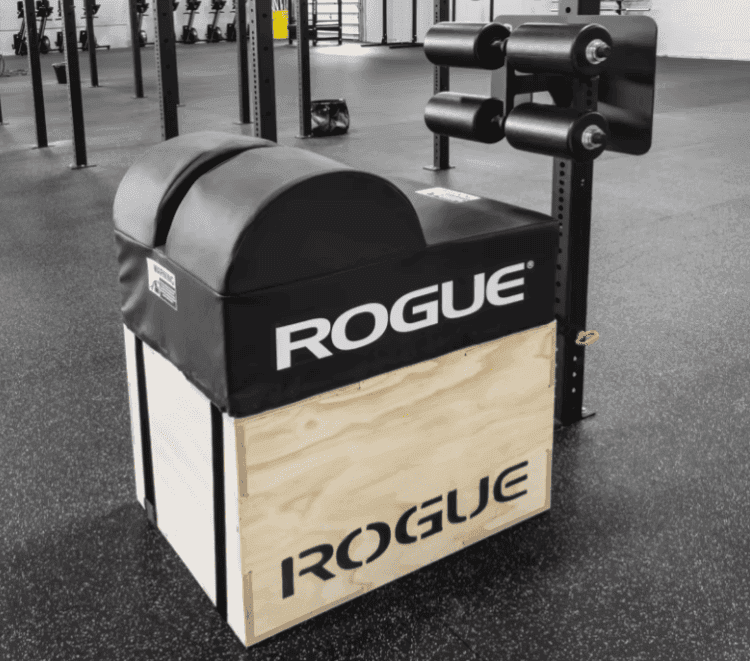 Rogue Echo 3x3
Check price
Rogue Echo 3x3
Check price
|
||
|---|---|---|---|---|---|
| Best for | Overall | Premium | Value | Budget | Small spaces |
| Rating (*) | |||||
| Build & stability | 92% | 96% | 80% | 76% | 86% |
| Adjustability | 90% | 92% | 88% | 84% | 70% |
| Footprint & versatility | 82% | 88% | 86% | 84% | 92% |
| Value | 90% | 70% | 94% | 92% | 84% |
| Price | $$ | $$$ | $ | $ | $ |
| Footprint (L×W) | 44.5" × 73" | 62" × 34" | 70" × 34" | 70" × 36" | Rack-mounted |
| Steel | 2×3" 11-ga | 3×3" Monster | Linear-bearing | 16-ga | 3×3" attach |
| Machine weight | 222 lb | 250 lb | 135 lb | 150 lb | Light |
| Made in USA | Yes | Yes | No | No | Yes |
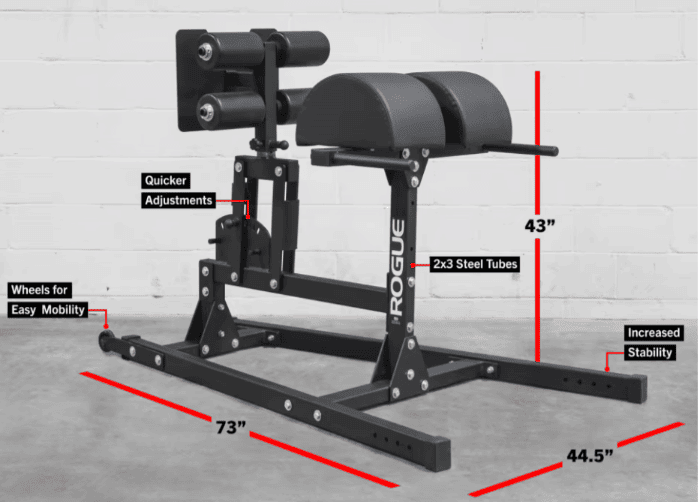 Rogue Abram 2.0
Our testing and selection process
How we assess GHD machines
We run every GHD roundup through the same five steps:
- We start as the buyer. I’ve owned a GHD for years and use it every week, so I know which corners hurt and which don’t.
- We research wide. We pull steel gauge, footprint, adjustment range, pad sizes, capacity and owner feedback on as many machines as we can find, 41 this time, into one spreadsheet.
- We score each machine with our weighted system. Data decides the ranking, and we shrink the score on thinly-specced machines so a light, cheap unit can’t fluke its way to the top.
- We split the field by job, because a 250 lb commercial GHD and a rack-mounted attachment are bought for very different gyms.
- We get hands-on where we can and lean on the SHG community for the rest.
You can read more about the process in our review guidelines.
How we score GHD machines
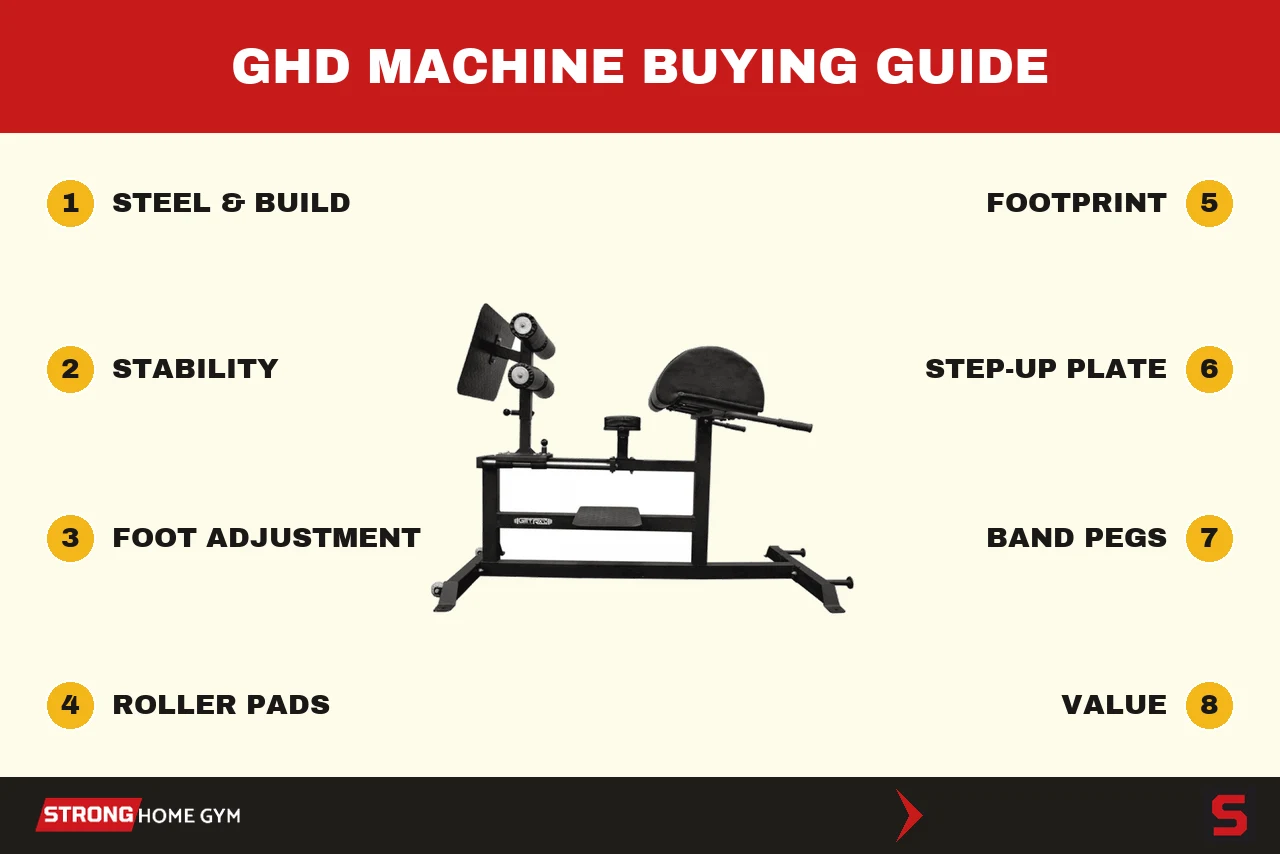
Here is what feeds the score and how much each part counts. Build leads, because a GHD that rocks or flexes under a hard rep is one you stop trusting fast.
We grouped it into four weighted factors:
- Build & stability (30%) - steel gauge, weld quality, capacity, and whether it stays planted unbolted.
- Adjustability (25%) - the foot-roller mechanism and range, plus pad comfort across different heights.
- Footprint & versatility (20%) - size, rack-mount option, and the moves beyond the glute-ham raise.
- Value (25%) - what you actually get for the money.
Build & stability (30%)
This carries the most weight, and stability is the reason. A glute-ham raise throws your whole bodyweight forward and back, and a machine that rocks or shifts under that turns a hard set into a nervous one.
The good machines manage it with a wide, heavy base and a low centre of gravity, so they stay put without bolting down. Heavier-gauge steel and welded joints hold up over years of loaded reps where thin tube and bolt-together frames eventually work loose.
Adjustability (25%)
A GHD has to fit the lifter, and the foot roller is where that happens. You move it forward, back, up and down so the hip pad sits at your crease and your feet lock in without strain.
How quickly you can do that matters as much as the range. A swing-arm or linear-bearing system slides smoothly to a new position; a basic pin-and-hole setup is slower and coarser between settings.
Footprint & versatility (20%)
A standalone GHD eats floor space, so we weigh the size against what it gives back. The difference between the biggest and smallest standalone here is under 10 square feet, so footprint rarely decides it on its own.
Versatility is the other half. The best machines add a step-up plate to mount easily, band pegs for accommodating resistance, and a frame that handles back extensions and weighted sit-ups, not just the glute-ham raise. A rack-mounted GHD trades some of that for almost no dedicated footprint.
Value (25%)
We build a quality-adjusted picture of price. GHDs run from a few hundred pounds to genuinely commercial money, so the question is how much real machine you get for the spend. A well-built mid-priced unit that does everything beats a flashy one that only justifies its cost on the badge.
Find the perfect GHD machine for you
Overall | Premium | Value | Budget | Small spaces
Here is how the five machines stack up on our overall score:
Rogue Abram GHD 2.0
Best OverallQuick specs
- 2×3” 11-gauge steel, USA-made
- 44.5” × 73” footprint, 222 lb
- 10-slot swing-arm foot adjustment
- Adjustable footplate angle, stable unbolted
The best value in a serious standalone GHD: heavy 11-gauge steel, a smooth swing-arm adjustment, and the stability of machines costing twice as much.
Summary of experience, tests & opinions
What I like
- The swing-arm adjustment is the bit you feel every session. One motion to reposition the foot roller, smooth and quick, where cheaper machines make you fight a pin.
- It just doesn’t move. I’ve thrown hard glute-ham raises at our test unit and it stays planted, no bolting, no creep across the floor.
- The hip padding is genuinely good, firm enough to support the hinge without numbing your legs on a long set.
What I don’t
- There’s no foot platform to step onto when mounting, so getting on and off is less graceful than the Monster’s stepped deck.
- It’s a big, heavy machine at 222 lb. Once it’s placed you won’t be shuffling it around on a whim.
Pros & cons
Pros
- Quick one-motion swing-arm adjustment - faster and smoother than a pinned foot roller.
- Heavy 11-gauge USA steel with an adjustable footplate angle.
- Stays stable without being bolted down.
Cons
- No step-up platform for mounting.
- Large footprint and 222 lb, so it’s a place-it-and-leave-it machine.
Read more about the Rogue Abram 2.0
Balance is what wins it the top spot.
It does more than rival machines at the same price, it’s a clear step up from Rogue’s own basic GH-1, and it gets close enough to the far pricier Monster that most people never feel the gap. So it suits the serious home lifter who wants one posterior-chain machine that does the lot. Deadlift and squat heavy, train glute-ham raises properly, have the floor to leave a machine standing, and this is the one I’d buy.
Skip it if you chase every commercial convenience regardless of cost, or you’re genuinely short on floor space. Those two have better homes here.
The honest read on its nearest rival, the Rogue Monster: the Monster is the better machine in a handful of ways. A mostly welded frame, a lever arm, angled bottom rollers, a step-up deck. None of it is game-changing, and the Monster costs more than double. You’re paying for refinement rather than a different league of machine.
For the overwhelming majority of home lifters, the Abram delivers the substance and keeps the money in your pocket.
Then there’s the detail a spec sheet won’t tell you. That swing-arm adjustment looks like a small upgrade on paper, but it’s the thing you actually touch every session, and owners in the SHG community say it’s the reason they stopped dreading repositioning the roller for a partner or a different lift. One motion. No fighting a pin. The same swing-arm dropped the centre of gravity too, so the machine feels rooted under a hard rep in a way the old Abram never did.
That’s the part you stop noticing, because it never lets you down.
Rogue’s own walkthrough shows the swing-arm adjustment and the build up close:
It heads our weighted overall ranking:
Bottom line
The Rogue Abram 2.0 is the best-value serious GHD: heavy steel, a smooth swing-arm, and rock-solid stability for far less than the commercial machines.
The Abram might be for you if… you want a do-everything standalone GHD that stays planted and you don’t need to chase the absolute top tier.
It’s not for you if… money is no object and you want every convenience, or floor space is genuinely tight. See the Monster or the Echo.
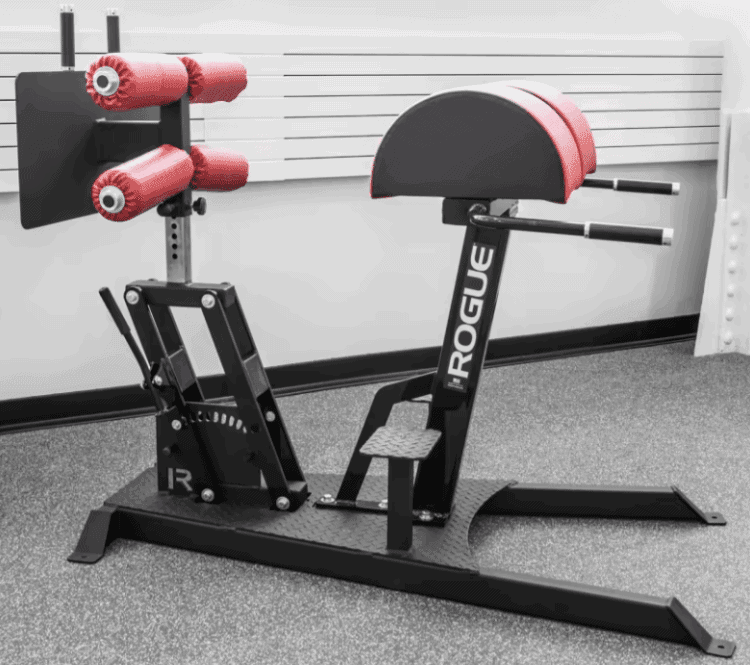
Rogue Monster Swing Arm GHD
Best PremiumQuick specs
- 3×3” Monster steel, USA-made
- 62” × 34” footprint, 250 lb
- Lever-arm swing adjustment, angled rollers
- Step-up decks, reverse-raise top handles
The no-compromise GHD: a mostly welded Monster frame, a lever-arm adjustment and every convenience, for those who want the best and will pay for it.
Summary of experience, tests & opinions
What I like
- The welded Monster frame is the most solid thing here. It packs the same stability as the bigger Abram into a smaller footprint, which is a neat trick.
- The angled bottom rollers make sliding your feet in and out noticeably easier, a small comfort you appreciate on every rep.
- Top handles open up reverse leg raises, and the step-up decks make mounting clean rather than a clamber.
What I don’t
- It costs more than double the Abram, and the gap in performance simply isn’t that wide. You’re paying for refinement rather than a different league of machine.
- Built-to-order means a wait, so it’s not the pick if you want a GHD in the gym this week.
Pros & cons
Pros
- Welded 3×3 Monster frame - the most rigid and stable machine here, in a compact footprint.
- Angled rollers, step-up decks and reverse-raise top handles.
- Lever-arm swing adjustment, smooth and quick.
Cons
- More than double the Abram for a modest real-world gain.
- Built-to-order, so expect a wait.
Read more about the Rogue Monster Swing Arm GHD
This is the GHD for the buyer who wants the best and isn’t counting every pound.
Everything the Abram does well, the Monster does a notch better. The welded frame is more rigid, the angled rollers ease your feet in and out, and the step-up decks and top handles add real convenience plus a couple of extra movements. So it fits the lifter building a forever gym, or the busy garage where the machine takes daily punishment and the welded frame earns its keep over years.
Skip it if you’re weighing value at all, or you need a GHD this week. The next point covers both.
Value is the catch, and it’s a big one. The Monster costs more than twice the Abram, and once you’ve used both back to back the difference is refinement rather than capability. Both stay planted. Both adjust smoothly. Both train the posterior chain hard. The Monster simply feels a touch more polished doing it.
Worth knowing before you commit: it’s built to order and ships fully assembled by freight, so it isn’t a machine that turns up in a couple of boxes mid-week. Owners flag the wait as the real surprise, the box on a pallet, the freight booking, the lead time, none of which shows up next to the steel gauge. The flip side is you unbox almost nothing, which on a 250 lb machine is a mercy.
Two more things that only show up in use. The angled bottom rollers are capped with steel ends, and a few lifters have caught their ankles sliding their feet in fast, so the comfort gain comes with a small learning curve. The height adjustment uses the same handle as the Abram, so if you’ve come off one, nothing feels new. The welded base is the real standout in person: it packs the Abram’s stability into a footprint roughly a foot narrower and shorter, which is why it suits a tighter garage.
On build and stability, nothing here matches it:
Bottom line
The Rogue Monster is the premium GHD: the most rigid frame here, every convenience, and a price only a keen buyer will justify over the Abram.
The Monster might be for you if… you want the best-built GHD on the list and the cost doesn’t put you off.
It’s not for you if… you’re weighing value at all. The Abram gives you most of it for under half.
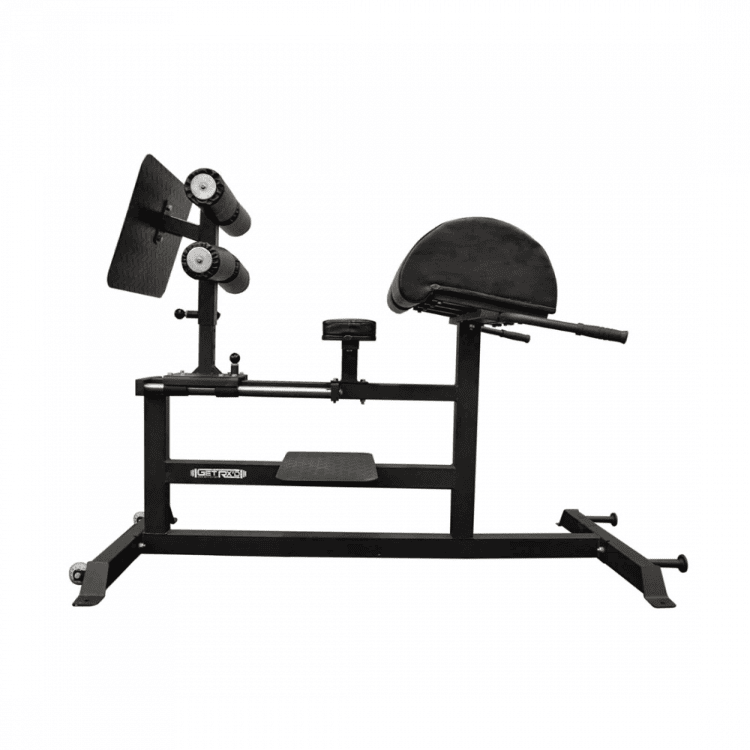
GetRXd Linear Bearing GHD
Best ValueQuick specs
- 70” × 34” footprint, 135 lb
- Linear-bearing foot adjustment
- 14 forward/back, 7 up/down positions
- Big footplate, wheels and band pegs
The most well-rounded machine at the budget end: a smooth linear-bearing adjustment, loads of positions and the small extras, for a fraction of Rogue money.
Summary of experience, tests & opinions
What I like
- The linear-bearing slide is the headline, and it earns it. It glides to a new foot position instead of jumping between pin holes, which is rare at this money.
- The footplate is big and grippy, so getting set is easy even for taller lifters.
- The thoughtful extras add up. Wheels to move it, band pegs for accommodating resistance and a step-up plate, none of which you expect at the price.
What I don’t
- The padding doesn’t feel as plush or as dense as Rogue’s. It does the job, but on a long set you notice the difference.
- You can’t adjust the footplate angle, so you’re fixed to one foot position. For most people that’s a non-issue, but it’s a corner the Abram doesn’t cut.
Pros & cons
Pros
- Linear-bearing adjustment - smooth, fine foot positioning that beats a pin setup.
- Big footplate, wheels, band pegs and a step-up plate.
- Far cheaper than the Rogue machines while covering the key boxes.
Cons
- Padding trails Rogue’s in feel and density.
- Fixed footplate angle.
Read more about the GetRXd Linear Bearing GHD
This is the machine I point value-minded buyers toward.
It earns the spot by leaving almost nothing important out. Against the Rogue units it costs a great deal less, and against rivals in its own price band it’s the most complete: better adjustability, a bigger footplate, the small extras cheaper machines skip. So it suits the lifter whose budget rules out the Rogue machines but who still wants smooth, fine adjustment and a GHD they’ll trust under a hard rep.
Skip it if you want the densest padding for long sit-up sessions, or an adjustable footplate angle. Both point you up to the Abram.
Set against its nearest rival, the REP GHD, the GetRXd edges it on the two things you feel most. The linear-bearing slide is smoother and finer than REP’s height-stop setup, and the heavier build sits a touch more planted. REP claws some back with brand backing and warranty, but on the machine itself the GetRXd is the more complete tool, which is why it leads our value score.
The honest gaps are padding and the fixed footplate. The hip pads are firm and functional but lack the dense, supportive feel of Rogue’s, which you register on a long set. The footplate, though, is a quiet win owners keep mentioning: big and genuinely grippy, so taller lifters get set in seconds. Neither gap stops it doing the job, and for most lifters neither will ever come up.
A few things only long-term use reveals. The bearing slide repositions with a single hand, a two-finger pull on the pin, so swapping settings between exercises is quick. The half-moon hip pads are larger than rivals, comfy for raises but big enough to shorten your range a touch on back extensions. The step-up plate is the weakest part, lighter than the rest, so mount it deliberately rather than hopping on. After more than a year the frame showed no flex and the slide stayed smooth.
That’s the reassurance that matters most at this price.
The walkthrough below shows the linear-bearing slide, the footplate and the half-moon pads up close:
On pure bang for your buck, it leads the field:
Bottom line
The GetRXd is the value pick: a linear-bearing GHD with the key features and the extras, for a fraction of premium money. Padding and a fixed footplate are the only real trades.
The GetRXd might be for you if… the Rogue machines are out of budget and you still want smooth adjustment and the useful extras.
It’s not for you if… you want the densest padding or an adjustable footplate angle. Step up to the Abram.
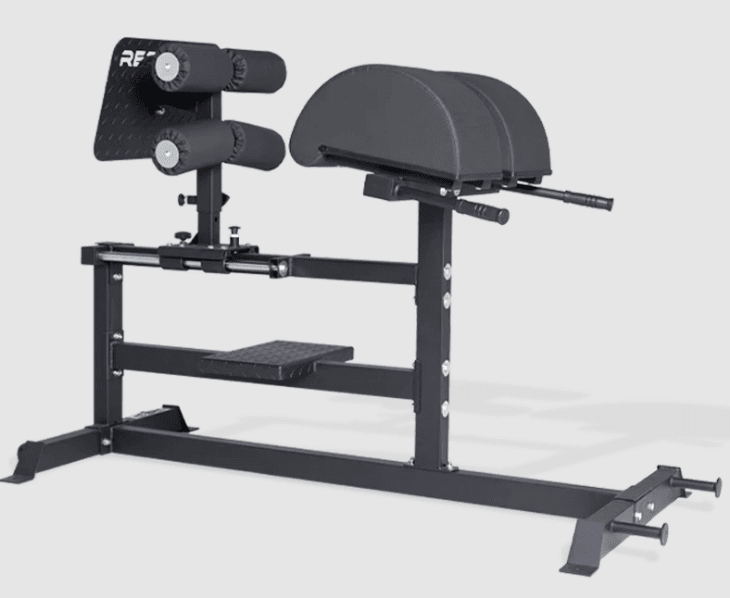
REP Fitness Glute-Ham Developer
Best BudgetQuick specs
- 16-gauge steel, 70” × 36” footprint
- 500 lb user capacity, 150 lb machine
- 13 height stops, 21” × 15” footplate
- Angled roller pads, wheels for moving
The cheapest GHD here from a brand you can trust: angled rollers, a big footplate and a smooth, stable adjustment, all at an honest budget price.
Summary of experience, tests & opinions
What I like
- The angled roller pads are the nicest surprise here. They cradle your feet so locking in feels secure rather than a balancing act, which not every budget machine manages.
- The adjustment is smooth and the machine sits stable through a normal set.
- It comes from REP, so there’s a real warranty and support behind it, which I weigh heavily on a cheaper machine.
What I don’t
- The 16-gauge frame is the giveaway. It’s lighter and a touch less rigid than the 11-gauge Abram, and under really aggressive, loaded reps you feel that difference.
- At 150 lb it’s lighter overall, so it’s a notch less planted than the heavyweight machines when you throw your bodyweight forward hard.
Pros & cons
Pros
- Angled roller pads - comfortable, secure foot lock-in for the money.
- 13 height stops and a big 21×15” footplate.
- Backed by REP’s warranty and support, with wheels to move it.
Cons
- 16-gauge steel, lighter and less rigid than the premium frames.
- Less planted than the heavier machines under aggressive reps.
Read more about the REP Fitness GHD
This is the budget GHD to buy when you want a trusted brand behind a low price.
REP’s whole game is value, and this machine plays it well: angled rollers, a generous footplate and a smooth height adjustment, all wrapped in a warranty a no-name bargain can’t offer. So it’s the pick for the first-time buyer on a tight budget who still wants a real company standing behind the purchase. The cheapest machine here without rolling the dice on support.
Skip it if you want the most rigid frame at this end, that’s the GetRXd, or you load glute-ham raises heavy every session, where the heavier machines feel more planted.
The honest line is the steel. At 16-gauge it’s lighter than the GetRXd’s build and well short of the Abram’s heavy 11-gauge frame, so you feel a touch more give under really hard, loaded reps. Perfectly stable for normal training, it just doesn’t feel as bank-vault solid as the heavyweights.
Against the GetRXd, its nearest rival, the GetRXd edges it on overall value and adjustment smoothness. The REP’s trump card is the brand and the support. If something goes wrong, you’re dealing with an established company, not chasing a seller who’s vanished. And there’s a detail the spec sheet hides: the angled roller pads cradle your feet so locking in feels secure rather than a balancing act, which on the cheapest machine here is the surprise people mention most.
For a first GHD on a tight budget, that backing and that small comfort are worth a lot.
REP’s own overview runs through the build, the angled rollers and the flip to sit-up mode:
It sits right at the sharp end of our value score:
Bottom line
The REP GHD is the budget pick with a safety net: comfortable angled rollers and a fair price, backed by a real brand. The lighter 16-gauge frame is the trade.
The REP might be for you if… you want the cheapest GHD here but still want a warranty and support behind it.
It’s not for you if… you want the most rigid build at the price. The heavier GetRXd edges it on steel and adjustment.
Rogue 3x3 Echo GHD
Best for Small SpacesQuick specs
- Rack-mounted GHD attachment
- 30” × 24” × 10” vinyl pad
- Fits Rogue Monster Lite 3×3 racks
- Detent-pin foot roller, grabber foot grip
The space-saver: a GHD that pins onto your 3×3 rack instead of taking its own floor, for less than a standalone machine.
Summary of experience, tests & opinions
What I like
- The whole pitch is space, and it delivers. Mounted to the rack it claims almost no dedicated floor, then comes off when you need the rack for something else.
- Stability is a non-issue because it borrows your anchored rack, so there’s no rocking even on hard reps.
- The grabber foot fabric grips well, and the standard 3×3 dimensions mean it fits the Monster Lite racks a lot of home gyms already run.
What I don’t
- You need a platform to stand on to use it, since the pad sits at rack height rather than near the floor.
- Adjustability is the weak spot. A detent-pin foot roller is coarser and slower than the swing-arm and linear-bearing systems on the standalones.
Pros & cons
Pros
- Rack-mounted - frees the floor space a standalone GHD would eat.
- Standard 3×3 fit for Monster Lite racks, and very stable on an anchored rack.
- Cheaper than a standalone machine.
Cons
- Needs a platform to use at the right height.
- Coarser detent-pin adjustment than the standalone machines.
Read more about the Rogue 3x3 Echo GHD
This is the GHD for the gym where space is the real constraint.
Instead of a standalone frame eating 15 to 20 square feet, the Echo pins onto a 3×3 rack and comes off when you’re done, so the only footprint is the platform you stand on. So it suits the small-gym owner who already runs a 3×3 Monster Lite rack and can’t spare the floor for a standalone. If your alternative is no GHD at all because there’s simply no room, the Echo is the answer.
Skip it if you have the floor and want the smoothest adjustment, a standalone like the Abram wins there, or if you don’t own a compatible rack.
Be honest about the trade. The standalone machines all adjust more smoothly, and the Echo’s detent-pin foot roller is coarser to set. You also need a platform at the right height, one more thing to own and store. None of that matters if the alternative is no GHD at all.
Against the budget REP GHD, the closest rival in spirit, the choice comes down to your room rather than the machines. The REP gives you a smoother, freestanding setup if you have the floor; the Echo gives you serious posterior-chain work in a gym that has none to give. One lived detail owners mention: the grabber foot fabric grips far better than expected, so even with the coarser pin you don’t slide around mid-rep, and strapped to an anchored rack there’s zero rocking, which is more than some standalone machines manage.
Just check your rack matches Rogue’s 3×3 Monster Lite spacing first. That compatibility is the whole game here.
Rogue’s own video shows how the roller and pad mount to the rack:
On footprint and versatility, it leads the list:
Bottom line
The Rogue Echo is the small-space pick: a rack-mounted GHD that frees your floor and stays rock-steady on an anchored rack. A platform and coarser adjustment are the trade.
The Echo might be for you if… you run a 3×3 rack, you’re short on floor space, and a standalone GHD is more than you can fit.
It’s not for you if… you have the room and want the smoothest adjustment. A standalone like the Abram is the better experience.
What is a GHD machine (and do you need one)?
A GHD, short for glute-ham developer, is a machine built around two hip pads and an adjustable foot roller. You lock your feet against the roller, rest your hips on the pads, and hinge your whole upper body down and back up. That single setup unlocks the glute-ham raise, a hamstring and glute movement you can’t really load any other way at home.
The foot roller is the heart of it. Slide it to set the hip pad at your crease, and the machine fits you. Get that wrong and the hinge feels awkward, which is why adjustment quality matters so much.
What it does beyond the glute-ham raise
A GHD earns its footprint by being several stations in one.
- Glute-ham raises. The headline move, training the hamstrings and glutes through a range bodyweight work never reaches.
- Back extensions. Hinge from the hips to hammer the lower back and spinal erectors, loaded with a plate or band.
- GHD sit-ups. Anchor your feet the other way for a long-range abdominal movement.
Who actually needs one
If you deadlift, squat or run and want a stronger, more resilient posterior chain, a GHD is one of the best single machines you can own, provided you have the floor for it. If your space is tight or your training leans heavily upper-body, a rack-mounted GHD or a simpler hyperextension bench may make more sense than a full standalone.
Other GHD machines we considered
Rogue GH-1 Glute Ham Developer. Rogue’s more basic standalone, and the machine the Abram 2.0 grew out of. It’s solid, but the Abram’s swing-arm adjustment and lower centre of gravity make it the better buy for similar money. Check the Rogue GH-1 here.
Force USA Commercial GHD. Some recent roundups have crowned this the new best overall, and on paper it’s impressive. We left it off because it isn’t cleanly available to US home buyers right now, and we only rank machines you can actually get and we’d stand behind. We’re watching it.
Bells of Steel Reverse Hammer 2.0. A clever two-in-one that combines a GHD with a reverse hyper, which is a genuinely smart use of space. It was out of stock at the time of writing, so we’ve held it back rather than send you to a machine you can’t buy. Check the Reverse Hammer here.
The bottom line
If you want one GHD and you have the floor for it, the Rogue Abram 2.0 is the call. Heavy steel, a smooth swing-arm adjustment and stability without bolting it down, all for far less than the commercial machines. It’s the GHD most home lifters will be happiest with.
From there it’s about budget and space. Money no object and you want the best build? The Rogue Monster is a notch above on everything except value. Watching the spend? The GetRXd is the most complete machine at the budget end, and the REP GHD is the cheapest with a real brand behind it. Tight on floor space? The rack-mounted Rogue Echo frees the room a standalone would claim.
Whichever you choose, set the foot roller so the hip pad sits at your crease, start with bodyweight reps to learn the hinge, and build from there. Few machines pay back the floor space like a GHD does.
GHD machine FAQs
What is a GHD machine and what does it do?
A GHD, or glute-ham developer, is a machine with a pair of hip pads and an adjustable foot roller that lets you anchor your feet and hinge your whole upper body forward and back. The headline move is the glute-ham raise, which trains the hamstrings and glutes through a range bodyweight work can’t reach. It also handles back extensions, weighted sit-ups and reverse hyper-style work, so one machine covers the whole posterior chain that a home gym often neglects.
Is a GHD machine worth it for a home gym?
A GHD is worth it if you train the posterior chain seriously and have the floor space, roughly 15 to 20 square feet for a standalone. It builds hamstring and lower-back strength that carries straight over to deadlifts, squats and running, and it doubles as a back-extension and sit-up station. If your space is tight or your training is mostly upper body, a rack-mounted GHD attachment or skipping it altogether makes more sense.
Do you have to bolt a GHD machine to the floor?
Most quality standalone GHDs do not need bolting down. The good ones, like the Rogue Abram 2.0, sit on a wide, heavy base with a low centre of gravity, so they stay planted through a hard glute-ham raise. Cheaper or top-heavy machines can rock, which is one reason build and footprint matter so much. A rack-mounted GHD attachment relies on your anchored rack instead, so stability is a non-issue there.
How much space does a GHD machine need?
A standalone GHD machine needs roughly 15 to 20 square feet, with a footprint around 70 inches long and 34 to 44 inches wide, plus clearance to hinge forward. The difference between the biggest and smallest standalone here is under 10 square feet, so size rarely decides it. If floor space is genuinely tight, a rack-mounted GHD like the Rogue Echo stores away on your existing rack and needs almost no dedicated room.
What’s the difference between a standalone and a rack-mounted GHD?
A standalone GHD is a self-contained machine you place on the floor, ready to use and very stable, but it takes up dedicated space. A rack-mounted GHD is an attachment that pins onto your power rack, so it stores away and costs less, but you need a compatible rack and a platform to set it at the right height. Standalone suits anyone with the room; rack-mounted suits small gyms that already own a sturdy rack.
What muscles does a GHD machine work?
A GHD machine trains the whole back of the body. The glute-ham raise hits the hamstrings and glutes hard, the back extension targets the lower back and spinal erectors, and GHD sit-ups work the abs through a long range. Because you can load all of these with a plate or band, a GHD builds real posterior-chain strength that transfers to deadlifts, squats, sprinting and everyday hingeing.
