

We scored 102 grip strengtheners across five categories and picked the six worth owning.
Grip is the thing that quietly caps your deadlift, your rows and your carries. A grip strengthener is how you stop it being the weak link, if you buy the right kind.
Most people buy the wrong kind. I have watched plenty of cheap spring grippers end up in a drawer, and the reason is always the same.
The aim was simple: work out which tools genuinely build grip, which ones you outgrow in a fortnight, and which type of grip each one actually trains.
Let’s see how they stacked up.
Related
If your grip is failing before your back does on heavy pulls, a strengthener is only half the answer. Have a look at the best lifting straps here for the sets where you need to hold on regardless, and our top picks for lifting chalk for the days your hands are just sweaty.
Compare the best grip strengtheners
 THERABAND FlexBar
Check price
THERABAND FlexBar
Check price
|
 Fat Gripz Pro
Check price
Fat Gripz Pro
Check price
|
 GRIPZILLA
Check price
GRIPZILLA
Check price
|
 FitBeast Kit
Check price
FitBeast Kit
Check price
|
 Prohands Gripmaster
Check price
Prohands Gripmaster
Check price
|
||
|---|---|---|---|---|---|---|
| Best for | Overall | Forearms & elbows | Barbell work | Adjustable | Budget | Finger strength |
| Rating (*) | ||||||
| Training effect | 99% | 88% | 93% | 87% | 72% | 78% |
| Progression | 95% | 80% | 71% | 96% | 74% | 68% |
| Build quality | 98% | 92% | 95% | 85% | 66% | 85% |
| Grip types covered | 64% | 74% | 87% | 77% | 89% | 72% |
| Value for money | 80% | 98% | 83% | 52% | 96% | 80% |
| Grip trained | Crush | Rotation, extensor | Support, thick bar | Crush, adjustable | Crush, finger, extensor | Individual fingers |
| Resistance range | 60 to 365 lb | Four colour levels | Whatever you load | 50 to 300 lb | 22 to 132 lb | Three tensions |
| Progression method | Buy the next gripper | Buy the next bar | Add weight to the bar | Turn the dial | Swap the tool | Buy the next unit |
| Price | $$ | $ | $$ | $$$ | $ | $$ |
 Captains of Crush
Our testing and selection process
How we assess the grip strengtheners
We always use a 5 step process in our reviews:
- We start as the buyer. Between us we have bought most of the cheap grippers that end up in a drawer, which is a useful education.
- We do a ton of research, collecting information on as many grip tools as possible and putting it into a spreadsheet.
- We rate each tool using our exclusive weighted rating system, explained in the section below.
- We use data to decide our top picks rather than personal bias toward brands.
- We get our hands on as many of the top picks as possible. Our community is great at helping with this.
You can read more about this process in our review guidelines.
How we test and score the grip strengtheners
Below is an overview of how we reached the score and ranked the tools.
Specifically, it lists the factors in the rating formula and their gravity (how important they are).
I grouped them into five chunks for simplicity:
- Training effect (34%) - does it build grip you can actually use, or just make your hand tired.
- Progression (22%) - can you add resistance over months, or do you outgrow it.
- Build quality (16%) - springs, hinges, handles, and whether it survives a year.
- Grip types covered (16%) - crush, support, pinch, extensor, and how many it touches.
- Value for money (12%) - cost against how long it stays useful.
Training effect (34%)
The single biggest reason grip trainers fail is that they were never hard enough.
A gripper you can close for thirty reps is a warm-up. Grip responds to load like anything else, so a tool that does not challenge you within about five to eight hard reps is not training anything, it is just occupying your hand. That is why so many bargain-bin spring grippers end up unused: they were too easy on day one.
The second reason is a mismatch nobody explains. Squeezing a handle is crush grip. Holding a heavy bar is support grip. They are related but they are not the same, and getting very good at one does surprisingly little for the other.
| Grip type | What it does | Where it fails you | Train it with |
|---|---|---|---|
| Crush | Squeezes the hand shut | Handshakes, sport | A hand gripper |
| Support | Holds on to a load | Deadlifts, carries, rows | Thick bars, holds, carries |
| Pinch | Fingers against thumb | Plate carries, climbing | Plate pinches, finger tools |
| Extensor | Opens the hand | Elbow and forearm pain | Bands, extensor rings |
My tip: if your deadlift is where your grip gives out, a hand gripper is the wrong purchase. Hold the bar for time at the top of your last set instead, and it costs nothing.
Progression (22%)
This carries almost as much weight as training effect, because it decides whether the tool is still useful in six months.
There are three ways a grip tool handles progression, and they are not equal. Fixed-resistance tools mean buying the next one up each time you get stronger, which works but adds up. Adjustable tools let you turn a dial and keep going for years. Load-based tools sidestep the problem entirely, because the resistance is whatever you put on the bar.
Build quality (16%)
Springs fatigue and hinges wear.
A cheap coil gripper loses tension across a few hundred reps, which quietly makes your training easier at exactly the point it should be getting harder. Knurled steel handles and a properly seated spring cost more and stay honest. For anything you intend to use for years, this is where the money goes.
Grip types covered (16%)
Some tools do one thing very well and some cover several jobs adequately.
Neither approach is wrong, and which one suits you depends on whether you have a specific weakness or a general one. A dedicated crush gripper will build a stronger squeeze than any multi-tool kit. A kit that includes extensor bands and a finger exerciser touches three types at once and none of them deeply.
Value for money (12%)
We score cost against how long the tool stays useful.
In other words…
The cheapest tool is poor value if you outgrow it in a month, and the dearest is good value if it is still challenging you in three years. That maths is what moves the budget picks down and keeps the adjustable ones respectable despite the outlay.
Find the perfect grip strengthener for you
Best overall | Best for forearms | Best for barbell work | Best adjustable | Best budget | Best for fingers
Here is how the six tools stack up on our overall score:
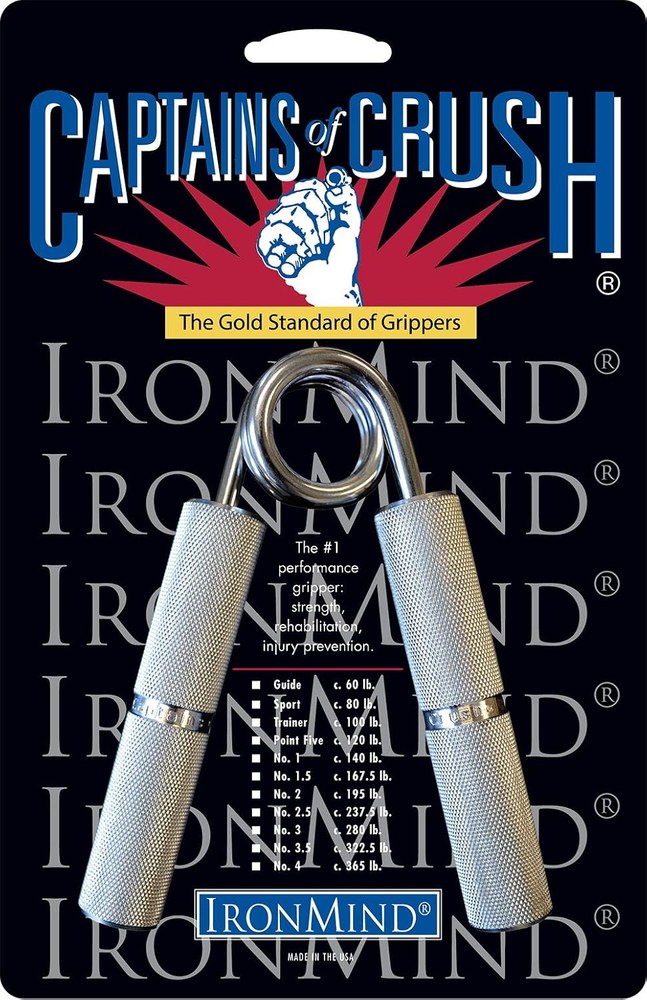
IronMind Captains of Crush
Best OverallQuick specs
- Knurled aluminium handles, steel spring
- Eleven strengths, 60 lb to 365 lb
- Trains crush grip specifically
- 4.8 stars from over 2,000 ratings
The reference gripper. Closing one is a recognised benchmark rather than a marketing claim, and the range goes far past where you will ever get.
Summary of experience, tests & opinions
What I like
- The knurling is proper knurling, the kind you find on a decent barbell. Cheap grippers have smooth plastic handles that slip out of a sweaty hand before the spring is anywhere near its limit.
- There is no soft phase. The spring resists evenly right through the range instead of collapsing once you get past halfway, which is what makes the last centimetre so honest.
What I don’t
- Progression means buying another gripper. The jumps between strengths are large, and there is a real gap in the middle of the range that a lot of people stall in.
- It is one movement. Once you own it, that is the entire scope of what it does forever.
Pros & cons
Pros
- Eleven strength levels covering 60 lb to 365 lb.
- Knurled aluminium handles and a spring that holds its tension for years.
- 4.8 stars across more than 2,000 ratings, and the accepted benchmark in grip sport.
Cons
- Fixed resistance, so progressing means buying the next one up.
- Trains crush grip only, which is not the grip that fails on deadlifts.
Read more about the IronMind Captains of Crush
If you want crush grip and you want it done properly, this is where the conversation ends.
What separates it from a bargain gripper is honesty of resistance. Cheap coil grippers have a spring that gives way through the middle of the squeeze and only bites at the very end, which makes them feel harder than they are and lets you cheat the last few millimetres with a wrist flick. This one loads evenly the whole way, so a rep is a rep. That is also why closing a numbered one has become a genuine benchmark among people who train grip seriously.
Picking your first is the bit people get wrong.
- You want crush grip trained properly, with no soft phase
- You are happy buying the next level as you progress
- You want kit that will outlast the rest of your gym
- Your grip fails on deadlifts (that is support grip, go thick bar)
- You want one tool that covers several grip types
- You would rather turn a dial than buy a ladder
Most people should not start at the bottom of the range, and most people should not start at the level they think either. Buying two adjacent strengths at once is the sensible move: one you can close for reps and work volume with, one you cannot yet close, which becomes the target. Buying a single gripper you can already shut is the most common way this purchase gets wasted.
The honest limitation is scope. Crush grip is one of four grips, and it is not the one that drops your deadlift. If holding the bar is your problem, the Fat Gripz does far more for you than this does, and the two together cover most of what a lifter needs.
Against the GRIPZILLA, this is the better-built tool with the better feel, and the GRIPZILLA is the better system, because turning a dial beats buying a ladder of springs.
It leads on the thing that matters most:
Bottom line
The IronMind Captains of Crush is the top-rated grip strengthener for 3 main reasons:
-
The resistance is honest. Even loading through the whole squeeze, with no soft middle to cheat through.
-
The range does not run out. Eleven strengths from 60 lb to 365 lb, so nobody outgrows the system.
-
It is built like a barbell. Knurled aluminium and a spring that holds tension for years.
It might be for you if… you want crush grip trained properly and you will buy up the range as you progress.
It’s not for you if… your grip fails holding a heavy bar, where the Fat Gripz targets the grip that is actually letting you down.
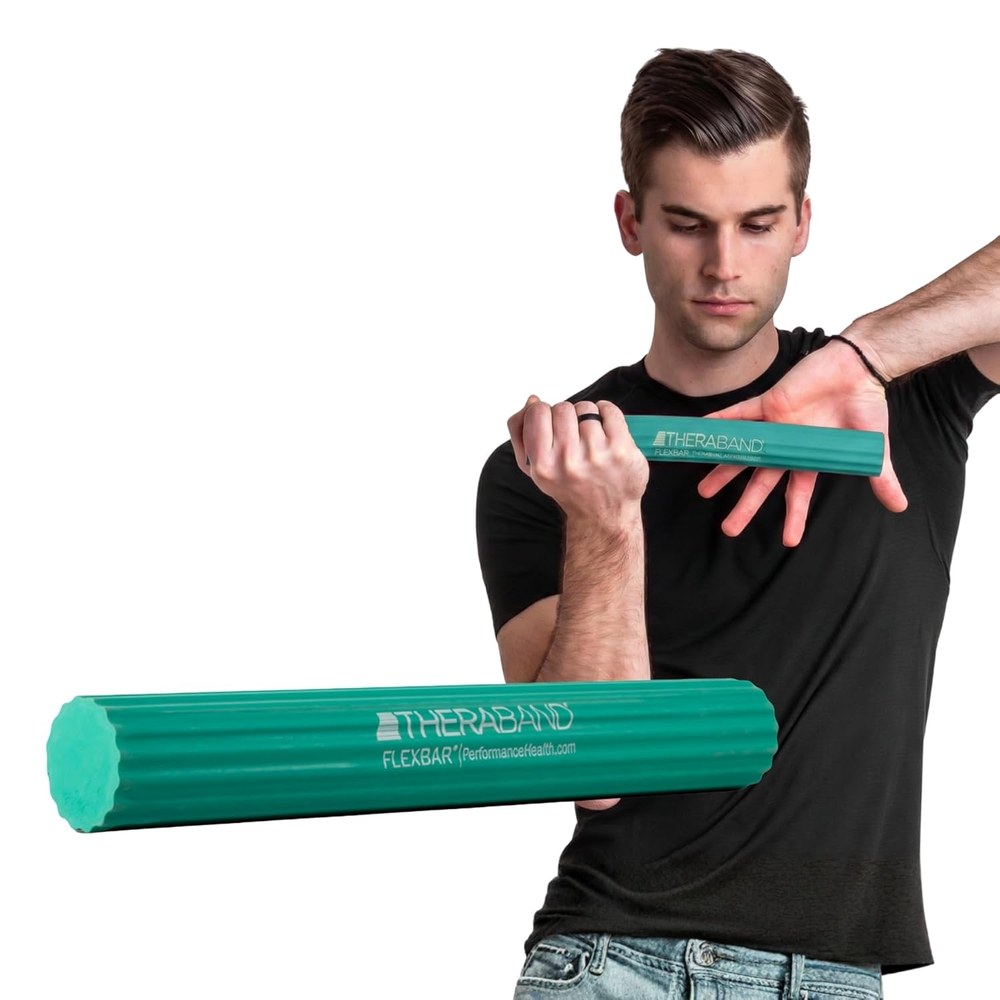
THERABAND FlexBar
Best for Forearms & ElbowsQuick specs
- Flexible rubber bar, four colour-coded levels
- Trains rotation and extensor strength
- Widely used for tennis and golfer’s elbow
- 4.7 stars from over 8,800 ratings
The only pick here that trains the muscles on the back of your forearm, which are the ones nobody trains and the ones that ache.
Summary of experience, tests & opinions
What worked
- The twisting movement hits the forearm in a way no gripper does. You feel it along the outside of the arm rather than in the palm, which is exactly the area that gets sore from heavy pulling.
- Steve, our certified PT, has used these with clients through elbow trouble for years, and it is one of the few bits of kit he recommends without caveats.
What didn’t
- Progression means buying the next colour, and the jump between levels is noticeable rather than gradual.
- It looks like nothing. Handing someone a rubber stick and telling them it is training equipment takes some explaining.
Pros & cons
Pros
- Trains rotation and extensor strength, which almost nothing else here does.
- Over 8,800 ratings at 4.7 stars, the largest review base in this lineup.
- Cheapest pick here and the best value score as a result.
Cons
- Four fixed levels, so progression means another purchase.
- Does very little for crush grip.
Read more about the THERABAND FlexBar
Buy this if your forearms or elbows ache, not if your grip is weak.
That distinction matters. Every other tool on this page closes your hand, which trains the flexors on the inside of the forearm. Nothing trains the extensors on the outside, and that imbalance is a well-recognised contributor to elbow pain in people who pull heavy. The FlexBar works by twisting against the rubber, which loads the forearm through rotation and makes the extensors work eccentrically as you let it unwind.
That eccentric unwinding is the whole mechanism, and it is why this bar turns up in physiotherapy so often.
Where it does not help is grip strength as most people mean it. It will not make you hold a deadlift longer and it will not close a gripper. It is a maintenance and rehabilitation tool that happens to sit in the grip category, and it is the best-value thing on this page for exactly that job.
The colour levels are worth understanding. Start softer than feels impressive, because the movement is unfamiliar and the muscle group is untrained, and a bar that is too stiff turns into a wrestling match rather than controlled work.
Only the budget kit runs it close on value:
Bottom line
The one everybody should own and almost nobody does. It costs very little, it takes two minutes at the end of a session, and it trains the half of your forearm that every other tool here ignores.
It might be for you if… your elbows or forearms ache after heavy pulling weeks.
It’s not for you if… you want raw crush strength, where the Captains of Crush is the tool for it.
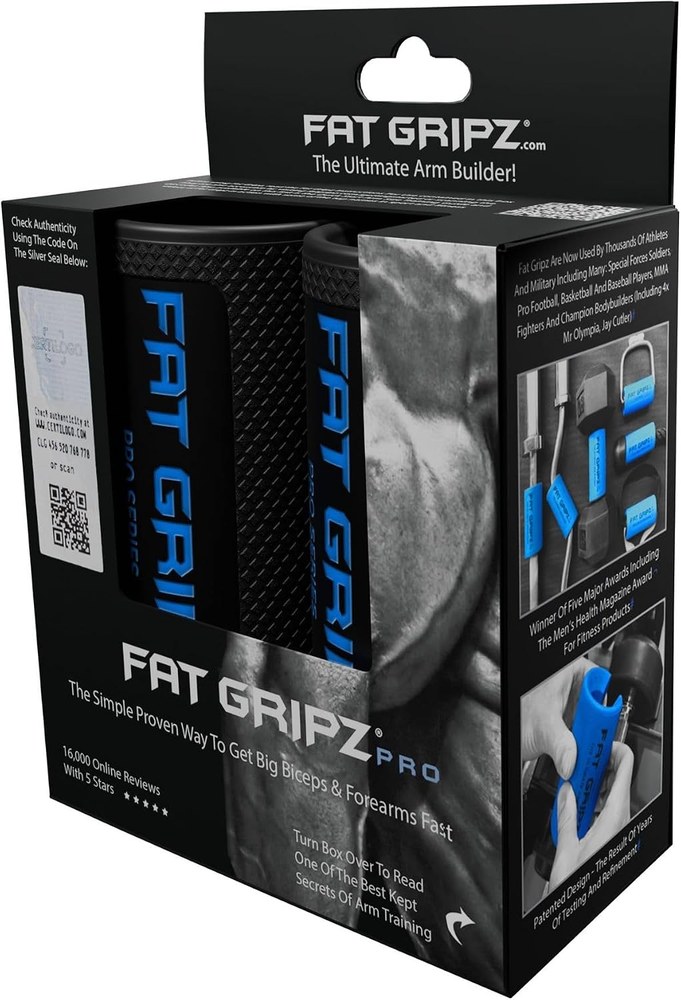
Fat Gripz Pro
Best for Barbell WorkQuick specs
- 2.25” outer diameter thick-bar sleeves
- Fits barbells, dumbbells, pull-up bars
- Trains support grip under real load
- 4.8 stars from over 1,000 ratings
The only pick here that trains the grip that actually fails on deadlifts, using the weights you already own.
Summary of experience, tests & opinions
Where it shines
- Slide them onto a bar and every set you were already doing becomes grip training. No extra time, no extra session, which is why they actually get used.
- The first time you try to row with them you will drop the weight by a third, and that is the whole point landing.
Where it falls short
- They roll on the bar under heavy load unless you squeeze properly, which is either a feature or an annoyance depending on your mood.
- You cannot use them for your top sets. Loading a bar to your working weight and then making it impossible to hold is not progress.
Pros & cons
Pros
- Trains support grip, the one that actually limits deadlifts and carries.
- Works with kit you already own, so the resistance ceiling is whatever you can load.
- Dense rubber that has held its shape across years of owner reports.
Cons
- Fixed diameter, so no fine progression in the grips themselves.
- Not usable on your heaviest sets without cutting the weight.
Read more about the Fat Gripz Pro
The pick that fixes the problem most people actually have.
Here is the mismatch that runs through this whole category. People buy a hand gripper because their deadlift grip fails. Deadlift grip failing is support grip: your fingers slowly opening under a sustained load. A hand gripper trains crush grip: snapping the hand shut against a spring. Training the second one does surprisingly little for the first.
Thickening the bar attacks support grip directly. A wider diameter means your fingers cannot wrap as far around, the load sits further out on the fingers, and holding on becomes the limiting factor long before the muscle does.
Use them on rows, pull-ups, curls and carries rather than on your heaviest pulls. Working sets at a reduced weight with a thick bar build grip; failed top sets do not build anything. That reduction is not a failure of the tool, it is the tool working.
Progression is the weak spot, and it is worth being straight about it. The grips are one diameter and that never changes, so all your progression has to come from the weight on the bar. In practice that is plenty, because the ceiling is your entire plate collection, but you do not get the fine-grained steps an adjustable gripper gives you.
Pair these with the Captains of Crush and you have covered crush and support between two tools, which is most of what a lifter needs.
It scores well across the board on breadth:
Bottom line
If your grip gives out on deadlifts, rows or carries, this is the pick that addresses it. It turns training you are already doing into grip training, which is why it gets used long after a gripper has gone in a drawer.
It might be for you if… support grip is your limiter and you already own a barbell and plates.
It’s not for you if… you want a tool you can use on the sofa, where the Captains of Crush or the FitBeast kit fit better.
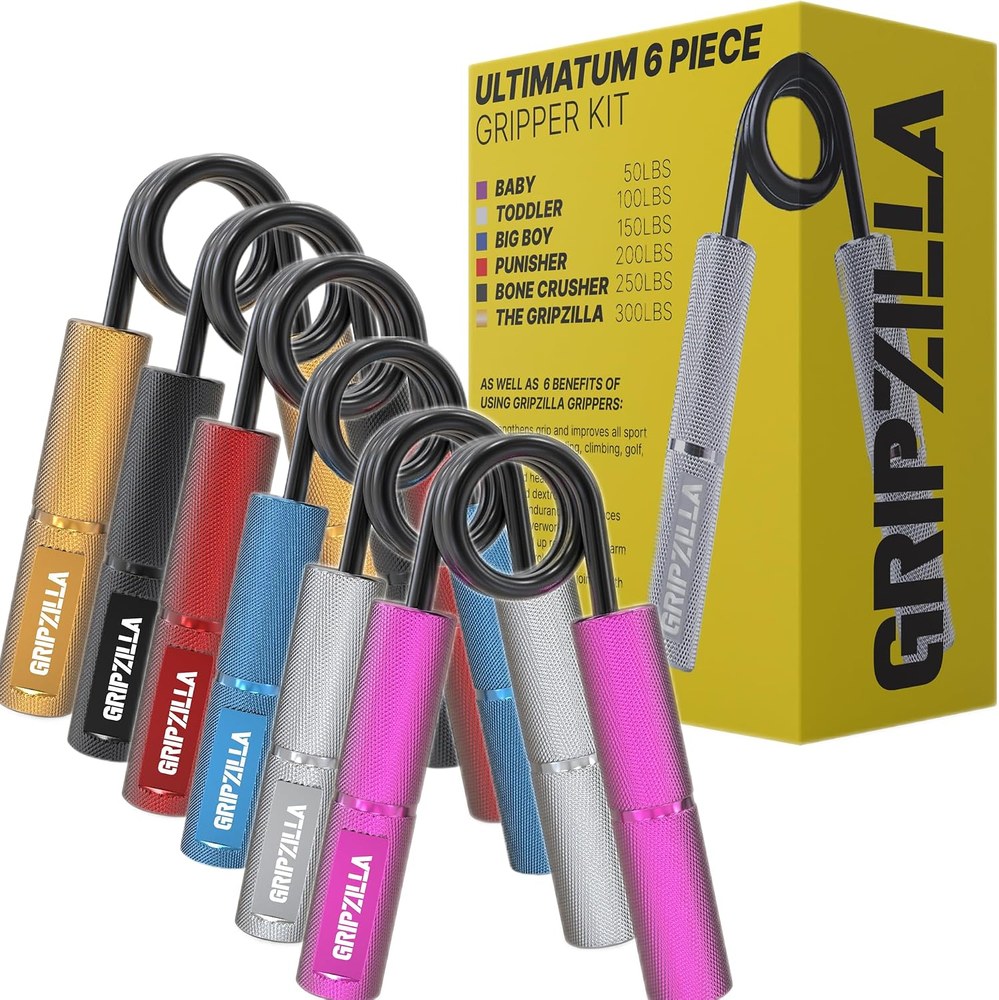
GRIPZILLA Grip Strength Trainer
Best AdjustableQuick specs
- Adjustable 50 lb to 300 lb
- One tool covers the whole range
- Steel construction with knurled handles
- 4.7 stars from over 230 ratings
Turn a dial instead of buying a ladder of fixed grippers, which over a few years is the cheaper route.
Summary of experience, tests & opinions
The wins
- Being able to drop the resistance mid-session for a back-off set is something no fixed gripper allows, and it changes how you can programme grip work.
- Two people of very different strength can share one tool, which matters if more than one person uses your gym.
The downsides
- It costs several times what a fixed gripper does, and that is a lot to spend before you know whether you will stick with grip training.
- The adjustment mechanism is one more thing that can wear, where a solid spring has nothing to go wrong.
Pros & cons
Pros
- 50 lb to 300 lb in one tool, so the progression problem disappears.
- Fine steps rather than the big jumps between fixed grippers.
- Steel build with knurled handles.
Cons
- Easily the most expensive pick here, and the worst value score.
- Smaller review base than the established names.
Read more about the GRIPZILLA Grip Strength Trainer
The system rather than the tool, and that is the case for it.
Fixed grippers have one structural flaw: every time you get stronger, you buy another one. The jumps between levels are large, so you spend months stuck between two, and the ladder gets expensive. An adjustable trainer removes all of that. You turn a dial, the resistance changes in small steps, and one purchase covers you from beginner to genuinely strong.
- Back-off sets at a lower resistance after a heavy top set
- Warming up properly instead of going straight into your working level
- Sharing one tool between people of different strengths
- Small increments, so you are never stuck between two levels
The catch is the outlay, and it is a real one. This costs several times what a fixed gripper does, which is a lot to commit before you know whether grip training will stick for you. There is a sensible sequence here: start with a fixed gripper, and if you are still using it in six months and closing it easily, upgrade to this rather than buying up the ladder.
Build is good rather than exceptional. The steel and knurling are solid, but a dial mechanism has moving parts that a sealed spring does not, and the review base is much smaller than the established names, so there is less long-term evidence either way.
Progression is where nothing else comes close:
Bottom line
Buy it once and never think about grip progression again. It only makes sense if you already know you will stick with this, because it costs several fixed grippers up front.
It might be for you if… you are committed to grip training and would rather spend once than buy a ladder.
It’s not for you if… you are testing the water, where the FitBeast kit costs almost nothing and tells you the same thing.
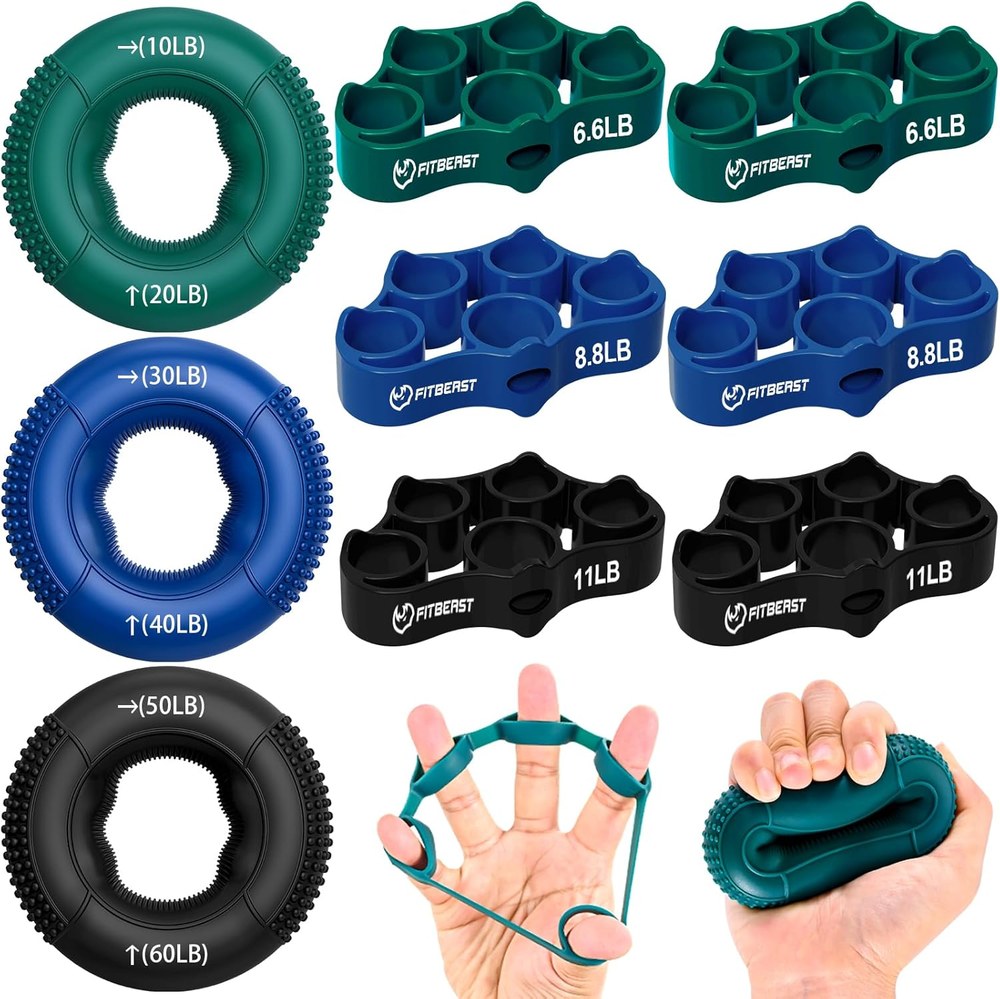
FitBeast Grip Strength Trainer Kit
Best BudgetQuick specs
- Five-piece kit, adjustable gripper included
- Extensor bands and finger exerciser
- 22 lb to 132 lb adjustable range
- 4.4 stars from over 3,900 ratings
Five tools for less than a takeaway, and it is the only cheap option here that includes extensor bands.
Summary of experience, tests & opinions
What’s good
- The extensor bands are the bit worth having. They cost pennies as part of the kit and they train the one thing every other budget option ignores.
- For finding out whether you will actually stick with grip work, spending this little is the sensible experiment.
What’s not
- The top of its range is where a serious gripper starts. If you already lift, you will be at the ceiling of the adjustable gripper quickly.
- Build is what the price suggests. The plastic and springs will not still be honest in three years.
Pros & cons
Pros
- Covers crush, finger and extensor work in one cheap box.
- Adjustable gripper rather than a fixed spring.
- Nearly 4,000 ratings, which is unusual evidence at this price.
Cons
- Resistance ceiling is low for anyone who already trains.
- Build quality is the obvious compromise.
Read more about the FitBeast Grip Strength Trainer Kit
The right first purchase, and an honest dead end after that.
Both of those things are true at once. If you have never trained grip and you are not sure you will keep it up, spending very little to find out is smarter than committing to a serious tool. And the kit format means you get to try several types of grip work rather than guessing which one you needed.
The extensor bands are genuinely the highlight, which is a strange thing to say about the cheapest item on this page. They are rubber rings you open your fingers against, they take thirty seconds, and they train the muscles that every gripping movement neglects. Buying those separately costs almost nothing, but most people never think to, and having them in the box means they get used.
Where it runs out is strength. The adjustable gripper tops out around the point a proper gripper begins, so anyone who already deadlifts will be at its ceiling inside a couple of months. At that point you have learned what you needed to know and the sensible move is the Captains of Crush or, if you want to stop buying, the GRIPZILLA.
| Stage | Tool | Why you move on |
|---|---|---|
| Finding out | This kit | You close the gripper easily |
| Committed | Captains of Crush | Buying up the ladder adds up |
| Done buying | Adjustable trainer | Nothing left to outgrow |
Buy it to find out whether grip training is for you. Do not buy it expecting it to still challenge you next year.
Breadth is its genuine advantage:
Bottom line
The cheapest way to find out whether grip training suits you, and the extensor bands alone are worth the money. Expect to outgrow the gripper.
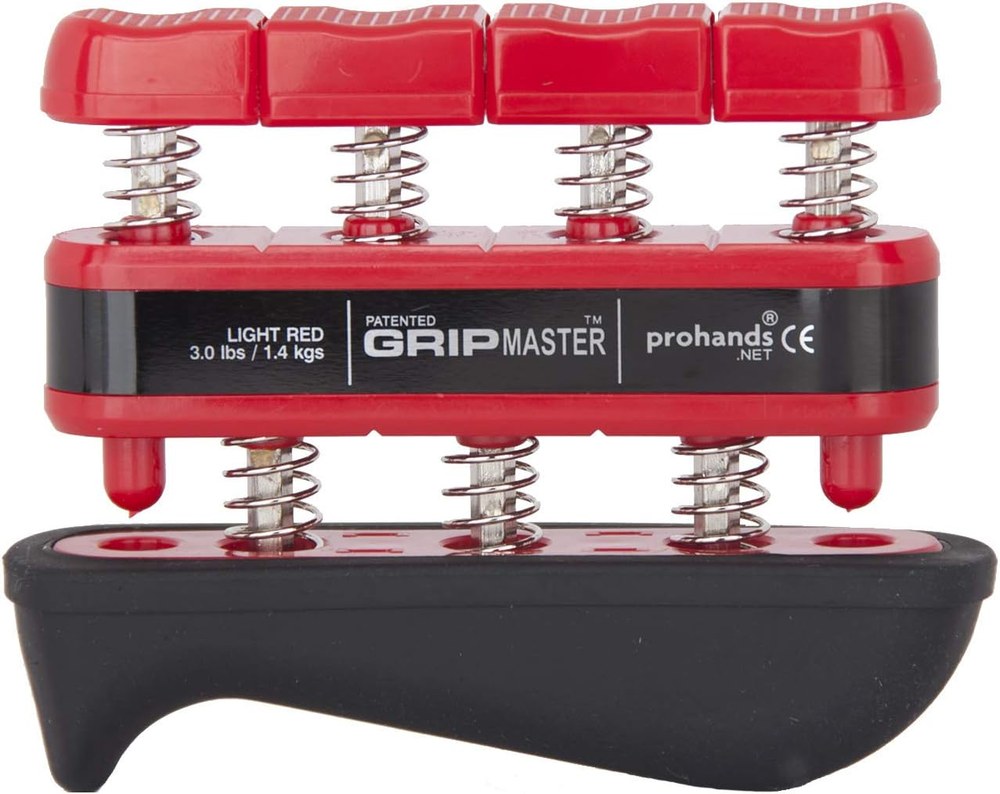
Prohands Gripmaster
Best for Finger StrengthQuick specs
- Four independent spring-loaded buttons
- Trains each finger separately
- Three tension options
- 4.6 stars from over 400 ratings
The only tool here that loads each finger on its own, which is what climbers and musicians actually need.
Summary of experience, tests & opinions
Where it earns its place
- Isolating a single finger shows you exactly how uneven your hand is. The little finger on your weaker hand will surprise you, and it is not a pleasant surprise.
- It is quiet and small enough to use while doing something else, which is the only reason low-intensity finger work ever gets done consistently.
Where it limits you
- The tension is a long way below what a lifter needs for anything to transfer to the bar. This is dexterity work, not strength work.
- Three fixed tensions is a narrow ladder, and you have to buy a whole new unit to move up.
Pros & cons
Pros
- Four independent spring buttons, so each finger is loaded separately.
- Well made, quiet, and small enough to keep on a desk.
- Genuinely useful for climbers, musicians and hand rehabilitation.
Cons
- Resistance is far too light to affect barbell grip.
- Only three tensions, and progression means a new unit.
Read more about the Prohands Gripmaster
A specialist tool, and it is worth being clear about who the specialist is.
If you lift and you want a stronger deadlift hold, this is not it. The tensions involved are a fraction of what your hand deals with holding a loaded bar, and no amount of finger-button work will change what happens on your last set. That is not a criticism of the tool, it is a mismatch between the tool and the reason most people land on this page.
Who it genuinely suits is anyone who needs individual finger control and endurance rather than whole-hand strength. Climbers working finger-specific weaknesses. Guitarists. People coming back from a hand injury who need to load one finger without loading the rest.
What it does uniquely well is expose asymmetry. Every other tool here lets your strong fingers cover for your weak ones, because the hand works as a unit. Load them one at a time and you find out very quickly which finger has been coasting, and that information is useful even if you never use the tool again.
Buy it if you need finger-level control. Skip it if you came here because your deadlift grip fails.
It sits mid-pack on build, which is respectable for the money:
Bottom line
Excellent at a narrow job. If you need individual fingers loaded separately it is the only sensible pick here, and if you do not, it will not move your lifts.
How we created this list of best grip strengtheners
Here are our criteria on how we picked these grip strengtheners, and how we valued each criterion when making decisions:
- Training effect (34%)
- Progression (22%)
- Build quality (16%)
- Grip types covered (16%)
- Value for money (12%)
You can find out all about our selection process here.
Other grip strengtheners we tested - close-but-no-cigar
- WOD Nation Hand Grip Strengthener - a decent adjustable gripper, but its range tops out well below the GRIPZILLA for not much less money.
- Xtensor extensor trainer - does the extensor job properly, though the bands in the FitBeast kit get you most of the way for a fraction of the cost.
- ProsourceFit heavy-duty gripper - solid enough, simply beaten on feel and spring quality by the Captains of Crush.
- Title Boxing grip strengthener - fine budget coil gripper with nothing to distinguish it from a hundred others.
- Cheap spring gripper multipacks - the ones you find in every marketplace search. Too easy on day one and the springs soften from there.
- Grip-strength dynamometers - useful for measuring where you are, but they measure rather than train.
Grip strengthener FAQs
Do grip strengtheners actually work?
For crush grip, yes, as long as the tool lets you add resistance over time.
A gripper you can already close for thirty reps is a warm-up rather than training, which is why cheap spring grippers stop doing anything within a fortnight.
What they will not do is transfer much to your deadlift, because holding a heavy bar is support grip. For that, the Fat Gripz is the right tool.
What are the different types of grip strength?
There are four worth knowing.
Crush grip is squeezing something in your palm, which is what a hand gripper trains. Support grip is holding on to a load, which is what fails on deadlifts and carries. Pinch grip is holding something between fingers and thumb.
Extensor strength is opening the hand against resistance, and it is the one almost nobody trains. The FlexBar is the pick for that.
Will a grip strengthener build bigger forearms?
A little, but not much on its own.
Forearm size responds to volume and load through the wrist and fingers, and most handheld grippers apply a modest load for a short time.
Wrist curls, heavy carries, thick-bar work and holding the bar without straps do more for forearm size than any gripper will.
How often should I train grip?
Two or three short sessions a week is plenty, and it does not need its own workout.
The forearms recover quickly, but they are also working on every pull you do, so stacking heavy gripper work on a heavy deadlift day is how you end up with sore elbows.
Put a few sets at the end of an upper-body session and progress the resistance rather than the reps.
Should I train the extensors as well?
Yes, and it takes almost no time.
Every gripping movement closes the hand, so the flexors get all the work and the extensors on the back of the forearm get none. That imbalance is a common contributor to elbow pain.
A set or two of opening your fingers against a band after gripping work is enough, which is what makes the FlexBar and the FitBeast bands worth owning.
Are expensive grip strengtheners worth it?
It depends entirely on whether you need progression.
A cheap gripper is fine to start with, but once you can close it there is nowhere to go, and buying a ladder of fixed grippers adds up fast.
An adjustable tool costs more once and keeps working for years. If you are unsure how serious you will get, start cheap and upgrade when you outgrow it.
The bottom line
For crush grip done properly, the IronMind Captains of Crush is the one to buy. Honest resistance with no soft phase, a range nobody outgrows, and build quality that will see out most of your gym.
But check which grip is actually failing you before you spend anything.
If your hands give out holding a heavy bar, that is support grip and the Fat Gripz is the fix. If your elbows and forearms ache, the FlexBar trains the half of the forearm everything else ignores, and it costs very little. Want to stop buying grippers as you get stronger? The GRIPZILLA turns progression into a dial. Testing the water? The FitBeast kit is cheap enough to be a fair experiment. And for individual finger work, the Prohands Gripmaster is the only real option here.
There are two things to do now:
- If you want to give the tools another look, click here to skip back to the table.
- If you want to put a pin in it, bookmark this page and come back. We keep it updated, fresh, and relevant.
Stay strong.
