

We scored 40 squat stands across four categories and picked the five most worth your money.
I have coached and lifted on squat stands for years; for many home gyms they’re the smartest way to barbell train in a tight space. The team ran every stand here through our weighted scoring, so these picks come from data and owner reports, not one lifter’s hunch.
The aim was simple: find the stands that hold a heavy bar without wobbling, fit a real home gym, and earn their keep at a fair price.
Let’s see how they stacked up…
Editor's note · updated June 22, 2026
We rebuilt this guide for 2026 and re-rated the field with it.
What changed:
- The Rogue SML-2C is our best overall. It’s the most well-rounded stand here, with a connected base, a proper pull-up bar, and an upgrade path into a half rack.
- We still lead on true independent stands, which most roundups skip. The Rogue S-4 is our best two-upright pick, with the Bells of Steel 3.0 the value independent.
- Stock note: the Bells of Steel 3.0 is temporarily out of stock on the US store at the time of writing. It’s still the current product, so we’ve kept it in with a flag; check availability before you buy, and lean on the Rogue S-4 if you need an independent stand today.
Related
A squat stand is the compact end of the rack world. If you want built-in safeties, see our best squat racks and best power racks. Short on height? Our best short power racks and best folding squat racks cover tight rooms.
Compare the best squat stands
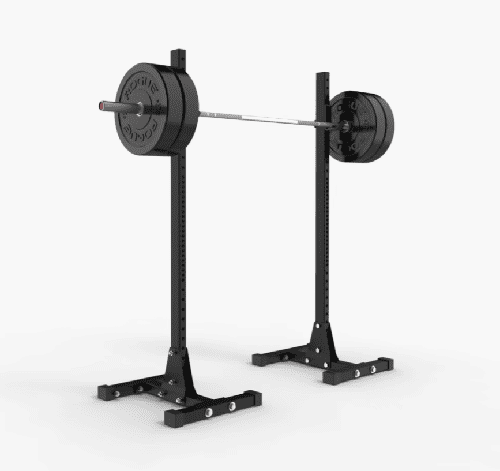 Rogue S-4 2.0
Check price
Rogue S-4 2.0
Check price
|
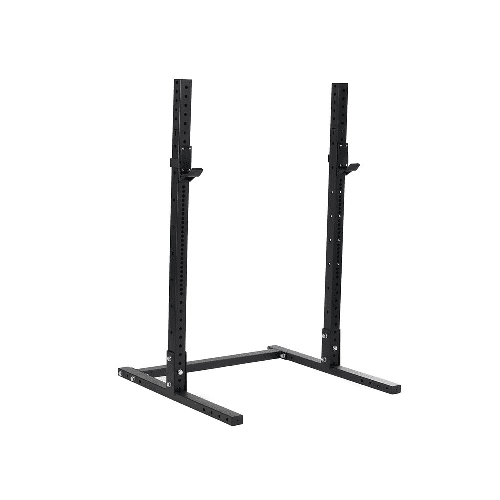 Titan X-3 Short
Check price
Titan X-3 Short
Check price
|
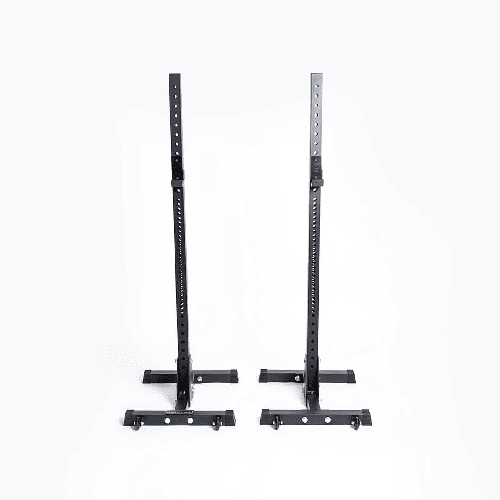 Bells of Steel 3.0
Check price
Bells of Steel 3.0
Check price
|
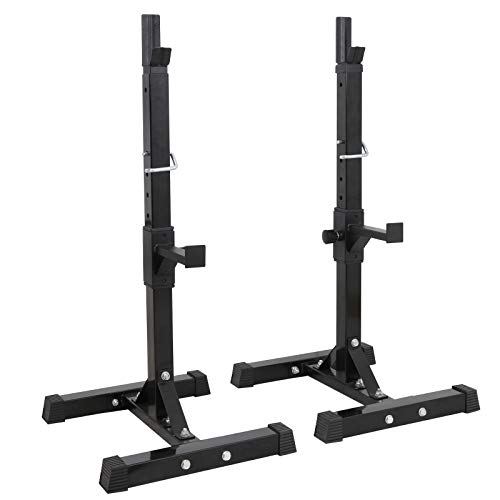 F2C Adjustable
Check price
F2C Adjustable
Check price
|
||
|---|---|---|---|---|---|
| Best for | Overall | Independent | Compact | Value independent | Budget |
| Rating (*) | |||||
| Build & stability | 92% | 94% | 88% | 82% | 72% |
| Adjustability | 90% | 90% | 86% | 84% | 80% |
| Footprint & features | 90% | 78% | 86% | 88% | 84% |
| Value | 82% | 80% | 92% | 90% | 92% |
| Price | $$$ | $$ | $$ | $$ | $ |
| Type | Connected | Independent | Connected | Independent | Independent |
| Steel | 3×3" 11-ga | 3×3" 11-ga | 3×3" 11-ga | 2.3×2.3" 12-ga | 50 mm tube |
| Capacity | 1,000 lb | High | 1,000 lb | 600 lb / stand | 550 lb |
| Pull-up bar | Yes | No | No | No | No |
| Made in USA | Yes | Yes | No | No | No |
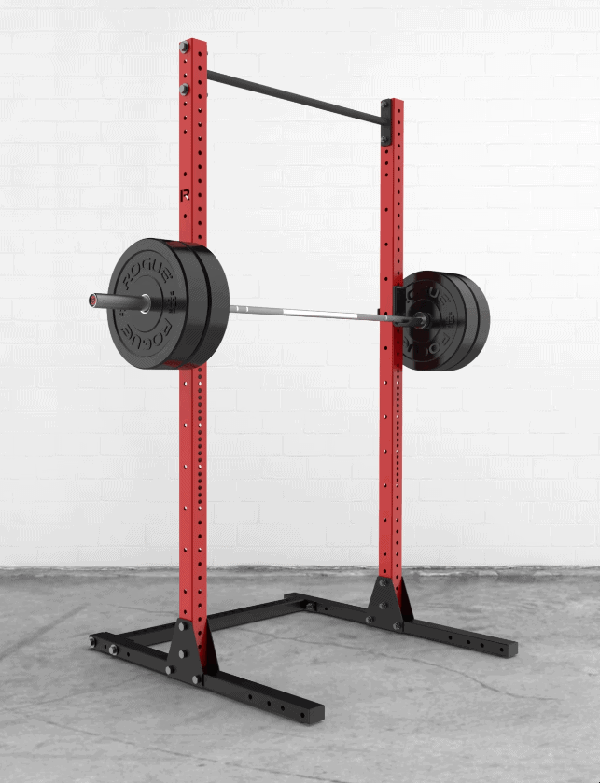 Rogue SML-2C
Our testing and selection process
How we assess squat stands
We run every squat stand roundup through the same five steps:
- We start as the buyer. Most of our team has trained on a stand rather than a full rack at some point, so we know where the corners get cut.
- We research wide. We pull steel size and gauge, footprint, hole spacing, capacity and owner feedback on as many stands as we can find, 40 this time, into one spreadsheet.
- We score each stand with our weighted system. Data decides the ranking, not brand loyalty.
- We split the field by job, because a connected stand with a pull-up bar and a pair of independent uprights are bought for very different rooms.
- We get hands-on where we can and lean on the SHG community for the rest.
You can read more about the process in our review guidelines.
How we score squat stands
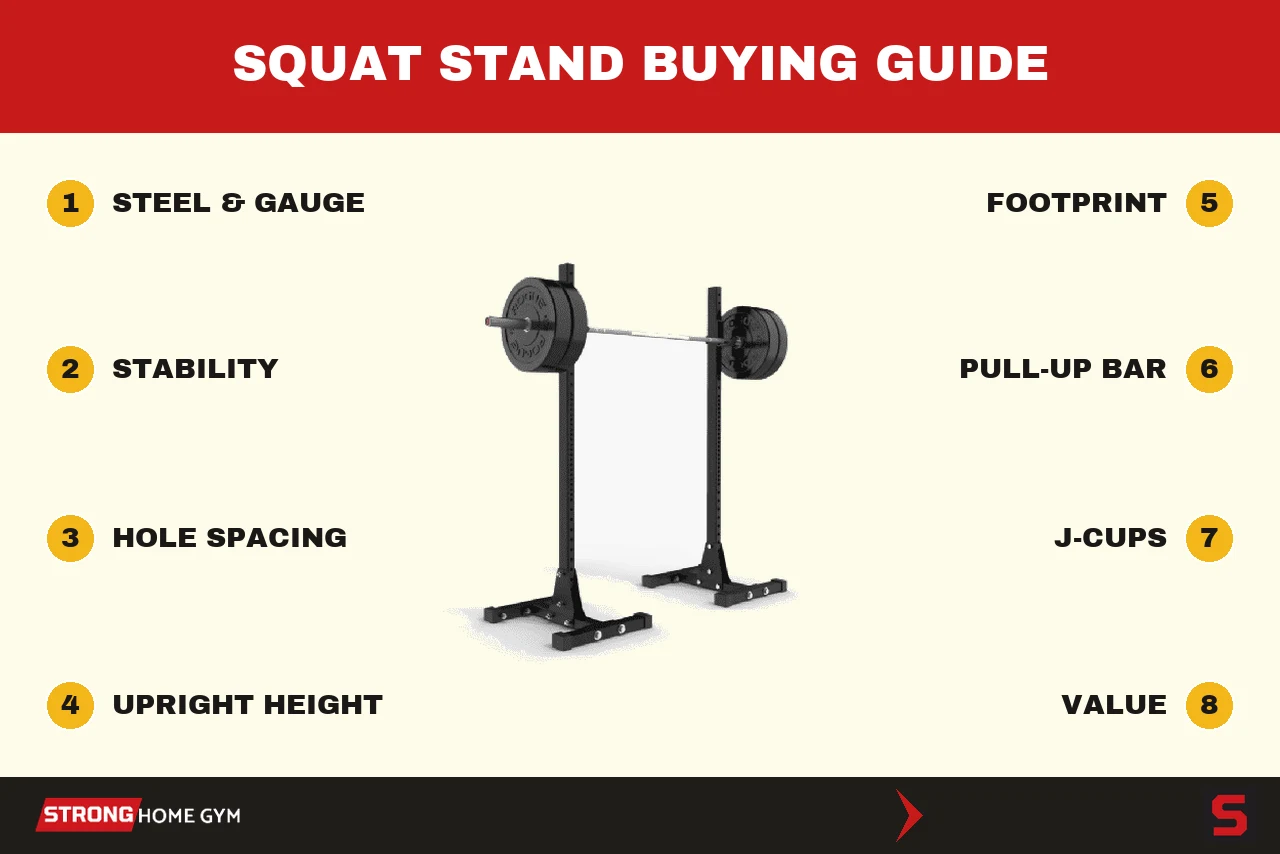
Here is what feeds the score and how much each part counts. Build and stability lead, because a stand with no rear support has to stay planted under a heavy bar.
We grouped it into four weighted factors:
- Build & stability (30%) - steel size and gauge, base design, and how planted it stays under load.
- Adjustability (20%) - hole spacing, J-cup quality, and how easily it fits your lifts.
- Footprint & features (25%) - size, a pull-up bar, wheels, and any upgrade path.
- Value (25%) - what you actually get for the money.
Build & stability (30%)
This carries the most weight because a squat stand has no cage around you. It holds the bar and nothing else, so when it stays rock-solid you trust it, and when it shifts you stop pushing.
The biggest factor is whether the stand is connected or independent, and it’s the single thing most people get wrong. A connected base ties the uprights into one rigid unit; independent uprights stand alone and lean on their own feet. Both can be excellent, but they behave differently under a heavy bar.
Steel size matters too. A 3×3-inch 11-gauge upright is the home-gym standard and barely flexes; thinner tube or a smaller profile gives a little more under a grinding squat.
Adjustability (20%)
A stand earns its keep by fitting your lifts, and that comes down to the holes and the J-cups. We score how fine the spacing is and how solid the cups feel.
Westside hole spacing is the mark to look for. It tightens the gaps to one inch through the bench and rack zone, so you can set the bar at exactly the right height instead of choosing between too high and too low. Wider single-spacing across the whole upright is fine for squats but frustrating for the bench.
Footprint & features (25%)
This is where the stand has to suit your actual room. We weigh the floor space it takes, plus the extras that make it more than two posts: a pull-up bar, wheels, a low-ceiling height, and whether it grows with you.
A connected stand can carry a pull-up bar and often upgrades into a half rack later. An independent pair takes almost no space and fits any bar, but tops out as just uprights. Neither is better, they suit different gyms.
Value (25%)
We build a quality-adjusted picture of price. A stand is the budget route into barbell training, so the question is how much solid steel and useful feature you get for the spend. A well-built mid-priced stand that nails the basics can score as well here as a premium one with a badge.
Find the perfect squat stand for you
Overall | Independent | Compact | Value | Budget
Here is how the five stands stack up on our overall score:
Rogue SML-2C Squat Stand
Best OverallQuick specs
- 3×3” 11-gauge steel, USA-made
- Westside hole spacing (1” / 2”)
- Fat / skinny pull-up bar up top
- 1,000 lb capacity, lifetime warranty
The most well-rounded stand here: a rigid connected base, a proper pull-up bar, and a path to grow into a half rack later.
Summary of experience, tests & opinions
What I like
- The connected base makes it feel like a rack rather than a pair of posts. You can load it and lift without that nagging thought about whether an upright will shift.
- The pull-up bar up top is a genuine bonus, with fat and skinny options, so it covers a movement the independent stands simply can’t.
- Knowing I can bolt on Monster Lite parts later took the pressure off the decision. It’s a stand that grows instead of a stand you replace.
What I don’t
- It’s the priciest pick here, which is the main thing holding its value score back.
- The connected base is one fixed width, so unlike independent uprights you can’t space it to an unusual bar.
Pros & cons
Pros
- Connected base with a pull-up bar - rack-like stability and an overhead bar in one.
- 3×3” 11-gauge USA steel, 1,000 lb capacity, lifetime warranty.
- Upgrade path into a half rack via Monster Lite add-ons.
Cons
- The most expensive stand on the list.
- Fixed base width, so no custom spacing.
Read more about the Rogue SML-2C
This is the stand we point most people to.
It removes the usual squat-stand compromise. A plain pair of uprights saves space, but it feels less planted and can’t carry a pull-up bar. The SML-2C hands you connected stability and the overhead bar without jumping up to a full rack, so one purchase covers squats, presses and pull-ups.
That’s the pitch.
It’s for the lifter with the floor space and the ceiling height who wants one stand to handle everything for years. Tight room, low ceiling, or you only want two posts to shove against a wall? Skip it for the independent picks.
The closest sibling here is the independent Rogue S-4. The S-4 is arguably the better pure upright, with thick 7-gauge bases, and it packs away far smaller. But the SML-2C wins on everyday usefulness: the pull-up bar, the rack-like feel, and the path to grow into a half rack instead of topping out as two posts. Know you want pull-ups in the same footprint, and the comparison ends there.
The upgrade path is the detail that seals it. Plenty of people start with a stand to save money, then wish they’d bought a rack; this one lets you add to it instead of starting over, which over a few years is the cheaper road.
One owner note we keep hearing: the J-cups sit close to the upright. On a heavy bench you nudge the bar forward as you rack, or it catches the lip on the way back. It’s a habit to learn rather than a fault, and exactly the kind of thing a spec sheet never tells you. The connected base is also heavy to shift once built, so decide where it lives before you bolt it together.
Rogue’s own walkthrough shows the build and the layout clearly:
It takes the top slot on our weighted overall score:
Bottom line
The Rogue SML-2C is the do-everything stand: connected stability, a pull-up bar, and room to grow into a half rack. The price is the only real catch.
The SML-2C might be for you if… you want one stand that squats, presses and does pull-ups, with the option to expand later.
It’s not for you if… you need the smallest footprint or a custom bar width. The independent Rogue S-4 is the call.
Rogue S-4 Squat Stand 2.0
Best IndependentQuick specs
- 3×3” 11-gauge uprights, 7-gauge bases
- 72” tall, USA-made
- Westside hole spacing (1” / 2”)
- Lifetime warranty
The best true independent stand: two heavy, separate uprights with thick bases, for the lifter who wants Rogue build and a tiny footprint.
Summary of experience, tests & opinions
What I like
- For two separate uprights, it’s astonishingly solid. The thick 7-gauge bases plant it in a way most independent stands can’t manage, so it never feels tippy under a working squat.
- Being independent, I can set the uprights to any bar width and shove them flat against a wall between sessions. It’s the most space-flexible pick here.
- It’s full Rogue: 3×3 uprights, faultless welds and a lifetime warranty, so it’s a buy-once piece.
What I don’t
- There’s no pull-up bar and no connecting base, so it can’t grow into a rack the way the SML-2C does. It is what it is.
- You’re paying Rogue money for what is, in the end, two posts, which is why the value score sits where it does.
Pros & cons
Pros
- Thick 7-gauge bases - the most planted independent stand here.
- Set to any bar width and stores flat against a wall.
- 3×3” 11-gauge Rogue build with a lifetime warranty.
Cons
- No pull-up bar and no upgrade path.
- Premium price for a pair of uprights.
Read more about the Rogue S-4 2.0
This one is for the lifter who specifically wants independent uprights and won’t compromise on how solid they feel.
Most roundups skip true independents because they’re fiddlier to judge. They earn their place anyway: they fit any bar, store flat, and slot into a shared or awkward space a connected base can’t reach. The S-4 is the best of them, and it’s our pick for that exact buyer.
Square it up first.
That’s the one quirk of free-standing posts. The uprights aren’t joined, so each session starts with a quick eyeball to keep them square, or the bar racks at a slight angle. Owners also find the bases wide and flat enough to drop a plate on top as ballast if you train near the top of your range, which is the sort of trick you only learn from using it.
What separates it from cheaper independents like the Bells of Steel 3.0 is the steel under your feet. The gap is the bases: thick 7-gauge H-bases against the Bells’ lighter 2.3-inch 12-gauge frame, and you feel it the moment you walk out a heavy squat. No sway. The Bells trades that planted feel for wheels and a lower price; the S-4 trades portability for the steadiest posts here.
The honest limit is that it stays two posts forever. No pull-up bar, nothing to bolt on, so if you think you’ll want a rack later, the connected SML-2C is the smarter long game.
Two assembly notes. The 2.0 ships bolt-together rather than welded, so you build it, but it packs down small and goes up stairs in pieces. The triangular base plates jut out in front, so leave clear floor ahead of each upright or you’ll catch a shin walking the bar out.
On build and stability, it leads the entire list:
Bottom line
The Rogue S-4 is the best independent stand: two heavy uprights on thick bases that fit any space and any bar. No pull-up bar and a premium price are the trade.
The S-4 might be for you if… you want true independent uprights with no compromise on how solid they feel.
It’s not for you if… you want a pull-up bar or a path to a rack. The connected SML-2C covers both.
Titan X-3 Series Short Squat Stand
Best Compact / Low-CeilingQuick specs
- 3×3” 11-gauge steel
- 71.25” overall (low-ceiling)
- 42” × 42” walk-in, Westside spacing
- 1,000 lb capacity
The low-ceiling pick: full 3×3 build and a 1,000 lb rating in a stand short enough to fit a basement or garage with limited headroom.
Summary of experience, tests & opinions
What I like
- It solves the low-ceiling problem without dropping to flimsy steel. At 71 inches it fits under a basement joist, yet it’s the same 3×3 11-gauge you’d find on a full-height rack.
- The 42-inch walk-in depth gives you room to step in and out and to bench inside it, which a shallow stand doesn’t.
- It costs noticeably less than the Rogue stands while matching them on the steel that matters, which is why it’s the value standout among the connected picks.
What I don’t
- The short height means no usable pull-up bar up top, so you lose that movement.
- It’s Titan, so the welds and finish are a small step behind Rogue’s. Nothing that affects performance, just fit and polish.
Pros & cons
Pros
- 71” low-ceiling height - fits a basement or low garage that taller stands won’t.
- Full 3×3” 11-gauge steel and a 1,000 lb rating.
- 42” walk-in depth and Westside spacing, well under Rogue money.
Cons
- Too short for a usable overhead pull-up bar.
- Welds and finish trail Rogue slightly.
Read more about the Titan X-3 Short
Buy this when your ceiling makes the decision for you.
A lot of basements and garages can’t take a full-height stand, and the usual fix is a flimsy short rack. The X-3 Short dodges that trap: proper 3×3 11-gauge steel and a 1,000 lb rating packed into a 71-inch frame, so you lose the height while keeping the build. Measure up and the buyer it’s made for is obvious, the low joist, the converted basement, the garage where a tall stand won’t stand up.
Got the headroom? Skip it: you’d pay for a short frame and lose the overhead pull-up bar for nothing, and a height-blessed room is better served by the SML-2C.
That’s the head-to-head that matters most. Against the SML-2C the X-3 Short gives up the pull-up bar the short height can’t carry, plus a touch of Rogue’s fit and finish, and hands back a real saving for steel that’s just as serious. Same gauge, same capacity, smaller bill, lower roofline. Your ceiling is what makes this call.
One practical plus is the 42-inch walk-in depth, so you bench inside it and step in and out comfortably instead of perching on the edge of a shallow stand.
The detail the spec sheet skips is the bolt-together build. It ships flat and assembles in pieces, so owners get it down a basement stairwell a welded one-piece stand would never clear, which for a lot of low rooms is the whole point. Our note from living with it: torque the upright bolts properly on day one, then re-check after the first few heavy sessions. A half-snug bolt is where the only real wobble complaints come from.
Two more in use. The flat feet mean no bolting to the floor, which suits a basement or rental, though it wants a level surface to sit steady. The J-cups are bare metal, so a strip of cheap UHMW tape inside saves your bar’s knurling.
It sits at the top of our value score, level with the budget F2C:
Bottom line
The Titan X-3 Short is the low-ceiling pick: serious 3×3 steel and a 1,000 lb rating in a frame that fits a basement, for less than the Rogue stands. The lost pull-up bar is the trade.
The X-3 Short might be for you if… your ceiling is low and you want full-size build without paying Rogue prices.
It’s not for you if… you have the height and want an overhead pull-up bar. The SML-2C gives you that.
Bells of Steel Squat Stands 3.0
Best Value IndependentQuick specs
- 2.3×2.3” 12-gauge uprights
- Westside hole spacing (1” / 2”)
- 600 lb capacity per stand
- 29” × 24” footprint each, built-in wheels
The value way into independent uprights: a solid wheeled pair that costs well under the Rogue S-4 and rolls out of the way when you’re done.
Summary of experience, tests & opinions
What I like
- The wheels are the clever bit. Each upright moves on its own, so I can roll them to a wider stance for squats and a narrower one to bench, then wheel them into a corner.
- For a value stand, the build holds up. The Westside spacing means I can set the bar exactly right for the bench, which budget stands often botch.
- Being independent, it goes wherever the room allows and stores almost flat against a wall.
What I don’t
- The 2.3-inch 12-gauge uprights are a step down from the Rogue’s 3×3 11-gauge, so it doesn’t feel quite as bombproof under a near-maximal squat.
- Stock has been patchy lately, so it’s worth checking availability before you set your heart on it.
Pros & cons
Pros
- Built-in wheels - roll each upright to set the width, then tuck them away.
- Westside hole spacing and an honest 600 lb per-stand rating.
- Costs well under the Rogue S-4 for true independent uprights.
Cons
- Smaller 2.3” 12-gauge steel than the premium stands.
- Availability has been intermittent.
Read more about the Bells of Steel 3.0
The wheels are what set this one apart.
It’s the value entry into independent stands, and the rolling is the trick. Most independents are a dead lift to reposition; these roll, so changing your stance for squats versus bench, or clearing the floor entirely, takes seconds. For a shared garage that doubles as something else, that’s genuinely useful, and it’s why it suits a budget lifter whose room has to do double duty.
Train heavy in a space you can leave set up and you’d be better served stepping up. The 3.0 is about flexibility and price.
Set against the Rogue S-4, the gap is the steel. The 2.3-inch 12-gauge uprights are perfectly solid for normal training, but they don’t have the planted, bombproof feel of the Rogue’s 3×3 frame and thick 7-gauge bases when you’re grinding a heavy single. The flip side: the Rogue can’t move once it’s down, while the Bells rolls into a corner in seconds. You’re trading a little confidence for a real saving and the mobility, and for most home lifters that’s a fair swap.
One owner detail worth knowing: the wheels only bite when you tip the upright back onto them, so under a loaded bar the stand sits flat on its feet and doesn’t drift. Anyone assuming the wheels mean it rolls around mid-set has it backwards. The J-cups also fit snug on the 2.3-inch tube, so they don’t rattle, though the first few height changes take a firmer push before they free up.
One thing to flag honestly. Stock has been coming and going on the US store; it’s the current product rather than a discontinued one, so it should return, but check it’s actually available before you commit. Need an independent stand today and it’s out? The Rogue S-4 is the one to step up to.
Bells of Steel’s own overview of their squat stands shows the wheels and the J-cups in action:
On footprint and features, the wheels push it near the top:
Bottom line
The Bells of Steel 3.0 is the value independent: wheeled, mobile uprights with Westside spacing for well under the Rogue. Lighter steel and patchy stock are the trade.
The 3.0 might be for you if… you want independent uprights you can roll around, at a price below the premium pick.
It’s not for you if… you want the most planted feel under heavy loads, or you need it in stock today. The Rogue S-4 is the sturdier, surer bet.
F2C Adjustable Squat Stand
Best BudgetQuick specs
- 50 mm steel tube, adjustable 40”-66.5”
- 14 spotter-pin positions
- 17.7” × 20.1” footprint each
- 550 lb capacity (440 lb at full height)
The cheapest way to barbell train: a pair of height-adjustable posts that cost a fraction of the brand-name stands and take almost no room.
Summary of experience, tests & opinions
What I like
- For the money, the telescoping height is brilliantly handy. One pair covers a low bench setup and a high overhead-press setup, then collapses small for storage.
- The tiny per-upright footprint suits a cramped room where even an independent pair of full stands won’t fit.
- With 14 pin positions, you can dial in a workable height for most lifts, which is more than you’d expect at this price.
What I don’t
- The 50 mm tube is thin, and the capacity drops to 440 lb at full height, so this is a stand for lighter and moderate loads rather than heavy singles.
- It’s a budget Amazon unit, so the finish, J-cups and overall feel are basic. It does the job rather than inspiring confidence.
Pros & cons
Pros
- Telescoping 40”-66.5” height - one pair for bench, squat and press, stores small.
- Tiny footprint, fits the tightest rooms.
- 14 pin positions and the lowest price on the list.
Cons
- Thin 50 mm tube; capacity drops to 440 lb at full height.
- Basic budget build, suited to lighter lifting only.
Read more about the F2C Adjustable
This is the absolute entry point.
You buy it when the budget is tiny or you just want to start lifting now. The trick is the telescoping height: where every other stand here is fixed, these collapse and extend, so one cheap pair covers a low bench press and a high overhead press, then drops down to tuck away in a cupboard. No other stand on the list folds that small.
The compromises are exactly what the price tells you. The 50 mm tube is thin and the honest capacity falls to 440 lb at full extension, so it’s built for bodyweight-plus and moderate barbell work rather than heavy squat singles, fine as a starter or backup but quick to outgrow once you anchor a serious strength programme.
Stay well under the rated number.
It’s also the only Amazon-listed stand here, so its link goes direct to Amazon rather than through our usual redirect. As a first step into barbell training on the smallest budget it does the job, then you upgrade to one of the steel stands above when your lifts get serious.
A few notes from seeing it in action. The telescoping uprights are held by a single pin each, so there’s a touch of play where the inner tube slides into the outer, and the pair sways a little if you rack carelessly. Set them on a flat floor, lower the bar gently, and it settles. The two safety catch arms double as crude spotter pins, a genuine plus at this price, but they sit close to the upright, so leave a little clearance when you set your bench height. Each post is light too, so the stand can creep when you re-rack from a wide grip.
It ties for the top of our value score, as you’d expect from the cheapest pick:
Bottom line
The F2C is the budget starter: telescoping, tiny and dirt cheap. Thin tube and a modest real capacity mean you’ll outgrow it once you lift heavy.
The F2C might be for you if… you want the cheapest possible way into barbell training and you lift light to moderate.
It’s not for you if… you squat heavy or want a stand to keep for years. Step up to the Titan X-3 Short or a Rogue stand.
Independent vs connected squat stands
The biggest choice in a squat stand isn’t the brand, it’s whether the two uprights are joined or free. Get this right and the rest is detail.
Connected stands
A connected stand bolts the uprights to a shared base, turning them into one rigid unit. That brings two real advantages: it’s more stable under a heavy bar, and it can carry a pull-up bar across the top. Many, like the SML-2C, also upgrade into a half rack later. The trade is a fixed width and a bigger, less movable footprint. For most home gyms with the space, connected is the easier, more capable choice.
Independent stands
An independent stand is two separate uprights you position yourself. That makes them endlessly flexible: set them to any bar width, store them flat against a wall, and fit them into a room a connected base can’t. The cost is a little stability and no pull-up bar, since there’s nothing tying them together. For tight, shared or awkward spaces, or anyone who values packing the gym away, independents like the Rogue S-4 earn their place.
If you’re unsure and you have the room, start with a connected stand. If space or flexibility is your constraint, independents are the answer the big roundups tend to overlook.
Other squat stands we considered
REP SR-4000. A strong connected stand and a genuine rival to the SML-2C, especially on value. It narrowly missed the cut, but it’s well worth a look if you want a connected stand and prefer REP. Check the REP SR-4000 here.
Titan T-3 Independent. Titan’s true independent stand, and a cheaper route to two uprights than the Rogue S-4. It was on backorder at the time of writing, but it’s a solid budget-independent option when it’s in stock. Check the Titan T-3 Independent here.
Valor BD-series. Budget independent stands that do the basics for very little. The finishes aren’t up to Rogue’s, but for a beginner watching every pound they’re a fair starting point.
The bottom line
If you want one squat stand and you have the room, the Rogue SML-2C is the call. The connected base, the pull-up bar and the upgrade path into a half rack make it the most useful stand here, and the one most home gyms will be happiest with.
From there it’s about your space. Want true independent uprights that fit anywhere and feel rock-solid? The Rogue S-4 is the best of them, with the Bells of Steel 3.0 the wheeled value version. Low ceiling? The Titan X-3 Short keeps the serious steel and loses the height. Smallest possible budget? The F2C gets you lifting for very little.
Whichever you choose, remember a stand has no built-in safeties, so add spotter arms where you can, keep a sensible margin when you train alone, and you’ll have a barbell setup that does almost everything a rack does for a fraction of the space.
Squat stand FAQs
What is a squat stand?
A squat stand is a pair of uprights with J-cups that hold a barbell at the right height to unrack and squat or press. It is the smallest, cheapest way to lift heavy with a barbell at home, taking far less floor space than a full power rack. Stands come in two types: connected, where a base joins the two uprights, and independent, where the uprights are two separate pieces you place yourself. Both do the same core job of holding the bar so you can get under it.
What’s the difference between an independent and a connected squat stand?
A connected squat stand has a base bar joining the two uprights into one rigid unit, which makes it more stable and lets it carry a pull-up bar up top. An independent squat stand is two separate uprights you space yourself, which packs down small, suits any barbell width and tucks away easily, but is a little less stable and can’t hold a pull-up bar. Connected suits most home gyms; independent suits tight or shared spaces.
Are squat stands safe and stable enough to squat heavy?
A good squat stand is stable enough to squat heavy, but they have no built-in safeties to catch a failed rep like a power rack does. Connected stands with a wide base are the most stable; independent stands are steadier the wider you space them. The safe move is to add spotter arms where the stand allows, lift within a sensible margin, and bolt the stand down if you go truly heavy. Without safeties, never push to failure alone.
Squat stand or power rack, which should you buy?
Buy a squat stand if floor space or budget is tight and you mainly squat, bench and press. Buy a power rack if you have the room and want built-in safeties to fail safely, plus more attachment options. A connected stand like the Rogue SML-2C splits the difference, often upgrading into a half rack later. If you train heavy and alone, the rack’s safeties are worth the extra space; otherwise a stand does the lifting for far less.
Do you need to bolt down a squat stand?
You don’t have to bolt down most quality connected squat stands for normal training, as their base keeps them planted. Bolting down becomes worthwhile if you lift very heavy, do dynamic work, or use a lighter or independent stand that can shift. Independent stands in particular feel steadier anchored. If you’d rather not drill the floor, choose a heavier connected stand with a wide base and keep your working weights sensible.
