
We compared more than 70 pairs of J-hooks across the four things that actually matter on a loaded bar: build, bar protection, fit and value. Five made the cut, one for each way people tend to buy them.
Steve has run racks in home and commercial gyms for over twenty years and has sourced, fitted and worn out more J-cups than he’d care to count. So these picks come from time under the bar and our weighted scoring, not a skim of the spec sheets.
The job a J-hook has is dull and vital: hold the bar dead still, take a rack without marking the knurling, and slot into your upright without a wobble.
Here’s what held up, and how to match a pair to your rack…
Editor's note · updated July 3, 2026
We rebuilt this guide for 2026 and re-checked every pick against what’s actually on sale.
What changed:
- The GetRXd cup keeps the top spot, now sold under its RX3 name (it still fits the Builder uprights). Nothing beats it for a heavy 3x3 standard cup at a sensible price.
- We swapped in the REP Round Sandwich J-Cups 2.0. The original round sandwich sold out, and the 2.0 is the current production version in the same slot.
- We confirmed the Ghost Roller 2.0 is still Rogue’s current roller. Rogue bought Ghost Strong back in 2022 and, thankfully, kept the design intact.
- We re-scored the field on our current four-factor system and cut the old walls of text down to what you need to choose.
Related
A new set of cups usually means the rest of the rack is getting some love too. See our best squat racks if you’re still choosing the frame, our best power rack attachments for what else bolts on, and the best Olympic barbells for a bar worth protecting.
Compare the best J-hooks
 REP Round Sandwich 2.0
Check price
REP Round Sandwich 2.0
Check price
|
 Rogue Ghost Roller 2.0
Check price
Rogue Ghost Roller 2.0
Check price
|
 Rogue Infinity
Check price
Rogue Infinity
Check price
|
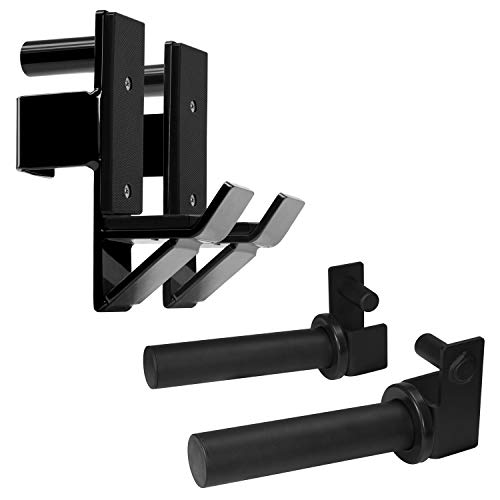 Yes4All Holder
Check price
Yes4All Holder
Check price
|
||
|---|---|---|---|---|---|
| Best for | Overall / 3x3 | Sandwich | Roller | Rogue 2x3 | Budget / 2x2 |
| Rating (*) | |||||
| Build quality | 90% | 88% | 92% | 92% | 82% |
| Bar & rack protection | 82% | 94% | 86% | 84% | 64% |
| Fit & security | 88% | 88% | 90% | 90% | 74% |
| Value | 92% | 76% | 72% | 70% | 94% |
| Price | $$ | $$ | $$$ | $$ | $ |
| Type | Standard | Sandwich | Roller | Standard | Standard |
| Fits | 3x3" upright | 3x3" upright | 3x3" Monster | Rogue 2x3" Infinity | 2x2" upright |
| Pin | 1" | 5/8" or 1" | 1" (5/8" option) | 5/8" bullnose | 1" hole |
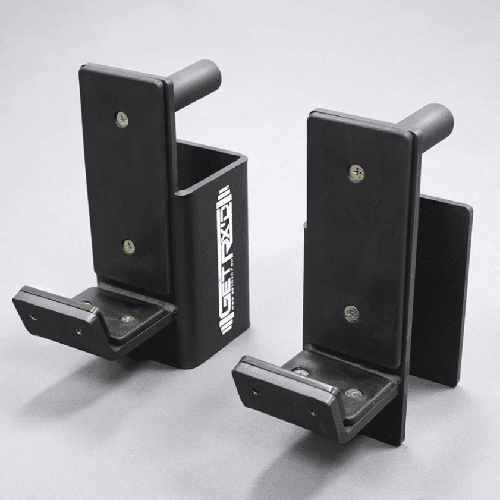 GetRXd RX3
Our testing and selection process
How we assess J-hooks
We run every J-hook roundup through the same steps:
- We start as the buyer. Steve, our certified PT, has fitted cups on home and commercial racks for over twenty years and knows what separates a cup you forget about from one that nags you every session.
- We research wide. We pull profile, pin size, steel gauge, lining, welds, capacity and owner feedback on as many cups as we can find, more than 70 this time, into one spreadsheet.
- We score each pair on our weighted system. Data decides the ranking, not the badge on the front.
- We split the field by job, because a 3x3 standard cup and a roller for a Rogue Monster get bought for very different reasons.
- We get hands-on where we can and lean on the SHG community for the rest.
You can read more about the process in our review guidelines.
How we score J-hooks
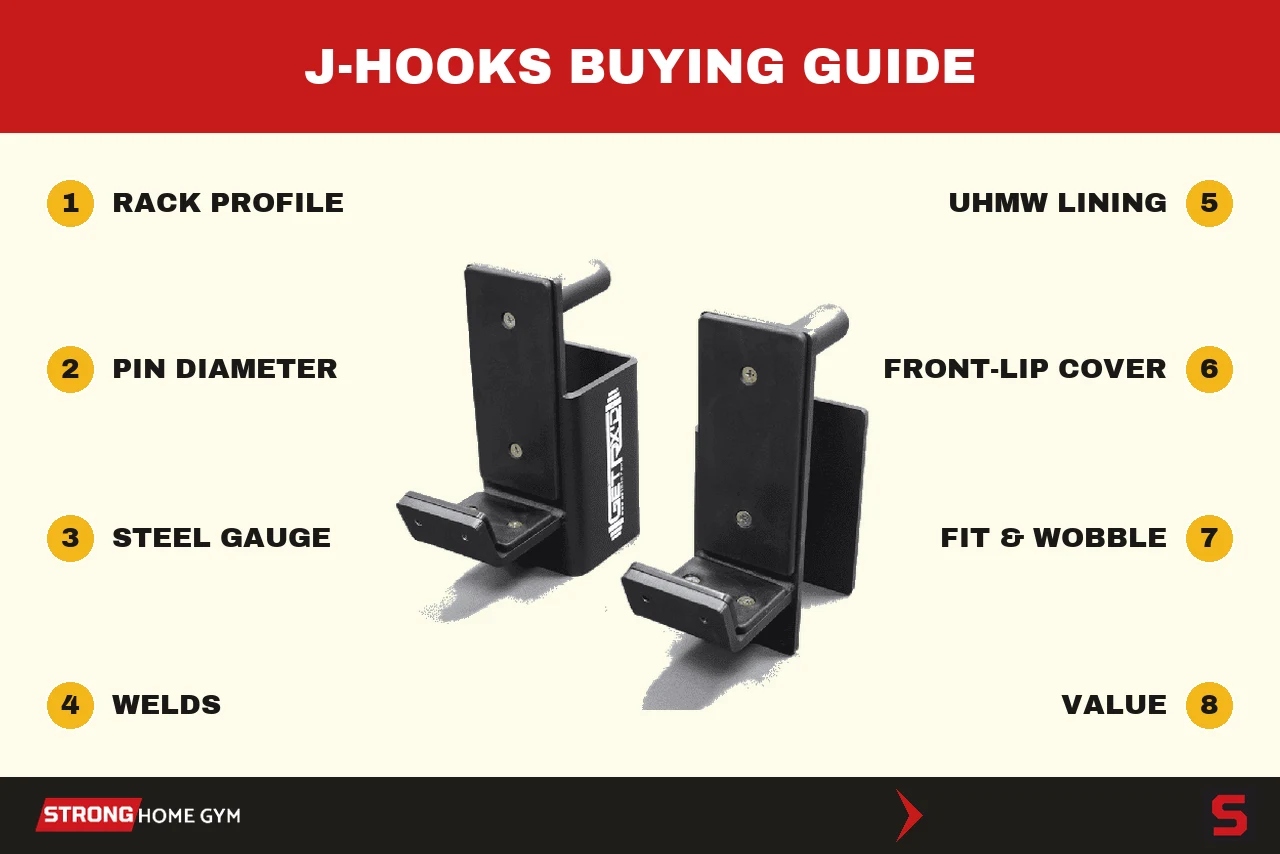
Here’s what feeds the score and how much each part counts. Build leads, because a cup that flexes or cracks a weld is no use whatever else it does.
We group it into four weighted factors:
- Build quality (35%) - steel gauge, welds, tolerances and finish.
- Bar & rack protection (25%) - how much of the bar and rack the lining actually covers.
- Fit & security (20%) - how tight it sits, whether it rattles, and its locking options.
- Value (20%) - what you get for the money.
Build quality (35%)
This carries the most weight. A J-hook holds a loaded bar at chest and shoulder height, so the steel, the welds and the finish are the whole foundation. We look at gauge, how clean the welds are (especially around the front lip, where a single-line weld is a red flag), and how tight the tolerances feel in the hand.
Gauge is the headline number, but it isn’t the whole story. Premium cups run 7 to 8 gauge; a solid budget cup is 11 gauge; below that you start to feel flex under a heavy bar.
Bar & rack protection (25%)
The best cups keep metal off metal. Your bar should only ever touch UHMW plastic lining, which spares the knurling, and ideally there’s lining on the back too so the cup doesn’t scuff the upright. We score how much of that contact the lining actually covers.
Two spots often go bare: the front lip on basic standard cups, and the rolling face on steel rollers. Neither is a dealbreaker, but both are why a fully lined sandwich cup scores highest here.
Fit & security (20%)
A cup can have every number right and still rattle. Fit comes down to precise tolerances and enough lining to take up the slack between pin and upright, so the cup sits tight and doesn’t lift. We score how snug it feels and whether it offers a lock-knob or second pin for the looser budget cups.
Most quality cups don’t need extra locking. On cheaper pairs, a lock-knob is a cheap bit of peace of mind.
Value (20%)
We build a quality-adjusted picture of price. The cheapest cup that holds a bar solidly can be smart money, and so can a mid-priced cup you’ll never think about again. We weight it below build and protection, because a bargain that flexes or marks your bar isn’t a bargain.
Find the perfect J-hook for you
Overall / 3x3 | Sandwich | Roller | Rogue 2x3 | Budget / 2x2
Here’s how the five pairs stack up on our overall score:
GetRXd RX3 J-Cups
Best OverallQuick specs
- Fits 3x3” GetRXd RX3 and Builder uprights, 1” pin
- Heavy-gauge steel, triangle-welded under the lip
- UHMW plastic lining on the hook
- Rated past 1,000 lb, sold as a pair
The standard cup that gets the most right for the most people: a hefty 3x3 hook with a clean build and a price that doesn’t sting.
Summary of experience, tests & opinions
What I like
- The build punches well above the price. Thick steel, tidy welds and a triangle weld under the lip give it a planted, hefty feel that cheaper cups can’t fake.
- The value is the whole story. In the 3x3 one-inch size, the real rivals cost roughly double, and the cheap imports aren’t close on finish. That gap is why it wins.
- It sits tight on the upright with no fuss, and the UHMW on the hook keeps the knurling off the steel where it counts.
What I don’t
- There’s no lining on the front lip, so the bar can touch metal as it rolls into place. Minor, but a sandwich cup avoids it entirely.
- One finish, one size family. If you’re not on a 3x3 upright, this isn’t your cup.
Pros & cons
Pros
- Premium build at a mid-range price - the standout value in its size.
- Thick steel and clean welds, including the triangle weld under the lip.
- UHMW lining on the hook and a tight, rattle-free fit.
Cons
- No padding on the front lip.
- Made for 3x3 uprights only.
Read more about the GetRXd RX3 J-Cups
This is the cup we point most people to, and the reason is dull but decisive: in the most common home-rack size, a 3x3 upright with a 1-inch pin, almost nothing matches it for the money.
Buy them if:
- You’re on a 3x3 rack with 1-inch holes and want one solid pair you never think about again.
- You want a premium feel without paying premium-brand prices.
- You’d rather spend the saving on plates than on a badge.
Skip them if you’re chasing full bar protection on every face (a sandwich cup does that better), or your rack isn’t a 3x3 with 1-inch pins, in which case one of the picks below is the right fit.
The field in this size is thinner than you’d expect. It really comes down to this cup, Rogue’s Monster, and a scatter of generic imports. Rogue’s is excellent and costs about twice as much; the imports save a little but give up welds, finish and tolerances to do it. That leaves the RX3 sitting in the sweet spot, with most of the premium feel and none of the premium price.
The one honest gap is the bare front lip. If that bothers you, a strip of felt sorts it, or you step up to a sandwich cup. For most lifters it’s a non-issue, because the lip only brushes the bar on the way into the cup, not while it’s loaded.
Note that GetRXd now sells this under the RX3 name. It’s the same cup, and the listing still confirms it fits the older Builder uprights too.
They take the top slot on our weighted overall score:
Bottom line
The GetRXd RX3 J-Cups are our top pick for three reasons:
-
Premium build, sensible price. Thick steel and clean welds without the flagship markup.
-
They fit the most common rack. A 3x3 upright with 1-inch pins is what most home lifters own.
-
Nothing else in the size beats the value. The alternatives cost double or cut corners.
They might be for you if… you’re on a 3x3 rack and want one solid standard pair for life.
They’re not for you if… you want full-face bar protection (see the sandwich) or you’re on a different upright (Rogue 2x3 or 2x2).
REP Round Sandwich J-Cups 2.0
Best SandwichQuick specs
- Fits 3x3” uprights, 5/8” (4000) or 1” (5000) pins
- UHMW plastic on every contact face
- Rounded profile that gathers the bar to centre
- Rated 1,000 lb, sold as a pair
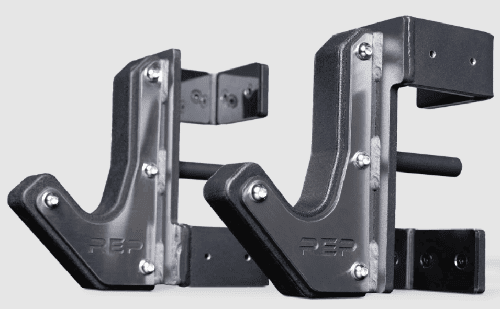
Full bar protection without the boutique price. The rounded UHMW block wraps the bar on every face and nudges it to centre as you rack.
Summary of experience, tests & opinions
What I like
- No metal touches your bar, anywhere. The whole cradle is UHMW, so the knurling stays crisp season after season.
- The rounded face is quietly clever. It gathers a slightly off-line bar into the centre, so ragged racking sorts itself out.
- It’s wider and longer than a flat sandwich cup, which spreads the load and makes it less inclined to shift.
What I don’t
- The welds aren’t quite as crisp as the flagship brands’, though they’re perfectly sound.
- The front lip stands a touch taller, so there’s marginally more to clear when you rack.
Pros & cons
Pros
- Complete bar protection - UHMW on every contact face.
- Rounded profile self-centres the bar on the way in.
- Wider and longer than a flat sandwich cup, and cheaper than the premium names.
Cons
- Welds a shade behind the flagship brands.
- Slightly higher front lip to clear when racking.
Read more about the REP Round Sandwich J-Cups 2.0
If your worry is chewing up an expensive bar, this is the honest answer to it. A sandwich cup means there’s no bare steel anywhere the bar sits, so the knurling never grinds against metal. The 2.0 is REP’s current version of the round sandwich, and it lands the same balance the original did: near-flagship protection for a friendlier price.
Worth it over a standard cup if:
- You own a bar you actually care about and want the knurling to last.
- You rack a little messily and like the way the rounded face gathers the bar to centre.
- You want full protection but don’t want to pay boutique-brand money for it.
Less necessary if you run a hard-wearing training bar and a standard cup’s occasional lip contact doesn’t trouble you. In that case the RX3 above saves you money.
The rounded shape is the part people underrate. A flat sandwich cup protects just as well, but you have to place the bar squarely. The round profile does some of that for you, cradling the bar and setting a consistent distance off the rack every rack. It’s a small thing that adds up across a session.
The trade-off is a slightly taller front lip, so there’s a fraction more to lift the bar over when you rack, and the welds are a step behind the very best. Neither changes the verdict. For most home lifters wanting total bar protection, this is the value pick, and it comes in both 5/8-inch (4000 series) and 1-inch (5000 series) pins so it fits either REP rack generation.
On our weighted overall score it sits just behind the standard pick:
Bottom line
REP’s Round Sandwich 2.0 is the pick when protecting the bar matters most. UHMW on every face keeps the knurling pristine, the rounded profile helps you rack clean, and it undercuts the flagship sandwich cups on price.
It might be for you if… you own a bar worth looking after and want zero metal-on-bar contact.
It’s not for you if… you’re happy with a standard cup’s occasional lip contact and would rather save the money (RX3), or you want the bar to self-return every time (roller).
Rogue Ghost Roller J-Cups 2.0
Best RollerQuick specs
- Fits 3x3” Rogue Monster (1” pin) or Monster Lite (5/8” pin)
- Conical, self-returning roller design
- Single-piece formed steel frame
- Bar range 1” to 2” shaft, sold as a pair
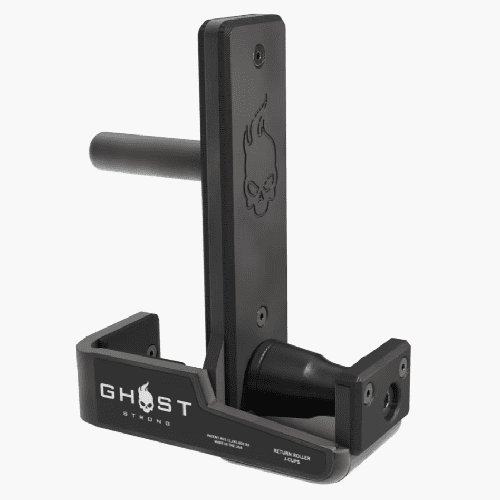
The cleverest way to rack a bar. The contoured roller gathers the bar and centres it for you, so racking takes no thought at all.
Summary of experience, tests & opinions
What I like
- The self-centring is genuinely useful. The sloped roller catches the bar and slides it to the middle in two directions, so you rack without lining anything up.
- The 2.0 fixed what nagged the original. The pin sits higher and the tolerances are tighter, so it stays put where the first version could wander.
- Rogue craftsmanship throughout, and it’s cheaper than the boutique return-rollers it competes with.
What I don’t
- It’s the priciest cup here, and rollers ask you to lift the bar a touch higher to clear them.
- The steel roller face means the bar meets metal there, a deliberate call for durability over knurling.
Pros & cons
Pros
- Self-returning roller centres the bar in two axes with no effort.
- Tight, high-end Rogue build, much improved over the first version.
- Cheaper than the boutique return-rollers it’s modelled on.
Cons
- The most expensive pick here.
- Steel roller face contacts the bar, and you rack a little higher.
Read more about the Rogue Ghost Roller J-Cups 2.0
This is the one people fall for once they’ve used it. A roller cup adds a contoured tube that the bar rolls onto, and because the tube is sloped, it gathers a slightly off-centre bar and returns it to the middle. Rack the bar roughly, and it sorts itself out. For training alone, that’s a real quality-of-life upgrade.
Buy them if:
- You train solo and want racking to be effortless, especially when you’re tired at the end of a set.
- You have a Rogue Monster (1-inch pin) or Monster Lite (5/8-inch pin) 3x3 rack.
- You want the best roller and don’t mind paying for it.
Skip them if budget leads your decision, or full knurling protection matters more to you than convenience, since the roller face is bare steel by design.
There’s a bit of history worth knowing. Rogue bought Ghost Strong in 2022, and the worry at the time was that they’d flatten what made it special. They didn’t. The 2.0 keeps the conical roller and multi-radius receiver that set it apart, and quietly corrects the original’s two faults: the pin now sits higher and the fit is tighter, so it stays where you put it instead of drifting.
Against its real rivals, the boutique return-rollers, the Ghost does the same trick for less, with Rogue’s build behind it. The catches are the price, which is the highest here, and the fact that a roller sits a fraction deeper, so you clear the bar a touch higher when you rack. If the self-centring appeals, both are easy to live with.
It lands mid-pack on our weighted overall score, held back only by price:
Bottom line
The Ghost Roller 2.0 is the pick if racking convenience is what you’re after. The sloped roller centres the bar for you, the 2.0 fixed the original’s wander, and it undercuts the boutique rollers it competes with.
They might be for you if… you train alone on a Rogue Monster or Monster Lite and want racking to take no thought.
They’re not for you if… you’re watching the budget (RX3) or you want full knurling protection over convenience (sandwich).
Rogue Infinity J-Cup Set
Best For Rogue 2x3Quick specs
- Fits Rogue 2x3” Infinity racks and stands, 5/8” bullnose pin
- 7-gauge steel, low-profile rounded design
- UHMW inserts front and back
- Rated 1,000 lb, sold as a pair
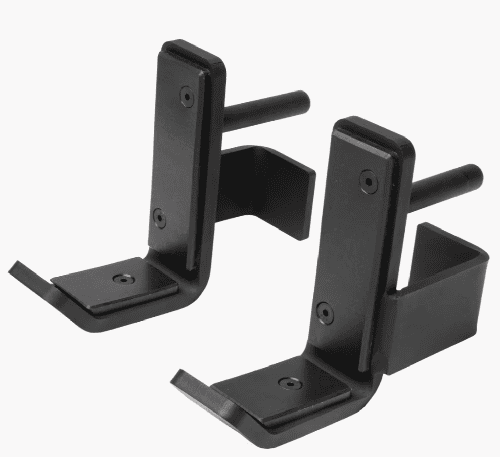
The obvious upgrade if you’re on a Rogue Infinity rack. Laser-cut, cleanly finished, and lined on both faces to spare the bar and the upright.
Summary of experience, tests & opinions
What I like
- The finish is spotless. Laser-cut edges, no sharp spots on the steel or the plastic, and the spacing is judged just right.
- Both faces are lined. UHMW front and back means the bar and the upright both stay unmarked.
- It sits dead tight on an Infinity upright, exactly as a first-party cup should.
What I don’t
- It costs more than a generic 2x3 cup, and the value score reflects that.
- No back-of-lip padding, so the same small lip-contact caveat as most standard cups.
Pros & cons
Pros
- First-party fit on Rogue Infinity racks, tight and rattle-free.
- Laser-cut 7-gauge build with a clean, snag-free finish.
- UHMW inserts front and back.
Cons
- Pricier than generic 2x3 cups.
- Standard-style lip, so occasional bar-to-lip contact.
Read more about the Rogue Infinity J-Cup Set
If your rack is a Rogue Infinity, this is the cup made for it, and that matters more than any spec. A 2x3 upright with 5/8-inch holes is its own size, and buying the cup designed for it gets you a fit that a generic 2x3 pair, or an adapted 3x3 cup, can’t match.
Buy them if:
- You own a Rogue Infinity rack or stand and want a clean, first-party fit.
- You value finish and tolerances and are happy to pay a little for them.
- You want both the bar and the upright protected by lining.
Skip them if you’re on a different upright (they won’t fit), or you’re hunting the lowest price for your 2x3, where a generic cup does a rougher version of the same job.
What you’re paying for is Rogue’s execution. It’s laser-cut, the edges are clean, there are no sharp spots anywhere, and the spacing is dialled so the bar sits where you expect. UHMW inserts sit front and back, so this is one of the better-protected standard cups here, not just a bare hook. Against the budget 2x3 alternatives, those cut lining, finish and racking depth to hit their price, and you feel the difference.
The only real mark against it is value, and that’s relative: it costs more than a generic cup because it’s a better one. If you own the rack it’s built for, it’s the easy call.
It sits fourth on our weighted overall score, strong everywhere but value:
Bottom line
For a Rogue Infinity rack, the Infinity J-Cup Set is the natural choice: a first-party fit, a clean laser-cut build, and lining on both faces. You pay a little over a generic cup, and you get a noticeably better one.
They might be for you if… you own a Rogue Infinity rack and want the cup built to fit it exactly.
They’re not for you if… you’re on a 3x3 (RX3) or 2x2 (Yes4All) upright, or price is the deciding factor.
Yes4All Barbell Holder
Best Budget / 2x2Quick specs
- Fits 2x2” uprights with 1” holes
- 6mm steel plate, thick rubber liner
- Lock-knob to stop slippage
- Rated 500 lb each (1,000 lb pair), sold as a pair
Cheap, and much sturdier than the price suggests. The go-to upgrade for a 2x2 rack when you don’t want to spend much.
Summary of experience, tests & opinions
What I like
- The steel is almost comically thick for the money. At 6mm it’s stouter than plenty of premium cups, and it feels planted under a loaded bar.
- The lock-knob is a smart touch at this price. It takes up the slack on a 2x2 upright and stops the cup wandering.
- For a budget 2x2 rack, it’s the sensible upgrade that just works.
What I don’t
- The lining is rubber rather than UHMW, so it won’t wear as well over the long haul.
- No padding on the front lip, and the finish is paint, not powder coat.
Pros & cons
Pros
- Very cheap, and burly - 6mm steel that shrugs off a heavy bar.
- Lock-knob keeps it planted on a 2x2 upright.
- Sensible sizing and racking depth for the money.
Cons
- Rubber liner instead of UHMW, so shorter lining life.
- Paint finish and a bare front lip.
Read more about the Yes4All Barbell Holder
Plenty of budget racks are 2x2, and quality cups in that size are thin on the ground, which is exactly where this pair earns its place. It’s cheap, it’s stocked on Amazon, and it’s built far heavier than the price hints.
Buy them if:
- You’re on a 2x2 rack with 1-inch holes and want a solid upgrade without spending much.
- You want thick steel and a lock-knob over fancy finishes.
- You’d rather put the saving towards plates or a better bar.
Skip them if long-term lining life matters to you, or you want the crisp welds and UHMW of a premium cup. For that, you’d move up a rack size and a price bracket.
The steel is the headline. At 6mm it’s thicker than a lot of premium cups, because thick steel is cheap and easy to weld, so on raw sturdiness it holds its own with anything here. The lock-knob is the other clever bit: on a 2x2 upright, tolerances tend to be looser, and the knob takes up that slack so the cup doesn’t lift or rattle.
Where it gives ground is the lining and the finish. The pads are rubber, not UHMW, so they’ll soften and wear sooner, and you may end up gluing on a replacement strip down the line. The finish is paint rather than powder coat. None of that stops it doing the job cheaply and solidly, which is the whole point of a budget cup. If the rubber lining bothers you, step up to a lined standard cup; if it doesn’t, this is a lot of J-hook for very little.
It sits fifth on our weighted overall score, carried by value:
Bottom line
The Yes4All Barbell Holder is the budget answer for a 2x2 rack: thick 6mm steel, a handy lock-knob, and a price that barely registers. You give up UHMW lining and a smart finish, but you keep the part that holds the bar.
They might be for you if… you’re on a 2x2 rack and want a sturdy upgrade for very little.
They’re not for you if… you want UHMW lining and premium welds, or your rack is a 3x3 (RX3) or Rogue 2x3 (Infinity).
What kind of J-hook do you actually need?
There are three types, and picking the right one is mostly about what annoys you. Here’s who each suits.
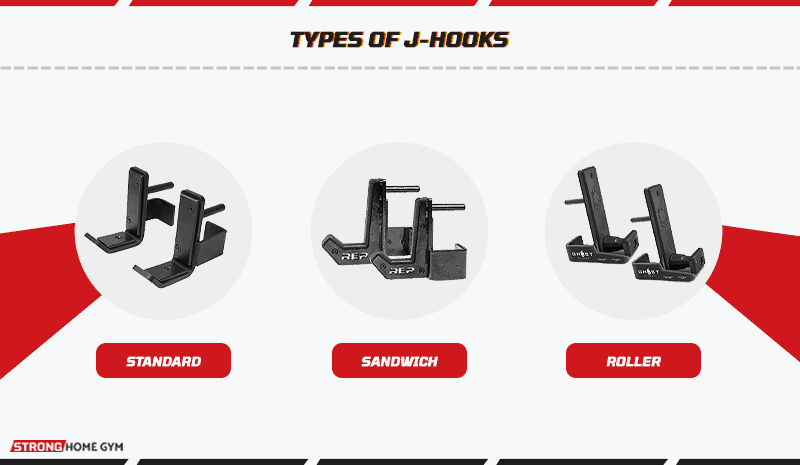
Standard J-hooks
The kind that comes with most racks: a simple lined hook. If your rack pair is basic or worn, a better standard cup is the cheapest worthwhile upgrade, and for most lifters it’s all you ever need. The one weak spot is the front lip, which is often bare steel, so the bar can brush metal as it rolls in. Our RX3 and Infinity picks are the standard cups to beat.
Sandwich J-hooks
A UHMW plastic core wrapped in a steel shell, built so no metal ever touches your bar. If you own a bar you care about, this is the type that keeps the knurling crisp. It costs a little more than a standard cup and offers no extra convenience, just complete protection. The REP Round Sandwich is our value pick here.
Roller J-hooks
A contoured tube the bar rolls onto, which gathers it to centre as you rack. It’s the convenience option: rack the bar roughly and it sorts itself out, which is a real help when you train alone. Rollers cost the most and sit a touch deeper, so you clear the bar a bit higher. The Ghost Roller 2.0 is the one we’d buy.
Will they fit your rack?
This is the part to get right before you spend anything. A J-hook has to match your rack on two measurements, and a mismatch on either means it won’t sit properly.
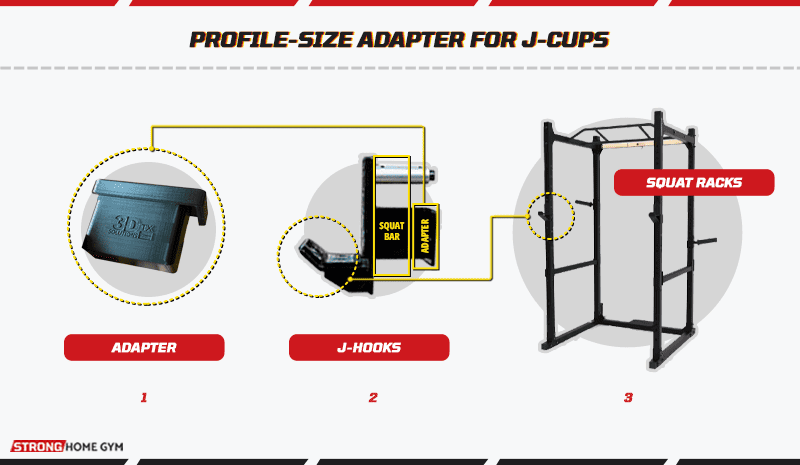
- Upright profile. Most home racks are 3x3, 2x3 or 2x2 inches. Measure the tube, don’t guess.
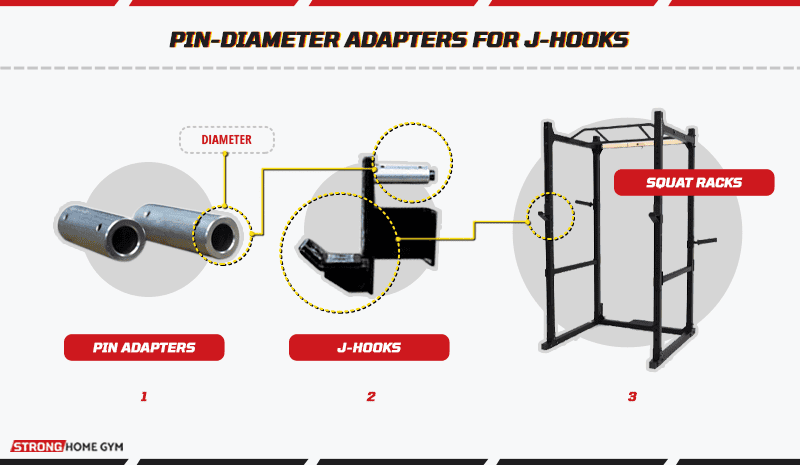
- Pin or hole diameter. Commonly 1 inch or 5/8 inch. A 1-inch pin won’t drop into a 5/8-inch hole, and a 5/8-inch pin rattles in a 1-inch hole.
Some of the best cups are made for one size only, usually 3x3, because that’s where the demand is. If your rack is a different size, buy the cup made for it rather than forcing a fit.
You can bridge a mismatch with adapters, a profile adapter to pack out a smaller upright, and a pin-diameter adapter to size a smaller pin up to a bigger hole, but they add cost and a little slop. With so many cups now made for each common size, most people never need them.
Other J-hooks we considered
Rogue Monster J-Cups. Superb, and the benchmark 3x3 cup in build terms. We didn’t crown them because they cost roughly double our top pick for a difference most home lifters won’t feel. If budget’s no object and you’re on a Monster rack, they’re excellent.
Bells of Steel and Titan T-3 cups. Both brands make standard, sandwich and roller cups that are wired and sensibly priced, and either is a fair shout if you’re already in their rack ecosystem. They land a step behind our picks on finish and fit, not enough to fault, just not enough to top the list.
Bridge Built Combo Roller. A roller-and-sandwich hybrid: you rack onto the rolling part, then it settles onto a flat sandwich face. Genuinely clever, and beautifully made, but it’s a lot of money for a home gym and overkill unless you specifically want that hybrid action.
Boutique premium sandwich cups. There are small-batch cups out there with oversized UHMW blocks and magnetic anti-sway pins that reviewers love. They’re excellent and expensive, and we can’t currently point you to a tracked deal on them, so we’ve left them off rather than send you somewhere that doesn’t help at the checkout.
The bottom line
If you’re on a standard 3x3 rack and just want one good pair, get the GetRXd RX3 J-Cups. They’re built like premium cups and priced like sensible ones, and nothing in the size beats them for the money.
From there it’s about what you care about. Want the bar fully protected? The REP Round Sandwich 2.0 keeps metal off the knurling on every face. Train alone and want racking to be effortless? The Ghost Roller 2.0 centres the bar for you. On a Rogue Infinity rack? The Infinity set is the first-party fit. On a budget 2x2? The Yes4All Holder is thick, cheap and does the job.
Whatever you choose, measure your upright and hole size first. Get the fit right and any of these will outlast the rack they sit in.
J-hook FAQs
What is a J-hook, and what does it do?
A J-hook (also called a J-cup) is the bracket that pegs into your squat rack’s upright and holds the loaded barbell at rest. You rack and unrack the bar off the pair of them for squats, presses and rows. A good one holds the bar dead still, protects the knurling and the rack from metal-on-metal scuffing, and slots in without a wobble. Most racks ship with a basic pair, and upgrading is one of the cheapest ways to make a rack feel better to use.
Will any J-hook fit my squat rack?
No, and this is the one thing to get right before you buy. J-hooks are sized to two measurements: the upright profile (usually 3x3, 2x3 or 2x2 inches) and the pin or hole diameter (commonly 1 inch or 5/8 inch). A cup made for a 3x3 upright with a 1-inch pin won’t sit properly on a 2x3 Rogue upright with a 5/8-inch hole. Measure your upright and check the hole size against the product listing every time.
Are sandwich or roller J-hooks worth it over standard ones?
It depends on what annoys you. A standard cup is cheapest and does the job. A sandwich cup wraps the bar in UHMW plastic on every contact face, so there’s no metal touching your knurling anywhere. A roller cup adds a contoured tube that gathers the bar to centre as you rack it, which is a real convenience if you train alone and rack messy. If you own a pricey bar, or you rack heavy and want it easier, the upgrade pays off. If not, a good standard cup is plenty.
What steel gauge should J-hooks be?
Most high-quality J-hooks use 7 to 8 gauge steel, which is around 4.5mm thick and stiff enough that you’ll never feel it flex. For a budget cup, 11 gauge (about 3mm) is fine. Below that, into 14 gauge, you start to notice give under a heavy bar. Oddly, some cheap cups are actually thicker than premium ones, because thick steel is easier to weld, so gauge alone doesn’t tell you the whole story. Welds, tolerances and lining matter just as much.
Do I need J-hooks with a second safety pin or lock-knob?
Usually not on a quality cup. Precise tolerances and a good UHMW lining give a tight fit that doesn’t move, and most lifters find a second pin more hassle than help because it slows down height changes. On cheaper cups with looser tolerances, a lock-knob or a secondary pin is a sensible bit of security to stop the cup lifting or rattling. The better the fit, the less you need one.
Can I use 3x3 J-hooks on a 2x3 rack?
Yes, with a profile adapter that packs out the difference, and you may also need a pin-diameter adapter if the hole sizes don’t match. It works, but it adds cost and a little slop. Given how many cups are now made for each common size, most people are better off buying the pair made for their rack in the first place, and only reaching for adapters if you’re set on a specific cup that doesn’t come in your size.
