

We scored 66 lat pulldown machines across 18 build aspects to find the 5 best lat pulldown machines for a home gym, judged on what decides whether a pulldown earns its floor space or gathers dust.
I’ve owned and coached in home gyms for over two decades, and I’ve bolted, built, and broken in more cable machines than I can count, so I know which pulldowns feel smooth and which grind. Our team scored every pick the same way, on current stock and real prices, so this is data, not a brand’s sales sheet.
The goal was simple: cut the machines you can’t buy right now and the ones that wobble, and hand you a short list that fits your space, your rack, and your budget.
Let’s see if we did a good job…
Editor's note · updated June 5, 2026
We rebuilt this guide on our current scoring system and re-checked stock on every pick, which forced a big reshuffle.
What changed:
- Titan Plate-Loaded Lat Tower took the overall slot. It’s a freestanding lat-and-row combo, in stock and brand-direct, at a budget-tier price.
- The old standalone picks are sold out or gone: the Bells of Steel Lat Pulldown, Ironmaster Cable Tower, and the Synergee unit are all unavailable right now, so the in-stock market leans on Titan and REP.
- Live interactive scoring replaced the static charts, and value scores now track real prices.
Related
I’ve built cable stations into more home gyms than I can count. If you’d rather bolt a pulldown to your rack, see our guide to the best lat pulldown bars, and for the full back-training picture, read our home gym build guide.
Compare the best lat pulldown machines
 Titan Selectorized
Check price
Titan Selectorized
Check price
|
 Titan T-3/X-3 Attach
Check price
Titan T-3/X-3 Attach
Check price
|
 Valor CB-12
Check price
Valor CB-12
Check price
|
|||
|---|---|---|---|---|---|
| Best for | Overall | Premium / rack-attached | Selectorized | Budget rack-attached | Cheap standalone |
| Rating (*) | |||||
| Quality | 86% | 92% | 86% | 78% | 72% |
| Versatility | 84% | 96% | 80% | 78% | 74% |
| Brand & reputation | 82% | 90% | 82% | 80% | 72% |
| Value | 90% | 68% | 78% | 86% | 84% |
| Type | Standalone | Rack-attached | Standalone | Rack attachment | Standalone |
| Resistance | Plate-loaded | Dual 260 lb stacks | 300 lb stack | Plate-loaded | Plate-loaded |
| Max load | 400 lb | 260 lb / stack | 300 lb | 300 lb | 200 lb |
| Cable ratio | 1:1 | 2:1 | 1:1 | 1:1 | 1:1 |
| Low row included | Yes | Yes | Yes | Yes | Yes |
| Price | $$ | $$$$ | $$$ | $$ | $ |
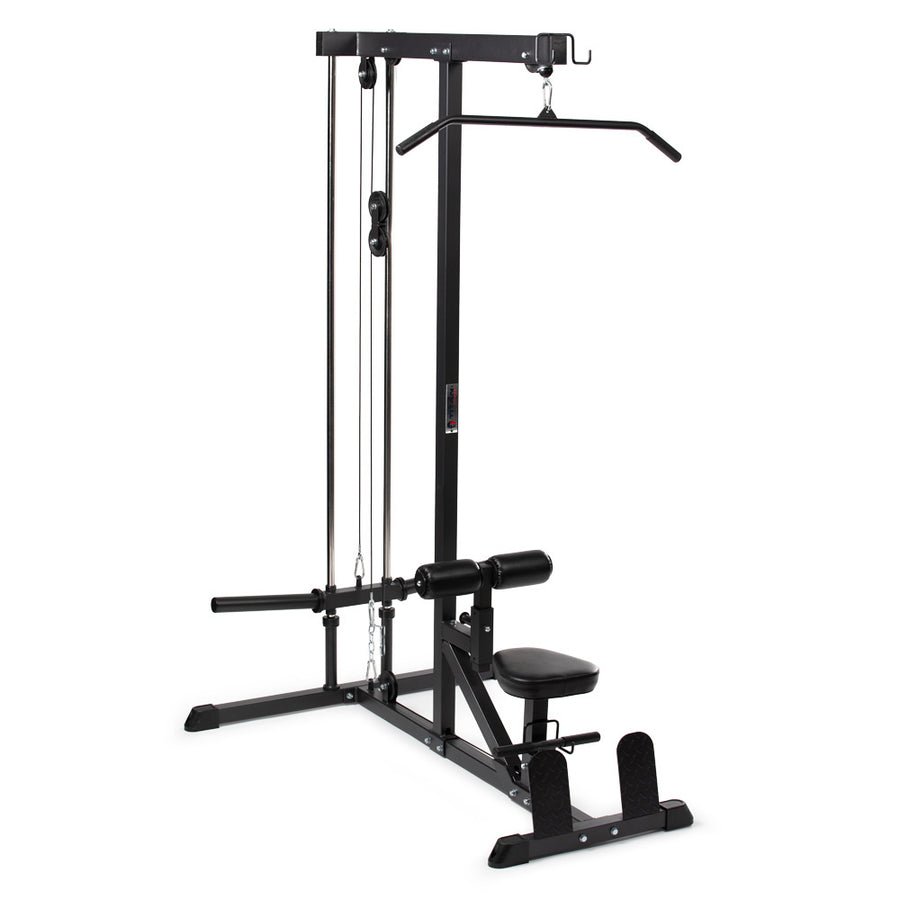 Titan Lat Tower
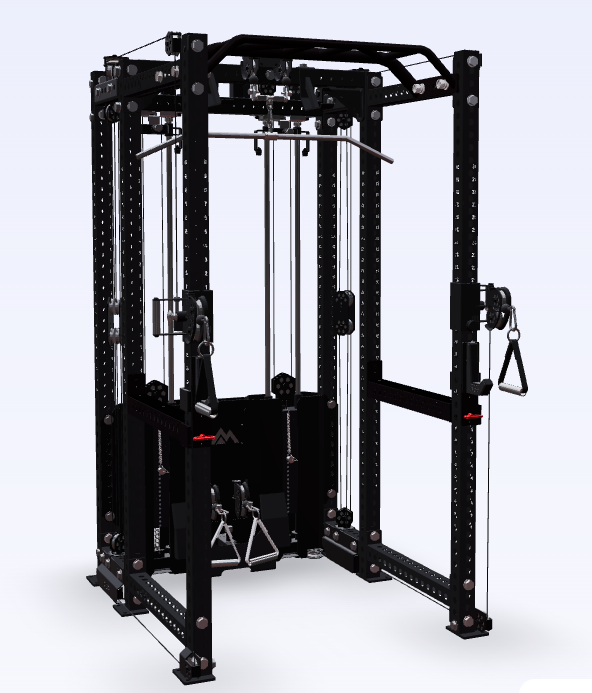 REP Ares 2.0
Our testing and selection process
How we assess the lat pulldown machines
We always use a 5 step process in our reviews:
- We start as the buyer. I’ve run a gym for over two decades and pulled on every kind of lat machine there is, so we know what smooth feels like.
- We do a ton of research. We pull specs, prices, stock status, and owner reports on every machine worth a look into one master spreadsheet.
- We rate each machine with our weighted scoring system. The categories and weights are below.
- We let the data make the call instead of the logo. A budget unit can out-score a name brand on value and still earn its slot.
- We get our hands on as many top picks as possible. Our community is a big help here.
You can read more in our review guidelines.
How we test and score the lat pulldown machines
A lat machine has a few jobs, so the scoring follows them. What separates a good one from a bad one is a smooth cable and solid frame, whether it fits your space and rack, and what it costs against all that.
I grouped it into 4 chunks:
- Quality (40%) - the frame steel, the pulley and cable smoothness, the seat and thigh pad, and how stable it stays under a hard pull.
- Versatility (8%) - standalone versus rack-attached, plate-loaded versus stack, the low-row option, and what else it covers.
- Brand & reputation (15%) - what owner reports and track record say about longevity and service.
- Value for money (37%) - the real price against the build and function you get, normalized to the lineup.
Here is how the 5 picks rank on the overall score, with the Titan Lat Tower out in front:
Quality of a lat pulldown machine (40%)
This is the biggest category, and on a lat machine it comes down to the frame, the cable, and the seat.
A heavy-gauge frame is what keeps the machine planted when you pull hard, where a thin one rocks and creeps across the floor. The cable and pulley decide the feel. Sealed pulleys and a coated cable run silky for years, while cheap hardware develops a notch and a squeak. The seat and thigh pad matter more than people expect, because if your legs lift off on a heavy set, you can’t pull through the full range.
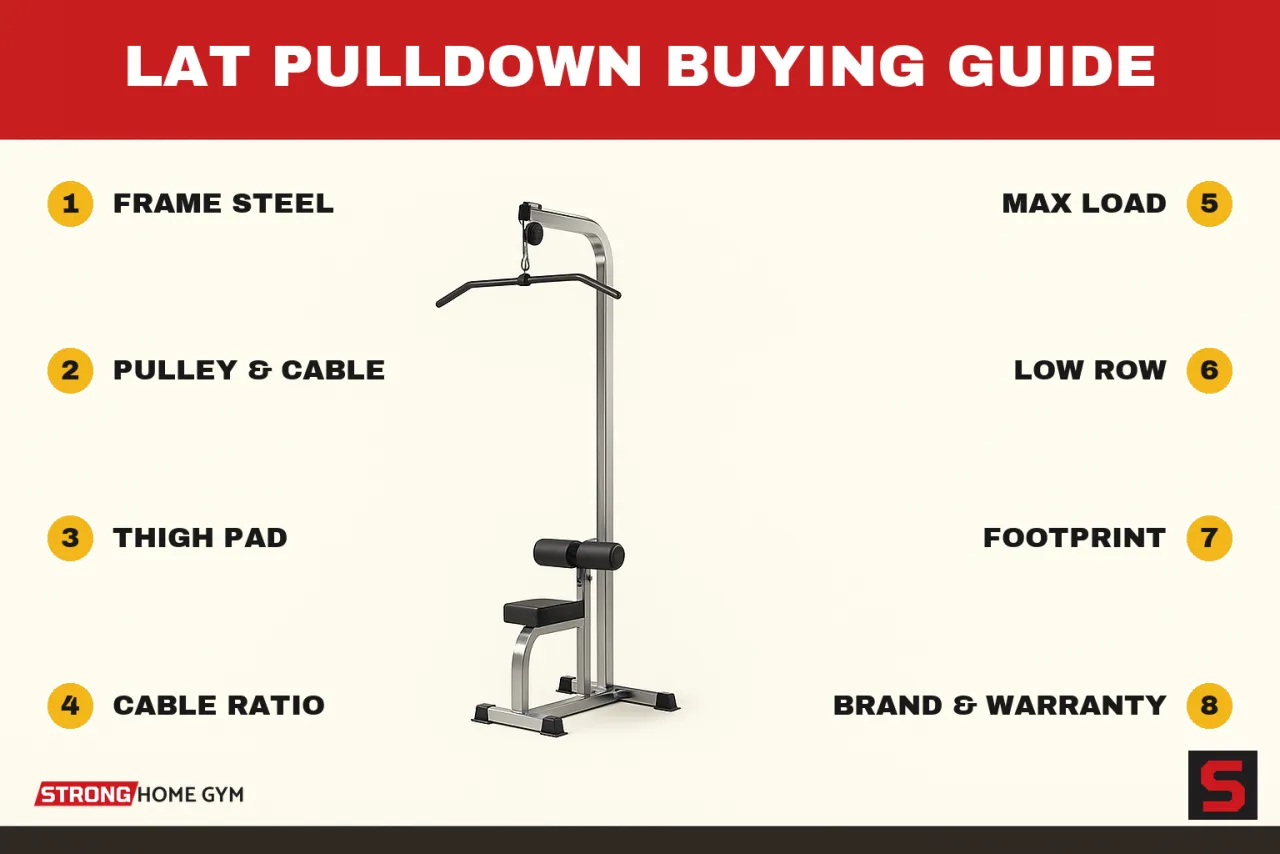
My tip: look for an adjustable thigh pad with a real range. A fixed pad that doesn’t pin your legs turns every heavy pulldown into a fight.
Versatility (8%)
This is a small slice, because every machine here pulls down and rows. But the form factor changes who it suits.
Versatility on a lat machine is mostly standalone versus rack-attached.
The versatility of a lat pulldown machine comes down to the following:
- Standalone versus rack attachment (do you have a rack to bolt to?)
- Plate-loaded versus selectorized stack (load plates, or pin the weight?)
- Extra functions (low row, cable angles, a full functional trainer?)
Standalone versus rack attachment
The first call is whether you own a rack.
A standalone unit like the Titan Lat Tower needs no rack and goes anywhere, which suits a gym built around benches and dumbbells. A rack attachment like the Titan T-3/X-3 bolts to a power rack you already own, costs less, and saves floor space, but only fits specific racks. If you have a compatible rack, the attachment is the cheaper path.
My tip: if you already own a power rack, price the bolt-on attachment first. It’s usually half the cost of a freestanding tower and takes a fraction of the floor.
Brand & reputation (15%)
This group is comprised of 3 sub-factors:
-
Current owner satisfaction (40%). What recent buyers say about cable smoothness, stability, and assembly.
-
Track record and longevity (35%). How the brand’s machines hold up across years of owner reports, not just the first month.
-
Service and warranty (25%). How the brand handles a frayed cable or a worn pulley.
Value for money (37%)
We create price towers and award the machines that cost less for the same smooth cable, stable frame, and function.
In other words…
We look for the machine that makes you pay for the pulleys and the steel, not for the logo on the upright.
Find the perfect lat pulldown machine for you
Best Overall | Best Premium | Best Selectorized | Best Budget Rack-Attached | Cheapest Standalone
Titan Plate-Loaded Lat Tower
Best Overall Lat Pulldown MachineQuick specs
- Type - Standalone, plate-loaded
- Max load - 400 lb (dual posts)
- Ratio - 1:1
- Extras - Lat bar + low row included
The freestanding combo I’d put in most home gyms. A lat pulldown and a low row in one unit, dual plate posts, a true 1:1 ratio, and a budget-tier price, brand-direct.
Summary of experience, tests & opinions
What I like
- It’s a freestanding lat-and-row combo that needs no rack, so it drops into a gym built around benches and dumbbells and works on day one.
- The dual plate posts and 1:1 ratio mean the weight you load is the weight you feel, with a 400-pound ceiling well past what most people pull.
- It uses the plates you already own, so there’s no expensive stack to pay for, which is why it lands at a budget-tier price.
What I don’t
- A plate-loaded tower means stripping and reloading plates between exercises, which is slower than pinning a stack on the Selectorized version.
Pros & cons
Pros
- Freestanding lat and low row – a full pulldown-and-row station that needs no rack.
- Dual plate posts, 1:1 ratio – loads with your own plates, and felt weight matches loaded weight.
- 400-lb capacity – well past anything most lifters will pull, with room to grow.
- Brand-direct from Titan – a tracked buy at a budget-tier price.
Cons
- Plate-loaded – you reload plates between moves, slower than a selectorized stack.
- Needs floor space – a freestanding tower takes more room than a rack attachment like the T-3/X-3.
Read more about the Titan Plate-Loaded Lat Tower
This is the machine I point most home-gym owners toward, especially anyone without a power rack to bolt onto.
It wins overall on value and reach. You get a full lat-pulldown-and-low-row station that stands on its own, loads with plates you already own, and pulls at a true 1:1 ratio, all for a budget-tier price. With Bells of Steel and Ironmaster’s standalone units out of stock right now, it’s also one of the few freestanding pulldowns you can actually buy today.
Set against the rack-mounted REP Ares, it’s a different animal. The Ares is a full dual-stack functional trainer that does fifty movements, but it costs many times more and bolts to a REP rack. The Titan does the one job a lat machine needs to do, stands anywhere, and costs a fraction. For a focused back station, that’s the smarter spend.
This is the pick for nearly anyone who wants a standalone pulldown. Step up to the Ares only if you want a full cable gym, or the Selectorized version if you’d rather pin weight than load plates.
That blend of function, reach, and price is why it tops the overall score:
Bottom line
The Titan Plate-Loaded Lat Tower is the top-rated lat machine for 3 main reasons:
-
It stands alone - a full pulldown-and-row station that needs no rack and goes anywhere.
-
It loads your plates - dual posts and a 1:1 ratio, no expensive stack to pay for.
-
It’s priced right - all that function brand-direct at a budget tier, which is why it tops the value score.
The Titan Lat Tower might be for you if… you want a standalone pulldown and low row, no rack required, at the lowest sensible price.
It’s not for you if… you want a full cable gym, where the REP Ares does far more, or you’d rather pin a stack than load plates, where the Selectorized version fits.
REP Ares 2.0
Best Premium Lat Pulldown MachineQuick specs
- Type - Rack-attached functional trainer
- Resistance - Dual 260 lb stacks
- Ratio - 2:1
- Extras - Lat, row, and 50+ cable moves
The do-everything pick. A dual-stack functional trainer that bolts to a REP rack and adds a lat pulldown, a seated row, and a full cable gym in one unit.
Summary of experience, tests & opinions
Where it shines
- It’s not really a lat machine, it’s a full cable gym. Beyond the pulldown and seated row, the dual independent pulleys do flys, presses, curls, and fifty other movements.
- The selectorized 260-pound stacks mean you pin the weight and go, no plates to load, with smooth commercial-grade pulleys.
- It bolts to a REP PR-4000 or 5000, so it shares your rack’s footprint instead of adding a whole new machine.
Where it falls short
- It costs many times what a focused lat tower does, and it only fits a REP rack. That’s the trade for a whole cable gym in one attachment.
Pros & cons
Pros
- Full cable gym – lat pulldown, seated row, flys, presses, and dozens more from dual pulleys.
- Dual 260-lb selectorized stacks – pin the weight and go, with smooth commercial pulleys.
- Bolts to a REP rack – shares your existing footprint instead of adding a separate machine.
Cons
- Premium price – many times the cost of a focused lat tower, which sinks its value score.
- REP racks only – needs a PR-4000 or 5000, so it’s not an option without one.
Read more about the REP Ares 2.0
This is the pick for the lifter who wants far more than a lat machine and already runs a REP rack.
Its edge is sheer breadth. The dual independent stacks turn your rack into a full cable gym, so the lat pulldown and seated row are just two of dozens of movements you get, all with smooth selectorized weight. For a one-and-done back, chest, and arm station, nothing else here comes close.
The honest catch is price and fit. Lined up against the Titan Lat Tower, the Ares costs many times more and only bolts to a REP rack, where the Titan stands anywhere for a fraction. If all you want is pulldowns and rows, the Ares is overkill, which is exactly why it scores low on value despite the best build here. If you want a whole cable gym, it’s worth every penny.
Buy it if you want a full cable gym on a REP rack. Pass if you only need a focused, affordable pulldown.
It leads the field on versatility by a mile, on the strength of being a full functional trainer:
Bottom line
The REP Ares 2.0 is the move if you want a full cable gym, not just a lat machine, and you already own a REP rack. The dual stacks and 50-plus movements are the draw. For a focused, affordable pulldown that stands on its own, the Titan Lat Tower is the smarter buy.
Titan Selectorized Lat Tower 10-300
Best Selectorized Lat Pulldown Machine
Quick specs
- Type - Standalone, selectorized
- Resistance - 300 lb pin stack
- Ratio - 1:1
- Extras - Lat bar + low row included
The pin-and-go standalone. A freestanding lat-and-row tower with a full 300-pound weight stack, so you change load in a second with no plates to handle.
Summary of experience, tests & opinions
What worked
- The 300-pound pin stack is the appeal. You drop the pin and the weight changes in a second, no stripping and reloading plates between drop sets.
- It’s a full freestanding lat-and-row tower like the plate-loaded version, so it needs no rack and covers both pulls.
- The heavier frame and stack make it the most stable, planted Titan pulldown here under a hard pull.
What didn’t
- The stack is what you pay for. It costs a clear tier more than the plate-loaded tower, which does the same lifts with plates you already own.
Pros & cons
Pros
- 300-lb pin stack – change weight in a second, ideal for drop sets and supersets.
- Freestanding lat and low row – a full pulldown-and-row station, no rack needed.
- Heavy, stable frame – the most planted Titan pulldown under a hard pull.
Cons
- Pricier than plate-loaded – the stack costs a tier more than the plate-loaded tower.
- Heavier to move and assemble – the stack and frame are a bigger build than a plate unit.
Read more about the Titan Selectorized Lat Tower 10-300
This is the tower for the lifter who wants standalone pulldowns without ever touching a plate.
Its one real advantage over the plate-loaded version is speed. The 300-pound pin stack lets you change weight instantly, which matters on drop sets, supersets, and any session where you’re chasing the pump rather than a 1RM. It’s the same freestanding lat-and-row format, just with a stack instead of posts.
The trade against the plate-loaded Lat Tower is pure money. Both stand alone, both pull at 1:1, both include the low row, but the stack version costs a clear tier more for the convenience of pinning weight. If you value speed and already have plates spoken for, the stack earns its keep. If you’d rather save the money, the plate-loaded tower does the same lifts.
Buy it if you want pin-and-go convenience in a standalone unit. Save money with the plate-loaded tower if you don’t mind loading plates.
It matches the plate-loaded tower on build quality, a step behind the premium Ares:
Bottom line
The Titan Selectorized Lat Tower is the pick if you want a standalone pulldown with a pin stack so you never load a plate. The instant weight changes are the draw. If you’d rather save the money and load plates, the plate-loaded tower does the same lifts for less.
Titan T-3 / X-3 Lat Tower Attachment
Best Budget Rack-Attached Lat Pulldown
Quick specs
- Type - Rack attachment (T-3 / X-3)
- Resistance - Plate-loaded, 300 lb
- Ratio - 1:1
- Extras - Lat bar + low row included
The cheapest way to add pulldowns. A plate-loaded lat-and-row attachment that bolts onto a Titan T-3 or X-3 rack you already own, for a fraction of a freestanding tower.
Summary of experience, tests & opinions
Where it earns its place
- It’s the cheapest pulldown here by a wide margin, because it borrows your rack’s frame instead of bringing its own. If you own a Titan T-3 or X-3, that’s a big saving.
- The plate-loaded lat and low row cover both pulls at a true 1:1, the same core function as a freestanding tower.
- It takes almost no extra floor, bolting to the rack you already stand in.
Where it limits you
- It only fits Titan T-3 and X-3 bolt-down racks made after late 2021. No rack, or the wrong rack, and it’s a non-starter.
Pros & cons
Pros
- Cheapest pulldown here – borrows your rack’s frame, so you only pay for the pulley and arms.
- Plate-loaded lat and low row – both pulls at 1:1, the same core function as a tower.
- Almost no extra footprint – bolts to the rack you already own.
Cons
- Specific racks only – fits Titan T-3 and X-3 bolt-down racks from late 2021 on, nothing else.
- Plain build – a budget attachment, a step below a dedicated freestanding tower.
Read more about the Titan T-3 / X-3 Lat Tower Attachment
This is the pick for the lifter who already owns a Titan T-3 or X-3 rack and wants pulldowns for the least money.
Its whole pitch is value through reuse. Because it bolts to a rack you already own, you skip the cost of a second frame and pay only for the pulley system and arms. That makes it the cheapest way on this list to add a real plate-loaded lat pulldown and low row.
The line against the Titan Lat Tower is simple: the standalone tower goes anywhere and needs no rack, while this attachment is cheaper but only fits specific Titan racks. If you have the right rack, the attachment is the obvious value play. If you don’t, the freestanding tower is the one to buy. Owner reports are happy as long as the rack match is right, so check the fit first.
Buy it if you own a Titan T-3 or X-3 and want cheap pulldowns. Choose the Lat Tower if you have no rack or a different one.
It sits near the top on value, second only to the overall pick:
Bottom line
The Titan T-3/X-3 attachment is the move if you already own a compatible Titan rack and want pulldowns for the least money. The rack reuse is the whole saving. If you have no rack or a different one, the standalone Titan Lat Tower is the buy.
Valor Fitness CB-12
Cheapest Standalone Lat Pulldown
Quick specs
- Type - Standalone, plate-loaded
- Max load - 200 lb
- Ratio - 1:1
- Extras - Low row + ab harness
The rock-bottom freestanding pick. A compact plate-loaded lat-and-row station for the least money, fine for a beginner or a light-load home gym.
Summary of experience, tests & opinions
What’s smart
- It’s the cheapest standalone here, so a beginner gets a real freestanding lat-and-row station without committing big money.
- It includes a low-row T-bar and an ab harness, so it covers more than just the pulldown for the price.
- It uses 1-inch standard plates out of the box and takes Olympic plates with adapters, so it works with whatever you own.
What’s not
- The 200-pound capacity and lighter frame are the catch. Strong pullers will out-grow it, and it’s less planted than the heavier Titan towers.
Pros & cons
Pros
- Cheapest standalone – a real freestanding lat-and-row station for the least money.
- Low row plus ab harness – more functions than the bare pulldown for the price.
- Adjustable seat and thigh pad – pins your legs so you can pull through the full range.
Cons
- 200-lb capacity – strong lifters will out-grow it, where the Titan towers go to 300-plus.
- Lighter frame – less planted under a hard pull than the heavier units, and Amazon-only.
Read more about the Valor Fitness CB-12
This is the station for the beginner or light-load lifter who wants a freestanding pulldown as cheaply as possible.
Value is the only reason to buy it, and at this price it’s a fair one. You get a compact lat-and-row tower with a low-row T-bar and an ab harness, enough to train your back at home without spending much, and it works with the plates you already own.
The gap against the Titan Lat Tower is capacity and build. The Titan goes to 400 pounds on a heavier, more planted frame, while the Valor caps at 200 on a lighter one. For a strong puller that ceiling arrives fast, but for a beginner or anyone keeping loads moderate, the Valor does the job for the lowest price. Owner reports call it a solid starter rather than a forever machine.
Buy it as a cheap first pulldown. Step up to the Titan Lat Tower the moment you out-grow 200 pounds or want a sturdier frame.
It holds a strong value spot for the lowest price, despite the lighter build:
Bottom line
The Valor CB-12 is the move if you want the cheapest freestanding pulldown to train your back at home. The low capacity and lighter frame are what the low price buys. The moment you out-grow 200 pounds, the Titan Lat Tower is the upgrade.
How we created this list of best lat pulldown machines
Here are our criteria on how we picked these machines, and how we valued each criterion when making decisions:
- Quality (40%)
- Versatility (8%)
- Brand reputation & reviews (15%)
- Value for money (37%)
You can find out all about our selection process here.
Other lat pulldown machines we tested - close-but-no-cigar
- Bells of Steel Lat Pulldown Low Row - a former editorial favorite, but every variant was sold out at the time of writing, so it’s benched until it restocks.
- Ironmaster Cable Tower V2 - a smart compact attachment for the Super Bench, but it’s out of stock right now, so we held it back.
- Synergee Lat Pulldown - the old budget pick, now discontinued and gone from every US retailer.
Lat pulldown machine FAQs
What is the best lat pulldown machine for a home gym?
The best lat pulldown machine for a home gym is the Titan Plate-Loaded Lat Tower.
It’s a freestanding combo with a lat pulldown and a low row, a 400-pound capacity, and a true 1:1 ratio, all for a budget-tier price.
If you already own a rack, a bolt-on attachment like the Titan T-3/X-3 saves money and floor space.
Is a plate-loaded or selectorized lat pulldown better?
A plate-loaded lat pulldown is better for most home gyms because it costs less and uses the plates you already own, like the Titan Lat Tower.
A selectorized stack like the Titan Selectorized Lat Tower is better if you want to change weight in seconds without loading plates, but you pay more for the convenience.
Pick plate-loaded to save money, selectorized to save time.
Do I need a standalone lat pulldown or a rack attachment?
You need a standalone lat pulldown if you don’t have a power rack or want to keep your rack free, and a rack attachment if you already own a compatible rack and want to save money and space.
A bolt-on like the Titan T-3/X-3 attachment is the cheapest way to add pulldowns.
A freestanding unit like the Titan Lat Tower works anywhere.
What weight ratio should a lat pulldown have?
A lat pulldown should have a 1:1 ratio if you want the weight you load to match the weight you feel, which is what most plate-loaded units like the Titan Lat Tower use.
A 2:1 ratio, common on functional trainers like the REP Ares, halves the felt weight for smoother long pulls but means you load more plates.
For straightforward strength work, 1:1 is simplest.
How much room does a lat pulldown machine need?
A standalone lat pulldown machine needs roughly a 4-by-5-foot footprint plus headroom for the bar travel, like the Titan Lat Tower at about 47 by 57 inches.
A rack attachment adds only about 24 inches of depth to a rack you already own.
Measure your ceiling height too, since the cable and bar need clearance above your head.
The bottom line
I’ve run home gyms for over two decades and pulled on every kind of lat machine there is, and for this update we re-checked stock on every pick, which is why the lineup looks so different.
For most home gyms, the Titan Plate-Loaded Lat Tower is the pick. It’s a full freestanding lat-and-row station, loads with your own plates, and costs a budget-tier price, brand-direct.
If you want a whole cable gym and own a REP rack, the REP Ares 2.0 does far more. And if you already own a Titan T-3 or X-3 rack, the bolt-on attachment adds pulldowns for the least money.
There are two things to do now:
- If you want to give the machines another look, click here to skip back to the table.
- If you want to put a pin in it, bookmark this page and come back. We keep it updated, fresh, and relevant.
Stay strong and smart.
