

We scored 40 multi-grip barbells across four categories and picked the six most worth your money.
I have coached with these bars for over twenty years, and bought my own to press around a bad shoulder. The team ran every bar here through our weighted scoring, so these picks come from data and owner reports, not one lifter’s hunch.
The aim was simple: find the bars that sit kindly on bad joints, hold real weight without rusting or rattling, and rack cleanly in a normal home setup.
Let’s see how they stacked up…
Editor's note · updated June 22, 2026
We rebuilt this guide for 2026 and re-rated the field with it.
What changed:
- The Bells of Steel Arch Nemesis holds the top value spot. Fully knurled handles now, an arched frame, and the only bar here that doubles as a lat-pulldown attachment, all for a fraction of premium money.
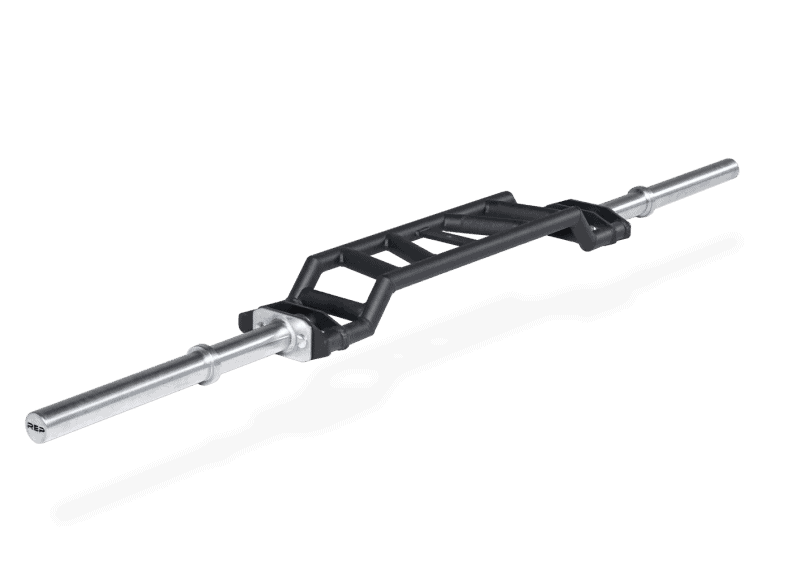
- The REP Cambered Swiss is the big new addition. It wasn’t in the old lineup at all. Hard-chrome sleeves, knurled handles and a frame built to fit any rack make it the all-rounder most people should look at first.
- The Kabuki Kadillac stays the premium pick, and the Rogue MG-3, Titan Camber Bar and Valor OB round out the classic, cambered and beginner slots.
Related
A specialty bar needs a home. See our best squat racks guide for cages at every price, the best Olympic barbells for your everyday straight bar, and the best EZ curl bars if it is mainly the arms you are training around sore elbows.
Compare the best multi-grip barbells
 REP Cambered Swiss
Check price
REP Cambered Swiss
Check price
|
 Kabuki Kadillac
Check price
Kabuki Kadillac
Check price
|
 Rogue MG-3
Check price
Rogue MG-3
Check price
|
 Titan Camber Bar
Check price
Titan Camber Bar
Check price
|
 Valor Fitness OB
Check price
Valor Fitness OB
Check price
|
||
|---|---|---|---|---|---|---|
| Best for | Overall / value | All-rounder | Premium | Classic flat | Cambered | Beginners |
| Rating (*) | ||||||
| Grip geometry | 90% | 88% | 86% | 84% | 82% | 82% |
| Build & finish | 84% | 90% | 96% | 92% | 82% | 74% |
| Compatibility | 84% | 90% | 92% | 76% | 80% | 88% |
| Value | 94% | 88% | 70% | 76% | 90% | 88% |
| Price | $$ | $$ | $$$ | $$$ | $ | $ |
| Bar weight | 24 lb | 45 lb | 45 lb | 43 lb | 39 lb | 26 lb |
| Capacity | 600 lb | 810 lb | 850 lb | ~1,000 lb | 1,000 lb | 300 lb |
| Handles | 3 angled, knurled | 4 sets, knurled | 3 angled, textured | 1 angled + 2 neutral | 4 grips, knurled | 4 angled / neutral |
| Finish | Powder coat | Powder coat / hard chrome | Powder coat / zinc | Powder coat | Powder coat | Powder coat / chrome |
| Made in USA | No | No | Yes | Yes | No | No |
 Bells of Steel Arch Nem
Our testing and selection process
How we assess multi-grip barbells
We run every multi-grip bar roundup through the same five steps:
- We start as the buyer. Most of our team trains with a Swiss bar, and I bought my first to press around a bad shoulder, so I know what a good one is worth.
- We research wide. We pull specs, grip counts and angles, capacity, sleeve length and finish notes, plus owner feedback, on as many bars as we can find, 40 this time, into one spreadsheet.
- We score each bar with our weighted system. Data decides the ranking, not brand loyalty.
- We split the field by job, because a flat neutral-grip bar and a deep football bar are bought for very different reasons.
- We get hands-on where we can and lean on the SHG community for the rest.
You can read more about the process in our review guidelines.
How we score multi-grip barbells
Here is what feeds the score and how much each part counts. Grip geometry and build share top billing, because a Swiss bar’s whole job is to let you press comfortably for years.
We grouped it into four weighted factors:
- Grip geometry & handles (30%) - the number, type and angle of the handles, the knurling, and how natural the bar feels under load.
- Build & finish (30%) - steel, welds, sleeve quality, honest capacity, and how well the coating lasts.
- Compatibility (15%) - whether Olympic plates sit snug and the bar racks in a normal cage.
- Value (25%) - what you actually get for the money.
Grip geometry & handles (30%)
This is the heart of a multi-grip bar. Get the handle angles right and the bar feels like an extension of your arms. Get them wrong and it fights you.
The single rule that matters most: if you are buying because of joint pain, you want at least one pair of angled handles, not just neutral ones. Angled grips let your forearms rotate slightly outward as your hands move apart, which is the natural path your arms want to take. Picture a dumbbell bench press and how your wrists turn as the weights spread, and you have the idea.
We also weigh the knurling. For pure pressing it barely matters, which is why Kabuki gets away with a textured coat instead. The moment you start rowing, curling or doing pull-ups on the bar, a knurled handle stops your hands sliding when they sweat.
Build & finish (30%)
A specialty bar gets loaded heavy and dropped onto safeties, so the steel, the welds and the sleeves have to hold up. We look hardest at the sleeves, because that is where bars cut corners.
Most budget bars wrap the sleeves in Schedule 80 pipe, which measures just under two inches. Olympic plates slide on, but they rattle, and standard collars do not always lock tight. Premium bars machine the sleeves to a true 50mm or hard-chrome them, so plates sit snug and your normal collars work.
Capacity matters less than people think. Anything rated past 500 lb is plenty for a pressing bar, so beyond that the number tells you more about durability than any limit you will ever test.
Compatibility (15%)
Two things decide whether a bar fits your gym: the sleeves and the cage. We covered the sleeves above. The cage is the central frame that has to slide between your rack uprights.
A wide cage near 42 inches is a tight squeeze on a narrow 42-inch rack, and a square frame can catch on the way in. A rounded or narrower cage drops in cleanly, which matters most at the worst moment, when you are shaking at the end of a hard set and trying to re-rack.
The shape of that central cage is what makes racking easy or fiddly:
Value (25%)
We build a quality-adjusted picture of price. A bar that nails the grips and the sleeves for fair money beats a premium one that only justifies its cost on the spec sheet. You can get a genuinely good multi-grip bar without paying flagship prices, and three of our six picks prove it.
Find the perfect multi-grip barbell for you
Overall | All-rounder | Premium | Classic flat | Cambered | Beginners
Here is how the six bars stack up on our overall score:
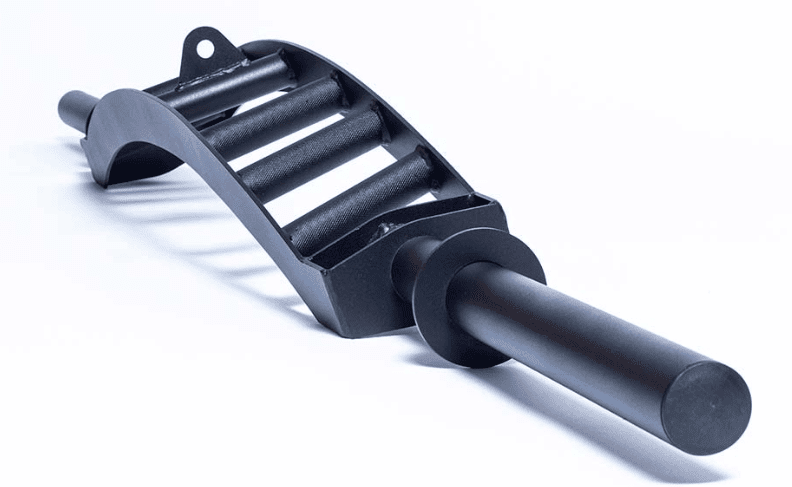
Bells of Steel Arch Nemesis
Best Overall / ValueQuick specs
- 24 lb (11 kg), 78” long, arched camber
- Three angled grips, now fully knurled
- 600 lb capacity, 49.7mm sleeves
- Doubles as a lat-pulldown attachment
The value find of the whole list: an arched bar with proper joint-friendly geometry, for two to three times less than the premium bars it borrows its design from.
Summary of experience, tests & opinions
What I like
- The arched frame stretches each rep a touch deeper than a flat bar, so a bench set feels like it asks more of you for the same plates.
- Clipping it onto the cable column genuinely surprised me the first time. A flat neutral-grip pulldown from a bar I already owned. I still don’t know why more makers haven’t copied it.
- At 24 lb it’s the lightest bar here by a wide margin, which I notice most on the days I’m loading and stripping it solo.
What I don’t
- The knurling is on the passive side. For pressing it’s fine, but on a heavy lat-pulldown I’d like more bite.
- The 1.9” sleeves mean standard spring collars don’t always lock tight, so I keep a set of screw collars next to it.
Pros & cons
Pros
- Arched, angled grips - the joint-friendly geometry of bars costing far more.
- Doubles as a lat-pulldown attachment, which nothing else here offers.
- Light, narrow cage that racks easily even in a tighter cage.
Cons
- Lower 600 lb capacity than the heavy cambered bars, though no presser will reach it.
- Sub-2” sleeves need locking or screw collars to hold plates snug.
Read more about the Bells of Steel Arch Nemesis
This is the bar I steer most home lifters toward.
It borrows the arched, increasing-angle geometry that makes the priciest bars so comfortable, then sells it for a slice of the outlay. You give up the machined sleeves and the plush finish. The thing that matters day to day, a grip that treats your shoulders kindly, you keep. That trade is the whole pitch.
Who is it for? The lifter pressing around a cranky shoulder who wants angled grips and a clever second use without flagship money, especially anyone short on space who likes that the same bar drops onto a cable column for neutral-grip pulldowns.
Who should skip it? Heavy pullers who load past 600 lb and want aggressive knurl, or anyone after the most over-built sleeves on the list.
Its nearest rival here is the REP Cambered Swiss. The REP is the better-built bar, with hard-chrome sleeves and a heavier capacity, so for one bar to last decades it edges ahead. The Arch Nemesis answers with the lat-pulldown trick and a lower price.
That’s the trade-off in a nutshell.
Buy the REP to keep forever. Buy the Arch Nemesis to do two jobs for less. One lived detail the spec sheet hides is how light it is: with a narrow cage too, it is the easiest bar here to wrestle on and off the rack when you are tired. That sounds minor until you are three sets deep and grateful for it.
One honest catch. The powder coat shows hook rash where the bar rubs the J-cups far sooner than a chromed bar would, so a quick wipe-down after sweaty sessions keeps it tidy. It is a cosmetic mark rather than a structural fault, but worth knowing.
The walkthrough below runs through the latest Arch Nemesis and its upgrades:
It runs away with our value score:
Bottom line
The Arch Nemesis is the value champion: premium geometry and a clever lat-pulldown party trick, at a price most people can stomach.
The Arch Nemesis might be for you if… you want comfortable angled grips without paying flagship money, and the cable-column trick appeals.
It’s not for you if… you want the most solid sleeves and the longest capacity on the list. Step up to the REP or the Kabuki.
REP Fitness Cambered Swiss Bar
Best All-RounderQuick specs
- 45 lb, 80.7” long, 14” loadable sleeves
- Four sets of knurled neutral / angled grips
- Hard-chrome 50mm sleeves, 810 lb capacity
- Cage fits 41” to 49” racks
The bar that gets the most things right at a fair price: four knurled grips, a forward camber for extra depth, and hard-chrome sleeves your normal collars actually fit.
Summary of experience, tests & opinions
What I like
- Four grip sets is the right number. The two inner pairs press like a normal multi-grip bar, and the outer pairs add the real camber depth when I want a bigger stretch on bench.
- The hard-chrome sleeves are the part I keep coming back to. Most bars at this price use powder-coated sleeves that look chewed up within a fortnight. These still wipe clean.
- REP pitched it cleverly between the budget bars and the Kabuki, and in use that is exactly where it sits.
What I don’t
- Because it is built to fit narrow racks, the camber depth only really shows up on the outer grips. The inner handles feel flatter than the bar’s looks suggest.
- The black powder-coat shaft is purely functional. It does the job, but there is nothing here that feels special the way the Kabuki does.
Pros & cons
Pros
- Hard-chrome 50mm sleeves - plates sit snug and standard collars fit, rare at this price.
- Four knurled grip pairs covering close, neutral and angled positions.
- 810 lb capacity and a cage that racks in everything from a 41” to a 49” frame.
Cons
- Real camber depth is felt mainly on the outer handles.
- Plain powder-coat shaft, no premium flourish.
Read more about the REP Fitness Cambered Swiss Bar
This is the one I would tell most people to buy and forget about.
It quietly does everything well. Four handle positions cover pressing, close-grip work and rows, the forward camber adds range when you want it, and the build steps clearly above the budget pack. Those hard-chrome sleeves are the part that sells it.
Who is it for? The lifter who wants one Swiss bar to handle pressing, rows and close-grip work for years, would rather pay a sensible price for hard-chrome sleeves than fight rattling plates, and has an awkward rack, since the cage swallows everything from a 41-inch to a 49-inch frame.
Who should skip it? Anyone chasing the deepest possible stretch of a true football bar, or anyone set on the cable-column party trick.
Can’t decide? This is the safe default.
The honest catch is the camber. REP designed the cage to drop into a narrow home rack, which meant keeping the frame shallow, so the dramatic depth you might expect from a football bar only really lands on the outer grips. On the inner handles it presses much like a flat multi-grip bar. Sensible for a bar most people run in a tight garage rack, but worth knowing if you are buying purely for camber.
Against the Kabuki it loses on finish and sleeve length, and against the Arch Nemesis it loses the cable-column trick. What it wins is the middle ground, where most home lifters actually live.
One detail you only learn after a few months. Owners who run it in a humid garage wipe the sleeves down and find them clean as day one, where a powder-coated sleeve would already be flaking at the plate stops.
REP’s engineering walkthrough below shows how the bar is built:
On build and finish it sits right behind the two USA-made bars:
Bottom line
The REP Cambered Swiss is the do-everything pick. Four knurled grips, a sensible camber, and hard-chrome sleeves that punch well above the price.
The REP might be for you if… you want one Swiss bar that covers pressing, rows and close-grip work, built to last, without premium money.
It’s not for you if… you want the deepest camber or the cable-column trick. Look at a dedicated football bar like the Titan or the Arch Nemesis.
Kabuki Strength Kadillac Bar
Best PremiumQuick specs
- 45 lb, arched camber, three grip widths
- 10° / 12.5° / 15° increasing angles
- Machined, zinc-coated 16.75” sleeves
- 850 lb capacity, USA-made
If money is no object, this is the bar. Precisely machined zinc sleeves, the longest loadable length on the list, and the cleanest geometry Kabuki makes.
Summary of experience, tests & opinions
What I like
- The sleeves are the whole story. Machined to a true fit and zinc-coated, so plates glide on, lock without extra collars, and the coating will not chip the way powder coat does.
- The increasing handle angles feel deliberate. Each width turns your wrist a little more, which keeps a wide press feeling natural rather than forced.
- It has the heft and finish of a bar you buy once. Everything about it reads premium in the hand.
What I don’t
- The handles use a textured powder coat instead of knurling. Plenty grippy for pressing, but if you row or curl heavy with sweaty hands you will want more bite.
- It is the priciest bar here by a distance, and the value score reflects that more than any flaw in the build.
Pros & cons
Pros
- Machined zinc sleeves - the longest and best-fitting on the list, no collars needed.
- Increasing handle angles that keep wide grips comfortable.
- USA-made, lifetime warranty, buy-it-for-life build.
Cons
- Textured handles instead of knurled, so less grip for pulling.
- The most expensive bar here, which tanks the value score.
Read more about the Kabuki Strength Kadillac Bar
This is the bar for the lifter who wants the best and is happy to pay for it.
Kabuki built the Kadillac around its sleeves. Where cheaper bars use thin pipe and ask you to add collars, the Kadillac machines its sleeves to spec and zinc-coats them, so plates sit tight and the finish stays clean for years in a humid garage. It feels like one beautifully made object in the hand.
Who is it for? The dedicated presser who benches and overhead presses far more than they pull, has the budget, hates faffing with collars, and wants a tool to buy once and keep.
Who should skip it? Value shoppers, and anyone who pulls with sweaty hands, since the textured handles will not hold the way knurl does.
The natural comparison is the REP. The Kadillac is the nicer bench experience, yet the REP gets you most of that comfort, adds proper knurl for pulling, and costs far less. Most people should buy the REP. Only a keen presser should reach for this.
That’s the line.
The three grip widths each set your wrist at a slightly steeper angle, which is what keeps a wide press feeling natural rather than forced:
A few lived details the spec sheet hides. The arched frame lifts the handles about three and a half inches above the sleeves, and that buys you genuine extra range of motion on the press rather than only a different hand angle. The frame is also only seven inches wide, against ten on the Rogue, so bent-over rows sit closer to your midfoot and feel more balanced.
One quirk to learn. That same arch means the unloaded bar likes to roll upside down in the J-cups while you set up for bench, mildly annoying until you flip it logo-down for pulls and logo-toward-your-feet for presses.
On build and finish, nothing here touches it:
Bottom line
The Kadillac is the connoisseur’s Swiss bar: faultless sleeves, clean geometry, and a finish that lasts a lifetime, for a price only a keen presser will justify.
The Kabuki might be for you if… you press more than you pull, you want the best-made bar on the list, and the cost does not put you off.
It’s not for you if… you want knurled grips for rows and curls, or you are shopping on value. The REP is the smarter spend for most.
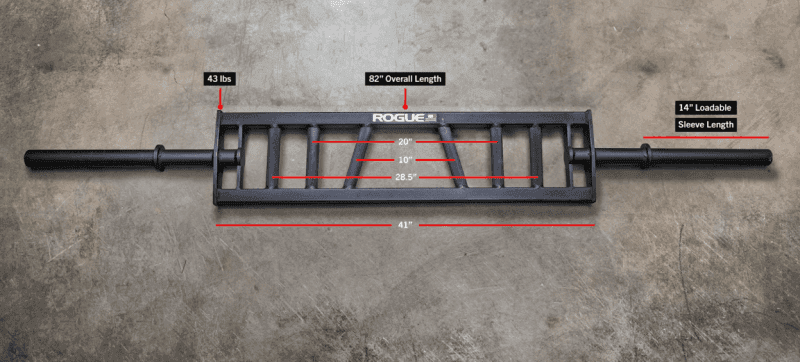
Rogue MG-3 Multi-Grip Bar
Best Classic FlatQuick specs
- 43 lb, 82” long, flat design
- One angled and two neutral knurled grips
- Specialty sleeves, 14” loadable
- USA-made, racks in a 49”+ frame
The flat-design pick for people who want neutral grips and Rogue build, with no camber and no fuss. A bar that will outlast the rack you hang it on.
Summary of experience, tests & opinions
What I like
- Typical Rogue build. The welds are clean, the knurling is even, and nothing on the bar feels like a corner was cut.
- The flat design is the right call for anyone easing in around a shoulder issue. There is no camber pulling the bar anywhere, so it sits predictable and stable.
- One angled and two neutral grips covers the bases without the crowded handle spacing you get on four-grip bars.
What I don’t
- The specialty sleeves are under two inches, so Olympic plates need specialty collars to sit tight. At this price I expect that to be sorted.
- The flat frame is the longest here to rack, needing a 49-inch or wider cage, so it is the least friendly to a narrow home rack.
Pros & cons
Pros
- Knurled handles - proper grip for rows, curls and pull-ups, where the Kabuki gives way.
- Rogue welds and finish, with the durability that implies.
- Balanced three-grip layout with no crowding.
Cons
- Sub-2” specialty sleeves need collars to lock plates.
- Wide rackable footprint, so it wants a 49”+ rack.
Read more about the Rogue MG-3
The MG-3 is the classic flat multi-grip bar done to Rogue’s standard.
There is no camber and no clever trick, just one angled grip and two neutral ones on a clean, tough frame. If you press around a shoulder niggle and want a bar with no surprises, the flat design reassures in a way the cambered bars do not. That predictability is the appeal.
Who is it for? The lifter who pulls as much as they press, runs a wide rack, and wants Rogue build with proper knurl over a camber they will rarely use.
Who should skip it? Narrow-cage owners, camber-chasers, and anyone who would rather not buy specialty collars.
Measure your rack before you fall for the welds.
Against the premium Kabuki it wins on handles, since Rogue knurls them where Kabuki textures, which flips which bar I would pick for pulling. Against the REP the trade reverses, with the REP bringing camber, hard-chrome sleeves and a cage that fits a tight rack.
A few things we noticed living with it. The knurl is genuinely good for a hollow-tube handle, biting enough to leave an imprint on a hard grip, so damp-handed rows and pull-ups stay secure. The build is typical Rogue, with neatly capped sleeve ends and none of the loose slag you can hear rattling inside cheaper bars.
Two catches. The handles sit at the same height as the loaded sleeves, so grip a touch off-centre and the bar tips back or forward until you reset your hands. And the 10-inch frame is wide enough to push the bar forward of your midfoot on heavy bent-over rows.
On build, it sits just behind the Kabuki:
Bottom line
The MG-3 is the flat-design pick: knurled grips, Rogue build, no camber and no gimmicks. The wide footprint and pipe sleeves are the trade for that quality.
The Rogue MG-3 might be for you if… you want a stable flat bar with proper knurling for pulling, and you have a 49” or wider rack.
It’s not for you if… you want camber, a narrow cage or sleeves that take normal collars. The REP covers all three.
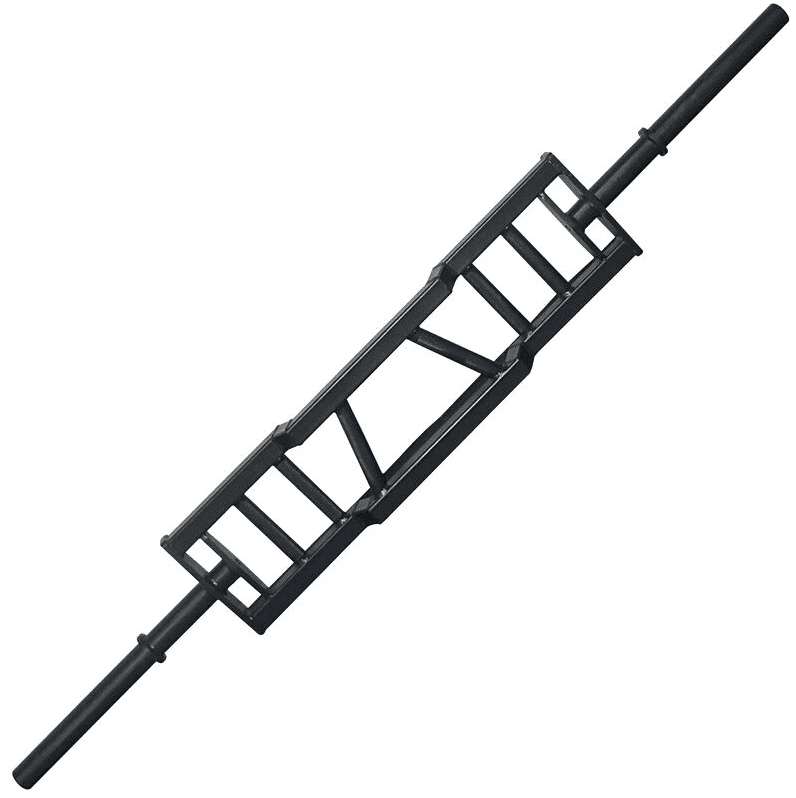
Titan Multi-Grip Camber Bar
Best CamberedQuick specs
- 39 lb, 82” long, 2” camber for ROM
- Four knurled grips, 10” to 28.5” wide
- 49.55mm sleeves, 13.75” loadable
- 1,000 lb capacity
The proper football-bar pick: a classic forward camber for deep, stretched pressing, at the lowest price of any specialty bar on the list.
Summary of experience, tests & opinions
What I like
- The camber is the reason to buy it. Pressed the usual way it lets the bar travel a couple of inches deeper, which lights up the chest and the stretch in a way a flat bar can’t.
- Flipping it for a shorter range is a genuinely useful trick when I want to overload the top half of a press.
- The knurling and powder coat are a clear step above what the price suggests, so you can load it heavy and still get a solid grip.
What I don’t
- The cage is wide, around 42 inches, so on a narrow rack you have to be careful sliding it in and out.
- This is a deep-camber football bar first and foremost. If your shoulder is the reason you are shopping, the extra stretch can be too much, and a flat or arched bar is kinder.
Pros & cons
Pros
- Classic forward camber - real extra range of motion for a deeper, harder press.
- Reversible for a shortened, board-press style range.
- Honest 1,000 lb capacity and solid knurling for the money.
Cons
- Wide cage that is a tight fit on narrower racks.
- Deep camber is too aggressive for some sore shoulders.
Read more about the Titan Multi-Grip Camber Bar
Buy this when you specifically want a football bar.
The forward camber is the whole point. Press it the normal way and the bar sinks a couple of inches lower than a straight bar would, stretching the chest and building strength out of the bottom of the press. Flip it over and that same camber shortens the movement, handy for overloading the lockout. One bar, two distinct jobs.
Here is what that forward camber does to the bottom of the press:
It is also the cheapest specialty bar here.
The build holds up better than the price implies, with knurling that has real grit and a powder coat tougher than Titan’s reputation suggests.
Two things to weigh: the cage and the camber. The frame is wide, so a narrow rack makes racking fiddly. And the deep camber, lovely for a healthy presser chasing range, can be too much for the cranky shoulder that sent you shopping for a multi-grip bar in the first place. If that is you, the flat Rogue MG-3 or the arched Arch Nemesis will treat you more gently.
Want the football-bar stretch for the least money? This is it.
It sits near the top of our value score, just behind the Arch Nemesis:
Bottom line
The Titan Camber Bar is the budget football bar: a real, reversible forward camber and an honest 1,000 lb rating for the least money on the list.
The Titan might be for you if… you want the deep-camber stretch of a football bar, you have a healthy shoulder, and price matters.
It’s not for you if… the camber is too aggressive for a sore joint, or your rack is narrow. The Arch Nemesis is the gentler, easier-racking choice.
Valor Fitness OB
Best for BeginnersQuick specs
- 26 lb, 73” long, rounded cage
- Four angled / neutral knurled grips
- Chrome 2” Olympic (or 1” standard) sleeves
- 300 lb capacity
The easy first specialty bar: cheap, light, with a rounded cage that slides into a tight rack and sleeves that take both Olympic and standard plates.
Summary of experience, tests & opinions
What I like
- The rounded cage is a small thing that makes a real difference. It is the only bar here whose frame slides into a narrow rack without me lining it up just so.
- Four knurled grips at this price is generous, and the chrome sleeves resist wear better than the powder coat you usually get this cheap.
- It takes both Olympic and one-inch standard plates, which suits a starter gym that hasn’t fully committed to Olympic kit yet.
What I don’t
- The 300 lb capacity is the real ceiling. The rackable section feels thin, and I’d be wary loading it hard, with bend showing as low as 200 lb.
- It won’t turn heads. The build is basic and the welds are functional rather than fine.
Pros & cons
Pros
- Rounded cage - the easiest bar here to rack on a narrow or busy frame.
- Chrome sleeves and four knurled grips, unusual at this price.
- Takes Olympic and standard plates, handy for a starter setup.
Cons
- Low 300 lb capacity, with flex showing at moderate loads.
- Basic build and functional welds, no premium feel.
Read more about the Valor Fitness OB
This is the sensible way in for a first specialty bar.
It is cheap and light, and the rounded cage racks more easily than bars costing three times as much. For someone learning whether they even like training with a Swiss bar, it answers the question without a big outlay.
The catch is the capacity. Valor rates it to 300 lb, and that feels honest, with the rackable section on the thin side and a little flex showing as you load it up. So anyone planning heavy pressing should look at the REP or the Titan. For lighter pressing, rehab work and learning the movement, it is plenty.
It is also the one Amazon pick here, so the link goes straight to Amazon. No brand warranty to lean on, then, just price and the rounded-cage convenience.
Owner reports three years in line up with where we landed it.
A few quirks to know before you buy. The sleeves spin unevenly, so one end can turn while the other stays put and nudges you off balance mid-press. There is loose debris rattling inside the hollow bar from the factory, a small jingle you never quite stop noticing. The finish is soft too: the coating scrapes through where the bar rests even under light use, and the sleeve end caps work loose and pop off when you load plates, so expect to glue them back in.
None of it is a deal-breaker at this price. It is just why this is a learn-the-movement bar to start on rather than one to grow into.
On racking and plate fit it scores well above its price:
Bottom line
The Valor OB is the easy entry point: cheap, light, easy to rack, and happy with any plates. Just respect the 300 lb ceiling.
The Valor might be for you if… this is your first specialty bar, you press light to moderate, and you want the easiest bar to rack.
It’s not for you if… you plan to load it heavy or want a bar to keep for years. Spend up to the REP.
What is a multi-grip barbell (and who needs one)?
A multi-grip barbell, also sold as a Swiss bar or a football bar, swaps the single straight shaft of a normal barbell for a frame holding several pairs of handles. Instead of gripping palms-down and behind a fixed bar, you grip palms-facing, with your hands somewhere along a row of neutral and angled handles.
That hand position is the whole reason the bar exists. Pressing palms-facing takes the strain off the front of the shoulder and off the elbows and wrists, which is why so many lifters who can’t comfortably flat-bench reach for one.
The two designs you’ll see
Most bars split into two camps, and it is worth knowing which you are buying.
- Flat and arched bars keep the handles roughly in line with the sleeves, sometimes on a gentle arch. They press much like a stable dumbbell movement and suit anyone training around a joint. The Rogue MG-3 is the flat version, the Arch Nemesis the arched one.
- Cambered football bars drop the handles forward of the sleeves, so the bar travels lower and stretches the press. They build strength out of the bottom but ask more of the shoulder. The Titan Camber is the example here.
Who actually benefits
Steve, our certified PT, points people toward a multi-grip bar in a few clear cases:
- Cranky shoulders or elbows. If a straight bar lights up your joints when you press, the neutral grip takes that pressure off. This is the number one reason people buy one.
- Pressing variety. The different handle widths and a touch of extra range keep bench and overhead work fresh without a second bar.
- Solo training. A bar you can grip out in front is easier to unrack and control alone than one balanced behind your neck.
If your shoulders are healthy and you only bench occasionally, you don’t need one. For anyone pressing around a niggle, though, it is one of the cheapest specialty bars that genuinely changes how you train.
Other multi-grip bars we considered
Rogue MG-1 and MG-2. The MG-1 runs straight handles only and the MG-2 angled only, so the MG-3 splits the difference and is the one we’d point most people to. Both are still excellent Rogue bars if you have a strong preference for one grip type. You can check the MG-1 here.
Titan V2 multi-grip bar. Essentially Titan’s take on the Rogue MG-3 at a lower price. The finishes aren’t as fine, but if you aren’t precious about the badge it is a lot of bar for the money. Check the Titan V2 here.
Edge Fitness combo bar. A clever double-handle design that lets you choose angled or neutral at any width, which makes it the most adaptable bar we looked at. It missed the list on availability and price; the build itself is excellent. Check the Edge combo bar here.
Intek Strength Neutral Grip Bar. A premium neutral-grip-only bar with a serious following, but it is a specialist tool at a specialist price, so it stayed off the main list.
The bottom line
If you want one multi-grip bar and you don’t have a specific reason to buy something else, the call is close between two bars. The Bells of Steel Arch Nemesis wins on value and throws in the lat-pulldown trick, while the REP Cambered Swiss is the better-built all-rounder with sleeves that take normal collars. Most people will be happy with either.
From there it comes down to what you value. Want the best-made bar on the list and you press more than you pull? The Kabuki Kadillac is glorious. Easing in around a sore shoulder? The flat Rogue MG-3 is the stable, predictable choice. Chasing the deep football-bar stretch on a budget? The Titan Camber delivers it. Just starting out? The Valor OB is the easy, cheap way in.
Whichever you pick, load it lighter than your straight-bar press to start, find the grip width that feels natural, and let it keep you pressing through the niggles a straight bar would cost you.
Multi-grip barbell FAQs
What is a multi-grip barbell for?
A multi-grip barbell, also called a Swiss bar or football bar, sits across a frame of neutral and angled handles instead of one straight shaft. You grip it palms-facing rather than palms-down, which takes the strain off cranky shoulders, elbows and wrists. That makes it a kinder way to bench, overhead press, row and curl, and the angled grips let people keep training pressing movements through joint niggles that a straight bar would aggravate.
Are multi-grip barbells worth it?
If a straight bar bothers your shoulders or elbows when you press, a multi-grip bar is well worth it, and it is one of the cheaper specialty bars you can buy. It earns its rack space as a joint-friendly pressing tool and adds genuine variety to bench, overhead and triceps work. If your joints are healthy and you only bench now and then, it is a luxury rather than a need.
How much does a multi-grip barbell weigh?
Most multi-grip barbells weigh between 24 and 45 lb. Lighter bars like the Bells of Steel Arch Nemesis come in around 24 lb, which is handy if you load and unload solo. Heavier cambered and premium bars like the Kabuki Kadillac run 45 lb, closer to a standard Olympic bar. Always factor the bar weight into your working load, especially on a first session.
Do multi-grip barbells fit a standard power rack?
Most do, but it is the spec to check before you buy. The central frame, often called the cage, has to slide between your rack uprights, and a wide cage near 42 inches is a tight fit on a narrow 42-inch rack. Bars with a rounded or narrower cage rack more easily. Check the rackable width against your rack’s inside measurement, and remember a shaking, fatigued you needs the bar to slide in cleanly.
Do you need special collars for a multi-grip barbell?
Sometimes. Many budget and mid-range bars use sleeves made from Schedule 80 pipe that measure just under two inches, so Olympic plates fit but rattle and standard spring collars do not always lock tight. Bars with precisely machined or hard-chrome 50mm sleeves, like the Kabuki Kadillac or the REP Cambered Swiss, take normal collars without fuss. If your bar has thin pipe sleeves, a set of locking or screw collars solves it cheaply.
