

We tested and scored 34 plyo boxes to find the 6 best plyo boxes, judged across the 5 categories that decide whether a box is worth your money.
I’ve built home gyms for ten years, and a plyo box earned its keep faster than almost anything else in the room. The team ran my picks through our scoring system, so this is data and owner reports, not just me talking.
The goal was simple: cut the noise and hand you a short list of soft, wood, and steel boxes that stay planted, spare your shins, and last for years.
Let’s see if we did a good job…
Related
We’ve spent years jumping, stepping, and pressing off boxes in this gym. Starting from scratch? Our how to build a home gym guide maps out where a plyo box fits.
Compare the best plyo boxes
 Rogue Foam Plyo Box
Check price
Rogue Foam Plyo Box
Check price
|
 Rogue Games Box
Check price
Rogue Games Box
Check price
|
 Titan Adjustable Plyo Box
Check price
Titan Adjustable Plyo Box
Check price
|
 AbMat RooBox
Check price
AbMat RooBox
Check price
|
 Synergee 3-in-1 Wood
Check price
Synergee 3-in-1 Wood
Check price
|
||
|---|---|---|---|---|---|---|
| Best for | Overall | Soft / beginner | Wood (3-in-1) | Adjustable steel | Premium | Budget |
| Rating (*) | ||||||
| Build & stability (35%) | 92% | 88% | 95% | 84% | 92% | 82% |
| Landing surface & shin safety (20%) | 95% | 96% | 74% | 70% | 92% | 72% |
| Height options & versatility (20%) | 90% | 80% | 92% | 95% | 78% | 86% |
| Footprint & storage (10%) | 80% | 78% | 84% | 88% | 80% | 82% |
| Value (15%) | 88% | 84% | 82% | 80% | 74% | 92% |
| Material | Wood core, foam, vinyl | Foam | Birch plywood | Steel | Wood with foam edges | Wood |
| Surface | Grippy vinyl | Vinyl over foam | Sanded plywood | Rubber top | Wood top, soft edges | Bare wood |
| Heights | 3-in-1, flip to change | Single, stackable set | 3-in-1, flip to change | 4 heights, adjustable | One size | 3-in-1, flip to change |
| Assembly | None | None | ~30-40 min | None | Yes | ~15 min |
| Price | $$ | $$$ | $$$ | $$ | $$$ | $ |
 REP 3-in-1 Soft Plyo Box
Our testing and selection process
How we assess the plyo boxes
We always use a 5 step process in our reviews:
- We start as the buyer. Most of our team have bought plyo boxes before, and I have jumped, stepped, and pressed off boxes in this gym for years.
- We do a ton of research. We pull specs, prices, and owner reports on every plyo box worth a look into one master spreadsheet.
- We rate each box with our weighted scoring system. The categories and weights are below.
- We let the data make the call and ignore brand loyalty. A REP can beat a Rogue. A Synergee can beat them both on value.
- We get our hands on as many top picks as possible. Our community is a big help here.
You can read more in our review guidelines.
How we test and score the plyo boxes
A plyo box looks like the simplest thing in the gym, a cube you jump on. The differences live in the bracing, the surface, and what happens to your shin when you miss.
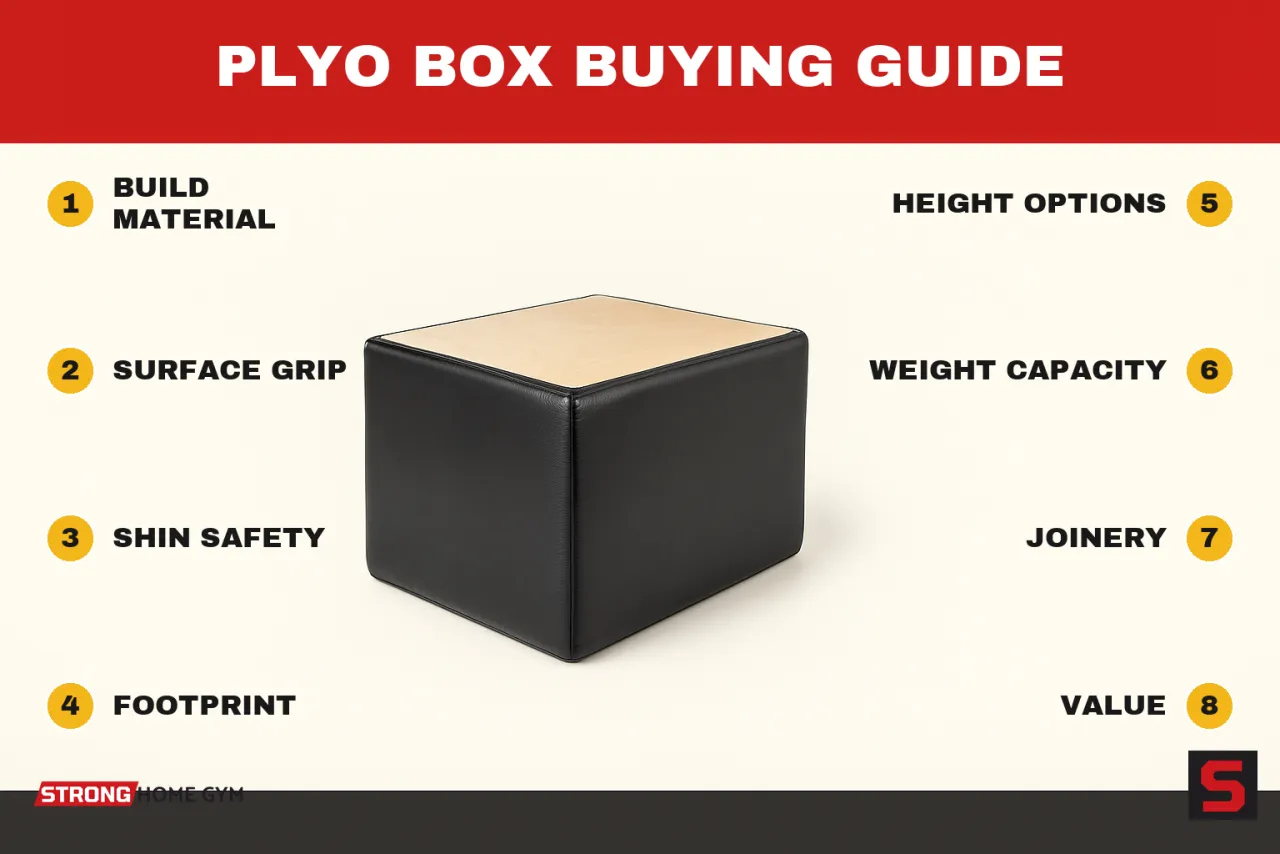
So we put the box where a buyer actually feels it, rep after rep, on fresh legs and on fried ones.
I grouped it into 5 chunks:
- Build and stability (35%) - the bracing, the joinery, and whether the box stays planted under a heavy landing.
- Landing surface and shin safety (20%) - how grippy the top is and how much a missed jump hurts.
- Height options and versatility (20%) - how many heights you get and how fast you can change them.
- Footprint and storage (10%) - how little floor it eats and how well it tucks away.
- Value for money (15%) - what you pay against what you get, normalized across the lineup.
Here is how the six picks stack up on the overall score, with the REP 3-in-1 Soft Plyo Box out in front:
Build and stability (35%)
This is the biggest category, because a box that walks or wobbles under you is the one that puts you in the emergency room.
A good box stays dead planted when you land heavy and tired. For wood boxes that comes from the internal bracing and the joinery, where interlocking joints mean the structure does not rely on the screws alone. For steel it comes from the welds and the lock pins. For a soft box it comes from the rigid core hiding under the foam, which is why a soft box with a wood center lands firm rather than mushy.
Weight capacity rides on the same build. Any box here holds a jumper with room to spare, but if you load up dumbbells for weighted step-ups, check the rating has real headroom over your bodyweight plus the load.
My tip: land on it hard once before you trust it. A box that gives a hollow thud and a half-inch of flex on the catch is the box that will creak and walk a year from now. The good ones feel like landing on a concrete pillar, with zero give underfoot.
Landing surface and shin safety (20%)
This is the category that decides whether a missed jump leaves a bruise or a gash.
Two things matter. Grip, where a textured vinyl, a rubber top, or a hexagonal overlay holds your foot once the sweat starts flowing, and a slick surface lets it slide. And forgiveness, where a soft foam outer or a molded foam edge cushions the shinburger that every box jumper has taken at least once. Bare wood corners are the sharpest, which is why the best wood boxes radius or cut their edges.
A bigger landing surface helps too. A narrow top forces a precise foot placement, which is exactly what you do not want on fried legs at the end of a session.
The movement you do most should steer the call. Box jumps are where shins get clipped, so a forgiving soft or foam-edged box pays off there. Heavy loaded step-ups reward the opposite: a rigid wood top and a tall weight rating, since you are standing the box up plus your bodyweight rep after rep.
Height options and versatility (20%)
This covers how many heights you get and how fast you can move between them.
A 3-in-1 box gives you three heights in one footprint, and you change them by flipping the box onto a different face, which takes seconds. An adjustable steel box covers four heights by moving the legs along set cutouts. A single-height box does one job, and a stackable foam system climbs the highest of all but costs the most.
Picking your starting height is less about your size than your ego. Most people are well served somewhere from 12 to 24 inches, with taller and stronger jumpers reaching higher over time. Buy more heights than you need today, because you drop down for tired-leg work and step up as you get fitter, all without a second box.
Footprint and storage (10%)
This covers how little floor the box eats and how easily it tucks away.
Steel and resin boxes are usually hollow, so they store kit underneath and slide into a corner. A 3-in-1 wood or soft box is one solid block that sits on the floor and cannot stack down. Adjustable boxes win here, since one compact frame replaces what would otherwise be a row of fixed boxes.
Value for money (15%)
We normalize value against the score-per-dollar across the lineup. The Synergee scores below the premium boxes but wins this category outright, because you are paying for honest wood and almost nothing else.
In other words…
We are hunting for the box that makes you pay for the logo rather than the build.
Find the perfect plyo box for you
Best Overall | Best Soft | Best Wood | Best Adjustable | Best Premium | Best Budget
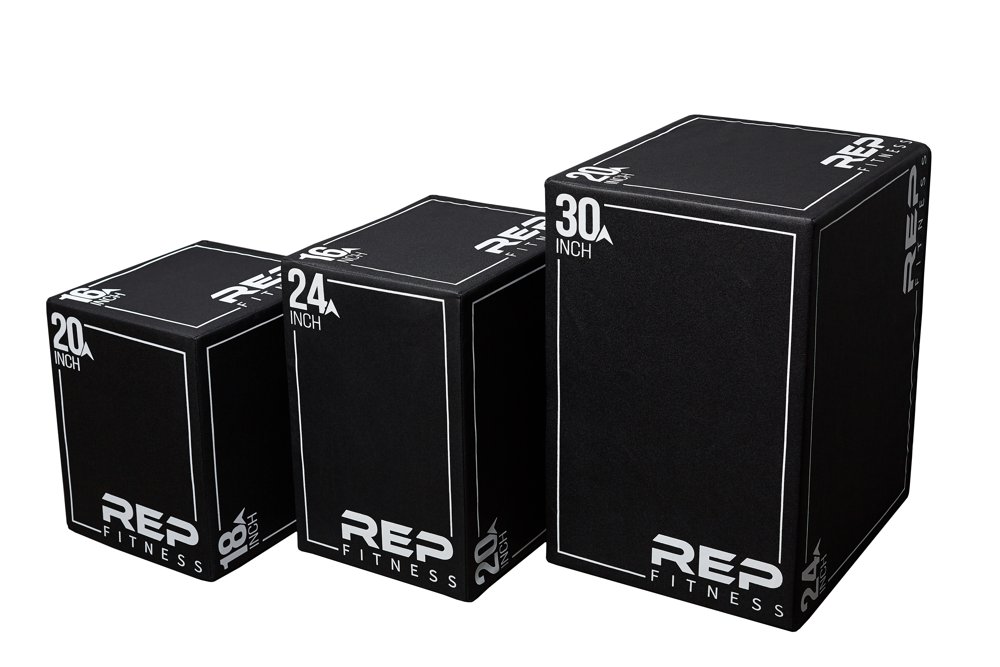
REP 3-in-1 Soft Plyo Box
Best Overall Plyo BoxQuick specs
- Material - wood core, dense foam, vinyl skin
- Surface - extra-grippy heavy-duty vinyl
- Heights - 3-in-1, flip to change
- Sizes - small, medium, and large
- Assembly - none, ready out of the box
The box I recommend to most people. A rigid wood core wrapped in 18mm of dense foam and the grippiest vinyl in the lineup, giving you three heights in one box with no assembly.
Summary of experience, tests & opinions
What I like
- The vinyl is the grippiest I have stood on. When the sweat starts pouring late in a session, my foot stays put on the top instead of skating, and that is the moment grip actually earns its money.
- The flip-to-change faces lock together with no slop. After a year of daily abuse mine still seats dead flush, no rattle, no gap opening at the seams, which is where cheaper soft boxes start to feel loose.
- Owner reports across our community land on the same line again and again: the foam shrugs off a clipped shin that would have drawn blood on bare wood, and the vinyl skin scuffs but never splits.
What I don’t
- The seam where the foam meets the vinyl is a magnet for chalk and dust, so it wants a quick wipe-down if you want it looking sharp. A small gripe, but a real one after a few dusty months.
Pros & cons
Pros
- Wood core, foam outer - it lands firm like wood but forgives a missed jump like foam, the best of both builds.
- Grippiest vinyl here - the heavy textured skin holds your foot through sweat better than any surface in the guide.
- You get three heights in one box with zero assembly, at a price that undercuts the premium wood and foam options.
Cons
- The solid block does not stack or store kit underneath, so it eats more floor than a hollow box.
- The largest size is heavy to shift on your own, so plan where it lives before you order it.
Read more about the REP 3-in-1 Soft Plyo Box
The REP takes the overall slot because it does every job a plyo box needs to do, and does none of them badly.
This is the box for the lifter who wants one box to cover box jumps, step-ups, box squats, and seated pressing without ever needing a second. The wood core lands firm and confident, the dense foam and grippy vinyl spare your shins and hold your foot through sweat, and the flip-to-change design hands you three heights in a single footprint. Our team ran a full conditioning block on it across fresh and fried legs, and nobody clipped a shin badly enough to stop a set, which is exactly the point of a soft box. Steve, our certified personal trainer, now starts nervous clients on the low face and flips it up as their confidence climbs, all without leaving the same square of floor.
Side by side with the Rogue Games Box, the REP gives up a little raw rigidity, since an all-wood box is stiffer underfoot, and it costs a touch less. For most home lifters that is the smart trade, because the foam forgiveness saves more shins than the extra stiffness ever wins.
The one place it shows its shape is storage. It is a solid block, so unlike a hollow steel box it cannot tuck kit underneath or stack down. If your real constraint is floor space, the Titan Adjustable folds more box into less corner.
That all-round balance is why it tops the overall score:
Bottom line
The REP 3-in-1 Soft Plyo Box is the top-rated plyo box for 3 main reasons:
-
It nails the build basics - a rigid wood core lands firm, while the dense foam and grippy vinyl keep you safe and planted.
-
It is the most versatile box here - three heights in one footprint, flip to change, with no assembly to slow you down.
-
It costs less than the boxes it matches - a mid-tier price for top-tier all-round performance, which is the smartest spend on the list.
If you want the stiffest, most premium all-wood feel, the Rogue Games Box is the step up.
The REP 3-in-1 Soft Plyo Box might be for you if… you want one box that does box jumps, step-ups, and seated work safely and never needs replacing.
It’s not for you if… floor space is your real constraint, in which case the Titan Adjustable tucks away smaller.
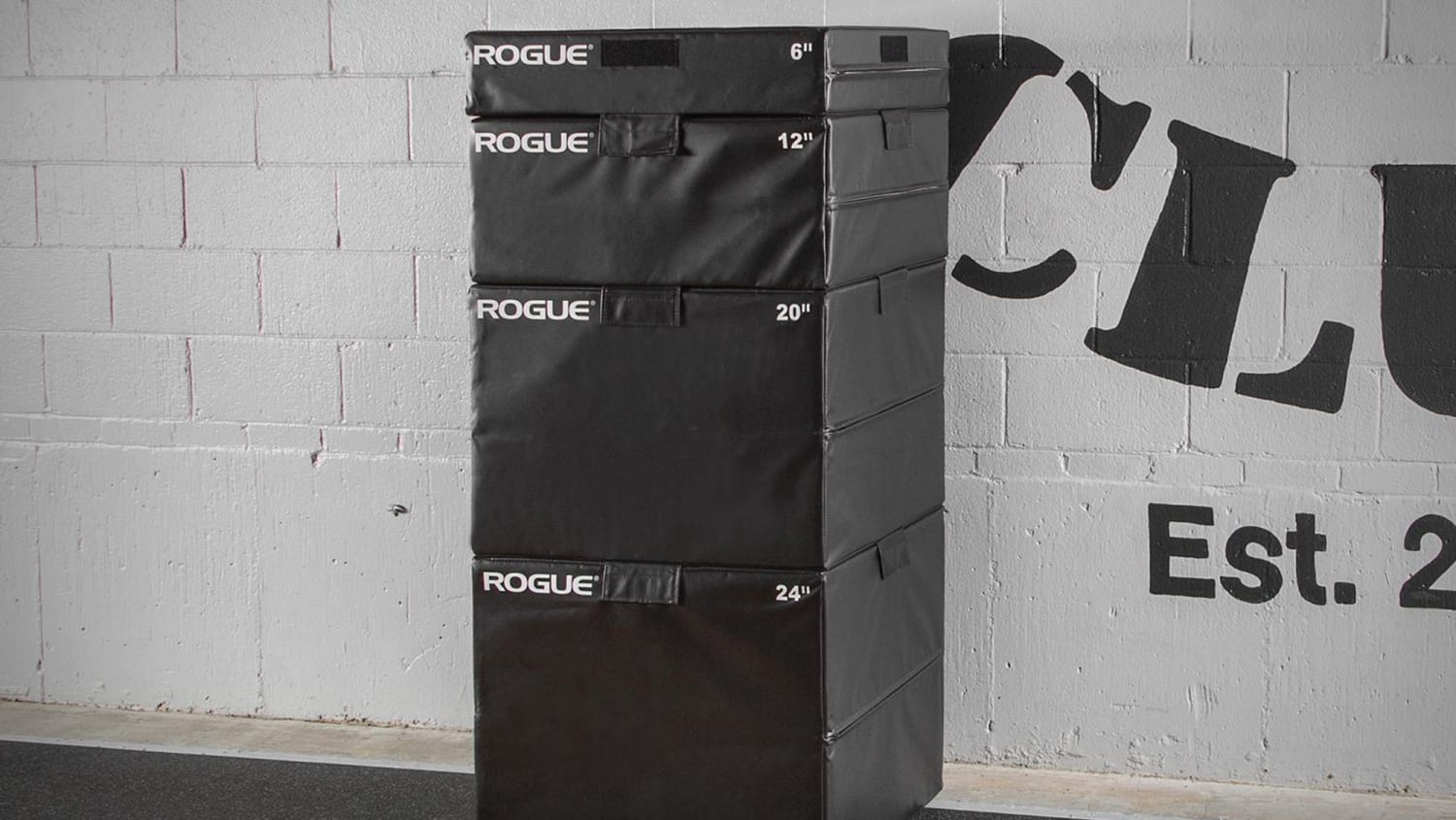
Rogue Foam Plyo Box
Best Soft Plyo BoxQuick specs
- Material - dense foam core, soft foam outer
- Surface - vinyl over foam
- Heights - single boxes, stackable set
- Stacking - hook-and-loop straps on all four sides
- Assembly - none, ready out of the box
The softest landing here. A dense foam core under a softer outer that takes the sting out of a missed jump, with boxes that strap together to stack tall.
Summary of experience, tests & opinions
The high points
- It is the box I hand anyone who flinched the first time they saw a box jump. The soft outer means a missed rep is a bump, not a gash, and that alone gets people jumping who never would have.
- Light enough to throw across the room one-handed. Moving it for a class or shoving it aside to sweep is a non-event, which you appreciate the day you reset the room for the fifth time.
- Owner reports we track keep saying the same thing: people buy the foam box the week after a bad scrape on a wood one, and not one of them regrets the spend.
The low points
- Stack two or three high and the tower develops a soft sway at the top of a jump. The straps hold, but landing on a tall stack never feels as locked-in as a single box, so I keep my heavy work on one tier.
Pros & cons
Pros
- A clipped jump leaves a bump instead of a gash, since the foam outer is the most forgiving surface in the guide.
- Dense core under the foam - it stays stable on a heavy landing instead of folding underfoot.
- Start low and stack tall as you progress, with hook-and-loop straps locking the boxes together on every side.
Cons
- Priciest soft option - a full stackable set is the costliest way onto a plyo box here.
- Wants a grippy floor - the foam base can creep on a slick surface, so it is happiest on rubber matting.
Read more about the Rogue Foam Plyo Box
If shin safety is the thing keeping you off a box, this is your box.
The soft foam outer is the most forgiving surface in this guide, and that matters most for anyone learning to jump or coming back from an injury. Steve, our certified personal trainer, runs beginners on it specifically because the fear of the shinburger is what stops most people committing to the takeoff, and a forgiving box removes that fear in a session or two. Under the soft skin sits a dense foam core, so it still lands with real structure rather than swallowing your foot like a cushion. The boxes strap together with hook-and-loop on every side, which means you start low and stack tall as your confidence and your hops climb.
Against the REP overall pick, the trade is firmness and price. The REP’s wood core lands stiffer and costs less for three heights, while the Rogue gives up some rigidity for the gentlest landing on the list. The foam box is the one to reach for when the thing standing between someone and their first clean rep is plain fear of the box itself.
The one habit it asks for is a grippy floor. On bare concrete the foam base can creep under a hard landing, so our team keeps it parked on rubber matting where it stays planted.
On landing safety, nothing here touches it:
Bottom line
Buy the Rogue Foam Plyo Box if shin safety is what is holding you back, or if you are coaching a nervous beginner. The soft outer is the gentlest landing here, the dense core keeps it stable, and the stackable straps let it grow with you.
You pay the most for that, since a full foam set is the priciest route onto a box, and it wants a grippy floor to stay put. For the lifter who values a fearless takeoff over saving cash, this is the pick.
The Rogue Foam Plyo Box might be for you if… you are new to box jumps or returning from injury and want the softest possible landing.
It’s not for you if… you want a firmer all-round box for less, where the REP wood-core soft box does it for the money.
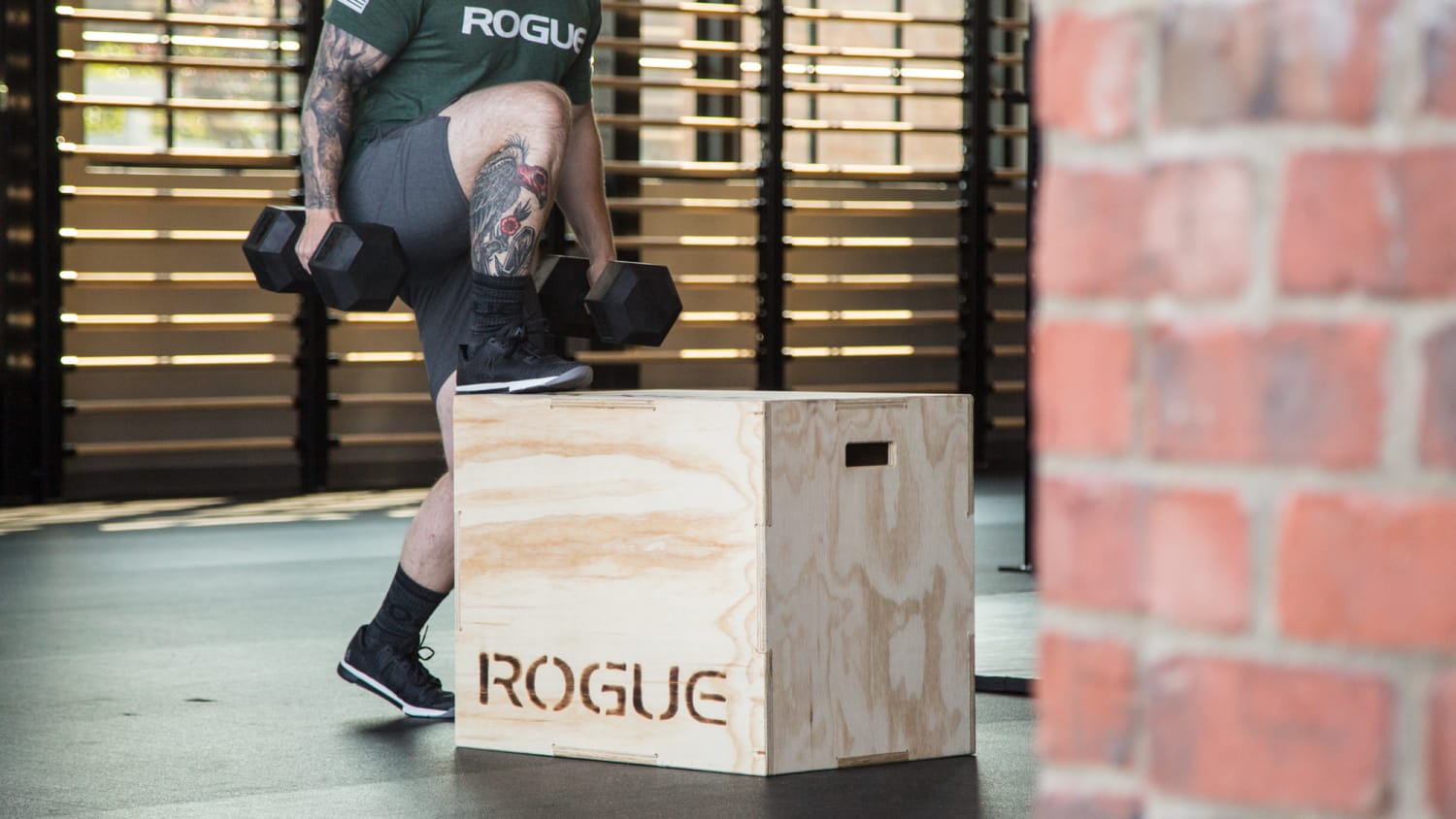
Rogue Games Box
Best Wood Plyo BoxQuick specs
- Material - 3/4-inch birch plywood
- Surface - sanded, grippy plywood
- Heights - 3-in-1, 20 / 24 / 30 inch
- Joinery - CNC interlocking puzzle joints
- Assembly - around 30 to 40 minutes
The premium wood pick. A 3/4-inch birch box with interlocking joints and radiused edges that lands like a concrete pillar and shrugs off years of abuse.
Summary of experience, tests & opinions
What earns its keep
- Landing on it feels like landing on a concrete pillar. There is zero flex and no hollow thud, so even on heavy 30-inch step-ups at the end of a session it stays planted and does not walk across the floor.
- The build, while a touch fiddly, slots together cleanly. The puzzle panels only fit one way, so there is no second-guessing which edge goes where, and ours came out square first try with no shimming.
- Months in, the plywood has worn in rather than worn out. The corners that started crisp have softened just enough from use that misses sting less now than they did on day one, which is the opposite of how a cheap box ages.
Where it asks more of you
- I have caught a shin on the corner more than once at the back end of a hard set. The radius helps, but tired legs and a hard edge are a bad mix, so this is a box that punishes sloppy late-session reps.
Pros & cons
Pros
- CNC interlocking joints - the wood locks together physically, so it stays square and rock-solid for years.
- Radiused edges - every corner is rounded, so a missed jump hits a curve rather than a sharp blade of plywood.
- Three heights, deep handles - 20, 24, and 30 inch in one footprint, with routed handles that make it easy to move.
Cons
- Still a wood box - the edges are softened but a hard miss on the corner still bites, unlike a foam box.
- Assembly and scuffs - it ships flat for a 30-to-40-minute build, and the raw wood picks up shoe marks fast.
Read more about the Rogue Games Box
If you want a wood box that lands like concrete and lasts a decade, this is the one.
The 3/4-inch birch build is the stiffest in this guide, and that rigidity is what serious jumpers and heavy step-up lifters are paying for. Our team put it through a three-month conditioning block of high-volume box jumps and weighted step-ups, and the verdict was unanimous: zero flex on the catch, no creak developing, and it never once walked across the floor under a heavy landing the way a cheaper box does. The reason is the CNC interlocking joinery, where the panels lock together physically so the structure does not lean on its screws. The radiused edges are the safety detail, rounding off every corner so a miss meets a curve instead of a 90-degree blade.
Set against the REP overall pick, the Rogue wins on pure rigidity and premium feel but gives up shin forgiveness, since wood is wood and foam is not. It also costs a tier more and needs assembling out of a flat pack. For the buy-it-once lifter who wants the most solid box on the market, that trade lands right.
The honest catch is the surface. The sanded plywood grips well when dry, but it is the hardest landing here, so if a clipped shin is your worry the soft Rogue Foam or the wood-core REP will treat you gentler. The raw wood also scuffs from shoe marks almost immediately, though in a working gym those marks read as badges of honor rather than damage.
On build and stability, nothing here beats it:
Bottom line
The Rogue Games Box is the box to buy if you want the most solid wood build on the market and you train heavy. The interlocking birch construction lands like concrete with zero flex, the radiused edges soften a miss, and it shrugs off years of abuse.
You pay the premium tier for that and you assemble it from a flat pack, and on the bar it asks for cleaner technique than a foam box since the corners still bite. For the buy-it-once lifter who values rigidity above all, this is the one.
The Rogue Games Box might be for you if… you train heavy box jumps and step-ups and want the stiffest, longest-lasting wood box made.
It’s not for you if… you want shin forgiveness or a no-assembly box, where the soft REP all-rounder fits better.
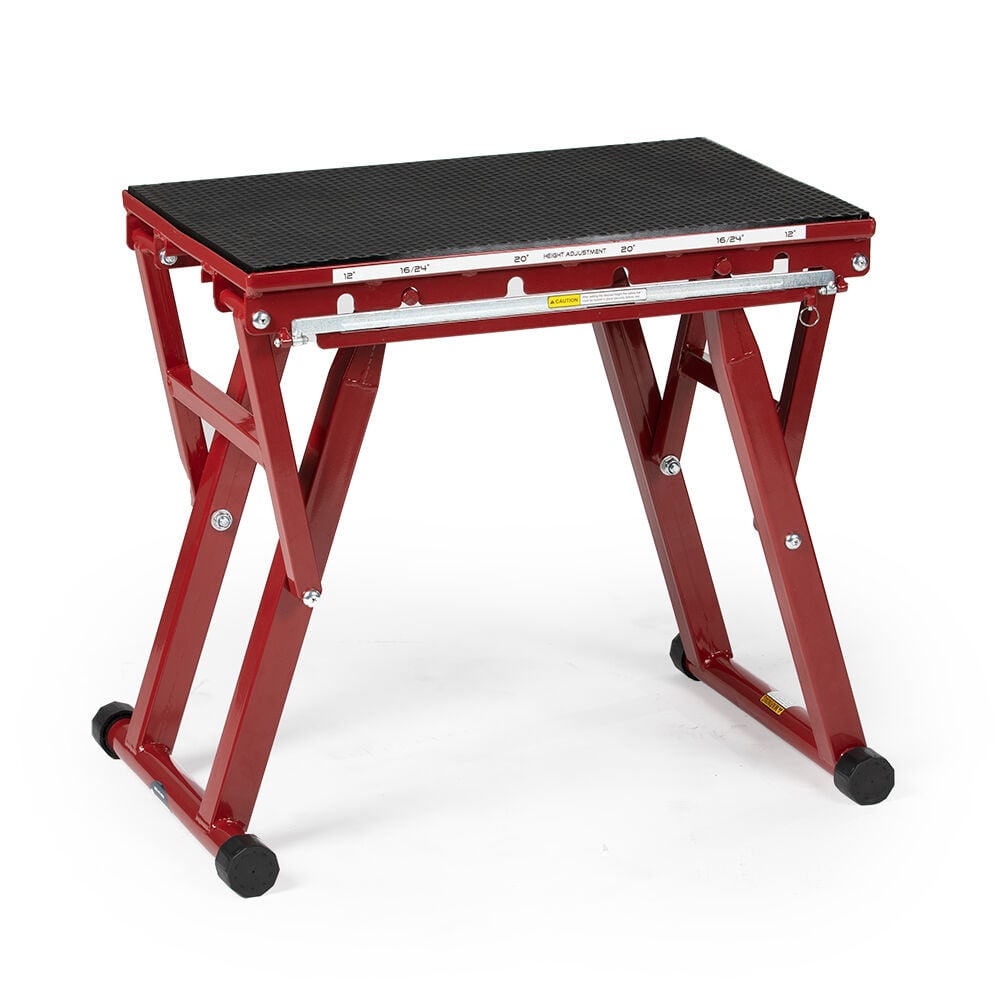
Titan Adjustable Plyo Box
Best Adjustable Plyo BoxQuick specs
- Material - powder-coated steel frame
- Surface - thick textured rubber top
- Heights - 4 settings, 12 / 16 / 20 / 24 inch
- Landing area - larger than most adjustables
- Assembly - none, change heights in seconds
The space-saving pick. A compact steel frame that locks to four heights, with a larger landing surface and a grippy rubber top, all in one corner-friendly footprint.
Summary of experience, tests & opinions
Where it shines
- The hollow frame quietly solved a clutter problem I did not know I had. Bands, a foam roller, and a couple of light plates all live under it now, and the whole thing still slides into the corner with a foot.
- It is the box a beginner and an advanced jumper can genuinely share. The 12-inch low setting most adjustables skip means a nervous client and a competitive lifter both train off the same frame on the same day.
- Steve, our certified personal trainer, rates it for circuit days specifically because the height drops between rounds without anyone hunting for a second box, which keeps a group session moving.
Where it falls short
- It rings. Land hard on the steel frame and you get a metallic clang the wood and foam boxes never make, so if you train early in a shared house, the rest of the house will know your rep count.
- The pop-pin lock collects grit if the box lives on a dusty floor, and a gritty pin sticks. A quick blast of compressed air every few weeks keeps the height changes smooth.
Pros & cons
Pros
- Four heights in one frame - 12 to 24 inches, more settings than most adjustable boxes, all in a compact base.
- A wider top than rival adjustables gives you real room to plant a foot on an explosive jump.
- Grippy rubber top and feet - the textured rubber handles sweat and shock and keeps the box planted.
Cons
- Firm, unforgiving landing - the rubber over steel does little for a clipped shin, unlike a soft box.
- Fiddly at first - the steel lock bar takes a few goes to learn before height changes feel quick.
Read more about the Titan Adjustable Plyo Box
This is the box for the lifter whose real constraint is floor space rather than budget or shin safety.
One compact steel frame covers four heights, which is why it tops the height-and-versatility category, and the 12-inch low setting most adjustables leave out makes it genuinely useful for a true beginner. Our team liked the landing top most: it is wider than the rival adjustable boxes, so there is real room to plant a foot on an explosive jump rather than aiming at a postage stamp. The thick textured rubber top handles sweat and shock well, and the rubber feet keep it planted so it does not creep across the floor mid-set. Because the steel frame is hollow, it stores kit underneath and slides into a corner, which a solid wood or soft box cannot do.
What you give up against the REP is the landing. Steel under rubber is firm and unforgiving, so it does nothing for a clipped shin the way a soft box does, and the weight rating, while plenty for most people, sits below a fixed steel box. The lock mechanism is also fiddly until you learn it, after which the height changes are quick.
It is the only adjustable in this guide for a reason. The soft and wood boxes win on feel and rigidity, but when the room itself is the problem, nothing else folds this much box into this little corner.
On height and versatility, nothing here comes close:
Bottom line
When floor space is your real problem, the Titan Adjustable Plyo Box earns its corner. Four heights live in one compact steel frame, the landing top is wider than rival adjustables, and the hollow base stores kit underneath. The trade is a firm, unforgiving landing and a lock mechanism that takes a few goes to learn.
If space is the constraint, this is the answer. If you have the floor and want a forgiving landing, a soft box like the REP feels far better for the shins.
The Titan Adjustable Plyo Box might be for you if… floor space is tight and you want four heights in one compact, corner-friendly frame.
It’s not for you if… you want a soft landing, where the Rogue Foam protects your shins far better.
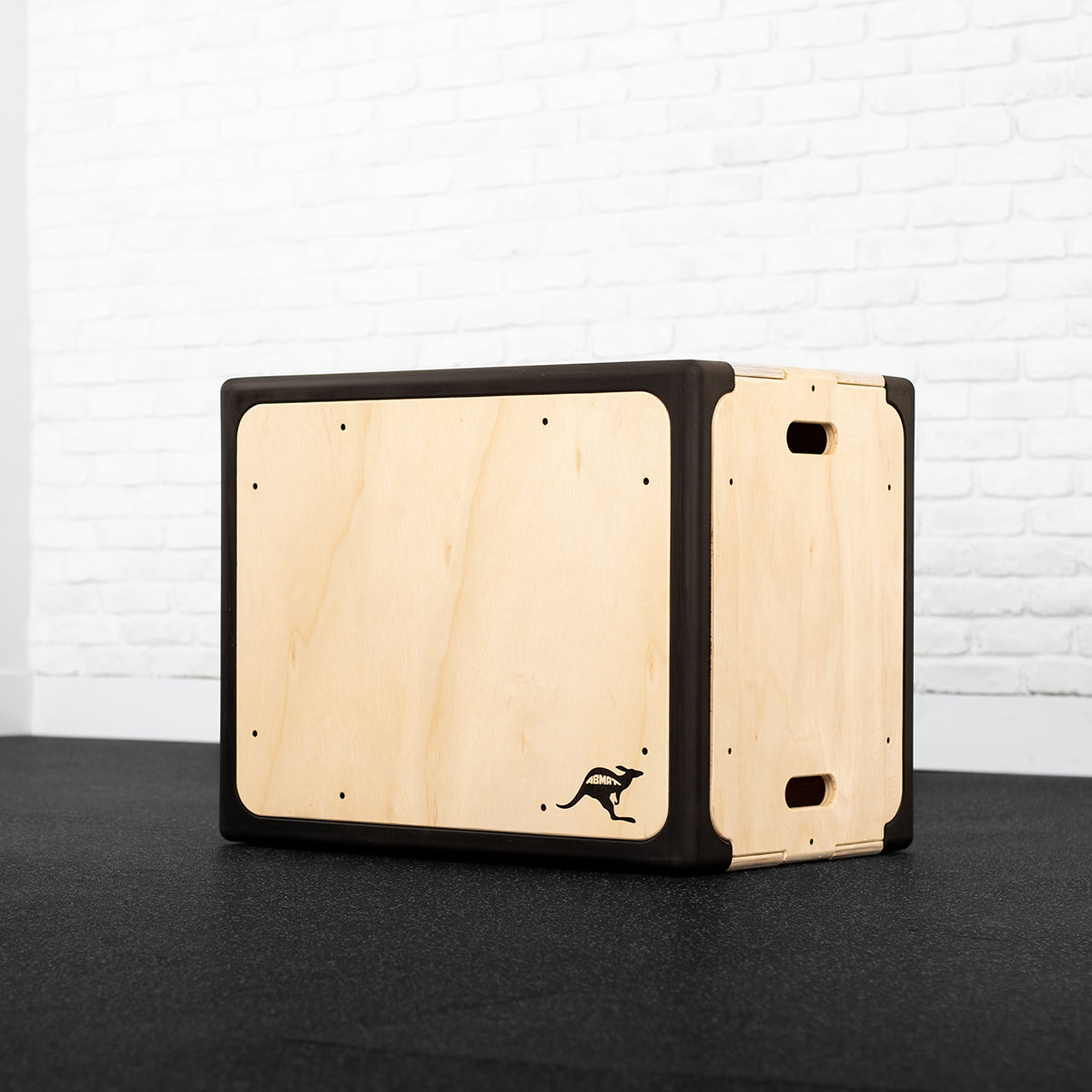
AbMat RooBox
Best Premium Plyo BoxQuick specs
- Material - wood platform, molded foam edges
- Surface - rigid wood top, soft foam corners
- Size - one size, 30 x 24 x 20 inch
- Made in - USA, custom logo option
- Assembly - yes, flat-packed
The premium pick. A rigid wood platform with molded foam edges, USA-made, that gives you a firm wood landing without the sharp corners that bite your shins.
Summary of experience, tests & opinions
Where it earns its place
- It solves the one real problem with wood boxes. The molded foam edges sit flush on every corner, so you keep the firm wood platform but a clipped shin meets foam instead of a sharp wooden blade.
- The foam does not peel. I have seen glued-on edge strips lift at the corners within a year on lesser boxes, and the way this foam is bonded, it has not budged a hair, which is the kind of detail you only notice when it fails on something else.
- People comment on it. Drop a logo on the panels and it photographs like gym furniture, which is exactly why it ends up in studios where the look matters as much as the landing.
Where it limits you
- One size means one height, and that height is tall. A shorter or newer jumper has nowhere to scale down, so it can sit unused in a household where not everyone is ready for a single high box.
- The premium shows up the day you have to ship or return it. It is heavy, it is bulky, and getting it back in the box is a job, so be sure before you commit.
Pros & cons
Pros
- Molded foam edges - flush foam on every corner protects shins while keeping the firm wood top.
- High-quality USA build - dense precision-cut foam and an attractive wood grain, made in the USA.
- Custom logo option - print your own art on the panels, which no other box here offers.
Cons
- One size only - no flip-to-change heights, so less versatile than a 3-in-1 box.
- Premium price - among the costliest boxes on the list, so value is its weakest category.
Read more about the AbMat RooBox
If you love a firm wood landing but hate what wood corners do to your shins, this is the box that fixes it.
The RooBox is a rigid wood platform with molded foam edges cut flush to every side, so you keep the solid, confident landing of wood while the corners stop being the sharp blades that cause the shinburger. Our team rated the foam work as the most refined here, dense and precisely fitted rather than a glued-on strip, which tracks for a brand whose whole reputation is built on fitness foam. The build is genuinely premium and USA-made, and the option to print your own logo or art on the panels is why it shows up in studio and commercial spaces as often as in serious home gyms. That same firm-but-safe combination is why it sits second only to the soft boxes on landing safety while matching the Rogue Games Box on build.
The catch is versatility and price. It comes in one size, so unlike a REP or a Synergee 3-in-1 you cannot flip it to a lower height, and a nervous beginner may want a smaller box first. It is also among the most expensive boxes here, which is exactly why value is its weakest score. Your money buys the foam edges, the USA build, and the customization rather than raw versatility.
The lifter this suits has settled on wood, hates what wood corners do to a shin, and has the budget to solve it properly. If you are still weighing multiple heights or hunting the smartest spend, you are not that buyer yet.
On build and stability, it sits right up with the best of the field:
Bottom line
The AbMat RooBox is the box to buy if you want a firm wood landing without the shin damage, and the budget is there for a premium, USA-made box. The molded foam edges solve the one real flaw of wood boxes, the build is top-tier, and you can even brand it with your own logo.
You give up versatility, since it comes in one size, and you pay the premium tier for the quality. For the wood lover who is tired of bashed shins, that trade is worth making.
The AbMat RooBox might be for you if… you want the firm landing of wood with foam-edge shin protection and you value a premium USA build.
It’s not for you if… you want multiple heights or the smartest spend, where the REP 3-in-1 does more for less.
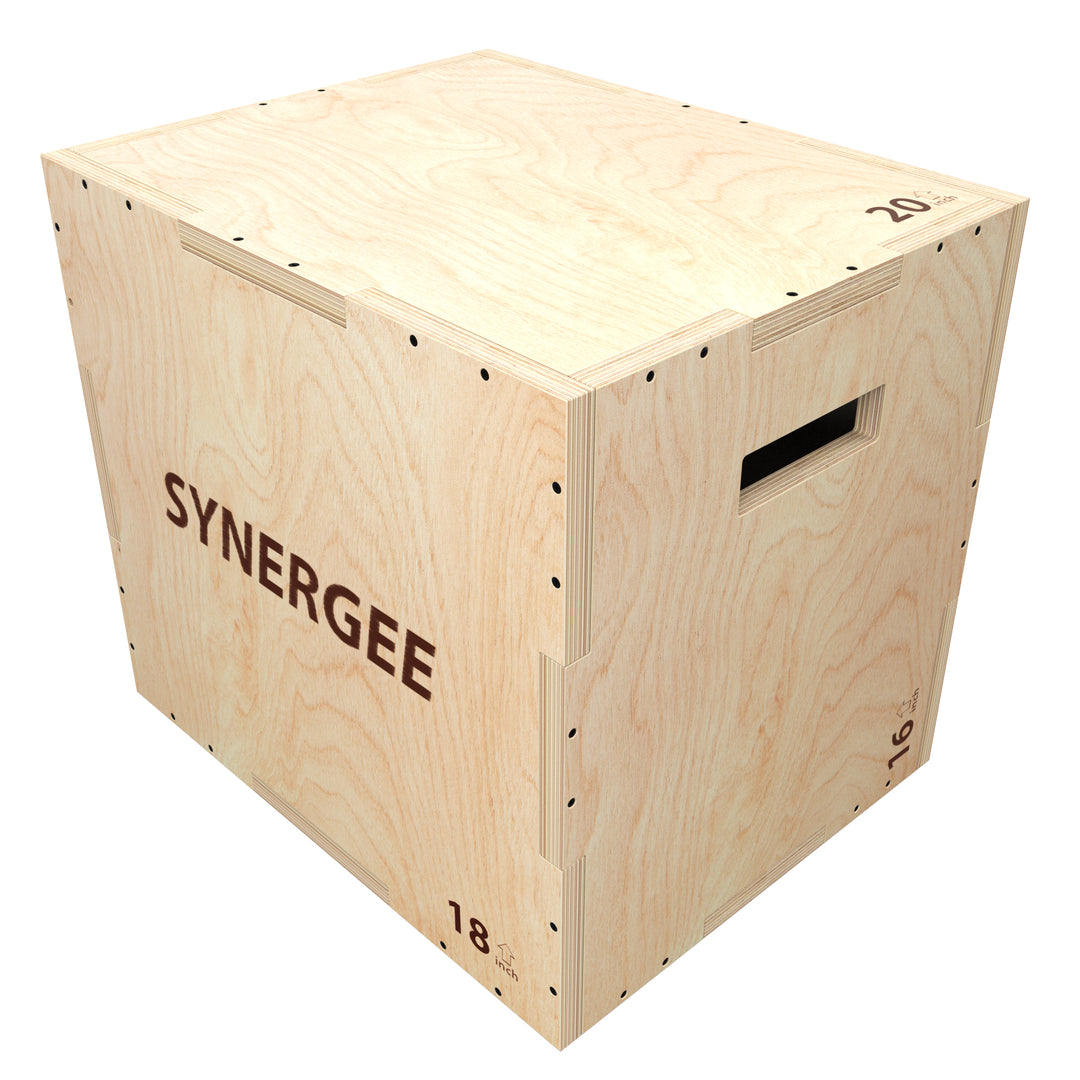
Synergee 3-in-1 Wood Plyo Box
Best Budget Plyo BoxQuick specs
- Material - 3/4-inch wood
- Surface - bare sanded wood
- Heights - 3-in-1, flip to change
- Sizes - four sizes, inner reinforcement
- Assembly - around 15 minutes
The budget pick. A no-frills 3-in-1 wood box with inner bracing and a high weight capacity, at the lowest price in the lineup.
Summary of experience, tests & opinions
The good
- For the price, it lands quieter than I expected. There is a faint hollow note on the tall face that the premium boxes do not have, but it is a long way from the tinny rattle a genuinely cheap box gives you.
- This is the box I point true beginners and bargain hunters toward. Spending up only pays off once you know you will keep training, and this gets you onto real wood in the meantime.
- It does not shout “cheap” in your gym. The 3/4-inch wood looks honest rather than budget, so it sits next to better kit without embarrassing you, which matters more than people admit.
The not-so-good
- After a few months the high face has loosened by the smallest fraction, just enough that I re-snug the screws now and then. Two minutes with a drill and it is solid again, but it is not a fit-and-forget box the way the pricier ones are.
Pros & cons
Pros
- Lowest price on the list - the cheapest way onto a genuine 3-in-1 wood box that still lasts.
- Three heights, four sizes - flip-to-change versatility with inner reinforcement and a high weight capacity.
- Side cutouts make it easy to shift around the gym, and it builds in roughly 15 minutes.
Cons
- Bare wood edges - exposed corners can scrape a shin on a miss, with no foam or softening.
- Build cuts corners - shorter screws and a less rigid feel than the premium wood boxes.
Read more about the Synergee 3-in-1 Wood Plyo Box
Synergee spends where it counts, on the wood and the bracing, and saves everywhere else.
The build is a clear step below the premium boxes, but for a first plyo box or a cheap addition that is the right place to cut, because the part doing the work is still honest 3/4-inch wood with inner reinforcement and a high weight capacity. For the money it punches up: owner reports across our community run for years of normal box-jump and step-up work with no real complaints beyond the surface scuffing. Our team built the largest size in about fifteen minutes from pre-drilled holes, and the side cutouts made it easy to shift around the gym afterward. The first thing a bargain-hunter notices is that it gives you three real heights in one box for the lowest spend here, which is exactly why it tops the value category. Buy it if you want a real wood box and the budget is tight; skip it if you jump heavy and want the dead-solid feel of a premium box.
Put it next to the Rogue Games Box and the gap is rigidity and finish: the Rogue locks together with precision joinery and lands like concrete for a lot more money, while the Synergee just does the job for the lifter who wants in for the least.
The edges are the one thing the saving costs you. They are bare and exposed like any cheap wood box, so a clipped shin bites every bit as hard. If shin safety is your worry, the soft REP or Rogue Foam will treat you far gentler for more money.
That is why it tops the lineup on value:
Bottom line
Buy the Synergee 3-in-1 Wood Plyo Box if you want a real wood box and the budget is tight. It gives you three heights, a high weight capacity, and easy handling, and it lands the best score-per-dollar in the lineup. You give up the dead-solid feel and finish of the pricier boxes, which is the one place the saving shows.
For the most box at the lowest price, this is the pick. If you jump heavy and want a more solid build, step up to the Rogue Games Box.
The Synergee 3-in-1 Wood Plyo Box might be for you if… you want a genuine 3-in-1 wood box and the budget is tight.
It’s not for you if… you jump heavy and want a premium, rock-solid build, where the Rogue Games Box is the step up.
How we created this list of best plyo boxes
Here are the criteria we used to pick these plyo boxes, and how much each one counted:
- Build and stability (35%)
- Landing surface and shin safety (20%)
- Height options and versatility (20%)
- Footprint and storage (10%)
- Value for money (15%)
You can read all about our selection process here.
Other plyo boxes we tested - close but no cigar
- Rogue Resin Plyo Box - a genuinely good stackable resin box that stores compact, but the Titan Adjustable folds more heights into less floor for similar money, so it edges resin for tight rooms.
- Rage Fitness Steel Plyo Box - the highest weight capacity here and welded solid, but the small landing top and firm steel surface put it a step behind the Titan Adjustable for most home jumpers.
- Bells of Steel 3-in-1 Wood - a strong wood box with a grippy hexagonal overlay and cut corners, but the Rogue Games Box lands stiffer and the Synergee wins on price, so it lands between the two.
- Yes4All 3-in-1 Wood - the most popular budget box on Amazon, but owner reports flag hardware and quality issues that put it a clear step below the Synergee once you actually jump on it.
Plyo box FAQs
What is the best plyo box?
The best plyo box is the REP 3-in-1 Soft Plyo Box.
It pairs a rigid wood core with dense foam and the grippiest vinyl here, so you get three heights in one box that lands firm yet forgives a clipped shin, all at a price that undercuts the premium tier.
For the stiffest all-wood build, the Rogue Games Box is the step up, and for the softest landing the Rogue Foam is the box to beat.
Soft, wood, or steel plyo box, which should I buy?
Buy a soft box if you train general fitness and want shin protection, which covers most home lifters.
A soft box with a wood core like the REP lands firm but forgives a miss, a wood box like the Rogue Games Box is the stiffest and usually cheaper but the edges bite, and a steel adjustable like the Titan saves the most floor space.
If you compete or jump heavy, the rigid wood build is worth the harsher landing.
What height plyo box should I start with?
Most beginners start somewhere between 12 and 24 inches and add height as they get stronger.
A 3-in-1 box like the REP gives you three heights in one footprint, so you can flip down to a safe height on tired legs and flip up on fresh ones, and the Titan even adds a 12-inch low setting.
Start lower than your ego wants, because a missed box jump scrapes a shin fast.
Are adjustable plyo boxes as good as fixed ones?
Adjustable plyo boxes are excellent when floor space is your main constraint, since one steel frame covers several heights in a compact base.
A fixed wood or soft box still has the edge on landing feel and forgiveness, but a good adjustable like the Titan gets very close while saving the space and storing kit underneath.
If space is not your problem, a soft box like the REP feels more natural underfoot.
Do plyo boxes need assembly?
Soft boxes like the REP and Rogue Foam arrive ready to use, while most wood and steel boxes ship flat for a 15-to-40-minute build.
The Synergee takes about fifteen minutes, the Rogue Games Box closer to forty, and the Titan Adjustable needs none at all since you just change the height.
All of them include the hardware and pre-drilled holes, so a drill and a few minutes is all you need.
The bottom line
I have jumped, stepped, and pressed off a lot of boxes over the years, because a plyo box is one of the cheapest pieces of kit that earns its keep the fastest.
For most people, the REP 3-in-1 Soft Plyo Box is the call. It lands firm thanks to the wood core, forgives a missed jump thanks to the foam, and costs a tier less than the boxes it matches.
If you want the stiffest, most durable all-wood box money buys, step up to the Rogue Games Box.
If you are new to box jumps or coming back from injury, the Rogue Foam gives the softest landing. And if money is tight, the Synergee 3-in-1 Wood is the most box for the least cash.
There are two things to do now:
- If you want another look at the picks, click here to skip back to the table.
- If you want to put a pin in it, bookmark this page and come back. We re-test it and update the picks whenever a box changes.
Stay strong.
