
We scored the best multi-station power towers on the market and picked the six worth your money.
A power tower was the first real bit of kit in my own garage, back before the rack and the plates arrived. The team ran the current crop through our weighted scoring, leaning on owner reports and our own time under the bar, so these picks come from data rather than one person’s favourite.
The aim was simple: find the towers that hold steady under a real adult, cover the four core stations well, and don’t fall apart in a year.
Here’s how they ranked…
Editor's note · updated June 23, 2026
We rebuilt this guide for 2026 and reworked the rankings from the ground up.
What changed:
- The Sportsroyals Power Tower is the new #1 overall. Its 450 lb extended base, adjustable pull-up bar and tilted arm pads make it the sturdiest, most adjustable tower most home lifters can buy without a big spend. One quick note on this brand below: buy the higher-spec 450 lb model, not the cheaper foam-grip version.
- The Steelbody STB-98501 drops to a budget slot. It held our top spot for years on the strength of its 14-gauge steel. It is still a solid frame, but its 300 lb rating and narrower base sit behind the newer Sportsroyals.
- We trimmed the list from thirteen picks to six. A long roundup hides the towers actually worth buying. We also dropped a couple of models that are no longer sold in the US.
Related
This guide covers full multi-station power towers, the cages with a pull-up bar, dip handles, a knee-raise station and push-up grips. If you only want a single bar, see the best free-standing pull-up bars for floor units and the best wall-mounted pull-up bars for fixed mounts. To add bodyweight stations to a rack instead, look at our best power rack attachments.
Compare the best power towers
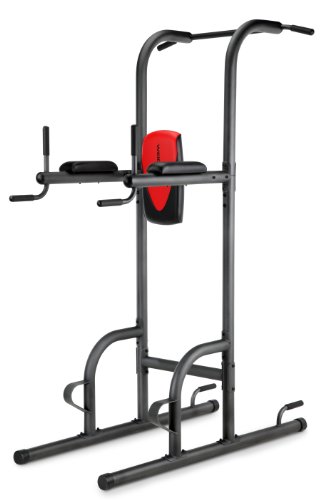 Weider
Check price
Weider
Check price
|
 Titan w/ Bench
Check price
Titan w/ Bench
Check price
|
 Stamina Outdoor Pro
Check price
Stamina Outdoor Pro
Check price
|
 OneTwoFit Wall-Mounted
Check price
OneTwoFit Wall-Mounted
Check price
|
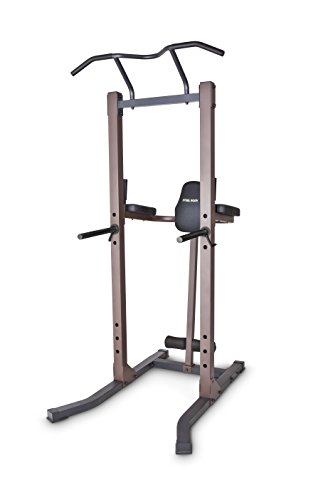 Steelbody STB-98501
Check price
Steelbody STB-98501
Check price
|
||
|---|---|---|---|---|---|---|
| Best for | Overall | Value | With a bench | Outdoors | Small spaces | Budget |
| Rating (*) | ||||||
| Build & stability | 88% | 72% | 80% | 92% | 78% | 82% |
| Stations & versatility | 92% | 82% | 94% | 80% | 70% | 82% |
| Footprint & assembly | 86% | 80% | 70% | 80% | 96% | 66% |
| Value | 90% | 92% | 86% | 82% | 84% | 78% |
| Price | $$ | $ | $$ | $$$ | $ | $$ |
| Capacity (lbs) | 450 | 300 | 350 | 330 | 440 | 300 |
| Stations | 5 | 4 | 5 + bench | 4 + step | 3 | 4 |
| Adjustable bar | Yes (6) | No | No | No | Mount height | No |
| Frame | 2mm steel, H-base | Steel | Steel | 11-gauge steel | Alloy steel | 14-gauge steel |
| Outdoor-rated | No | No | No | Yes | No | No |
 Sportsroyals
Our testing and selection process
How we assess power towers
We run every power tower roundup through the same 5 steps:
- We start as the buyer. Most of our team has owned a tower at some point, and I bought one as the very first machine in my garage, so I know what a good one feels like and where the cheap ones cut corners.
- We research wide. We pull capacity ratings, base design, station count, dimensions and a stack of owner reports into one spreadsheet.
- We score each tower with our weighted system. The data sets the order.
- We split the field by job, because a wall-mounted unit for a tiny room and an outdoor rig for the back yard are bought for completely different reasons.
- We get hands-on where we can and lean on the SHG community for the long-term reports we can’t gather ourselves.
You can read more about the process in our review guidelines.
How we score power towers
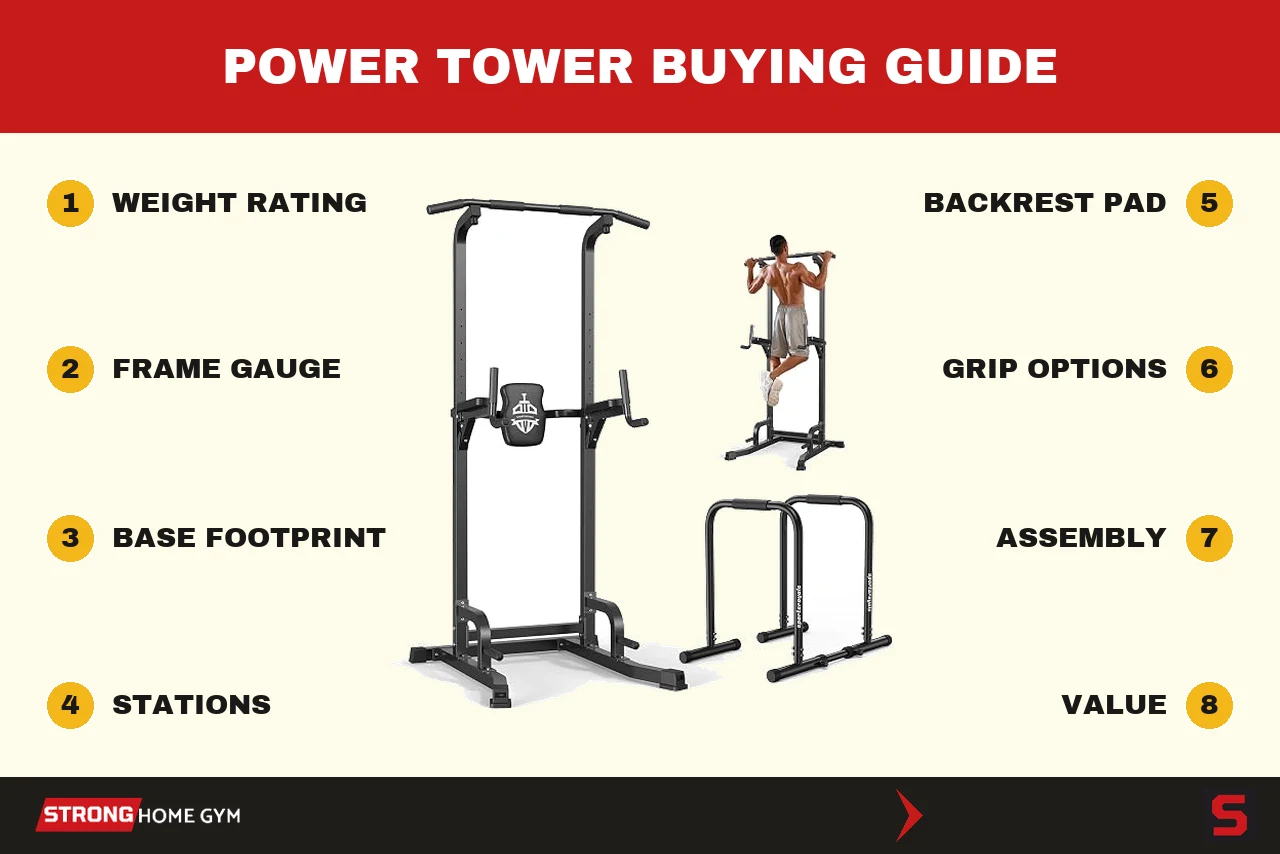
Here’s what feeds the score and how much each part counts. Build leads, because a tower that shifts under you is a tower you stop trusting.
We grouped it into four weighted factors:
- Build & stability (30%) - steel gauge, the base design, total weight, and the honest capacity rating.
- Stations & versatility (25%) - how many stations it covers, grip options, adjustability, and any extras.
- Footprint & assembly (20%) - floor space, ceiling height, and how painful the build is.
- Value (25%) - what you actually get for the money.
Build & stability (30%)
This carries the most weight. A power tower has no plates anchoring it down, so the frame and base are all that keep it steady while you swing through a rep.
We look at the steel gauge, the width and shape of the base, the number of floor contact points, and the total weight of the unit. A heavier tower on a wide H-base or triangular base stays planted. A light one on a narrow base rocks, and that rocking is the single most common complaint owners have.
Stations & versatility (25%)
The headline four are pull-up, dip, knee raise and push-up. The best towers do more: an adjustable-height pull-up bar, multiple grip widths, a removable back pad for sit-ups, or a bolt-on bench.
We score how many of these you actually get and how usable each one is. A dip station you can’t fit between is a station in name only.
back & biceps
chest & triceps
core
chest & core
Footprint & assembly (20%)
Towers eat floor space and headroom. We measure the footprint, flag the ones that need clearance front and back, and call out ceiling height for the fixed seven-foot frames.
Assembly counts too. A few of these towers are genuinely fiddly to put together, with vague instructions, and a buyer wrestling a frame for two hours is a buyer leaving a one-star review.
Value (25%)
We build a quality-adjusted picture of price. A tower that nails build and stations for a fair price beats a pricier one that only wins on a spec sheet. Tiers and relative value, never the cheapest sticker for its own sake.
Find the perfect power tower for you
Overall | Value | With a bench | Outdoors | Small spaces | Budget
Here’s how the six towers stack up on our overall score:
Sportsroyals Power Tower
Best OverallQuick specs
- 450 lb capacity, 2mm steel, extended H-base
- 6 pull-up heights (64.6 to 88.2 in), 7 backrest positions
- Pull-up, dip, knee raise, row, 3-angle push-up
- Arm pads tilted 10 degrees, padded back rest
The tower that gets the most right for the most people: a genuinely sturdy base, an adjustable bar that suits tall and short, and comfort details the cheap ones skip.
Summary of experience, tests & opinions
What I like
- The adjustable pull-up bar is the feature that earns its keep. Six heights mean a six-foot user gets a full hang and a shorter partner isn’t jumping for the bar. It also lets you drop the top bar to clear a low ceiling.
- The arm pads tilt inward by ten degrees, and you feel it on knee raises. A sweaty elbow stays put instead of sliding off mid-set.
- On the higher-spec model the dip handles sit solid in their sockets. That’s the difference our team noticed most against the cheaper version of this tower.
What I don’t
- Assembly is a slog. The instructions are thin and there are a lot of bolts, so set aside an evening and a power driver.
- The front crossbar of the base sits where your foot wants to go. You learn to step over it, but it’s a trip hazard the first week.
Pros & cons
Pros
- 450 lb capacity on a wide H-base - the sturdiest, highest-rated frame in this lineup.
- Adjustable pull-up bar across six heights, plus seven backrest positions.
- Multiple pull-up grips and three push-up bar angles for grip variety.
Cons
- Awkward, time-consuming assembly with unclear instructions.
- The narrow pull-up grips and a max bar height of 92.7 inches leave very tall users wanting a touch more.
Read more about the Sportsroyals Power Tower
It wins by removing the usual budget-tower compromise. Most cheap towers make you pick one thing to live with: a wobble, a fixed bar that’s too low, or grips that tear up your hands. This one sidesteps all three.
Buy this one if you’re:
- A bodyweight-first trainer who wants every station solid out of the box, no ballast and no fixing required.
- Tall or sharing the tower. The bar adjusts across six heights from 64.6 to 88.2 inches, so a six-footer gets a clean hang and a shorter partner isn’t jumping for it.
- After the highest honest capacity here. The 450 lb rating sits on a wide extended H-base with eight floor contact points, which is why heavier lifters can swing through reps without the frame walking.
Look elsewhere if you’re: out of floor space (the wall-mounted OneTwoFit reclaims every square foot), or you want to press a barbell as well as pull (the Titan adds a bench and J-hooks this one skips).
One thing to get right before you buy. Sportsroyals sells two towers that look alike, and they are not the same machine. The cheaper one has been flagged for a dip bar that wobbles in its sockets even fully tightened, thin foam grips, a pull-up bar that isn’t fully covered, and a support beam your knees clip on pull-ups. The higher-spec model we recommend fixes the dip wobble, uses a nicer matte powder coat, and drops that support beam clear of your legs. That is the 450 lb B0G2LF6J9K. Buy that one.
Stations on the day-to-day:
- Pull-up bar with wide, close and neutral grips, plus exposed metal sections if you want a bare-bar hang.
- Dip handles that hold firm on the higher-spec frame, the single biggest upgrade over the cheap model.
- Knee-raise station with arm pads tilted in by ten degrees, so a sweaty elbow stays put mid-set.
- Three-angle push-up bars and a row handle for grip variety most towers don’t bother with.
Footprint and ceiling are the usual tower ask: a roughly four-foot square of floor and enough headroom for the top bar at 88 inches, which you can drop for a low garage.
It’s not flawless. Assembly is a slog of thin instructions and a lot of bolts, so set aside an evening and a power driver. The pull-up grips also run a touch narrow for very wide hands. For a do-everything home tower, nothing here matches it.
The Sportsroyals takes the top slot on our weighted overall score:
Bottom line
The Sportsroyals is the tower to buy if you want one do-everything frame and no specific reason to pick something else. The 450 lb base holds steady, the bar adjusts to fit you, and the comfort details land. Just budget an evening for the build, and buy the 450 lb model rather than the cheaper one.
The Sportsroyals might be for you if… you want the sturdiest, most adjustable all-round tower and you’ll happily trade an evening of assembly for it.
It’s not for you if… you have no floor to spare and need to mount, in which case the OneTwoFit saves more room, or you want a bench, which the Titan adds.
Weider Power Tower
Best ValueQuick specs
- 300 lb capacity, 86 lb frame
- Four stations across two sides
- Padded handles and back rest, multi-grip bar
- 57 in L x 41 in W x 84 in H, easy assembly
The cheapest way into a real four-station tower. Light and a touch wobbly, but honest value for a first machine.
Summary of experience, tests & opinions
What I like
- It goes together fast. This is the one on the list a complete beginner can build in an evening without losing their temper.
- The two-sided design is quietly clever. Put two people on it and nobody’s queueing for the bar.
- The padded handles and back rest are comfortable enough that you forget you’re on the cheapest tower here.
What I don’t
- It’s light, around 86 pounds, and a heavier user feels the frame move on faster reps. Many owners weight the base with plates or sandbags to settle it.
- The dip handles are the weakest part. They do the job, but they don’t feel as solid as the pull-up and knee-raise stations.
Pros & cons
Pros
- Lowest price of any full tower here - the reason it’s the value pick.
- Four real stations plus a multi-grip pull-up bar.
- Quick, beginner-friendly assembly.
Cons
- Light frame wobbles under heavier users without added ballast.
- Two-sided layout needs clearance front and back, so it can’t sit against a wall.
Read more about the Weider Power Tower
This is the tower for the buyer who wants in cheap and isn’t carrying a lot of bodyweight yet.
It suits you if you’re:
- A first-timer on a tight budget who wants four real stations, not a single pull-up bar.
- On the lighter side. Under roughly 200 pounds you’ll likely never notice the sway, and the 300 lb rating leaves plenty of headroom.
- Training with a partner. The two-sided layout means one of you can dip while the other pulls.
Skip it if you’re a heavier lifter who wants a frame that’s rock-solid the moment it’s bolted together, or you need to push it flat against a wall.
Where it gives ground to the Sportsroyals is stability. The Weider frame is around 86 pounds, a good 130 lighter on a narrower base, so a bigger lifter swinging through pull-ups will feel it sway. The fix is the one owners reach for constantly: stack a couple of plates or drop a sandbag on the base and the wobble settles.
The two-sided layout is the bit people underrate. Most towers cram every station onto one face. The Weider splits them across roughly 57 by 41 inches of floor, dip and knee raise on the front, pull-up and push-up on the back, so the frame feels less cramped and two people can train at once. The catch is in the next paragraph.
You need clearance front and back to reach both faces, so it can’t sit in a corner. Plan for that and budget an hour for the build, which a beginner can manage without losing their temper.
The dip handles are the weakest part of the frame and the padded handles and back rest are more comfortable than the price suggests. No creak from the pull-up station, which is the one that matters most. For a first tower on a tight budget, it earns its place.
It runs near the top of our value score:
Bottom line
The Weider is the cheapest honest way into a four-station tower. It’s light and wants ballast under a bigger user, but it covers the basics and goes together fast.
The Weider might be for you if… you want a low-cost first tower, you weigh on the lighter side, or you’ll happily weight the base.
It’s not for you if… you’re a heavier lifter who wants a tower that’s rock-solid out of the box. Step up to the Sportsroyals.
Titan Power Tower with Bench
Best With a BenchQuick specs
- 350 lb capacity, 83 lb frame
- Five stations plus an integrated bench
- Pull-up, dip, knee raise, push-up, bench
- Rubberised feet, includes J-hook pegs
A tower and a bench in one frame. The pick if you want to press as well as pull without buying two pieces of kit.
Summary of experience, tests & opinions
What I like
- The bench is the whole point, and it changes what the frame can do. With the J-hook pegs you can rack a bar for light presses, not just hang and dip.
- Five stations in one footprint is the most versatile setup here. For a starter home gym, that’s a lot of training in one buy.
- Titan’s pricing is hard to argue with. You’re getting the bench thrown in for less than some plain towers cost.
What I don’t
- It’s long. Adding the bench pushes the frame past six feet front to back, so it needs a proper run of floor.
- Bigger users report some sway at the top of the pull-up station. It’s a starter frame, not a competition rig.
Pros & cons
Pros
- Five stations plus an integrated bench - the most versatile single frame on the list.
- Includes J-hook pegs for light barbell work.
- Reasonable price for everything that’s included.
Cons
- Large footprint, over six feet long, so plan the floor space.
- Can feel less stable under heavier users on the pull-up bar.
Read more about the Titan Power Tower with Bench
This is the tower for someone building a first gym in one purchase rather than three.
Buy it if you’re:
- Starting from scratch and want to pull, dip, raise, push and press off one frame. The integrated bench and J-hook pegs turn a bodyweight tower into a light barbell station.
- Short on budget but not on floor. You’re getting five stations plus a bench for less than some plain four-station towers cost.
Pass if you’re tight on space, or you weigh enough to want the steadiest possible pull-up bar. The 350 lb rating and 83 lb frame are honest, but this is a starter rig, not a competition cage, and bigger users report some sway at the top of the pull-up.
The honest comparison is against the Sportsroyals. The Sportsroyals is the sturdier, more adjustable bodyweight tower. The Titan trades a little of that solidity for a bench and barbell pegs the Sportsroyals doesn’t have. Pure bodyweight, the Sportsroyals wins. Want light pressing without a separate rack and bench, and the Titan is the smarter single buy.
The cost is floor space. That bench pushes the frame past six feet front to back, making it the longest tower here, so measure the run before you order, especially against a wall.
A few lived notes from time on the frame:
- The rubberised feet settle it on hard floor, but they won’t cure the top-of-pull-up sway a heavier user feels.
- The bench plus J-hooks is the genuine difference-maker. It is the gap between a tower you hang off and a frame you can also rack a bar on for light presses.
- Titan rotates this through stock and it can show as unavailable between runs. If it’s out when you look, the Stamina Outdoor Pro or the Sportsroyals are the next towers to consider.
On stations and versatility, it tops the list:
Bottom line
The Titan packs five stations and a bench into one frame, which makes it the most versatile single buy here. You pay for it in floor space and a bit of stability, but for a starter gym it’s a lot of training for the money.
The Titan might be for you if… you want bodyweight stations plus light pressing from one frame and you have the floor for a long unit.
It’s not for you if… you’re tight on space or want the steadiest pull-up bar. Look at the Sportsroyals or, for tiny rooms, the OneTwoFit.
Stamina Outdoor Power Tower Pro
Best for OutdoorsQuick specs
- 330 lb capacity, 144 lb frame
- 11-gauge steel, UV and corrosion-resistant coat
- Multi-grip pull-up, dip, push-up, step ledge
- Boltable into concrete, 3-year frame warranty
Built to live outside. Heavy 11-gauge steel and a weatherproof coat that shrugs off rain, sun and temperature swings.
Summary of experience, tests & opinions
What I like
- This is the sturdiest frame on the list, and it feels it. At 144 pounds of 11-gauge steel it doesn’t shift, even before you bolt it down.
- The coating is built for the job. Owners report it sitting through full seasons of rain and sun without the rust and paint-flaking that kills cheaper towers left outside.
- The step ledge on the back is a nice touch for box jumps or step-ups, things most towers can’t offer.
What I don’t
- No dedicated knee-raise station. You get pull-up, dip and push-up, but core work means hanging leg raises off the bar instead of a padded back rest.
- The dip handles sit a little short, so taller users find the dip a touch awkward.
Pros & cons
Pros
- Genuinely weatherproof 11-gauge steel - the reason it’s the outdoor pick.
- Heavy, stable frame that can also be bolted into concrete.
- Adds a step ledge for box jumps and step-ups.
Cons
- No padded knee-raise station.
- Premium price, and the dip handles run short for taller lifters.
Read more about the Stamina Outdoor Power Tower Pro
Buy this one for a single reason: you want to train outside and have your tower survive it. Standard towers left in the garden rust and flake within a season. This one is engineered not to.
It’s the right tower if you’re:
- Training in a garden, on a patio, or in an open carport where weather gets at the frame.
- A heavier lifter who wants the steadiest base here. At 144 pounds of 11-gauge steel it doesn’t budge, and you can bolt it into concrete to make it immovable.
- After extras a plain tower skips. The back step ledge doubles as a box-jump and step-up platform.
Skip it if you’re training indoors, where the Sportsroyals gives you more stations and an adjustable bar, or you want a dedicated padded core station, because this one has none.
The build is the story. Eleven-gauge steel is a meaningful step up from the thin tube most budget towers use, and the UV and anti-corrosion coating is what keeps the gold-coloured frame from fading and pitting through full seasons of rain and sun. The 330 lb capacity is honest, and the 3-year frame warranty backs it.
Set against the Sportsroyals, the difference is purpose. The Sportsroyals is the better all-round indoor tower with more stations and an adjustable bar. The Stamina trades the knee-raise station and some adjustability for a frame that genuinely belongs outdoors. Indoors, the Sportsroyals is the better buy. In the back yard, this is the only real choice on the list.
Two things to know before you commit:
- You only get pull-up, dip and push-up plus the step ledge. Core work means hanging leg raises off the bar, not a padded back rest.
- The dip handles sit a little short, so taller users find the dip a touch awkward.
It’s the dearest tower here, so it’s a pick for people who specifically need the outdoor build, not a default.
It runs away with our build and stability score:
Bottom line
The Stamina Outdoor Pro is the tower that lives outside and doesn’t rot. Heavy 11-gauge steel and a weatherproof coat make it the sturdiest frame here, at the cost of a knee-raise station and a higher price.
The Stamina Outdoor Pro might be for you if… you train in the garden or on a patio and want a tower that survives the weather.
It’s not for you if… you train indoors, where the Sportsroyals gives you more stations for less, or you need a dedicated core station.
OneTwoFit Wall-Mounted Power Tower
Best for Small SpacesQuick specs
- 440 lb capacity, alloy steel
- Wall-mounted, zero floor footprint
- Pull-up, dip and knee-raise stations
- Mounts at any height, 23.5 lb unit
A tower’s stations on the wall instead of the floor. The pick when you have no room for a full frame but you do have a solid wall.
Summary of experience, tests & opinions
What I like
- It uses no floor space at all, which is the entire reason to own it. In a box room or a shared garage, that’s the difference between owning a tower and not.
- You set the mount height yourself, so you can hang it high enough for a full pull-up, something the short fixed-frame towers can’t always manage.
- It flips from a pull-up bar to a dip and knee-raise station by lifting it onto a second set of hooks. Quick to switch mid-session.
What I don’t
- The grips are cheap foam and the padding is basic. It does the job, but it doesn’t feel premium under your hands.
- The mount is the catch. It wants a concrete or brick wall. On drywall you have to fit plywood or panels first, and it doesn’t include the lag bolts for that.
Pros & cons
Pros
- Zero floor footprint - the clear reason it’s the small-space pick.
- Mounts at any height you choose, good for tall users and low ceilings alike.
- Switches between pull-up and dip stations on the wall hooks.
Cons
- Needs a concrete or brick wall, or plywood backing on drywall, and no lag bolts are included.
- Cheap foam grips and basic padding.
Read more about the OneTwoFit Wall-Mounted Power Tower
This is the pick for the buyer who has genuinely run out of floor.
A box room, a corner of a shared garage, a flat with no space for a seven-foot frame. Bolt this 23.5 lb unit to a solid wall and you get a pull-up, dip and knee-raise station while reclaiming every square foot underneath.
It’s for you if you’re:
- Out of floor but you have a sound concrete or brick wall to anchor to.
- Tall, or fighting a low ceiling. You set the mount height yourself, so you can hang it high enough for a full pull-up that short fixed towers can’t always give.
- Confident with a drill and happy to source the right fixings.
Steer clear if you’re on plasterboard and don’t fancy a small carpentry job first, or you want a push-up station, which this layout drops.
The wall is the whole job, and it matters more than the spec sheet lets on:
- Masonry (concrete or brick): straightforward. Mark, drill, bolt, done.
- Stud and plasterboard: you fix plywood or timber across the studs first, then mount into that. The lag bolts for it aren’t in the box, so buy them to suit your wall.
Get that right and it’s genuinely good. The 440 lb alloy-steel rating is honest, the switch from pull-up bar to dip and knee-raise takes seconds by lifting the unit onto a second set of hooks, and setting your own height beats a short fixed tower for a proper hang.
The grips are the one weak spot. They’re cheap foam and the padding is basic, so it doesn’t feel premium under your hands. For the right room, nothing else here competes on space.
On footprint and assembly, it’s the clear winner:
Bottom line
The OneTwoFit puts a tower’s stations on the wall and gives you back the floor. It needs a solid wall and a proper mount, and the grips are basic, but for a tiny room nothing else here keeps up.
The OneTwoFit might be for you if… you’ve no floor space and you have a concrete or brick wall to mount on.
It’s not for you if… you only have drywall and don’t fancy a mounting project, or you want a push-up station. A floor unit like the Sportsroyals is simpler.
Steelbody STB-98501 Power Tower
Best BudgetQuick specs
- 300 lb capacity, 14-gauge steel
- Four stations: pull-up, dip, knee raise, push-up
- Multi-grip pull-up handles, padded back rest
- 2-inch knee-raise padding, 2-year warranty
Our former number one, still a solid, heavy-gauge frame at a fair price. A dependable four-station tower if the newer picks are out of budget.
Summary of experience, tests & opinions
What I like
- The steel is the thing. At 14-gauge it’s thicker than the tube most budget towers use, and that’s why owners report it lasting a decade rather than a year.
- The two inches of padding on the knee-raise station is more generous than you expect at this price. Core sets stay comfortable.
- The feet are shaped to settle the frame, so it sits steadier than its weight suggests.
What I don’t
- It’s tall and wide and eats a real chunk of floor and ceiling. Measure your room before you commit, because this is one of the bigger frames here.
- The bar height is fixed, so there’s no dropping it for a low ceiling or raising it for a taller user the way the Sportsroyals allows.
Pros & cons
Pros
- Thick 14-gauge steel - the reason this frame outlasts cheaper towers.
- Four full stations with a comfortable, well-padded knee-raise station.
- Backed by a 2-year warranty, longer than most in this price range.
Cons
- Large footprint and tall fixed frame that needs a decent ceiling.
- No adjustable bar height, and the 300 lb rating trails the newer picks.
Read more about the Steelbody STB-98501
For years this was our top power tower. It lost the crown to a better tower, not to any real fault of its own. The Sportsroyals arrived with a heavier base, a higher capacity and an adjustable bar, and that combination simply scores higher now.
What hasn’t changed is why people liked it. The 14-gauge steel is the headline. Most budget towers cut cost on the tube, and you feel it when the frame flexes. The Steelbody doesn’t, which is how it racks up owner reports measured in years rather than months, backed by a 2-year warranty that’s longer than most at this price.
Still the right buy if you’re:
- After a tough four-station tower (pull-up, dip, knee raise, push-up) that will outlast cheaper frames, and the newer picks stretch your budget.
- Roughly average height with a proper room. The 2-inch knee-raise padding is more generous than the price suggests, and the shaped feet settle the frame steadier than its weight implies.
Not for you if you’re tall or short of an adjustable bar, want more than the 300 lb rating, or need a compact footprint. The Sportsroyals covers all three.
Its weak spot is size, not strength. It’s one of the bigger frames here, tall and wide with a fixed bar, so it asks for a proper room and a decent ceiling and can’t drop for a low garage or rise for a taller user. That fixed footprint is what holds its score back, not the build.
Buy it with confidence and keep it for years.
On value it sits at the back of the pack, which reflects its age rather than its build:
Bottom line
The Steelbody is the heavy-gauge budget pick. The 14-gauge steel still outbuilds most cheap towers, and the only real knock is a big fixed frame and an ageing spec versus the newer winners.
The Steelbody might be for you if… you want a tough, long-lasting four-station tower and the newer picks stretch the budget.
It’s not for you if… you want an adjustable bar, a higher capacity, or a smaller footprint. The Sportsroyals gives you all three.
What is a power tower (and who needs one)?
A power tower is a free-standing steel frame that stacks the main bodyweight stations into one footprint. Up top sits a pull-up bar, usually with a few grip options. Below that are dip handles, a padded back rest with arm pads for hanging knee raises, and a pair of low handles for elevated push-ups.
You load it with nothing but your own bodyweight. No plates, no cables, no electronics. That’s the appeal: one frame covers most of an upper-body and core session for a fraction of what a rack with attachments costs, and in a fraction of the space.
The four stations, and what they train
Each station hits a different group, so one tower gives you a full upper-body and core day:
- Pull-up bar. Lats, upper back, biceps. Multiple grips let you switch between wide pull-ups and closer chin-ups.
- Dip handles. Chest, triceps and front delts. Lean forward for more chest, stay upright for more triceps.
- Knee-raise station. The core. You hang on the arm pads and lift the knees, hitting the lower abs hard.
- Push-up handles. Chest and triceps again, with a deeper range than push-ups off the floor.
Who actually benefits
Steve, our certified PT, points people toward a power tower in a few clear cases:
- Bodyweight-first trainers. If pull-ups, dips and core work are the backbone of your training, a tower puts all of it in one place.
- Small home gyms. One frame replaces a separate pull-up bar, dip station and ab unit, which frees up room and money for plates and a bar.
- Beginners building a first gym. A tower is an affordable, no-plates way to start, and you can add a weight vest or bands as you get stronger.
If you only ever do pull-ups, a free-standing or wall-mounted bar is cheaper and smaller. If you want to load a barbell for heavy squats and presses, you want a rack. For everyone training mostly bodyweight, a tower earns its corner fast.
Other power towers we considered
Body Champ VKR Power Tower. A versatile budget tower with an adjustable dip station that drops down for sit-ups, plus hanging straps for extra core work. It’s a fair option, but the towers above cover the same jobs with steadier frames, so it didn’t make the ranked list.
Fitness Reality X-Class. A high-capacity tower with an angled main frame that some lifters like for muscle-up attempts. It’s a heavy, capable unit, but stock and pricing have been inconsistent, so we’ve left it as an honourable mention rather than a ranked pick. If you specifically want the highest-capacity frame and you find it in stock, it’s worth a look.
We also dropped the IRONMAN Triathlon X-Class that sat on the old version of this list. It’s no longer reliably sold in the US, so there’s no point pointing you at it.
The bottom line
If you want one power tower and you’ve no special reason to pick something else, get the Sportsroyals Power Tower. The 450 lb base stays planted, the bar adjusts to fit you, and the comfort details are the ones the cheap towers skip. Just buy the higher-spec 450 lb model and set aside an evening for the build.
From there it’s about your situation. Tight budget? The Weider is the cheapest honest way into a four-station frame, light enough that you may want to weight the base. Want to press as well as pull? The Titan with Bench adds a bench and barbell pegs. Training outside? The Stamina Outdoor Pro is built to survive it. No floor to spare? The OneTwoFit goes on the wall. And if the newer winners stretch the budget, the Steelbody is a tough, long-lasting fallback.
Whichever you pick, set it on a level floor, weight the base if it shifts, and add a vest or bands once bodyweight stops being a challenge.
Power tower FAQs
What is a power tower?
A power tower is a free-standing steel frame that puts four bodyweight stations in one footprint: a pull-up bar up top, dip handles, a padded back rest with arm pads for hanging knee raises, and low push-up handles. You load it with your own bodyweight, so there are no plates to buy. One frame covers most of an upper-body and core session, which is why it earns its space in a small home gym.
Are power towers worth it?
A power tower is worth it if you train pull-ups, dips, knee raises and push-ups and you want them in one frame rather than three separate bits of kit. It is cheaper than a rack with attachments, takes up less room than a full rig, and needs no weight plates. If you only ever do pull-ups, a wall-mounted or doorway bar is cheaper. If you want to squat and bench heavy, you want a rack instead.
Do power towers wobble?
The cheaper, lighter towers can wobble, especially under a heavier user or during faster reps. A wide H-base or triangular base, more contact points on the floor, and a heavier overall frame all cut the movement. If a tower still shifts, you can load the base with plates or sandbags, or bolt an outdoor model into concrete. The sturdiest pick on our list, the Sportsroyals, holds 450 lb on an extended base.
How much space does a power tower need?
Most floor-standing power towers sit around seven feet tall and take up roughly a four-foot by four-foot footprint, though some two-sided designs need clearance front and back. Check your ceiling height first, because a fixed seven-foot frame plus a tall user reaching overhead needs more headroom than many garages have. Adjustable-height towers and wall-mounted units are the answer for low ceilings and tight rooms.
Can you build muscle with a power tower?
Yes. Pull-ups and chin-ups build the lats, biceps and upper back; dips hit the chest, triceps and shoulders; hanging knee raises train the core; and push-up handles add chest and triceps volume. Bodyweight progress slows once the movements get easy, so add a weight vest, a dip belt or resistance bands to keep loading the muscles. A power tower covers the whole upper body without a single plate.
Power tower vs squat rack: which should I buy?
Buy a power tower if your training is mostly bodyweight: pull-ups, dips, knee raises and push-ups. It is cheaper, smaller and needs no plates. Buy a squat rack if you want to load a barbell for squats, presses and rows. A rack with a pull-up bar and a dip attachment can do much of what a tower does, but it costs more and takes more room. Many home gyms end up with both.