
We scored more than 100 push-up boards across 4 quality categories and picked the 5 most worth your money.
Steve, our certified PT, has coached beginners through bodyweight training for years, and he’ll tell you straight: a push-up board isn’t magic. What a good one does is take the guesswork out of hand placement so you actually work every angle, and the best ones stay planted while you do it.
The aim was simple: sort the boards that guide your hands, hold steady and survive daily use from the flimsy ones that flex, tip and gather dust.
Let’s see how they stacked up…
Editor's note · updated July 2, 2026
We rebuilt this guide for 2026 and tightened both the rankings and the honesty.
What changed:
- The Power Press Original keeps the top spot. Its extra width and heavier handles still give the most stable, best-guided board we’ve used, so it stays our pick for most people.
- We swapped the wooden pick for the LALAHIGH all-in-one board. The old wooden listing has gone unreliable, and the LALAHIGH kit is now the board most other testers rank first, so it earns the slot as the best complete home-gym starter set.
- We restructured how we score. Four weighted factors now (build, grip and stability, versatility, value) instead of one catch-all quality bucket.
- We lead with the real question. Before the buying detail, we settle whether a push-up board is worth it at all. Short version: as a beginner’s guide, yes; as a muscle-building shortcut, no.
Related
Push-ups are one piece of a home setup. If you’re kitting out a corner, see our best home gym equipment picks, add load to your bodyweight work with the best weighted vest, and protect your wrists and floor with a decent exercise mat.
Compare the best push-up boards
 Iron Chest Master
Check price
Iron Chest Master
Check price
|
 AERLANG
Check price
AERLANG
Check price
|
 LALAHIGH
Check price
LALAHIGH
Check price
|
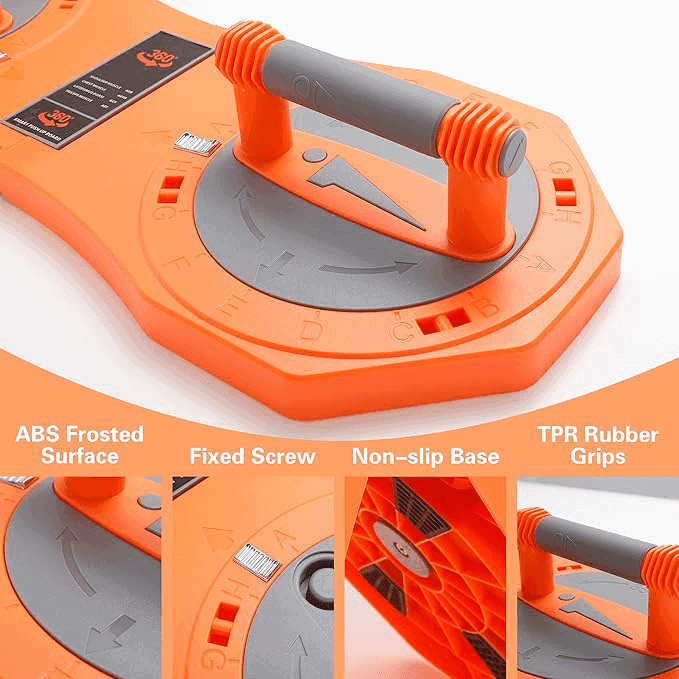 YIGM 360°
Check price
YIGM 360°
Check price
|
||
|---|---|---|---|---|---|
| Best for | Overall | Chest / pecs | Budget | All-in-one kit | Rotating handles |
| Rating (*) | |||||
| Build quality | 91% | 92% | 76% | 82% | 84% |
| Grip & stability | 88% | 86% | 72% | 82% | 90% |
| Versatility | 88% | 78% | 88% | 95% | 82% |
| Value | 86% | 78% | 95% | 92% | 80% |
| Positions | 30 | Chest press + bands | 30 | 15 + full kit | 360° rotation |
| Weight capacity | 300 lb | 600 lb | 300 lb | 300 lb | 286 lb |
| Material | ABS plastic | Aluminum & steel | ABS plastic | ABS plastic | ABS plastic |
| Price | $ | $$ | $ | $ | $ |
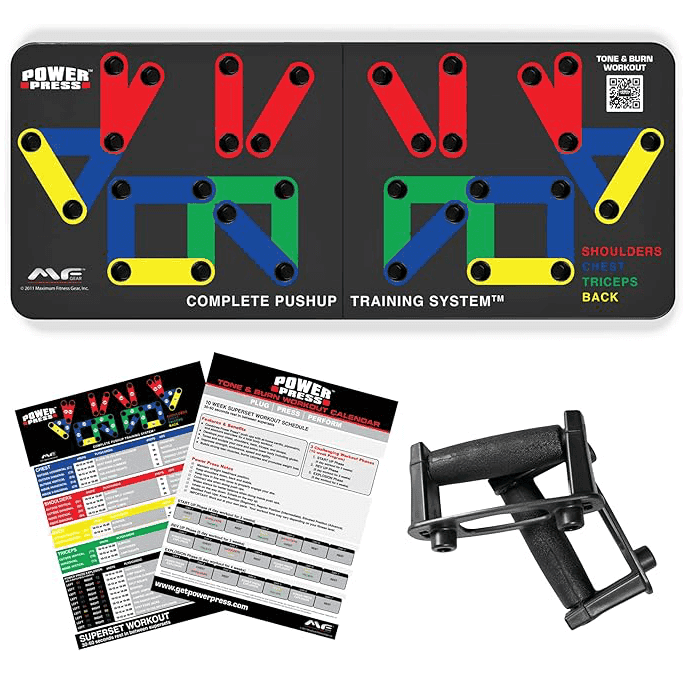 Power Press Original
Our testing and selection process
How we assess push-up boards
We run every push-up board roundup through the same 5 steps:
- We start as the buyer. Steve has coached clients through bodyweight progressions for years, and our team has bought and trained on boards across the price range, so we know what actually helps a beginner and what’s just marketing.
- We research wide. We pull materials, weight capacity, position count, handle design and owner feedback on as many boards as we can find, more than 100 this time, into one spreadsheet.
- We score each board with our weighted system. Data sets the ranking, and brand loyalty stays out of it.
- We split the field by job, because a chest-focused board and an all-in-one starter kit are bought for very different reasons.
- We get hands-on where we can and lean on the SHG community for the rest.
You can read more about the process in our review guidelines.
How we score push-up boards
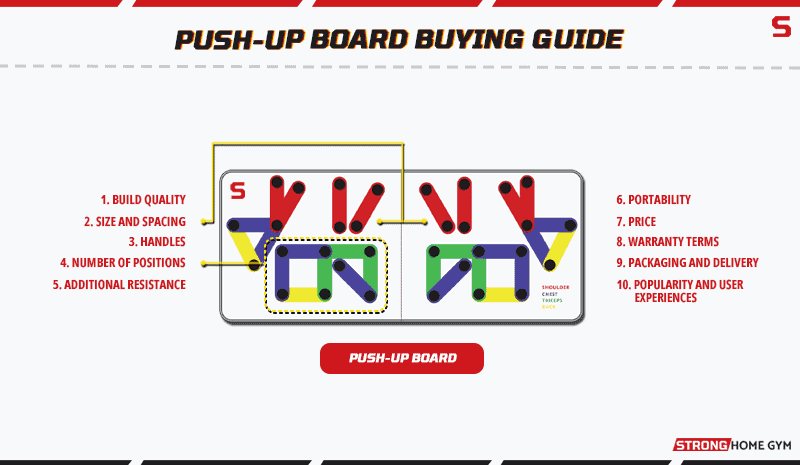
Here’s what feeds the score and how much each part counts. Build and stability lead, because a board that flexes or tips is worse than no board at all.
We grouped it into four weighted factors:
- Build quality (35%) - materials, weight capacity, and whether it survives daily use.
- Grip & stability (25%) - planted base, non-slip feet, comfortable handles that stay put.
- Versatility (25%) - position count, the muscles you can target, and any extras.
- Value (15%) - what you actually get for the money.
Build quality (35%)
This carries the most weight. The whole point of a board is that it holds firm while you press against it, and the material decides whether it does. Good boards use tough ABS plastic, the same stuff in Lego bricks and car trim, rated to around 300 lb. Cheap boards use thin PVC that bows under a hard rep and cracks at the handle sockets over time.
Weight capacity is the quick tell, but it isn’t the whole story. A 300 lb ABS board with solid handle mounts will outlast a flimsy one with a big number printed on the box. We load each board, watch the handle slots for flex, and note anything that creaks or works loose.
Grip & stability (25%)
A board earns your trust by staying put. We work each one on hardwood, tile and carpet, in wide and narrow positions, and watch for the board sliding or tipping when you press off-center. A wide, planted base with grippy feet holds through anything. A narrow board can lift a corner on a hard rep, which is how wrists get tweaked.
Handles matter here too. They should feel firm and stay seated in the slots, not twist or pop out mid-set.
Versatility (25%)
This is the whole reason a board beats bare floor. The color-coded slots let you slide the handles into set positions, and each color biases the push-up toward a different muscle. More useful positions, more muscles you can hit with one piece of kit. We also credit genuine extras: resistance-band anchors, a workout guide, a folding hinge for storage.
Here’s the signature part of the category, and the single most useful thing to understand before you buy. The colors are a hand-placement map.
Value (15%)
Push-up boards are cheap, so we weight value lightest and judge it against what you get. A budget board that’s honestly built can be smart money. A pricier one earns its keep only if the extra buys real stability, guidance or a full kit rather than a louder box. We flag the traps where you pay for marketing instead of a board that holds.
Find the perfect push-up board for you
Overall | Best for pecs | Budget | All-in-one kit | Rotating handles
Here’s how the five boards stack up on our overall score:
Power Press Original
Best OverallQuick specs
- Extra-wide ABS board, 38 x 16.5 x 2 in
- 30 color-coded positions, metal-cored handles
- 300 lb capacity, guided workout library, 1-year warranty
The board that gets the most right for the most people: extra width for a planted base, heavier handles than the copies, and a genuine library of guided routines so a beginner knows what to do.
Summary of experience, tests & opinions
What I like
- The extra width is the whole story. That broader base is what keeps the board planted when you press off-center, and it’s the difference Steve points to first when a client swaps up from a generic board.
- The handles feel like real equipment. They’re metal cored under the plastic and foam, so they don’t twist or creak the way hollow copies do after a few weeks.
- The guided routines actually earn their keep. Most beginners have no idea which slot works what, and the video library removes that wall.
What I don’t
- It’s big. Without the carry bag (sold separately) it’s an awkward thing to move around, and it won’t disappear into a drawer.
- A fair few of the color positions are only useful once you know what you’re doing. Early on you’ll live in maybe six of the thirty.
Pros & cons
Pros
- Wider and more stable than almost any board we’ve used
- Metal-cored handles that outlast hollow plastic
- 30 positions plus a deep library of guided workouts
- 1-year warranty, rare in this category
Cons
- Bulky to store and carry without the optional bag
- Some advanced positions are wasted on beginners
Read more about the Power Press Original
This wins because it fixes the two things that make cheap boards frustrating: they wobble, and they leave you guessing. The extra width plants the base so a hard rep doesn’t tip a corner, and the guided library tells you what each color slot is for. That combination is worth more to a beginner than any single spec on the box.
The handles deserve their own mention. Pull one out and you can feel the metal core through the foam, where the budget clones are hollow plastic that flexes and eventually pops loose. That’s why owner reports across our community keep this board in service for years while the generic ones get binned.
Be honest with yourself about size, though. This is a full-width board, and it won’t pack down small the way a travel board does.
Buy it if
- You're new to structured push-ups and want the routines done for you.
- You've found smaller boards tippy and want the most stable base here.
- You'll leave it set up rather than pack it away every session.
Skip it if
- You need something to throw in a bag for travel. The compact AERLANG suits you better.
- You want a whole home-gym kit rather than a lone board. Look at the LALAHIGH.
That all-round balance is what puts it top of our weighted overall score:
Bottom line
The Power Press Original is the board most people should buy: wide enough to stay planted, built with handles that last, and backed by the guidance that makes a board worth owning in the first place. It’s bulky, and it costs more than the flood of generic clones, but the extra buys stability and know-how you actually feel.
It might be for you if… you want one dependable board with the workouts spelled out for you.
It’s not for you if… you need something packable, or you want a full kit. The AERLANG and LALAHIGH cover those.
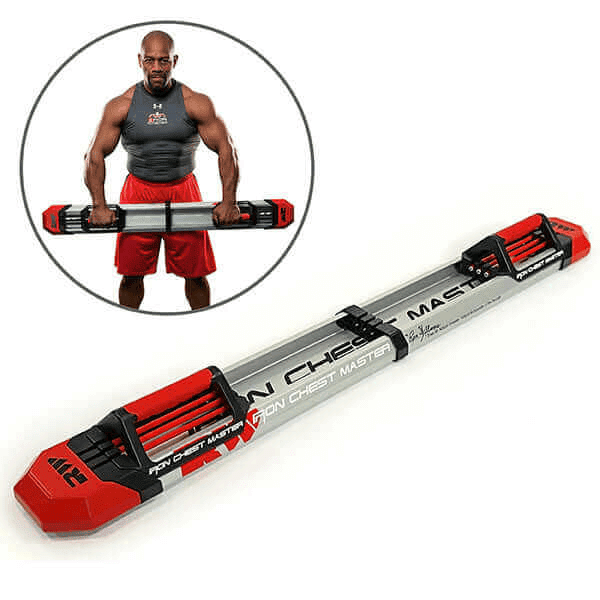
Iron Chest Master
Best for PecsQuick specs
- Steel and aluminum press frame, 48 x 6 x 4 in
- Optional resistance bands: 60, 120 or 180 lb
- 600 lb capacity, wrist-friendly pressing arc
Less a colored board, more a chest machine you press against the floor. The bands add resistance a normal push-up can’t, and the steel build is the toughest here.
Summary of experience, tests & opinions
What I like
- The resistance changes the exercise. Adding band tension loads your chest through a range a bodyweight push-up never touches, so it feels closer to a press than a floor drill.
- It’s built like gym kit. Steel rails and a proper hinge mean it doesn’t flex, and the 600 lb rating is real headroom.
- Being able to dial the bands up as you get stronger keeps it useful past the beginner stage, which most boards can’t claim.
What I don’t
- Setting the bands right is fiddly at first. Get the anchor points wrong and the tension feels lopsided until you sort it.
- The muscle-activation numbers on the marketing read as sales talk. The tool is good, but treat the percentages with a raised eyebrow.
Pros & cons
Pros
- Adds real resistance for progressive overload
- Toughest build in this roundup, 600 lb rating
- Works the chest in a stretched position that grows muscle
Cons
- Band setup has a learning curve
- Narrow focus: it’s a chest tool and little else
Read more about the Iron Chest Master
Think of this as a hybrid between a push-up and an incline press. The frame sits on the floor, the bands run over your back, and every rep fights that tension on the way up. That’s the one thing a plain board can’t give you: added load. For anyone whose push-ups have stopped being hard, it’s the honest way to keep the chest working.
The build backs it up. Steel rails, a solid hinge, red handles that don’t budge. Owner reports we track show the occasional loose screw out of the box, quickly fixed, but almost nothing about the frame itself wearing out.
Where it loses ground is breadth. This isn’t a color-coded board for hitting shoulders, triceps and back from a dozen angles. It does chest, and it does chest well, which is exactly why it sits behind the all-rounders on versatility while topping them on build:
Bottom line
The Iron Chest Master is the pick when your goal is a bigger, stronger chest and plain push-ups have stopped taxing you. The added resistance and the steel build put it in a different class from the color boards, as long as you accept it’s a specialist and not a jack-of-all-trades.
It might be for you if… you want to load your chest harder than bodyweight allows and keep progressing.
It’s not for you if… you want to work your whole upper body from many angles. A color board like the Power Press fits that better.
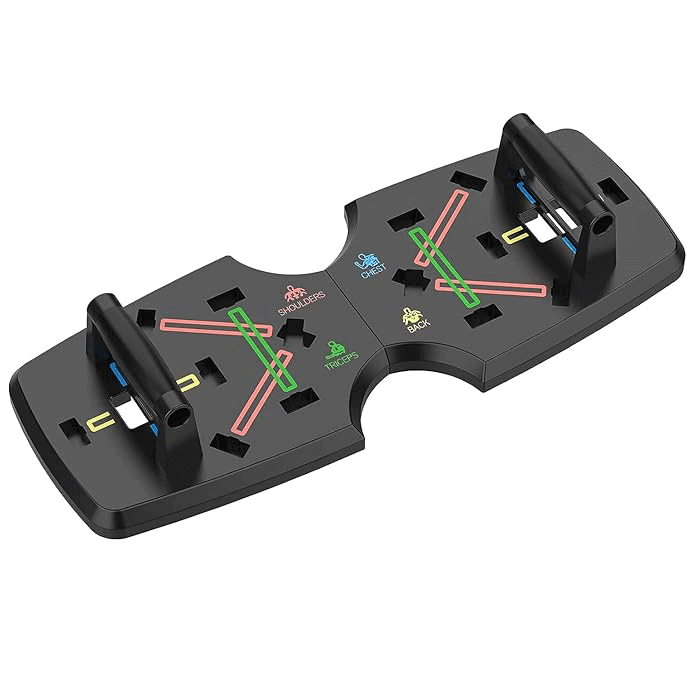
AERLANG
Best BudgetQuick specs
- Compact ABS board, 36 x 16.5 x 2 in
- 30 color-coded positions, foldable
- 300 lb capacity, optional accessory add-ons
The most you can spend almost nothing and still get a real board. It ticks the boxes that matter and folds away small, with stability the only real trade for the low price.
Summary of experience, tests & opinions
What I like
- It’s genuinely cheap without being junk. ABS rather than PVC, a real 300 lb rating, all the positions that matter. That’s the pitch, and it holds up.
- It folds down small. I’ve slung one in a bag for a trip and it barely registered, which the big boards can’t do.
- The full set of color slots is here, so a beginner isn’t short-changed on variety just because they saved money.
What I don’t
- The narrower base is the weak spot. Press hard off to one side and you feel it want to lift a corner, so I keep my reps controlled on it.
- The handles are bare plastic. Fine for short sessions, less kind on the palms once you’re past a few sets.
Pros & cons
Pros
- Cheapest board here that we’d actually recommend
- Foldable and light for travel or small spaces
- Full set of color-coded positions
Cons
- Narrow base is less stable under hard reps
- No padding on the handles
Read more about the AERLANG
This is the board I point people to when they’re not sure they’ll stick with it. It costs little enough that trying push-up training is a low-risk decision, and it still gives you the ABS build and the full color layout that make a board worth using. Spend the least, learn whether you like it, upgrade later if you do.
The compromise is stability, and it’s the honest kind. A smaller footprint means less to plant it, so on a hard single-arm or decline rep you notice the base wanting to shift. Keep the tempo controlled and it’s fine. Go ballistic and you’ll want the wider Power Press.
Here’s how the trade actually shakes out against our top pick:
| AERLANG | Power Press Original | |
|---|---|---|
| Price | Rock bottom | Mid tier |
| Stability | Narrow base, keep it controlled | Wide and planted |
| Handles | Bare plastic | Metal-cored, padded |
| Positions | 30, full set | 30, full set |
| Travel | Folds small, packs easy | Bulky without the bag |
On value alone, nothing here touches it:
Bottom line
The AERLANG is the low-risk way in: cheap, foldable, and honestly built enough that you’re not throwing money away. Accept the narrower base and the plain handles and it does the core job for a fraction of the price of the big boards.
It might be for you if… you’re testing the water, on a tight budget, or want a board that travels.
It’s not for you if… you train hard and explosive, where the wider Power Press stays put and this one won’t.
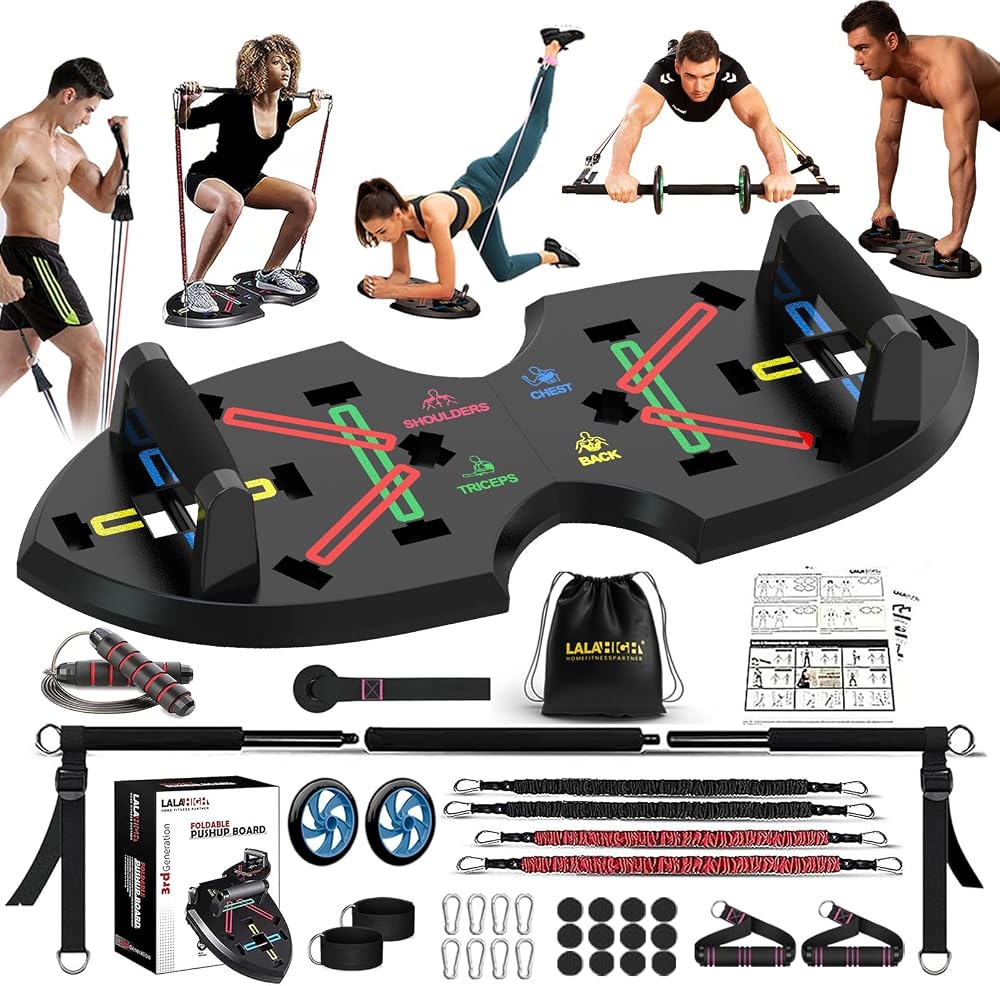
LALAHIGH
Best All-in-One KitQuick specs
- ABS board, 15 color-coded positions
- Includes resistance bands, Pilates bar, jump rope, ab roller
- 300 lb capacity, folds into a drawstring bag
Not just a board, a whole starter kit in a bag. The board is solid, and the bundled bands, Pilates bar, jump rope and ab roller turn one cheap purchase into a small home gym.
Summary of experience, tests & opinions
What I like
- You open the bag and you’ve basically got a beginner’s home gym. The board handles push-ups, the bands and Pilates bar cover pulling and core, the rope covers cardio.
- The board itself is no afterthought. It’s proper ABS with the standard color layout, a real board rather than the flimsy freebie you’d expect padding out a bundle.
- For someone starting from zero equipment, it’s the fastest way to a full routine without buying five separate things.
What I don’t
- The accessories are entry-level. The bands and rope are fine to learn on, but a committed lifter will outgrow them and want sturdier versions.
- With so many parts, the bag becomes the storage plan. Lose the drawstring sack and it turns into clutter fast.
Pros & cons
Pros
- Complete kit: board, bands, Pilates bar, jump rope, ab roller
- Solid ABS board with the full color layout
- Outstanding value for a first setup
Cons
- Accessories are basic and will get outgrown
- Lots of loose parts to keep track of
Read more about the LALAHIGH
This is the pick for the person with an empty corner and a small budget. Instead of a bare board, you get a kit that covers push, pull, core and cardio in one go. That breadth is why it’s climbed to the top of most current best-of lists, and why it takes our versatility slot by a clear margin.
The board at the heart of it is genuinely fine. ABS, the usual color-coded slots, a 300 lb rating, a folding hinge. It presses stable enough for controlled work, sitting a step behind the extra-wide Power Press on outright planting but well clear of the flimsy end of the market.
Here’s what’s actually in the bag:
- Push-up board · chest, shoulders, triceps and back through the color slots
- Resistance bands · rows, presses and assistance work the board can't do
- Pilates bar · adds the bands into standing pull and core movements
- Jump rope · a cardio finisher without leaving the mat
- Ab roller · direct core work to round out the session
One low-cost bag, four training jobs covered. That breadth is the reason to buy it, rather than the polish of any single piece.
Just know what you’re buying. The value is in the completeness rather than any single accessory being top-notch. A dedicated lifter will replace the bands and rope in time. A beginner will get months of varied training out of it first, which is exactly the point.
It runs away with our versatility score:
Bottom line
The LALAHIGH is the best way to go from no equipment to a full-body routine in one cheap purchase. The board is solid and the extras cover push, pull, core and cardio. Just buy it for the completeness, and expect to upgrade the odd accessory once you’re hooked.
It might be for you if… you’re starting from scratch and want a whole kit rather than a lone board.
It’s not for you if… you only want the best single board and already own bands and a mat. The Power Press is the sharper board on its own.
YIGM 360°
Rotating HandlesQuick specs
- Compact ABS board, 25 x 9.65 x 1.18 in
- 360-degree rotating handles, folds and locks
- 286 lb capacity, wrist-focused design
The board for cranky wrists. The handles rotate through the rep so your joints aren’t pinned at one hard angle, which is the real reason to pick it over a fixed board.
Summary of experience, tests & opinions
What I like
- The rotation is the point, and it works. Your wrist tracks naturally through the push-up instead of being locked flat, which takes real pressure off the joint.
- It folds down and locks flat. Small footprint, easy to stash, no rattle once it’s shut.
- Steve recommends it to clients coming back from wrist niggles, where a fixed board would have them wincing on the first set.
What I don’t
- The rotation feels wobbly until you trust it. The first few reps your hands want to steady a handle that’s meant to move.
- The listing hints at an LCD counter that isn’t really there, so ignore the gadget talk and buy it for the wrists.
Pros & cons
Pros
- Rotating handles ease wrist strain
- Folds and locks for easy storage
- Handles can’t mis-seat the way loose fixed ones do
Cons
- Rotation feels unstable at first
- No width adjustment, fewer positions than a color board
Read more about the YIGM 360°
Most push-up complaints aren’t about muscle, they’re about wrists. Pressing with your hand bent flat under load is what aggravates the joint, and it’s the reason a lot of people quit push-ups early. The rotating handles let the wrist turn through its natural arc instead, so the strain that usually builds up just isn’t there.
That single feature is the whole case for this board. If your wrists are the thing stopping you, it solves the actual problem.
The catch is that a moving handle feels unstable until you learn to trust it, and this is a plainer board than the color-coded pickers, with fewer positions to play with. You’re buying it for joint comfort ahead of variety. On that grip-and-stability score, where the handle design counts, it edges the whole field:
Bottom line
The YIGM 360° is the answer when wrists are what hold your push-ups back. The rotating handles keep the joint neutral through every rep, and it folds away small. You give up positions and a rock-steady feel, so buy it for comfort rather than variety.
It might be for you if… push-ups nag your wrists and you want to keep training pain-free.
It’s not for you if… your wrists are fine and you want the most angles. A color board like the Power Press gives you more.
Do push-up boards actually work, and are they worth it?
Let’s answer the question the honest way, because it’s the one everyone types into Google before buying.
A push-up board does not unlock muscle you couldn’t reach with plain push-ups. The marketing that promises huge activation gains over a normal push-up is overselling it, and the strongest skeptics in the calisthenics world are right to push back on those numbers. If you already know how to vary your hand position and program your own push-up work, a board adds very little.
So who is it for? Beginners, mostly. And that’s not a knock.
Most people starting out genuinely don’t know that moving their hands wider hits the chest, or that bringing them close and low loads the triceps. The board makes that decision for them. It sets the angle, keeps them consistent, and gives them a reason to work more than the one push-up variation they already know. For that person, the structure is worth the small outlay, which is why we still recommend the good ones.
Here’s how the color coding does its job. Each colored pair of slots puts your hands at a set width and angle, and that placement is what shifts the load:
- Red (chest). Hands set wide, so the pecs do most of the work through a big range.
- Blue (shoulders). A forward, narrower placement that tips more of the press onto the front delts.
- Yellow (triceps). Hands close and low, the classic diamond-style angle that hammers the triceps.
- Green (back). A wide, turned-out grip that pulls the upper back and rear shoulders into the movement.
None of this is magic. It’s your own bodyweight and good old hand placement, organized for you. Treat a push-up board as a form guide and a variety tool, not essential equipment or a shortcut, and you’ll get exactly what it’s good for. Push it as a muscle-building machine and you’ll be disappointed.
One honest limit worth naming: the board adds no resistance. Once bodyweight push-ups stop being hard, you’ll need added load to keep progressing, whether that’s a weighted vest, the band-loaded Iron Chest Master, or a move toward harder variations.
Other push-up boards we considered
These didn’t make the final five, but a few might suit you better than our picks depending on what you’re after.
HOTWAVE all-in-one set. Another board-plus-accessories bundle in the same spirit as the LALAHIGH, with bands and a bar thrown in. It’s a fair kit, but our testing and owner reports put the LALAHIGH’s board and layout a step ahead for the money.
PACEARTH wooden-handle board. An interesting idea: premium wooden handles on a schematic mat. It feels nice in the hand, but it drifts in and out of stock too often for us to point you at it reliably, which is the same availability problem that pushed the old wooden pick off this list.
Berleng 56-in-1 board. The highest position count we’ve seen printed on a board, and cheap with it. In practice most of those “positions” are theoretical, and you’ll use a handful, so the big number is more marketing than useful function.
Bare folding boards. The no-name folding boards are as cheap as the category gets. They work for a while, but the thin plastic and loose handles are exactly what our build score exists to catch. The AERLANG costs barely more and is honestly built.
The bottom line
If you want one board and no fuss, get the Power Press Original. The extra width keeps it planted, the handles outlast the clones, and the guided routines mean a beginner actually knows what to do with it.
From there it’s about your situation. Starting from nothing and want a whole kit for next to nothing? The LALAHIGH bundles board, bands, bar, rope and roller in one bag. Just testing the water on a budget? The AERLANG folds small and costs almost nothing. Chasing a bigger chest past bodyweight? The Iron Chest Master adds real resistance. Wrists holding you back? The YIGM 360° rotates to keep them neutral.
Whichever you pick, keep your expectations honest. A push-up board is a helpful guide that makes bodyweight training more structured and more varied, especially early on. It won’t do the work for you, and the results still come from showing up and pressing.
Push-up board FAQs
Do push-up boards actually work?
They work, but not the way the ads imply. A push-up board doesn’t unlock muscle you can’t hit with plain push-ups. What it does is guide your hands into set positions so a beginner can move through chest, shoulder, triceps and back angles with structure instead of guesswork. The color-coded slots add variety and keep you consistent. Treat it as a form guide, not a shortcut to results.
Are push-up boards worth it?
For a beginner or anyone who wants their bodyweight training laid out for them, yes, at the low price they sell for. The board removes the what-do-I-do-next problem and nudges you to work more angles than you would alone. If you already program your own push-up variations confidently, you can skip it. It’s a helpful aid, not essential kit.
What do the colors on a push-up board mean?
Each color marks a set of handle slots that bias the work toward one muscle group. On most boards red is chest, blue is shoulders, yellow is triceps and green is back, though brands vary the exact shades. Sliding the handles into a color changes your hand width and angle, which shifts where the push-up loads. The colors are really a hand-placement map.
Can you build muscle with a push-up board?
You can build real upper-body and core strength with one, especially early on when push-ups are still challenging. The board itself adds no resistance, so growth comes from progressive overload: more reps, harder angles, slower tempo, then decline or single-arm work. Once bodyweight push-ups get easy, you’ll need added load or a resistance option to keep gaining.
What weight capacity do I need in a push-up board?
For most people a 300 lb rating is plenty, since a push-up only ever loads the board with part of your bodyweight, not all of it. Heavier lifters or anyone doing explosive and single-arm work should look for 300 lb or more and a wide, planted base. The bigger risk isn’t the rating, it’s a narrow board tipping mid-rep, so stability matters more than the headline number.
Are push-up boards good for beginners?
This is where they earn their place. A beginner often doesn’t know how to vary hand position to work different muscles, and the board makes that decision for them. The set slots build good habits, the guided routines give a starting plan, and the variety keeps early training interesting. As you progress you’ll lean on the board less and your own programming more.