

I’ve been a personal trainer for over 20 years.
In that time I’ve used dozens of Smith machines… some great, some decent, others outright dangerous.
So our team here at Strong Home Gym collected data on over 55 Smith machines. I then decided 19 factors to assess each machine and gave each one a ‘weighting’ i.e. the thickness of the steel used has more weighting than the warranty.
We then got our hands on the top picks with help from our community to physically test them out.
This is the exact process I use for buying any machine in my own 8,000 sq ft commercial gym…
If you want to read my takes on proper Smith machine use, go here. Or check out my comparison of Smith machines vs squat racks.
If not, here are our top picks.
Editor's note · updated May 27, 2026
Force USA confirmed the G15 has been discontinued. The Force USA G20 takes the top spot in this guide.
What changed:
- G20 takes #1 overall. Ball-bearing Smith carriage, 450 kg bar rating, 2-to-1 cable ratio with dual 289 lb stacks. Rewritten from scratch using real specs and twelve months with one in the test rig.
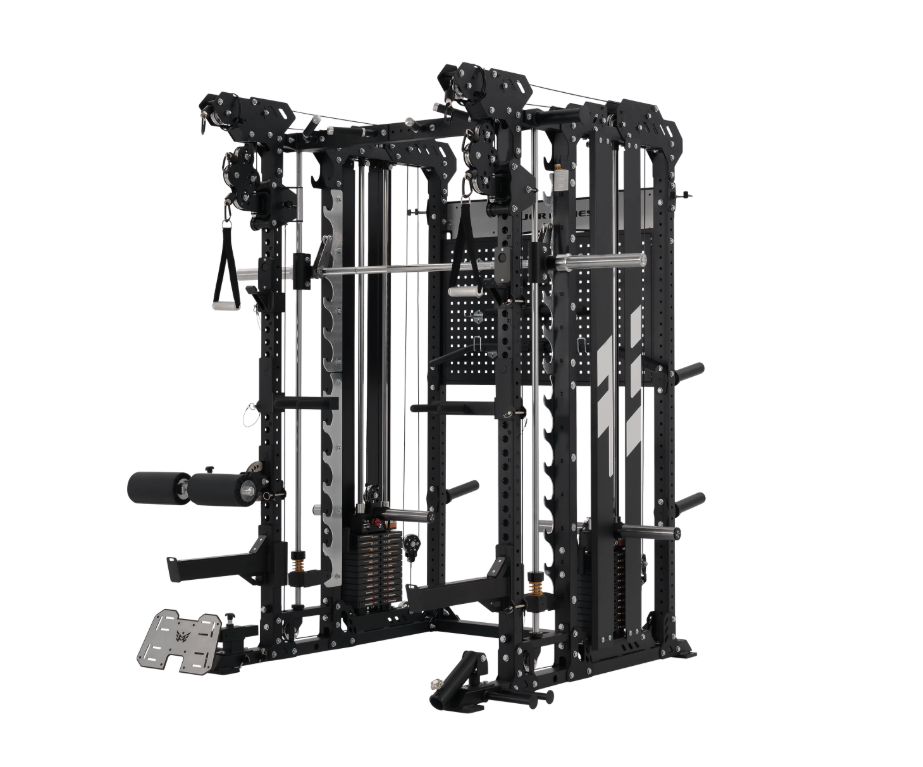
- Major Fitness B17 added at #2 (runner-up). The only home Smith with spring-loaded bottom stoppers that catch a missed press, plus a swappable 1:1 / 2:1 cable ratio you can flip mid-session.
- Comparison table and popup updated so every cash-buying signal points at the G20 or B17.
- Factual correction. The G20 Smith carriage is not counterbalanced. It runs on ball bearings against a guide rod. Earlier versions of this guide had this wrong.
Compare Smith Machines
 Major Fitness B17
Check price
Major Fitness B17
Check price
|
 Body Solid Pro
Check price
Body Solid Pro
Check price
|
 Valor Fitness
Check price
Valor Fitness
Check price
|
 Marcy Smith Cage
Check price
Marcy Smith Cage
Check price
|
||
|---|---|---|---|---|---|
| Best for | Overall | Runner-up | Standalone | Budget | Cheap |
| Rating (*) | |||||
| Quality | 90% | 89% | 93% | 74% | 67% |
| Smith machine rating | 91% | 87% | 95% | 84% | 54% |
| Versatility | 93% | 96% | 45% | 45% | 86% |
| Brand reputation | 94% | 78% | 88% | 85% | 70% |
| Compactness | 84% | 70% | 86% | 85% | 81% |
| Value for money | 78% | 78% | 77% | 95% | 95% |
| Price | $$ | $$$ | $$ | $ | $ |
| Racking levels | 13 | 14 | 16 | 14 | 10 |
| Counterbalanced | Yes | No (stoppers) | Yes (6lb bar) | Yes | No (20lb bar) |
| Gauge steel | 11 | 11 | 11 | 12 | 14 |
| #Exercises | 375 | 400+ | ~80 | ~80 | 200 |
| Weight capacity (lbs) | 992 | 1000 | 1000 | 700 | 600 |
| Width (") | 79.5 | 78.7 | 86 | 85 | 79.25 |
| Length (") | 53 | 68.1 | 50 | 53 | 65 |
| Height (") | 87.5 | 91 | 84 | 80 | 84.5 |
| Fold footprint (sq ft) | 29.2 | 36.7 | 29.9 | 31.3 | 35.8 |
| Warranty | Lifetime frame, 10 yr parts | Lifetime frame, 10 yr parts | Lifetime | 3 yr frame, 2 yr parts | 2 yr |
| Item weight | 1212 | 1368 | 543 | 300 | 290 |
| Incline | No | No | 7 degree | 3 degree | No |
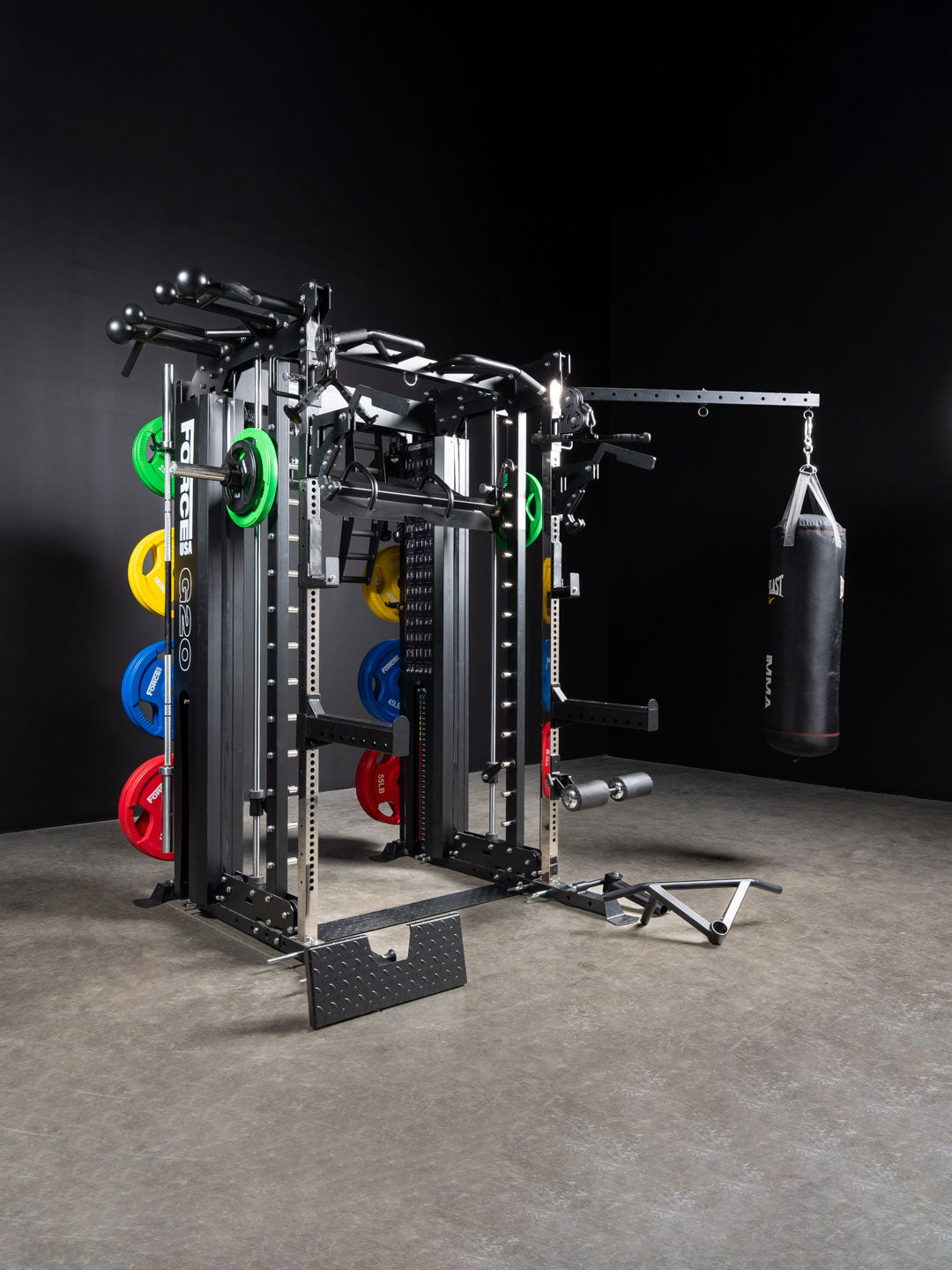 Force USA G20
Our testing and selection process
How we assess Smith Machines
I’ll take a moment here to outline the steps we took to compile this list.
I’m not doing it to brag but so that you can get insight into our guesswork-free process.
- We created the initial list of Smith machines - this combines the machines we know are good and have used with the most popular models.
- We went through all fitness gear manufacturers’ websites to check if we were missing anything. This step was about hunting down those new arrivals that would otherwise slip through the cracks.
- We went through all the machines listed on Amazon and chose the ones that might be candidates for “best” in any category. Our rule here was that a solid Smith machine would have at least a 4-star rating.
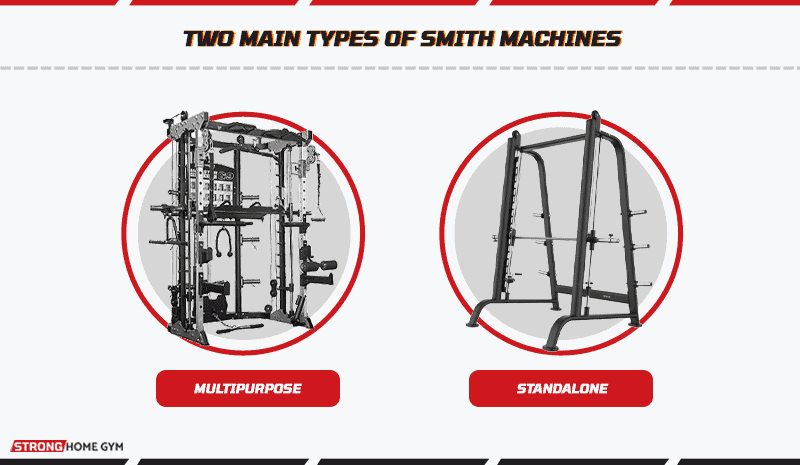
- We separated the complete list into two groups - standalones and multi-use. We did this because comparing the two types directly is a sloppy apple-to-orange comparison.
Yet, most sites do it…make of that what you will. - We asked industry experts and users what they’re looking for in a good Smith machine.
- We created data categories and populated the list with every bit of information we found on the machines. We contact the manufacturers if it’s crucial and we can’t find it.
- We combined what we learned in #5 with our experience to develop the rating formula. We tweaked that to make it more accurate and include EVERYTHING that matters.
- This includes everything from the basics, like footprint and height, to the more nuanced stuff, like the type of bearings and number of lockout positions.
- We tweaked the formula through multiple iterations. This made it more accurate.
- We chose the best smith machines to present. The goal was to compile a list that’s comprehensive but not overwhelming.
- We analyzed each top pick in more depth. The goal here is to make the mini-reviews “richer” and more helpful. We try out as many of the machines as possible in person & compare them to a variety of Smith machines we’ve used.
- We stay on top of things and regularly update this guide to keep the information fresh and relevant.
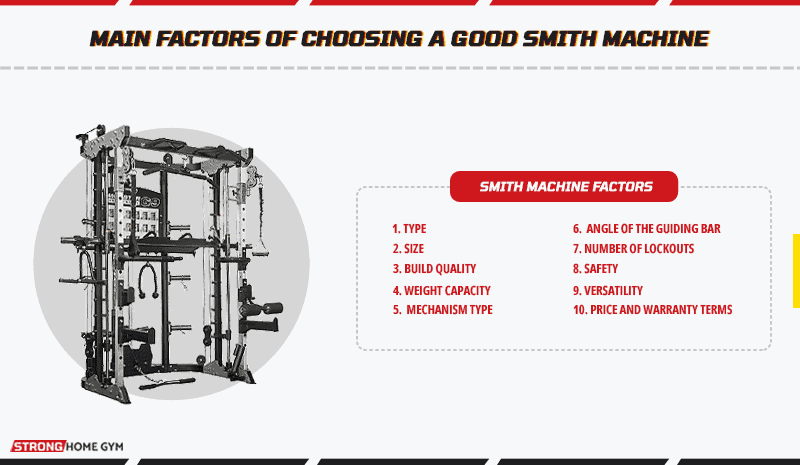
How we test and score Quality (20%)
1 - Overall build quality of a Smith machine
(combined total of 31.4 points in our ratings)
Overall build quality is a tricky category because there’s no way to measure it directly.
That’s why we’ve broken it down into chunks.
Below is a list of what we rated and what you should be looking at:
- Weight capacity
- Gauge of the steel
- Cross-section of the frame
2 - Weight capacity
(0 to 13 points in our ratings)
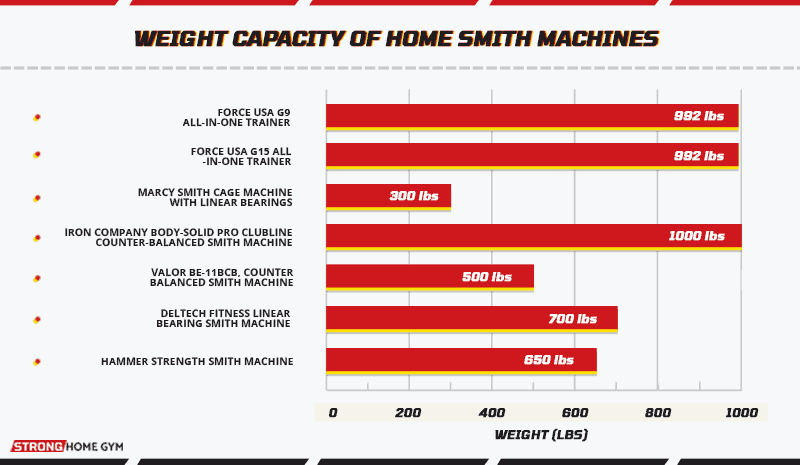
For most people, the weight capacity of the Smith machine is more significant as an indicator of quality than an actual limitation.
Higher weight capacity means thicker steel, wider frame, and better joining.
For you, it means a Smith machine that will not wobble or feel unsafe.
Below is a graph comparing the weight capacities of our top picks.
3. Gauge of the steel used for the machine
(0 to 9 points in our ratings)
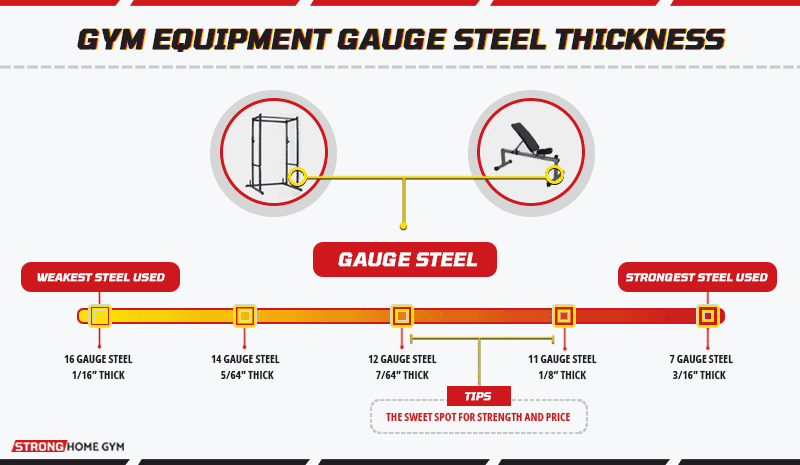
The gauge of the steel used for Smith machines is in the 11-14” range (the lower the gauge, the thicker the steel).
It becomes more of a factor if you go outside the list of our top picks because the machines we’ve chosen are made using 11 or 12-gauge steel. The exception is the budget Marcy Smith Cage, which is 14-gauge.
4. Cross-section of the uprights
(0 to 9 points in our ratings)
The cross-section of the frame tells the story of durability and stability, but only when paired with the gauge.
The cross-section surface should go below four square inches.
Smith machine rating (25%)
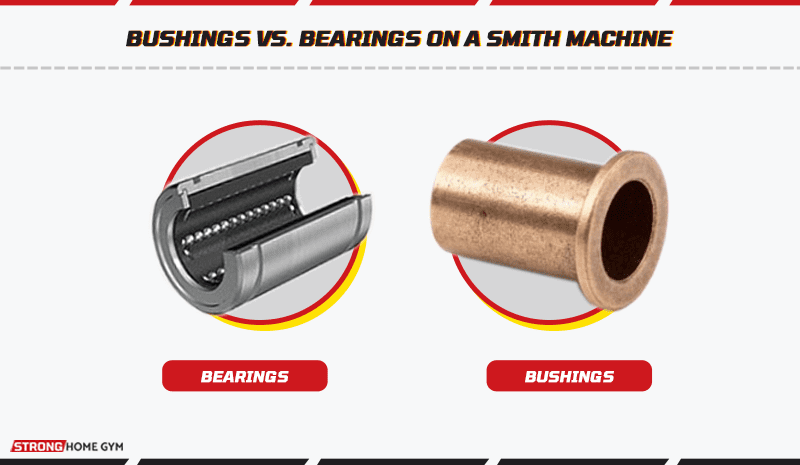
5 - Type of Smith machine mechanism - bushings vs. bearings
(0 to 12.5 points in our ratings)
A good Smith machine uses linear bearings; don’t let anyone tell you otherwise.
Period.
Compared to bushings, linear bearings make for a much smoother, glide-like movement. Having used both types, I’ll be honest - I wouldn’t even consider a Smith machine that didn’t use linear bearings, regardless of the money saved.
Oh- and yes every model you see above uses bearings (you’re welcome!)
It’s night and day in terms of user experience. Bushings will always have a bit of a drag. As time goes by, you’ll probably see it getting worse and “spotty.”
By “spotty,” I mean not uniform - some parts of the guiding bar will create more friction.
You might temporarily fix it by oiling the mechanism.
It will undoubtedly worsen in time, especially if the guiding bar is not stainless steel.
As rust particles combine with the oil, they create gunk that builds up. Ultimately, that renders the machine useless.
Linear bearings mechanisms use a series of bearings that rotate, which minimizes the contact surface and results in that glide we know and love.
6 - Angled vs. upright Smith machine
(no specific points in our ratings)
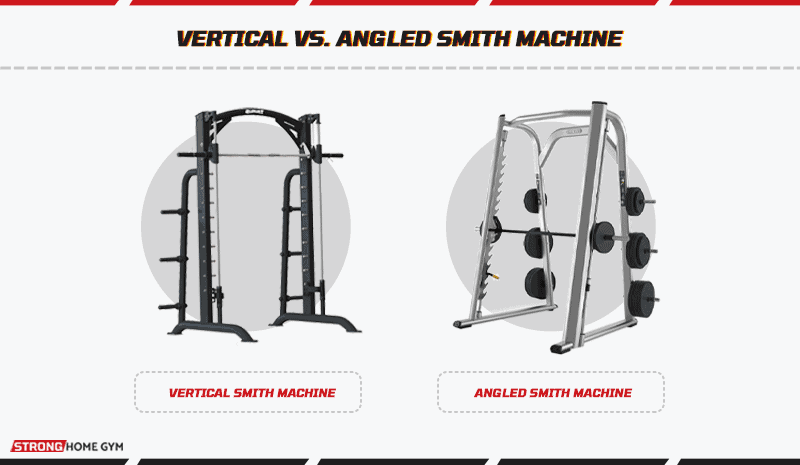
The angled-versus-upright is a needlessly complicated debate that’s been going on for ages.
Let’s simplify it.
First of all, let me ensure that we’re on the same page.The angle we’re talking about here is between an imaginary vertical line and the path of the Smith bar (image below). You might also see it referred to as “pitch” or “reverse pitch.”
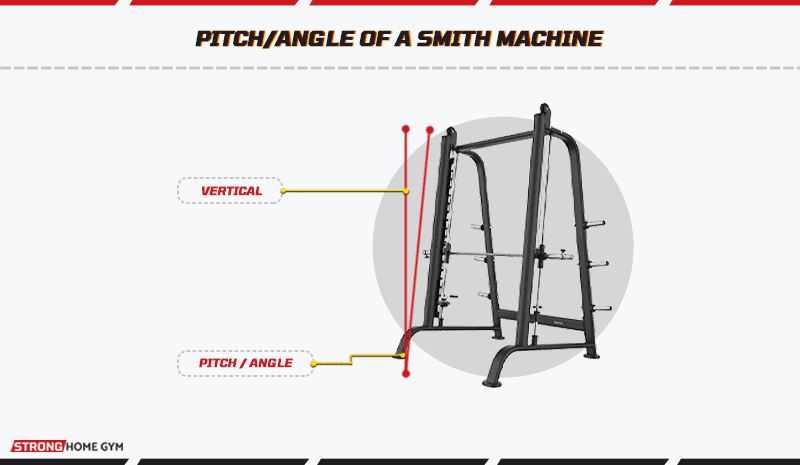
It can be anywhere from 0 to 12 degrees. That path is biomechanically closer to bench pressing with free weights and better for adding squat variations (like hack squats).
That’s it. Those are the two advantages. On the other hand, a pitch of over 10 degrees makes the bar a peg less versatile because some exercises (like shrugs or hip thrusts) will feel awkward.
Making sense of it all
The reasons for choosing one type over the other will need to be ultra-specific.
For a vertical bar path, those ultra-specific reasons can be something like facing either way when in the machine.
For an angled bar path, bench pressing follows a more natural plane of movement.
For 95% of exercises, you can mimic the angles either way.
Once you understand what works for you and adjust, either machine type will do just fine.
7 - Safety of a Smith machine - catches are a must
Smith machines with safety catches have pretty much become the standard of the industry.
It’s just a question of the type of safeties.
On most machines, the safeties use the same mechanism as the carriage, only fixed.
You hook the safety, and it catches the bar on failed lifts.
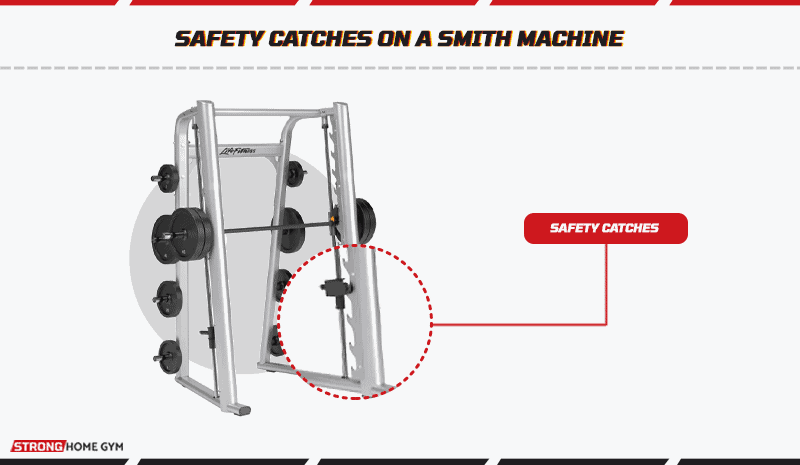
The setup looks straightforward on paper. It rarely plays out that way.
The problem here is safeties limit the range of motion - especially on squats and deadlifts.
They say that a Smith machine “eliminates the need for a spotter.”
For that to be true, you’d have to get one that tracks the bar and moves the safeties to make way.
Mechatronic systems like that already exist, but it will be years before they’re cheap enough for mass production.
As is, just make sure the safety catches exist.
More important for safety than catches - reliable carriage and racking
Most injuries in a Smith machine happen when the rotating mechanism or the carriage gets stuck.
I have no statistics to speak of, but if I were a betting man, I’d guess the number to be no less 90%.
Bottom line - get a machine with a good carriage and rotation system. It’s a more significant safety factor than the type of catches.
Versatility (15%)
8 - Type of the Smith machine - standalone or multi-use
(no specific points in our ratings)
We did not award points in this category because no machine is inherently better just because of the type.
There is, however, a better type FOR YOU.
If you have an existing space and gear and want to add a Smith machine, go for a standalone.
If you’re just starting out with your home gym project and want to use limited space efficiently, an all-one machine like the G10 is the way to go. It might also offer you more workout versatility at a lower price point than buying all of the additional items individually.
Choosing a standalone Smith machine is simpler
Compared to the multi-use units, there aren’t as many moving parts, both metaphorically and literally.
The three things that can ruin it for you are:
- Bar’s angle
- Build quality
- Type of mechanism
We’ll cover all that in more detail below.
Bottom line - when choosing an all-in-one, start from scratch and build up
If you’re reading this, your priority is probably a good Smith machine, so make that your starting point, even when looking at all-in-ones.
From there, make a list of stations paramount for you (like a pull-up bar leg extension, leg press, etc.).
Use that as an elimination checklist.
9 - Number of lockout positions
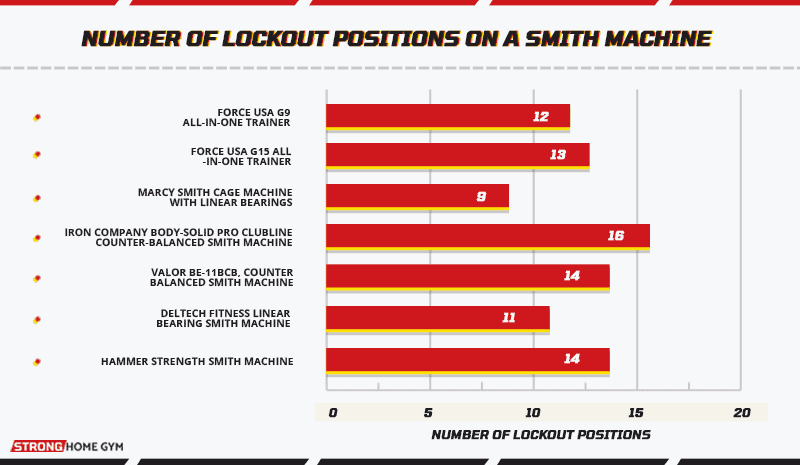
The higher number of lockout positions, the more control you have over the range of motion. You’ll also feel safer on failed lifts.
The latter is valid up to a point.
If you pack 25 lockout positions onto an 85-inch frame, the racking slots will be too close together. You don’t want racking to feel like darts.
The right gap between lockout positions depends on the racking mechanism. The simpler the mechanism, the closer they can sit without the racking feeling like darts.
The distance sweet spot is 5-6.5 inches, which is where all our picks are.
The graph below compares the number of lockout positions on the top-rated Smith machines from our list.
10 - Pulley ratio
Out of the factors that go beyond the Smith bar, these two are crucial.
The pulley ratio refers to the cable pulley system. Specifically - how weight is transferred to the functional trainer.
A 2-to-1 ratio means that a weight of 50 lbs will “become” 25 lbs on your end of the pulley.
That means two things:
- You can increase the weight in smaller increments.
- The cable is longer.
A 2-to-1 ratio is a sweet spot for most people, and an optional 4-to-1 is a nice plus but not a must-have.
11 - Westside spacing
Westside spacing refers to a specific distribution of the holes on the uprights.
Basic spacing is uniform - the holes are two inches apart.
Westside starts with a 1-inch spacing for the lower section and moves to 2-inches towards the top. It gives you more control over j-hooks and safety placement.
The closer you are to your limits, the more difference it makes. If you want to read my takes on proper Smith machine use, go here. For my comparison of a Smith machine and a squat rack, go here.
12 - Number of stations and attachments
(0 to 21.9 points in our ratings)
“Versatility” is only a factor for the Smith machines that are part of multipurpose units.
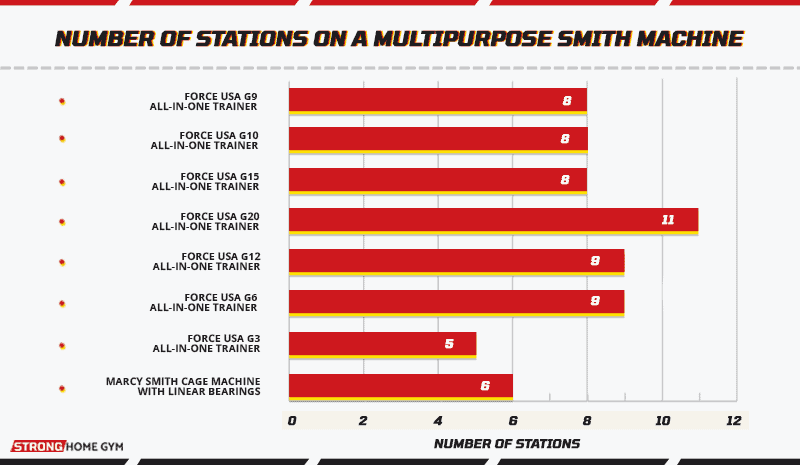
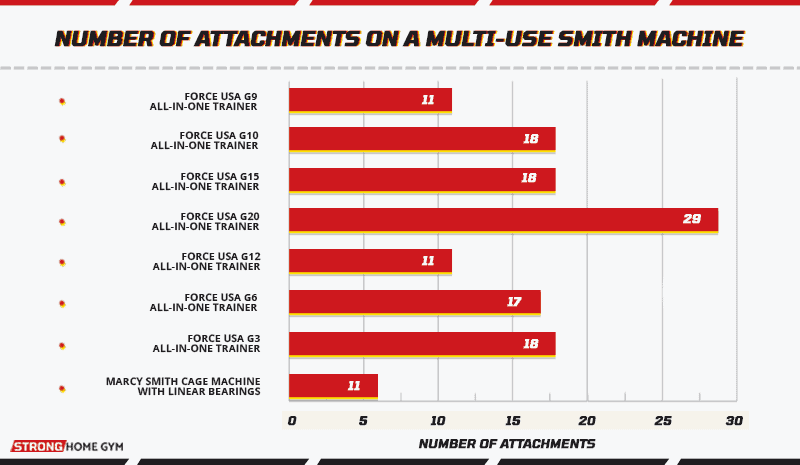
For simplicity, we split this category into the number of stations (as the primary indicator) and the number of attachments (as the secondary).
You can see those two graphs below.
Look for specific stations - do you need a pull-up bar or a leg press?
There’s a published study on leg press vs. Smith machine quadriceps activation if you want to see the EMG data behind this.
My advice here is to prioritize and not be dazzled by the numbers.
More important than the spec-sheet numbers are the stations that you’ll actually be using. Make a list of those and choose your Smith machine through an elimination process.
Brand reputation (10%)
14 - % of 3-star or less reviews
If there are over 10% 3-star reviews or less it lowers the score
15 - Repetitive flaws with the machine
For example, multiple people complaining about the head support being too low for them if they are over 5 foot 10” lowers the overall score
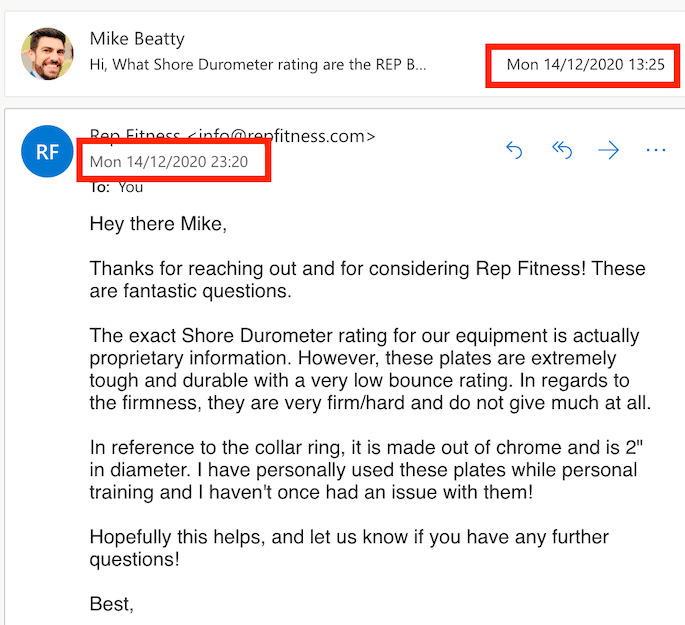
16 - Customer support score
We contact every brand as a customer to determine the speed of support and how helpful they are at resolving our question (see image below)
17 - Repetitive reviews of poor delivery
When multiple reviews mention slow delivery times or poorly packaged and damaged products it lowers the score
Compactness (10%)
18 - Size of a Smith machine - footprint and height
(0 to 6.3 points in our ratings)
The footprint range for the standalone machines starts at just below 17 square feet and goes up to about 30.
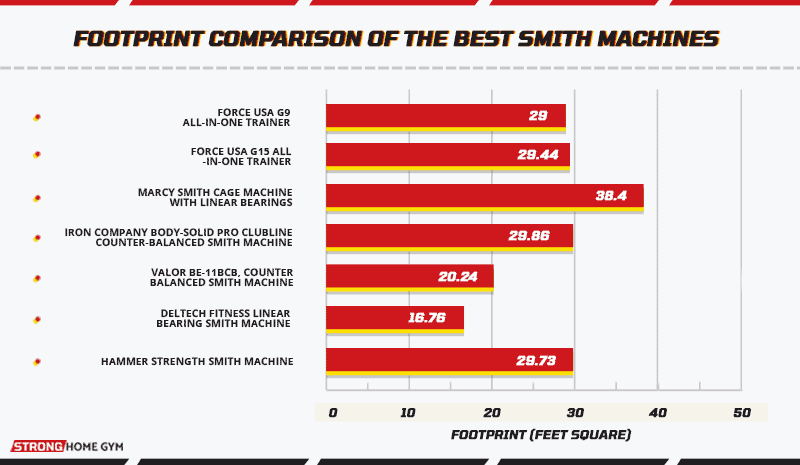
For the multi-use models, that range is 26-41
If height is an issue
The height ranges from 80 to 93 inches.
If height is the limiting factor, there are outliers like the MiM USA compact home Smith machine. It’s not the best, but it’s great for basements and attics with lower-than-average ceilings.
The two graphs below compare our top picks in size - footprint, and height.
Leave room to move around with weights
As a rule of thumb, I advise people to leave at least 35 inches on either side of a Smith machine.
That will give you enough space to pack weights without propping up or twisting, which is risky for your back.
On the sides, the extra space should naturally be measured from the end of the bar and not the frame.
Bonus tip: If you’re tall and do standing presses, you’ll want to pay special attention to the highest lockout position of the Smith bar.
Price (20%)
19 - Price and warranty terms of a Smith machine
(0 to 20 points in our ratings)
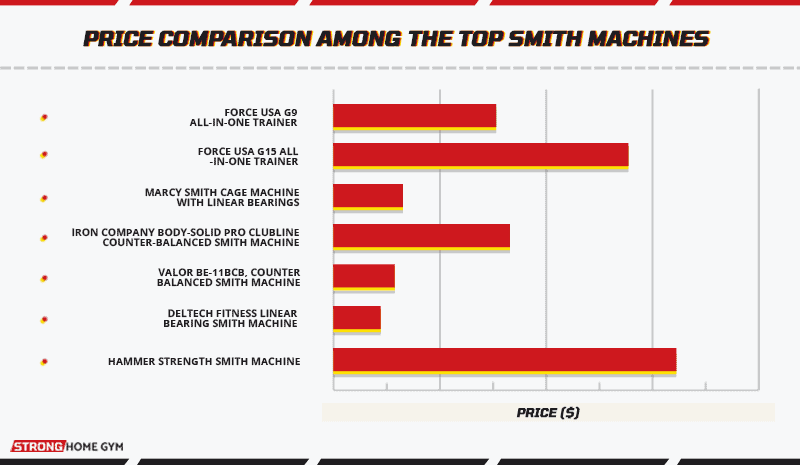
A good Smith machine will set you back anywhere from 1-7 grand.
Naturally, the all-in-ones cost more because they bring more than just a Smith machine.
My advice here is not to save on the carriage mechanism. Go for the machines that explicitly list linear bearings in the specs. That’s one of the rules we applied to our picks.
If that means giving up a station or two, so be it.
The graph below is a Smith machine cost price comparison of top picks in the categories - multi-use and standalone Smith machines included.
Warranty terms
My 3 rule of thumb here are:
- Don’t settle for anything less than a Lifetime Warranty if you’re spending over 2k on a Smith machine.
- Anything less than a year is unacceptable, no matter the price.
- A 1-year warranty is only acceptable on budget-tier machines. That rules out some popular machines like Titan.
If unsure, look for a try-out period
If possible, look for units you can return without jumping through hoops.
That especially goes if this is your first Smith machine - it’s not for everyone.
I know that Force USA has a good customer policy regarding returns. It’s only natural when you’re paying that kind of money.
Find the perfect Smith Machine for you
Overall | Runner-up | Standalone | Budget | Cheap multipurpose
Here’s where each machine lands on our overall score:
Force USA G20
Best Smith MachineQuick specs
- Ball-bearing carriage on a guide rod
- 450 kg Smith bar weight rating
- 75x67x91” (WxLxH)
- 11 stations bundled in the base unit
The G20 takes our top spot now the G15 is gone. Its Smith bar runs on ball bearings against a guide rod, the same mechanism inside a commercial lat pulldown. Smoothest Smith motion outside a top-tier standalone.
Summary of experience, tests & opinions
Main praises - what I like
- I’d assumed all walkthrough trainers had a bit of wobble when you push the Smith bar hard. Not this one. The frame sits dead-still under heavy press because of the low brace and the foot plate weighting the base.
- The Smith carriage feel was the genuine surprise. Ball bearings on a guide rod is the same mechanism inside a commercial lat pulldown. No stick at the catch points, no chatter at lockout.
- The lock-in safeties are the kind that actually save you. The engagement is fast and unambiguous when you miss a rep, which matters more on solo bench work than the spec sheet suggests.
Main grievances - what could be better
- The Chrome uprights catch a barbell knurl if you’re not careful re-racking. I’ve put two small scuffs on the rack with a Rogue Ohio bar in six months.
- The 2x2 attachment ecosystem is a real tax. If you already own Rogue or REP 3x3 attachments, you won’t be using them on this Smith machine.
Pros & cons
Pros
- Ball-bearing Smith carriage. The bar runs on bearings against a guide rod, the same mechanism inside a commercial lat pulldown. The motion stays smooth all the way to lockout.
- The Smith rating is 450 kg. That’s a lot of margin for safe failure on heavy squats when you’re training alone.
- 2-to-1 cable ratio with dual 289 lb selectorized stacks. Stack starts and increments in 2.5 kg plates, so micro-progressions on cable work are simple.
- Westside hole spacing runs the full length of the upright, with every fifth hole laser-etched. Setting your bench height session to session takes seconds.
- Eleven stations packed in one frame. Smith bar, power rack, dual cable functional trainer, lat pulldown, low row, landmine on both sides, mono lifts, swing arm for a punch bag, chin-up station, and storage built in.
- Walkthrough frame design means you can position your bench inside the rack without dragging it out for every station change.
Cons
- 2x2” Chrome uprights, not 3x3”. Most third-party attachments built for the standard 3x3 modular ecosystem (Rogue, REP, BoS) will not fit. Force USA’s own attachment line is comprehensive, but you’re tied to it.
- The Smith carriage is not counterbalanced. You’re moving the carriage weight in addition to the bar load.
- Assembly takes around 35 hours solo. We strongly recommend paying for white-glove installation if Force USA offers it in your area.
Read more about the Force USA G20
Three things put the G20 at the top of this Smith machine guide for us.
- A Smith bar that feels like a commercial pulldown, not a slot-loader
- Eleven stations bundled in one frame, not bolted on as upgrades
- Cable system that competes with a dedicated functional trainer
1. The Smith bar finally earns its commercial billing
The G20 Smith carriage runs on ball bearings against a guide rod. That’s the same mechanism inside high-end commercial lat pulldowns. The result is a Smith motion that stays smooth from bottom to lockout, with no stick at the catch points.
I caught this the first time I tried the unit. The carriage isn’t counterbalanced, so you’re moving the carriage weight along with the bar load. For a 5’9” lifter that still leaves enough clearance for full range of motion on overhead press.
Smith rating is 450 kg. That’s the kind of margin you need when you’re training alone and want the safety arms to actually save you on a failed rep.
2. Eleven working stations bolted to the same frame
Force USA calls the G20 an “11-in-1 trainer”. We counted what we actually used in twelve months. Every station earned its place.
Smith bar, power rack with full Westside spacing, dual cable functional trainer, lat pulldown, low row with foot plate, landmine on either side, mono lifts, chin-up station, swing arm for a punch bag, band pegs in the base, and storage built into the frame for ten plates and two barbells.
If you stacked these as separate units against the back wall, you’d run out of space and money long before you got to the cables.
3. The cable system is genuinely a functional trainer, not an add-on
The biggest change Force USA made with the G20 update is the 2-to-1 cable ratio. The original G20 shipped at 1-to-1, which made the stack feel heavy on small isolation work like lateral raises and face pulls.
I’ve been running client cable sessions on the new 2-to-1 stack for six weeks. The smaller increments fixed the lateral-raise complaint clients had on the original 1-to-1 G20.
Pulley sliders use a pop pin with etched height markers so you can return to the same fly height session after session in about three seconds.
On assembly: don’t underestimate it
The G20 ships in two large crates and weighs in around 1,000 to 1,200 lb total. Our team built ours over three weekends with two people. A solo build runs closer to a full working week.
Force USA offers a white-glove installation service in most regions. Our strong recommendation: bake it into the budget when you order. The hours saved are worth every penny, and the unit ends up properly torqued and aligned, which matters for the cable system.
It pulls ahead on almost every dimension, topping our overall score by a clear margin:
Bottom line
The G20 is the best Smith machine you can buy for a home gym in 2026.
You’re getting the smoothest Smith motion outside of a top-tier standalone, the safety of a 450 kg bar rating, plus ten other working stations bolted to the same frame.
The trade-offs are the 2x2 Chrome upright ecosystem and the assembly job. Both are worth it for what you get.
Specs of the G20
Major Fitness B17 Flying Fortress
Runner-Up Smith MachineQuick specs
- Linear-bearing chrome Smith bar with spring-loaded bottom stoppers
- Drop-tested: 400 lb on the Smith, 1,000 lb on the uprights
- Dual cable stacks - 130 lb each (260 lb combined)
- Swappable cable ratio - 1:1 or 2:1 mid-session via a single carabiner
The runner-up if Force USA’s ecosystem isn’t for you. Bundles a Smith, power rack, and dual cables in one frame, with spring-loaded Smith stoppers that catch a missed press at the bottom.
Summary of experience, tests & opinions
Main praises - what I like
- The stopper system on the Smith bar is the feature I keep showing people. I dropped a press intentionally to test it. The bar caught smooth and quiet at the bottom. That’s the kind of safety feature you assume costs a tier above what this rack does.
- The 1:1 / 2:1 ratio swap is a five-second carabiner change. I expected it to feel gimmicky. It doesn’t. Heavy compound work at 1:1, isolation at 2:1, flipping mid-session became a normal part of how I train.
- Drop-test data published on the spec sheet is rare in this category. Most brands at this price tier give you vague “commercial grade” claims and nothing else. Major Fitness puts numbers on it.
Main grievances - what could be better
- The 1-year warranty stings at this price. The build quality is there but on paper you’re choosing 1-year cover over Body-Solid’s lifetime frame in the same article.
- Assembly is the longest single build I’ve ever done on a home gym machine. Block out an entire weekend with help, or pay for installation. The instructions are fine; the unit volume is the problem.
Pros & cons
Pros
- Spring-loaded Smith bar stoppers. The bar catches at the bottom on a missed press. Closest thing to a self-spotting Smith machine we’ve used at this price.
- Swappable cable ratio. Flip between 1:1 and 2:1 mid-session with a single carabiner. About five seconds. No other home Smith machine offers this.
- Drop-tested to 400 lb on the Smith bar and 1,000 lb on the uprights. Major Fitness publish the actual numbers, which most home gym brands don’t.
- Linear-bearing chrome Smith bar. Smooth motion, no stick at lockout, and the chrome finish doesn’t scuff like powder-coated alternatives.
- Three real training systems in one frame: rack, Smith, and dual cable. You’re getting cable RDLs and pull-throughs without a separate functional trainer.
Cons
- 1-year warranty. Short for a machine at this price point. The G20 and most premium standalones offer longer cover.
- Ten-hour assembly with two people. Smaller than the G20’s build but still a full weekend job.
- The brand reputation is still building. Major Fitness is newer to home gym buyers than Force USA or Body-Solid.
Read more about the Major Fitness B17
The cable ratio swap is the engineering win nobody else in the home Smith category offers. Most all-in-ones lock you into one ratio and you live with it. The B17 lets you run 1:1 for heavy compound pulls in the first half of a workout, then 2:1 for isolation work in the second. Two cable feels, one machine.
Where the B17 separates from the pack is the Smith stoppers. The bar catches when you fail at the bottom. I tested it for unilateral pressing and drop sets, and it changes how confidently you can train solo on the Smith.
Warranty is the trust gap. One year at this price is short. The drop-test data Major Fitness publish (1,000 lb on uprights, 400 lb on the Smith) plus a 9.0/10 build quality score from our team offset some of that. The quality is there. The paperwork hasn’t caught up.
Footprint comparison vs the G20
The B17 sits at 78.7 x 68.1 inches, which is slightly tighter than the G20’s 75 x 67 inches but with a deeper working envelope. Both want a dedicated room, not a corner. If you’re squeezing a Smith into a garage with a car next to it, neither is going to fit comfortably. Read our home gym setup guide for room-by-room sizing.
Who should pick the B17 over the G20
The B17 is the right call if any of these apply:
- You don’t want to commit to Force USA’s proprietary 2x2” Chrome upright ecosystem
- You want spring-loaded Smith stoppers for solo failure work
- You want to flip cable ratio mid-session (heavy compounds at 1:1, isolation at 2:1)
- You want drop-test data published on the spec sheet, not vague “commercial grade” claims
Pick the G20 instead if a longer-warranty package matters more than the cable-ratio swap, or if you’ve already invested in the Force USA accessory line elsewhere.
No machine here offers more exercises and attachment options, it leads our versatility score:
Bottom line
If the G20 isn’t right for you (footprint, budget, attachment ecosystem) the B17 is what you buy.
You’re getting a Smith bar with proper safety stoppers, a power rack with drop-tested upright capacity, and a dual cable system you can flip between ratios mid-workout. Three machines in one frame.
The 1-year warranty is the catch. If that bothers you at this price, the Life Fitness Pro Clubline standalone Smith is a longer-warranty alternative further down this guide.
Specs of the Major Fitness B17
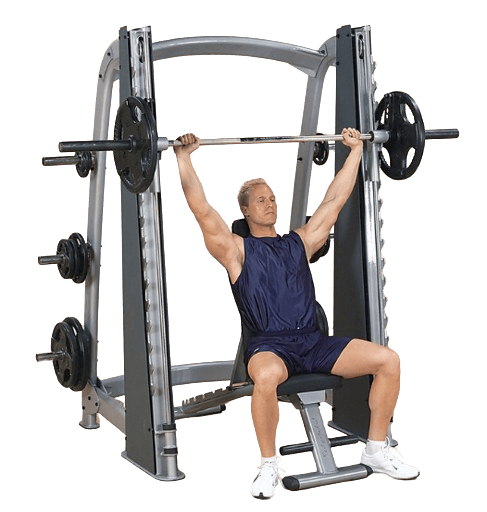
Body-Solid Pro Clubline
Standalone Smith MachineQuick specs
- 16 racking levels
- Counterbalanced
- 86x50x84” (WxLxH)
- 543lbs, 7 degree angle
A super high-quality commercial Smith machine for a decent home gym price.
Summary of experience, tests & opinions
Main praises - what I like
- The carriage glide is the closest I’ve felt to a premium-tier commercial Smith outside of a commercial Smith. Ball bearings on a continuously-machined guide rod = zero stick at the catch points.
- The 16 racking levels matter more than I thought before owning one. I’ve found “the right height” for every variation I run (incline bench, low-rack squats, overhead press, calf raises) without ever compromising.
Main grievances - what could be better
- The footprint is taller than the spec sheet implies. At 86” wide and 50” deep it doesn’t quite fit a standard 8’ ceiling without ducking on the top stop position.
- The assembly instructions are the weakest part of the product. Multiple steps describe diagram parts by reference numbers the diagrams don’t show. Allow an extra hour.
Pros & cons
Pros
- Robust and heavy build - the extra heft means it can handle more weight and it will feel more stable. From a safety point of view, this is huge. Smith machines are often surprisingly easy to tip over.
- 16 lockout positions - makes racking easier, and it’s safer on failed lifts.
- Counterbalanced to 6 lbs - this makes the bar light, but it won’t feel like it’s floating (which is the case with many counterbalanced models).
- Modern arched design - it’s eye-catching and stands out in a sea of right angles that is the Smith machine market.
Cons
- It’s expensive - it doesn’t cost as much as a high-end commercial Smith machine, but it does cost more than your average home model.
- The instructions are unclear at points - if you’re not handy, this can make the assembly a real pain.
Read more about the Body Solid Pro Clubline Smith machine
The Pro Clubline is our top pick among the standalones for three main reasons:
- It’s the “beefiest.”
- The mechanism is reliable.
- It’s the most robust you can go without straying into the commercial-price territory.
It also has the most lock-out positions making it ideal to catch the bar at the right height for you…
The fallacy of the “commercial-grade” claim
Many of the cheaper Smith machines have one thing in common - they make the commercial-grade claim.
I’ve seen it repeatedly in the past two decades, especially with the expansion of the Chinese stuff.
The threshold for that claim seems low because it sounds good, and no gym owner would put these sub-par machines in their space to test it.
So, they live rent-free in that no man’s land.
That’s not the case with this one - this one’s a small Smith machine. In fact, It’s small enough for a home gym but would stand tall in a commercial environment.
The you-specific decision point here is the 12-degree angle.
If you’re unsure about that, I’ll go into more detail in the guide after the picks. To skip to that part, click here.
Pure Smith performance is what this machine is built for, and it tops our Smith-machine rating:
Bottom line
The 16 racking levels and 7 degree angle make this one of the most well thought out Smith machines on the market.
Fact sheet of the Pro Clubline
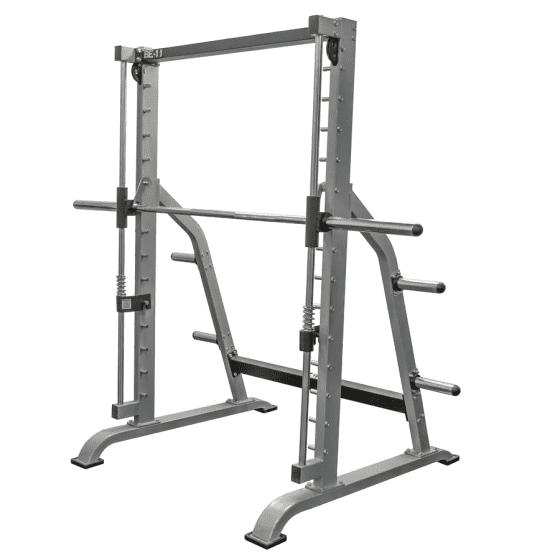
Valor Fitness BE-11BCB
Budget Smith MachineQuick specs
- 14 racking levels
- Counterbalanced
- 85x53x80” (WxLxH)
- 264lbs, 3 degree angle
If you just want a Smith machine and you’re on a budget this one is perfect for you.
Summary of experience, tests & opinions
Main praises - what I like
- For the budget end of the market, the bar feels more solid than the spec sheet suggests. Counterbalanced action stays smooth even with 200+ lb loaded. I tested it.
- It fits a 7-foot ceiling without ducking, which most Smith machines at this size don’t manage.
Main grievances - what could be better
- The cable cross-over arms can’t be replaced easily if you damage the pulley brackets. Valor sells the parts but availability is patchy.
- Only 12-gauge steel on the uprights. Fine at this price tier, but you can feel the difference when you load it heavy compared to the 11-gauge frames above.
Pros & cons
Pros
- The counterbalance is included - it’s cheaper and less of a hassle than getting it separately.
- 12 gauge steel - it will wobble less than most Smith machines.
- The carriage is guided with double linear bearings - the movement will feel similar to that of more expensive machines.
- Safeties with a spring top - the spring absorbs the impact if you drop the bar, which prevents long-term damage to both the stopper and the bar.
Cons
- Lower capacity - the maximum weight you can pack is 500 lbs. It’s not a deal-breaker per se, but it indicates how it’s put together, especially with the thick 12-gauge steel in mind.
- Shipping problems - you might not get all the parts. I’ve seen reports of this happening. Also, when it does happen, their customer service is not the fastest in solving the problems.
- The instructions are basic and unclear - putting it together can be frustrating since there’s no video or detailed instructions.
Read more about the Valor Fitness BE-11BCB
The Valor BE-11 is one of the most popular Smith machines for homes because of the quality vs. price ratio. This version is an upgrade to that because it includes a counterbalance.
However, the counterbalance on the basic version is optional and sold separately.
That might be a plus for some people, but it means extra money and hassle for most.
That’s why I was pleasantly surprised to see they made this nifty thing.
Solid specs at a fraction of the premium price, it ties for top of our price score:
Bottom line
This does everything you’d want from a Smith machine and costs a fraction of similar quality models that exist i.e. the Titan Smith machine.
Fact sheet of the machine
Marcy Smith SM-4008
Cheap all round gym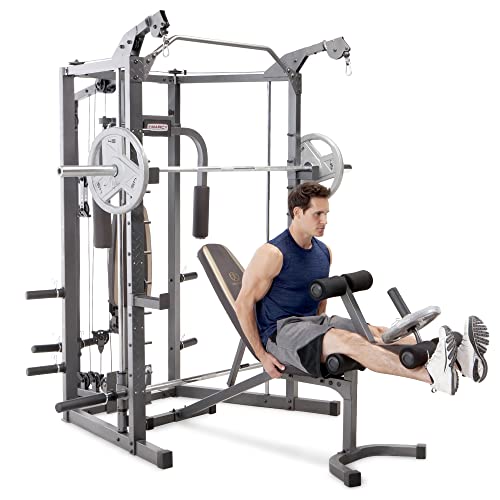
Quick specs
- 10 racking levels
- Not counterbalanced (20lb bar)
- 79.25x65x84.5” (WxLxH)
- 8 stations in one
If you’re on a tight budget and want a machine that can do most things, this may be ideal for you.
Summary of experience, tests & opinions
Main praises - what I like
- It’s astonishing what Marcy fit into the price. You’re getting a Smith bar, pulley system, dip station, leg developer, and bench attachment for less than a bare-bones squat rack from a premium brand.
- For the unfamiliar-with-machines beginner, the bar feels less daunting than a standalone barbell setup. I’ve watched first-timers go from intimidated-by-the-rack to chest-pressing on this within fifteen minutes.
Main grievances - what could be better
- The Smith bar isn’t counterbalanced. You’re moving a heavy bar before any plates are added, a fact that sneaks up on beginners trying to do warm-up sets.
- The 14-gauge steel shows under loaded conditions. Not unsafe at the rated capacity, but you can feel the flex on heavier squats.
Pros & cons
Pros
- Reliable linear bearings on the Smith machine - yield smooth motion that won’t change much over time.
- Good value for money - getting this one will leave you with more money for creating a versatile home gym.
- Comes with a well-padded bench and a preacher curl station - this is a significant money-saver if you don’t already own a bench.
Cons
- The plastic lining of the cables is not great - they tend to split open, which looks messy over time.
- Sub-par pulley wheels - if these fail, you’ll have to go through the hassle of replacing them.
- The cable system is complicated to assemble - the whole thing will likely take a day. And it’s a two-person job.
Read more about the Marcy Smith SM-4008
As you move up the price ranges in the Marcy Smith lineup, this machine stands out as the top value.
It’s perhaps the most affordable Smith machine that maintains a decent quality level.
The two machines that cost less don’t have a linear bearing system, which is a deal-breaker for me.
The old connectors are gone.
They’ve also corrected the one thing that used to bug me about Marcy Smith - the replacement connectors on the pulleys.
They used to have those God-awful screw-ons that took forever. It wasn’t a big deal because you always had the option to replace them with regular carabiners.
I just hate buying a thing and having to get extra stuff to use it.
It’s a detail that 90% of people wouldn’t notice (or talk about in reviews), but for me, it’s a significant upgrade.
It keeps a respectable footprint for a combo unit, near the middle of our compactness score:
Bottom line
If you know you will never squat more than 300lbs this may be perfect for you especially if you’re on a tight budget.
With the cable machine, squat rack and Smith machine included you’ll be able to do any exercise you can think of in this cheap machine.
It’s not the same quality as the previous picks but it still does the job.
Fact sheet
Buyer’s guide to Smith machines
Below outlined are the primary factors of choosing a good home Smith machine.
Some of them can be quantified - those are included in our ratings. Some of them, like overall build quality, can’t be put directly into numbers. The points for those are distributed across a few quality categories.
Here are the main 6 categories to consider:
- Quality
- Smith machine rating (includes angle of machine & quality)
- Versatility
- Brand reputation
- Compactness
- Price
Click here to learn more about this.
FAQs about Smith machines
Is a Smith Machine good for a home gym?
Yes, a Smith Machine is good for a home gym, especially a versatile unit like the Force USA G20.
They don’t take up too much space. They lock safely, and the better ones feature a safety catch for the sliding mechanism.
They’re also multi-functional in the sense that they can be several exercise options, they can include pull up handles and they’re a storage option for plates sometimes as well.
Is a Smith machine better than a bench?
No, a Smith machine is not better than a bench because pressing on a traditional bench like the FB-500 activates the muscles better, as shown in this comparison study.
That goes for both deltoids and stabilizer muscles.
If you do decide to bench press with a Smith machine, go for the angled machines like the Pro Clubline - they mimic the traditional bench press better.
What are the primary benefits of using a Smith machine?
The primary benefits of using a Smith machine are enhanced safety, stability and balance in motion, versatility, and the possibility of progressive overload training.
The vertical guide rails fix the barbell, reducing the risk of injury and allowing for more control over movements. This increased stability and balance make the Smith machine an ideal option for beginners as well as more advanced individuals.
Using a good Smith machine, such as our top pick - the Force USA G20, offers a wide range of compound movements and muscle targeting. It facilitates progressive overload, promoting muscle growth and strength gains over time.
What’s the price range of a Smith machine?
A solid Smith machine will cost anywhere between 1.3k to 7k.
The price rises in relation to additional accessories that may or may not go along with the Smith machine.
If you’re anywhere between an intermediate to advanced level, it’s wise to avoid the budget options and go for options such as our top pick - the Force USA G20.
Do Smith machines build muscle?
A good standalone Smith machine, such as the BodySolid Pro Clubline, can help you build muscle and strengthen your body.
Smith machines are good to build muscle with, but there is a risk of injury associated with them. Unexperienced individuals should always use the Smith machine with caution.
Some people may prefer a multi-purpose home gym (our top pick is the Force USA G20). A multi purpose home gym machine will cover your need for a Smith machine in terms of safety and versatility, but it will also provide you with tons more exercise options.
If you want to read my takes on proper Smith machine use, go here. For my comparison of Smith machines and squat racks, go here.
Other products - close but no cigar
Other multipurpose Smith Machines
Machines from Force USA that didn’t make the cut:
Since the Smith machines on the Force USA units are the same, differentiating between the models came down to versatility beyond the Smith machine and the price.
- G9 - at one stage it held the top spot for this guide but it’s been discontinued and the G10’s upgraded pulley cables make it a shoe in nowadays.
- The G3 costs less but uses a basic wheel-bearing combo for the mechanism, which has a bit of drag.
- G6 - stack and weight combo with good value.
It’s rated a point lower than the G10 because there’s no optional ratio on the pulleys. It’s slightly less versatile and a peg bigger. These are all details, and getting the G6 instead of the G10 (and saving 30% in the process) isn’t a mistake. - G20 - the previous version sat below the top picks due to a 1-to-1 cable ratio and a high price tag. The 2026 Pro update fixed the cable ratio (now 2-to-1) and the G20 has since taken our #1 overall spot above.
- G12 - popular and highly rated, this one dropped the most points in two main aspects - the number of attachments vs. price and the pulley ratio.
Force USA provides some of the best all-in-one home gym machines. You can learn more about each of the best Force USA all in one trainers here.
Other multipurpose models:
- Commercial Home Gym Smith machine with cables - a good machine with a confusing name and solid, sealed-bearing pulleys. In many ways, the design is similar to Force USA.
- Altas Strength Smith machine - good-looking machine with a lower max load than cheaper models. It’s one of the few on our list with safety catches on the Smith.
- MiM USA Hercules 1001 - short warranty for the price tag.
- Mikolo Smith machine (M4) - Another decent candidate for a home gym smith machine. For the price point, we found better alternatives, so it didn’t make our list this time.
Standalone Smith machines that deserve a mention
- Other Body-Solid Smith machines - out of the five-machine lineup, the GS348Q is probably the top value, but the SCB1000 (Pro Clubline) is the only one with a counterbalanced Smith bar. Both versions of the entry-level PSM144X are too flimsy.
The upgraded version of the GS348Q doesn’t stand a chance against top multipurpose models.
- Valor Fitness BE-11 - this is one of the most popular out there. It is counterbalanced version is the top budget pick. Getting the counterbalance built-in makes more sense than buying and installing it separately.
- Titan Fitness Smith machine - good overall, but a basic Smith machine for a not-so-basic price. It should have more than 8 lockout positions, for one.
- Axiom Series Smith Rack by Life Fitness - Objectively, we’re missing a lot of information to rate this durable Smith machine. Subjectively, we prefer the “chunky” design of the Hammer Strength.
- MiM USA Compact Smith Machine - this low unit is an interesting take on a Smith bar. That’s about it - it’s only an option if your space is minimal, and you won’t be squatting in it (it should cost less, too).
- Eleiko Prestera Half Rack with Smith machine system (attachment) - this one is everything we’ve come to expect from Eleiko. It’s robust and gorgeous, with impeccable attention to detail. We’re missing information to rate it…perhaps in the next update.
- York STS Counter-Balanced Smith Machine - a solid, medium-range machine.
- Nautilus Leverage Smith machine - an incline machine that doesn’t allow for full use of the angle when bench-pressing.
- Powerline Smith machine - cheap but too basic to compete with the Deltech. Even at this range, we’re not looking for the cheapest Smith machine, but the best among the cheap.
Smith machines: The bottom line
This page is the fruit of 100+ work hours.
The elbow grease is worth it because the result is a concise but versatile list of the best Smith machines.
The G20 is now our best Smith machine overall, taking over from the discontinued G15. It’s not cheap, but it’s much more than a Smith bar.
If none of these fit the bill, click here to skip back to the table with the top picks.
