

We tested and scored 46 weight plates to find the 6 best weight plates, judged across the 5 categories that decide whether a plate set is worth your money.
I’ve loaded, dropped, and worn out plates in this gym for ten years. The team took my notes and ran them through our scoring system, so it isn’t just me talking.
It’s scoring built on data, owner reports, and hands-on use.
The goal was simple: cut through the iron, steel, and rubber noise and hand you one clear pick per type, whatever you load on the bar.
Let’s see if we did a good job…
Related
We’ve spent years loading bars with every kind of plate in this gym. If you mostly do Olympic lifts and want rubber that drops safely, our best bumper plates guide ranks the rubber category in full. And for the bar those plates sit on, see our best Olympic barbell guide.
Compare the best weight plates
 Rogue Machined Olympic
Check price
Rogue Machined Olympic
Check price
|
 REP Black Bumper
Check price
REP Black Bumper
Check price
|
 REP Fractional / Micro
Check price
REP Fractional / Micro
Check price
|
 Titan Cast Iron Grip
Check price
Titan Cast Iron Grip
Check price
|
 CAP Olympic Grip
Check price
CAP Olympic Grip
Check price
|
||
|---|---|---|---|---|---|---|
| Best for | Overall / powerlifting | Cast iron | Bumper | Change / micro-loading | Budget | Cheapest |
| Rating (*) | ||||||
| Build & durability (35%) | 93% | 90% | 90% | 86% | 80% | 74% |
| Weight accuracy (25%) | 96% | 84% | 82% | 90% | 78% | 74% |
| Loadability & fit (15%) | 86% | 92% | 80% | 85% | 88% | 84% |
| Versatility (15%) | 84% | 88% | 92% | 80% | 84% | 80% |
| Value (10%) | 80% | 84% | 88% | 82% | 92% | 94% |
| Type | Calibrated steel | Machined cast iron | Rubber bumper | Change / fractional | Cast iron grip | Cast iron grip |
| Material | Machined steel, plug-calibrated | Machined cast iron | Virgin rubber, steel insert | Rubber-coated cast iron | Cast iron, e-coat | Cast iron, baked enamel |
| Weight tolerance | +/- 10 g | +/- 2% | +/- 1% | +/- 10 g | +/- 3% | +/- 5% |
| Collar fit | 50.4mm, snug | 50.5mm, snug | 50.4mm, snug | 50.4mm, snug | ~50.8mm | ~50.8mm, loose |
| Sold as | Pairs & sets | Pairs & sets | Pairs & sets | Pairs & sets | Pairs & singles | Pairs & singles |
| Price | $$$ | $$ | $$ | $ | $ | $ |
 Rogue Calibrated Steel
Our testing and selection process
How we assess the weight plates
We always use a 5 step process in our reviews:
- We start as the buyer. Most of our team have bought plate sets before, and I have racked up shelves of iron, steel, and rubber in this gym across a decade.
- We do a ton of research. We pull specs, tolerances, and owner reports on every plate worth a look into one master spreadsheet.
- We rate each plate with our weighted scoring system. The categories and weights are below.
- We let the data make the call, not brand loyalty. A REP can beat a Rogue. A Titan can beat them both on value.
- We get our hands on as many top picks as possible. Our community is a big help here.
You can read more in our review guidelines.
How we test and score the weight plates
A plate is a deceptively simple object, so people assume any plate is as good as the next. They are not.
The differences hide in the things you cannot see at a glance: how tight the tolerance is, how the insert bonds, how thin the plate sits so you can load more on the bar. So we put the weight where a plate buyer actually feels it over years of loading the bar.
I grouped it into 5 chunks:
- Build and durability (35%) - the materials, the machining, the finish, and how the insert bonds to a bumper.
- Weight accuracy (25%) - how close each plate sits to its stated weight, from calibrated grams to loose cast iron.
- Loadability and fit (15%) - collar fit on a 50mm sleeve, plate thinness, and how easily it handles.
- Versatility (15%) - whether the plate suits one job or covers Olympic lifts, slow lifts, and general training.
- Value for money (10%) - what you pay against what you get, normalized to the lineup.
Here is how the six picks stack up on the overall score, with the Rogue Calibrated Steel out in front:
Build and durability (35%)
This is the biggest category, and on a plate it covers more than it looks.
For cast iron and steel, build is about the machining and the finish. A machined plate has clean faces and a true collar opening, where a rough cast plate can chew up a bar sleeve and chip its enamel inside a year. Calibrated steel goes a step further: the weight is brought into tolerance with a plug set into the back of the plate.
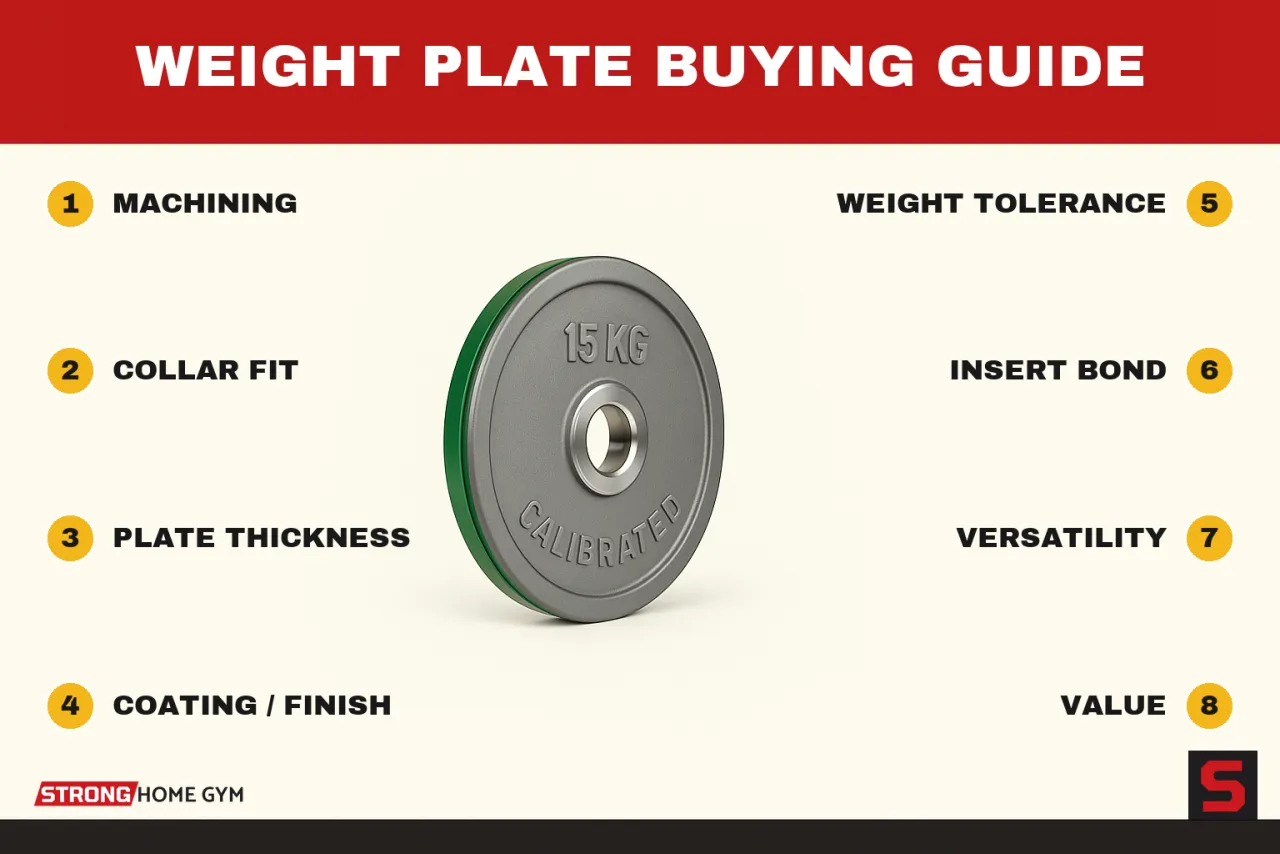
For a bumper, build is about the insert bond: the steel hub has to lock into the rubber so it never works loose after thousands of drops. A hooked insert, like the one on the REP Black Bumper, does exactly that.
My tip: look at the collar opening before the face. A machined opening slides clean and protects your bar. A rough cast opening is where the cheap plates give themselves away.
Weight accuracy (25%)
Stated weight and actual weight are not the same thing, and the gap widens as the price drops.
Calibrated steel is the tightest you can buy, machined to within 10 grams. Bumpers run around 1 percent, machined iron around 2 percent, and cheap cast iron grip plates can drift to 5 percent. That sounds small until you stack it: a 5 percent miss on a loaded bar can mean a couple of pounds you never accounted for, and worse, an uneven left-to-right load.
Here is how tight each pick sits to its stated weight, with the calibrated steel out in front:
For most lifters this category only matters at the margins. For a powerlifter chasing a one-rep max, or anyone who likes their warm-up jumps to be honest, it matters a lot.
Loadability and fit (15%)
Two things decide loadability: how the plate sits on the sleeve, and how thin it is.
A 50mm Olympic sleeve wants a snug plate, not a sloppy one. Too tight and you fight to load it; too loose and the plate rattles and slides under collars. Steve, our certified personal trainer, has loaded thousands of bars across his career and rates collar fit as the quiet difference between plates that feel premium and plates that feel cheap.
Thinness is the other half. A thin machined or calibrated plate lets you stack far more total weight on a bar than a fat bumper or deep dish does, which is why heavy lifters lean iron and steel.
My tip: if you are a big lifter, count how many 45s your bar holds with the plates you are eyeing. A thin calibrated plate can hold hundreds of pounds more than a fat rubber one before you run out of sleeve.
Versatility (15%)
This is where bumpers and iron split.
A bumper plate drops safely from overhead, so it covers Olympic lifts, CrossFit, and general training in one set. Iron and steel do not drop well, so they suit slow strength work: squats, presses, deadlifts off the floor.
The versatility of a plate comes down to:
- Whether it can be dropped without damaging the plate or the floor.
- How well it spans light to heavy in one consistent set.
- Whether it plays nicely with other plate types you already own.
For a do-everything home gym, a bumper set covers the most ground. For a dedicated barbell setup, iron and steel are the workhorses.
Value for money (10%)
We normalize value against the score-per-dollar across the lineup, so the cheapest plate does not automatically win.
In other words…
We are hunting for the plate that gives you real steel rather than a logo. Sometimes that is a budget grip plate that does the job for a starter set. Sometimes it is a machined iron plate that costs more but never needs replacing.
Find the perfect weight plates for you
Best Overall | Best Cast Iron | Best Bumper | Best Change | Best Budget | Cheapest
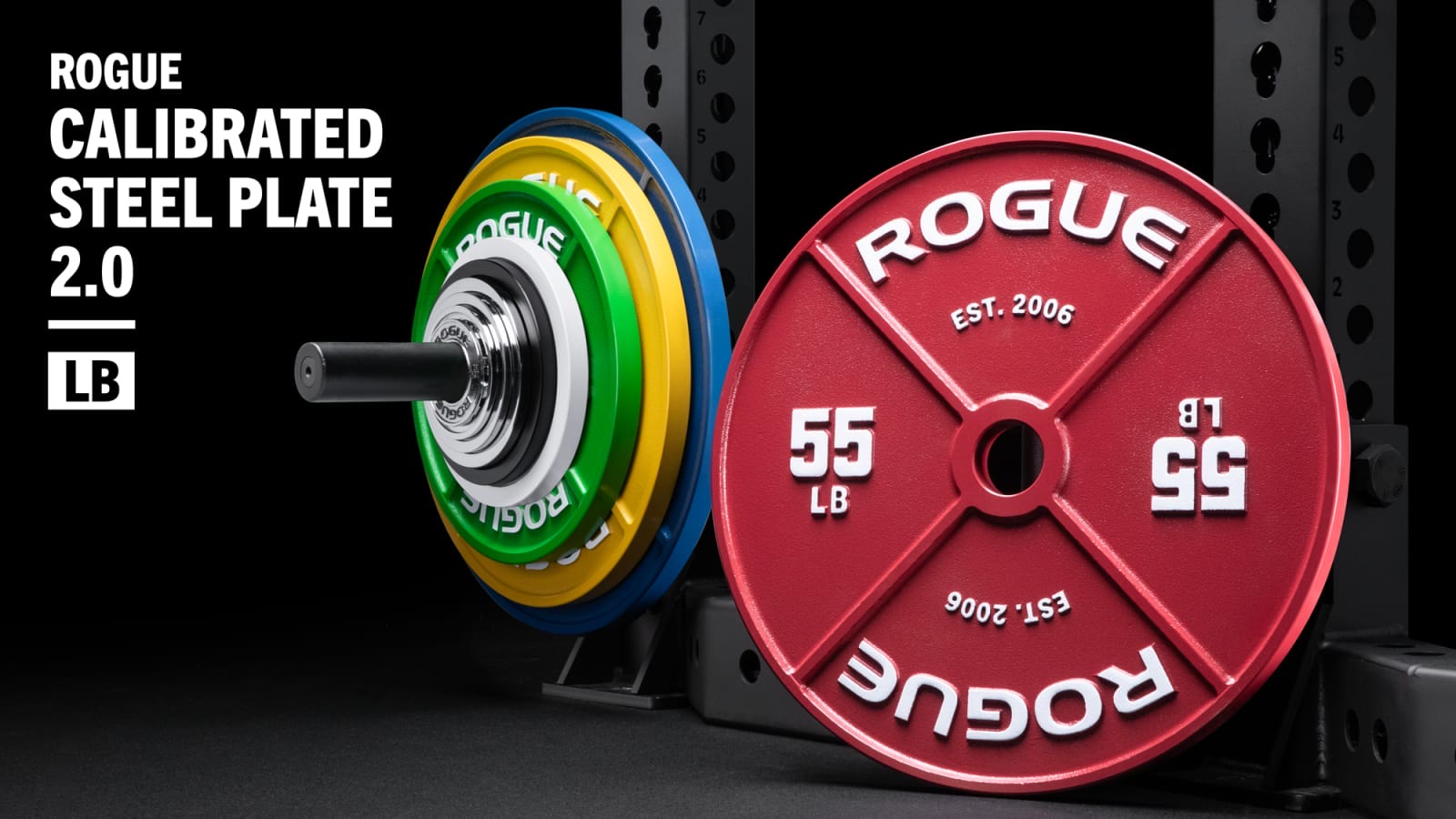
Rogue Calibrated Steel Plates
Best Overall Weight PlatesQuick specs
- Type - calibrated steel, plug-set
- Tolerance - +/- 10 grams
- Profile - ultra-thin for max loading
- Fit - 50.4mm, IPF-spec opening
- Sold as - pairs and full sets
The plate I point serious barbell lifters to. Calibrated to within 10 grams, color-coded, and thin enough to load a bar past 1,500 lb.
Summary of experience, tests & opinions
What I rate
- The IPF-spec opening grips the sleeve so tightly that the loaded bar stops rattling on a deadlift, and there is none of the side-to-side slop a loose cast plate leaves once the collars are off.
- These are the plates I stop double-checking. A few weeks in I quit weighing my warm-up jumps because the load was simply right, and that quiet confidence is what the price actually buys.
- Steve reaches for these first with competitive clients, since training against the exact plates you meet on a meet platform takes one variable off the table on the day that counts.
The catch
- The opening sits so snug that a new pair can fight you onto the bar at first, and the powder-coated collar ring scuffs a little paint off a grooved sleeve as it slides. Worth knowing if you are pairing these with a prized bar.
- They are murder to pick up off a flat floor. The profile is so thin there is no lip to hook a finger under, so reaching for a stray plate becomes its own small workout.
Pros & cons
Pros
- +/- 10 gram tolerance – the tightest accuracy you can buy, so your loaded bar is true down to the gram.
- Ultra-thin steel – you fit hundreds more pounds on a bar than a bumper allows, which is why heavy lifters choose calibrated.
- Color-coded and IPF-spec – fast to load and built to the standard competitive lifters train against.
Cons
- Premium price – the most expensive plate on this list, and you feel it in the wallet before the bar.
- Chips quickly – the finish is cosmetic rather than protective, so expect visible wear early.
Read more about the Rogue Calibrated Steel Plates
This is the plate for the lifter who chases numbers.
The calibrated steel wins overall because it does the hardest thing a plate can do, which is be exactly the weight it claims, every single plate. The accuracy comes from a plug set into the back of each plate that brings it into tolerance after the plate is weighed at the factory. The opening is cut to a 50.4mm IPF spec, so it sits dead snug on a sleeve with none of the rattle you get on a loose cast plate, and the steel runs so thin that a serious lifter can stack hundreds of pounds more before running out of bar. That combination of true weight, tight fit, and thinness is what no cheaper plate manages to do all at once.
Side by side with the machined iron one rung down, the everyday lift feels much the same, but the steel pulls ahead on two fronts: it is tighter on weight and thinner on the bar. The one real catch is cosmetic. The powder coat looks flawless on day one and goes rough inside a year, because chipping is simply what a powerlifting plate does once it has put in the miles, and it is the place owner reports across our community push back hardest.
Skip it if you mainly drop the bar or train casually, where the premium buys accuracy you will never feel. That precision is exactly why it tops the lineup on weight:
Bottom line
The Rogue Calibrated Steel is the top-rated plate for 3 main reasons:
-
It is exactly the weight it says - a 10-gram tolerance means your loaded bar is true in a way no cheaper plate can promise.
-
It loads heavier than anything here - the thin steel profile lets a serious lifter stack far more weight on the bar.
-
It is built to the competitive standard - IPF-spec and color-coded, so you train against the same plates you would compete on.
If you want the same machined quality in classic iron for less, the Rogue Machined Olympic is the step across.
The Rogue Calibrated Steel might be for you if… you train barbell lifts seriously and want plates that are dead accurate and thin enough to keep loading.
It’s not for you if… you mostly do Olympic lifts and drop the bar, in which case the REP Black Bumper is the safer rubber pick.
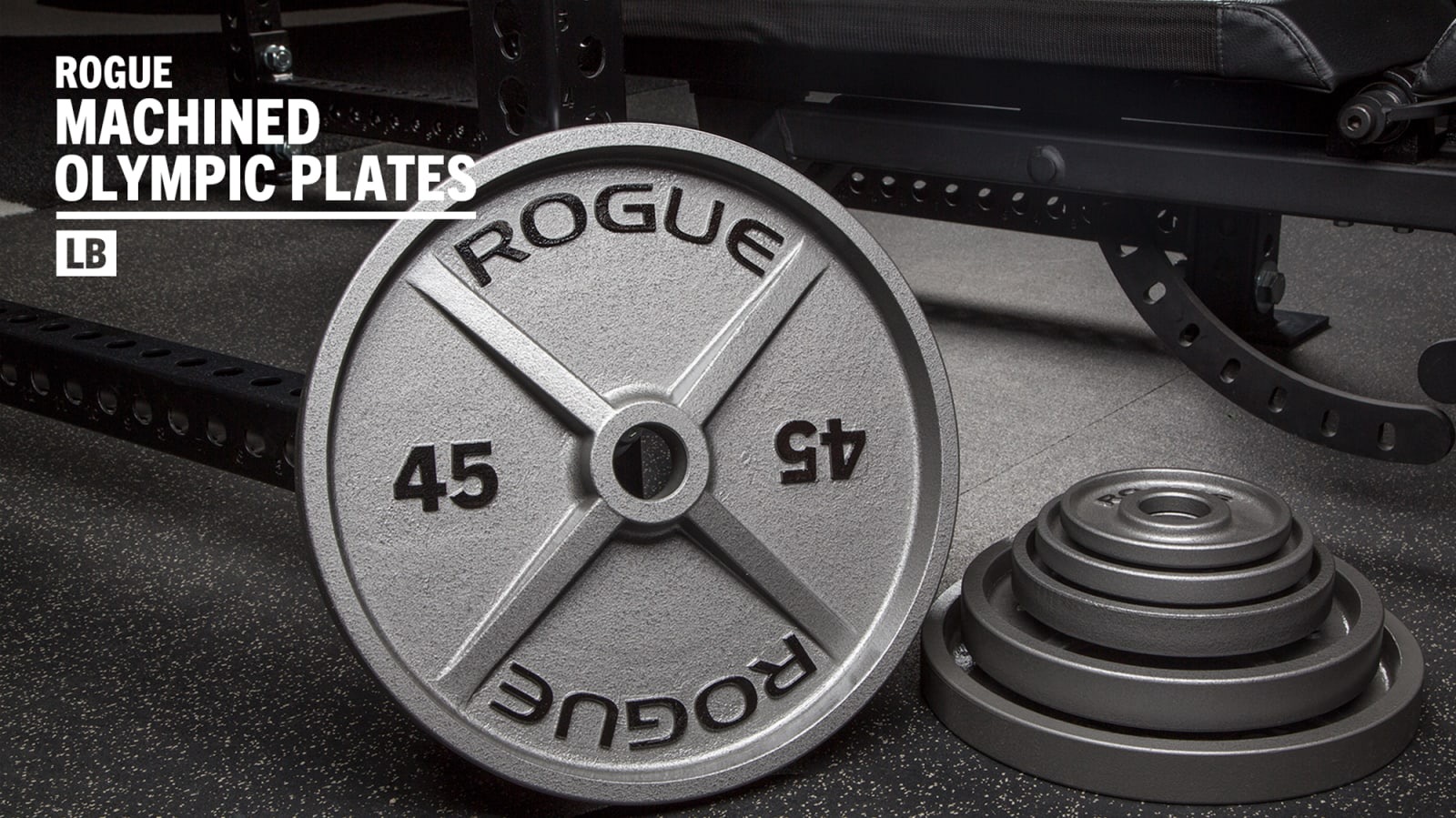
Rogue Machined Olympic Plates
Best Cast Iron Weight PlatesQuick specs
- Type - machined cast iron
- Tolerance - +/- 2%
- Profile - thin for iron, low-dish
- Fit - 50.5mm machined opening
- Sold as - pairs and full sets
The iron workhorse. Clean machined faces, a true collar opening, and a thin-for-iron profile that loads more on the bar than deep-dish plates.
Summary of experience, tests & opinions
The strengths
- This is the set I steer most home gyms toward, because it does the boring things right for a decade and never asks to be replaced. Buy once, load forever, and forget the receipt exists.
- Members who have run these for years report the same thing back: no cracked castings, no warped faces, no surprises. That kind of quiet track record is rarer in iron than the spec sheet suggests.
- The cast lip gives you something to hook a finger under, so dragging a stray 45 off the floor is far less of a fight than it is with the bare calibrated steel.
The weak spots
- It is honest bare iron, which means it wants a dry corner and the occasional wipe-down. Leave a pair in a damp garage over winter and you will find the first freckles of surface rust where rubber would have shrugged it off.
- I only ever clock the accuracy gap to calibrated when I deliberately weigh a pair side by side. In a normal session it is invisible, but a numbers-chasing lifter will eventually want the tighter spec.
Pros & cons
Pros
- Machined faces and opening – clean and true, so the plate protects your bar instead of chewing it up.
- Thin-for-iron profile – you load more total weight than deep-dish iron allows, closer to calibrated than to a fat plate.
- No-rubber simplicity – classic iron with nothing to delaminate or bounce, the kind of plate you hand down.
Cons
- 2 percent tolerance – fine for general training, but looser than the calibrated steel for precision work.
- Iron clanks and can rust – bare metal needs a dry room and a wipe-down, where rubber forgives neglect.
Read more about the Rogue Machined Olympic Plates
Machined iron is the plate most home gyms actually need.
It is the classic non-calibrated disc done properly: cast, then machined along the faces and the collar opening so it runs true and slides clean. That machining is the whole story. A rough cast plate at half the price will scratch a sleeve and chip its finish inside a year, where the machined opening here slides on snug at 50.5mm and protects a good bar instead of chewing it. The profile is thin for iron too, closer to a calibrated plate than to a deep dish, so a 45 sits compact and a serious lifter fits more on the bar before running out of sleeve. In our gym the finish has held across hard use with no flaking and no rust spots, which is exactly where cheap iron usually shows its price.
The trade against the calibrated steel above is a fair one. You give up the 10-gram tolerance for a 2 percent spec and a sliver of thinness, and you pocket a real saving. Set against the budget Titan grip plate below, the gap runs the other way: the Titan is looser and rougher in the opening, while this iron is tighter, smoother, and the last plate set you will buy.
Buy it if you run a dry indoor barbell gym and want iron done right; skip it if you drop the bar or want the rock-bottom price. Where it genuinely leads the lineup is loadability and fit:
Bottom line
The Rogue Machined Olympic is the right buy if you want classic iron done properly and you are not chasing competition accuracy. The machined opening protects your bar, the thin profile loads more than deep-dish iron, and the build shrugs off the years. It costs more than a rough cast grip plate, and every dollar of that goes into machining you can feel.
For a dedicated barbell gym that lives indoors and dry, this is the workhorse. Step up to the calibrated steel only if you need the tighter tolerance.
The Rogue Machined Olympic might be for you if… you want long-lasting iron with a clean fit for squats, presses, and pulls.
It’s not for you if… you drop the bar from overhead, where iron will crack a floor and the REP Black Bumper belongs instead.
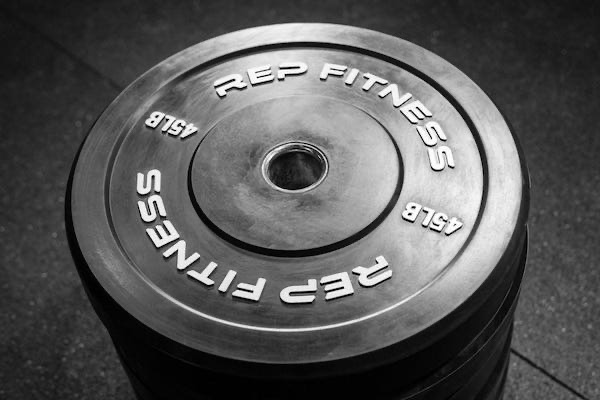
REP Black Bumper Plates
Best Bumper Weight PlatesQuick specs
- Type - virgin rubber bumper
- Tolerance - +/- 1%
- Insert - hooked stainless steel
- Fit - 50.4mm, snug on the bar
- Drop-safe - yes, for Olympic lifts
The bumper pick, and the one that tops our dedicated rubber ranking. Drop-safe, accurate to 1 percent, with a hooked steel insert built to outlast thousands of drops.
Summary of experience, tests & opinions
Where it earns its place
- The bounce is controlled rather than springy. Drop a loaded bar and it settles close to where it lands instead of skittering across the platform, which is the difference between resetting fast and chasing the bar around the room.
- Virgin rubber means none of the eye-watering recycled-tire reek. There is a faint factory smell out of the box, but it airs out within a week and never comes back, where cheaper crumb-rubber sets can stink up a closed garage for months.
- This is the set I point at anyone running one bar for everything, from cleans to accessory work, because rubber forgives the mixed training that iron quietly punishes.
Where it gives ground
- The tight opening that keeps it snug also makes it grippier to slide on and off than a loose bumper, so loading is a fraction slower and a touch louder. A fair trade for the lack of rattle, but you notice it.
- It is thick, as all bumpers are, so a strong lifter fills the sleeve sooner than they would like and ends up loading more change plates to make up small jumps.
Pros & cons
Pros
- Drop-safe rubber – takes overhead drops for Olympic lifts and CrossFit without cracking a floor.
- Hooked steel insert – locks into the rubber so the hub never loosens over years of drops.
- Snug 50.4mm fit – tighter than most bumpers, so it does not rattle or slide on the bar.
Cons
- Thick profile – you load far less total weight than iron or steel before the sleeve fills up.
- Looser than steel on weight – 1 percent is good for rubber but behind a calibrated plate.
Read more about the REP Black Bumper Plates
The REP Black Bumper is the plate to own if you drop the bar.
It is the most versatile pick on this list precisely because rubber forgives what iron punishes: overhead drops, sensitive floors, mixed training under one roof. The hooked stainless insert is the engineering that earns the durability, locking into the rubber so the hub never works loose after thousands of drops, and the 50.4mm opening is tighter than most bumpers so it sits snug rather than rattling around the sleeve. Plates our community has hammered for years come back with the same story: the hub stays put and the rubber does not split. That track record, more than any spec sheet, is why this one sits at the top of our dedicated rubber ranking.
Against the iron and steel above it, the trade is all about thickness. Where the calibrated steel runs ultra-thin for maximum loading, this bumper is fat by nature, so a strong lifter fills a sleeve far sooner. That is the price of drop-safety, and it is the right price to pay only if the bar actually hits the floor.
One caveat on scope. This hub is not the place to rank the whole rubber category, so we put every bumper, color set, and competition disc head to head in our best bumper plates guide; if you are buying rubber as your main plate, start there for the full lineup. On versatility, nothing else here matches it:
Bottom line
Buy the REP Black Bumper if you do Olympic lifts, CrossFit, or any training where the bar hits the floor. It is drop-safe, accurate for rubber, and built around a hooked insert that does not loosen. Skip it if you are a pure powerlifter chasing max loading, because the thick profile fills a sleeve fast and the calibrated steel is the better choice there.
If you want the full rubber comparison before you commit, our best bumper plates guide ranks every option in depth.
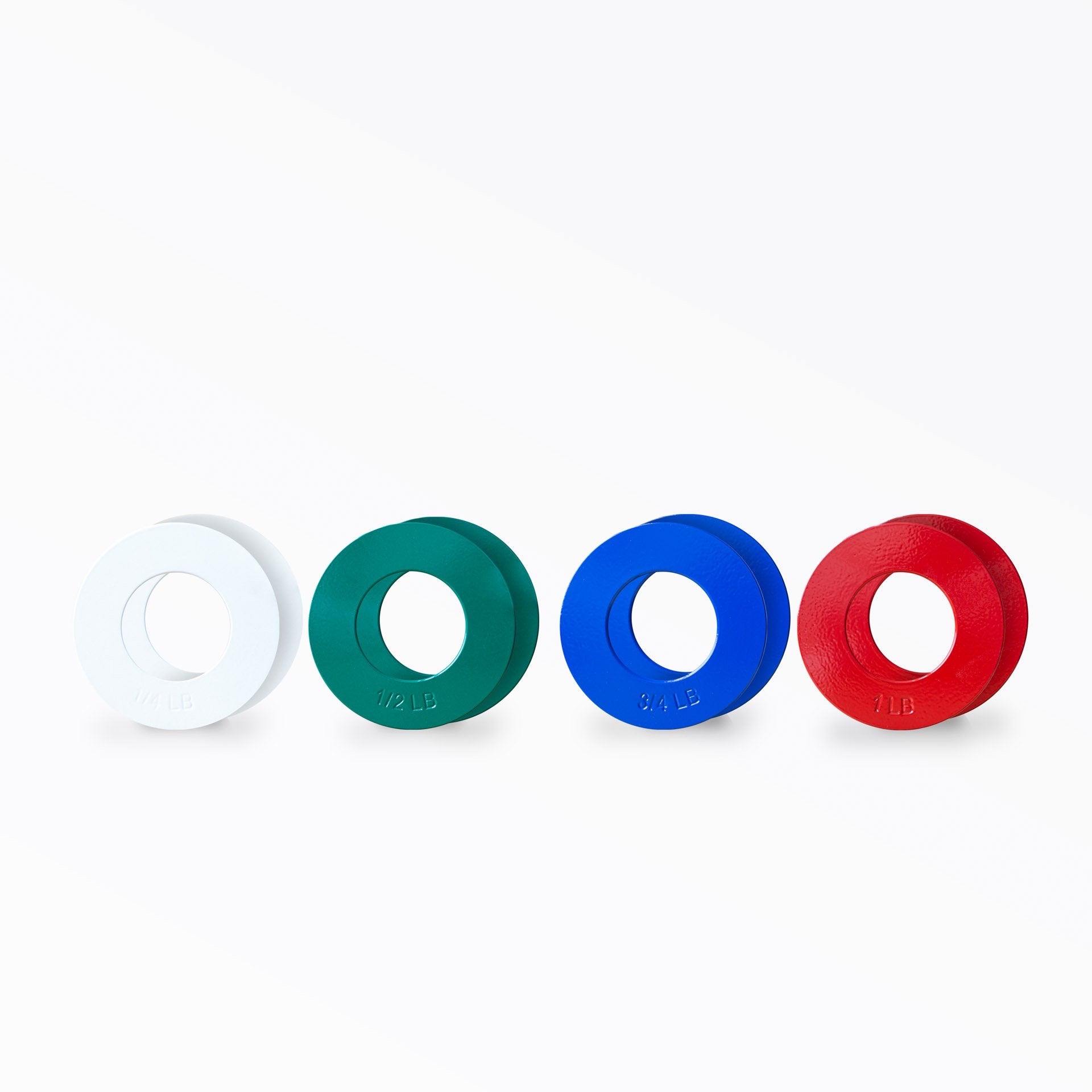
REP Fractional / Micro Plates
Best Change Weight PlatesQuick specs
- Type - change and fractional
- Range - 0.25 to 2.5 lb plates
- Tolerance - +/- 10 grams
- Finish - rubber-coated for grip
- Sold as - pairs and small sets
The micro-loading pick. Tiny 0.25 to 2.5 lb plates that let you add the smallest real jump and break through a stalled lift.
Summary of experience, tests & opinions
What’s smart
- The pressing lifts are where these earn their keep first. An overhead or bench press that stalls on a five-pound jump often climbs happily on a half-pound one, and that is the lift where most people meet a wall worth solving.
- The first thing I noticed living with a set is how quiet they are. Bare metal fractionals chime and skitter every time you brush the rack; the rubber coating turns that into a dull, drama-free thunk.
- Steve programs these for clients who have plateaued, and the pattern he sees is consistent. The bar keeps moving for months on jumps too small to feel but big enough to add up.
What’s awkward
- They earn a home. Loose on a shelf they vanish, so I keep mine in a small case by the rack, and the people who get the most from a set are the ones running a structured program rather than dabbling.
- A fraction of a pound is invisible until it is the only thing standing between you and a rep, which is exactly why you only reach for these once your big plates have stopped doing the job.
Pros & cons
Pros
- Micro-loading down to 0.25 lb – the smallest jump you can make, which is how you keep adding weight past a plateau.
- Tight 10-gram tolerance – the accuracy you actually need on a tiny plate, where a few grams is a big percentage.
- Rubber-coated – grippy to handle and kind to floors and bar sleeves.
Cons
- Niche by design – useless on their own, only valuable next to a main plate set.
- No storage included – ships loose with no case or tray, so you supply your own.
Read more about the REP Fractional / Micro Plates
Change and fractional plates are the unsexy secret of long-term progress.
Big plates jump in fives and tens; these bridge the gap with quarter-pound and half-pound steps. When a lift stalls, the fix is often not more effort but a smaller increment, and that is exactly what these buy you. The set runs from 0.25 lb up to 2.5 lb, rubber-coated so it grips a cold hand instead of squirting out onto your foot, and that coating also spares your floor and sleeves. They hold a 10-gram tolerance, which matters more than it sounds: on a half-pound plate a few grams of drift is a big percentage, so loose accuracy would defeat the whole point of micro-loading.
These are a supplement to a set, never a set on their own.
The natural comparison here is the calibrated steel, which shares that 10-gram tolerance at the big end of the bar; think of these REP plates as the small-end partner that keeps a precise load honest right down to the quarter pound. Steve programs micro-loading for clients who have stalled and reaches for plates like these to keep the bar moving. Buy them once your jumps stall, usually on presses first; skip them while you are still adding weight comfortably every session. On weight accuracy they sit second only to the calibrated steel:
Bottom line
Buy the REP Fractional / Micro plates if your lifts have stalled and a five-pound jump is too big. Skip them if you are still adding weight comfortably every session, because you do not need them yet.
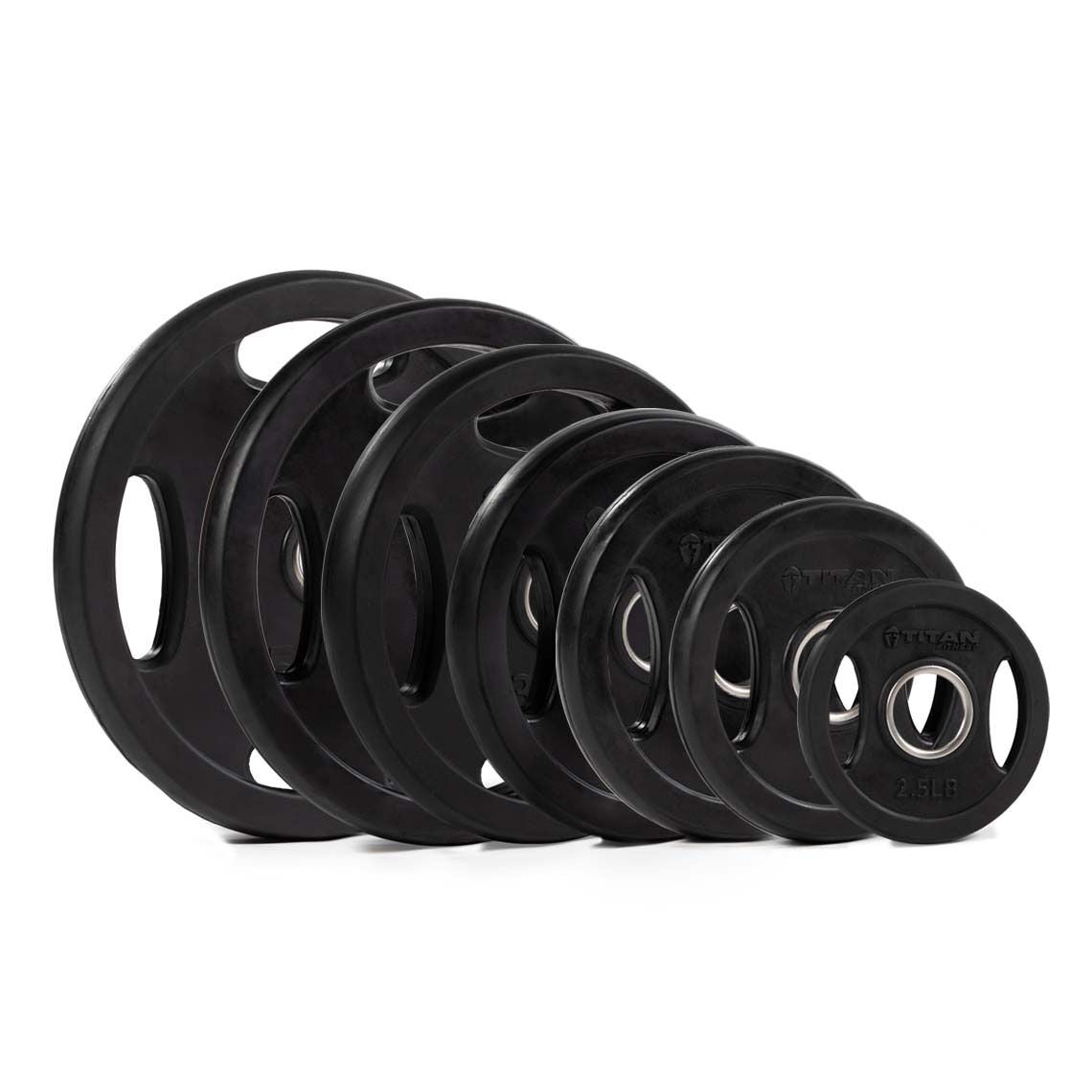
Titan Cast Iron Grip Plates
Best Budget Weight PlatesQuick specs
- Type - cast iron grip plate
- Tolerance - +/- 3%
- Handles - three angled cutouts
- Fit - ~50.8mm Olympic opening
- Sold as - pairs and singles
The best value in iron. Grip-handle plates with solid build for the money, widely available, and easy to add to over time.
Summary of experience, tests & opinions
The upside
- This is the set I hand new lifters who want real iron without a real-iron bill. It does the one job a first plate set needs to do, and it does not pretend to be more than that.
- The cutouts double as a carry handle off the rack, so hauling a pair across the garage stops being a knuckle-scraping job. Small thing, but it is the difference between racking plates and dreading it.
- Years into hard home use, the frame just keeps going, going by what owners tell us. No cracked handles, no split castings, which is where the genuinely cheap grip plates tend to come apart.
The downside
- The opening runs a touch wide of a true 50mm sleeve, so the plates sit with a little play and can clink and shift under the collars on a fast lift. Snug it is not.
- The enamel is a budget finish. Mine started flecking along the edges within a year of normal loading, the kind of cosmetic wear you forgive at this price but would not on a machined plate.
Pros & cons
Pros
- Three-handle grip – easy to carry and load, where a flat iron plate is awkward and edge-sharp.
- Best value in the lineup – real iron for the lowest spend that we still trust to last.
- Sold in singles – build a set gradually as your strength climbs.
Cons
- 3 percent tolerance – looser than machined iron, so the loaded bar is less precise.
- Cast finish – rougher opening and faces than the machined iron, so treat a nice bar with care.
Read more about the Titan Cast Iron Grip Plates
The Titan grip plate is the smart budget play because it does not cut the corner that matters.
The frame is solid, the three angled cutouts make it livable in the hand, and the price is the lowest we are comfortable recommending. The savings come off the tolerance and the finish, which are the right places to cut on a general-training plate. A 3 percent tolerance is genuinely loose, so across a loaded bar the plates can sit a touch uneven side to side, but it is real iron that held up to normal home use without the cracked handles you hear about on the very cheapest sets. It also sells in singles, so you can build the set a pair at a time as a lift outgrows the load.
Set against the machined iron higher up, the difference is real: looser weight, a rougher cast opening, a plainer finish. What you get back is a meaningful saving and the same basic job done.
Where it really separates from the CAP grip plate below is the corner CAP cuts further: CAP runs a looser 5 percent tolerance and an opening rough enough to mark a nice bar, while the Titan tightens both without leaving the budget tier. Buy it for a first set or a casual gym; skip it only if you want the rock-bottom price and will accept a looser plate. This pick wins clearly on value, second only to the cheapest grip plate:
Bottom line
The Titan Cast Iron Grip is the right buy if you want dependable iron and the budget is tight. The handles make it easy to load, the build lasts for normal home use, and you can grow the set in singles. You give up tolerance and finish next to the machined iron, which is the one place the saving shows.
For most people building a first plate set, this is the value sweet spot. If accuracy matters to you, step up to the machined iron.
The Titan Cast Iron Grip might be for you if… you want a dependable, easy-to-handle iron set without paying for machining you will not miss.
It’s not for you if… you want the absolute lowest price and will accept a looser plate, in which case the CAP grip plate goes cheaper still.
CAP Olympic Grip Plates
Cheapest Weight PlatesQuick specs
- Type - cast iron grip plate
- Tolerance - +/- 5%
- Handles - three angled cutouts
- Fit - ~50.8mm, can run loose
- Sold as - pairs and singles
The cheapest way onto a bar. A no-frills cast iron grip plate that gets a starter set loaded for the least money, with looser tolerances to match.
Summary of experience, tests & opinions
Where it delivers
- This is the plate for the absolute starter setup, the one whose only brief is to get a bar loaded this week. Pair it with a budget bar rather than a prized one and the rough edges genuinely stop mattering.
- For all its cut corners, the iron itself lasts. Members report sets soldiering on for years of casual home use, which is the most you can fairly ask of the cheapest plate on a list.
Where it limits you
- Plate-to-plate consistency wanders. Out of a single order you can find one pair that slides on fine and another that runs tight or rough, because there is no machining step to even them out.
- The opening sits loose on the sleeve, so the plates rattle and creep under the collars on anything explosive. Load a pair and you can feel one end hang slightly heavier than the other on the lockout.
Pros & cons
Pros
- Lowest price on the list – the cheapest real route to a loaded barbell.
- Angled handles – easy to carry and load for a cast iron plate.
- Widely stocked – easy to find and add to in singles or pairs.
Cons
- 5 percent tolerance – the loosest accuracy here, so the loaded bar is the least accurate.
- Rough cast opening – can scratch a good bar sleeve, and the enamel chips with use.
Read more about the CAP Olympic Grip Plates
The CAP grip plate exists to get a beginner lifting for the least money.
Judged on that single job it succeeds. There is nothing clever here: cast iron, baked enamel, three angled handles, a price that undercuts everything. For a recreational lifter or a first garage setup, that is often all that is needed, and owner reports across our community confirm it has served thousands of people fine for exactly that. The one corner CAP did not cut is the handles, which make a cheap plate feel less cheap in the hand and turn loading the bar from a chore into something you will actually do.
The real caveats are the tolerance and the opening.
At 5 percent it drifts more than any other plate here, and because the opening is cast at roughly 50.8mm rather than machined, it can run loose and rough enough to scratch a sleeve, with the enamel chipping over time. Set against the Titan grip plate one rung up, the story is simple: CAP is cheaper but looser and rougher, Titan costs a little more and buys a tighter plate with a kinder opening. Pair the CAP with a budget bar rather than a prized one, and those caveats stop mattering. Buy it when the only goal is the cheapest loaded bar this week; skip it the moment accuracy or a nice bar enters the picture. It tops the lineup on raw value, which is the whole point of this pick:
Bottom line
Buy the CAP grip plate if your only goal is the cheapest loaded bar and you will pair it with a budget barbell. Skip it if you want the loaded weight to be accurate or you plan to protect a nice bar, in which case the Titan grip plate is a small step up that buys a tighter plate and a kinder finish.
How we created this list of best weight plates
Here are the criteria we used to pick these plates, and how much each one counted:
- Build and durability (35%)
- Weight accuracy (25%)
- Loadability and fit (15%)
- Versatility (15%)
- Value for money (10%)
You can read all about our selection process here.
Other weight plates we tested - close but no cigar
- Strength Co. Olympic Iron Plates - superb USA-made machined iron with a deep lip that handles easily, but limited availability and a higher price keep the Rogue Machined Olympic ahead as the easier iron buy.
- Fringe Sport bumper plates - a strong rubber option with tight tolerances, but it goes head to head with the rubber category we rank in full in our best bumper plates guide, so we point bumper buyers there.
- Vulcan Alpha Bumpers - excellent hooked-insert durability and a long warranty, but again a bumper, so it belongs in the bumper ranking rather than this iron-led hub.
- REP Equalizer urethane plates - clever steel-insert handles that load fast, but the larger opening slides loose without collars, which knocks it below the REP Black Bumper for general use.
Weight plate FAQs
What are the best weight plates?
The best weight plates overall are the Rogue Calibrated Steel Plates.
They are accurate to within 10 grams, thin enough to load a bar far past most plates, and built to the standard competitive lifters train against.
If you want classic iron for less, the Rogue Machined Olympic is the smarter spend for most home gyms.
Cast iron or bumper plates - which should I buy?
Buy cast iron or steel if you mainly do slow barbell lifts like squats, presses, and deadlifts off the floor.
Buy bumpers if you do Olympic lifts or CrossFit and drop the bar, because rubber protects your floor and the plate.
We rank the whole rubber category in our best bumper plates guide, so start there if bumpers are your main set.
What are calibrated plates?
Calibrated plates are steel discs machined to a very tight weight tolerance, usually within 10 grams.
The accuracy comes from a plug set into the back of the plate that brings it into spec after it is weighed.
They are the choice for powerlifters because the loaded bar is exactly the weight it claims and the thin profile lets you keep loading, as on the Rogue Calibrated Steel.
How much weight should I buy first?
Most new lifters should start with around 230 lb of plates plus a bar, which covers a beginner’s working sets across the main lifts.
Buy in pairs so the bar loads evenly, and add more as your strength climbs.
Grip plates like the Titan Cast Iron Grip sell in singles, which makes building a set piece by piece easy on the budget.
Do I need change plates?
You need change plates once a five-pound jump becomes too big to add every session.
Small plates from 0.25 to 2.5 lb, like the REP Fractional / Micro, let you keep adding weight in honest increments and push past a stall.
If you are still progressing comfortably with your main plates, you do not need them yet.
The bottom line
I spent a long time loading and dropping these plates, because plates are the one purchase you want to get right once and load for a decade.
For serious barbell lifters, the Rogue Calibrated Steel is the call. It is dead accurate and thin enough to keep loading.
If you want classic iron done properly for less, the Rogue Machined Olympic is the iron most home gyms actually need.
If you drop the bar, go rubber with the REP Black Bumper and see our bumper guide. If money is tight, the Titan Cast Iron Grip is the value pick.
There are two things to do now:
- If you want another look at the picks, click here to skip back to the table.
- If you want to put a pin in it, bookmark this page and come back. We re-test it and update the picks whenever a plate changes.
Stay strong.
