

The face pull is a powerlifting accessory move that has made its way into the gym mainstream. It’s a valuable exercise to prepare your upper body for heavy pressing, increase stability of the scapular area and strengthen and develop the upper back muscles.
They’re also an excellent ‘prehab’ exercise - one that strengthens vulnerable muscles, preventing potential future injury. Anyone who performs a lot of pressing will know the injury risk if you don’t prepare your shoulders properly…
To do a face pull you need to have a cable pulley machine - something that most home gym trainers don’t have.
That’s why I’ve put together this face pull alternative article. As a certified PT, I’ve been training people in their garage gyms for decades.
Most of them don’t have a cable machine so I’ve become pretty adept at using exercises that work the same muscles in the same way as those done on cable machines in the gym.
Face Pull Muscles Worked
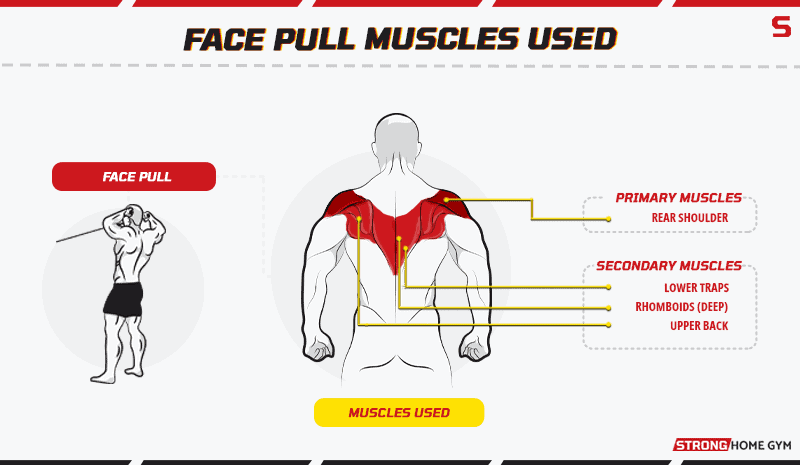
The face pull exercise mainly targets the rear deltoid (shoulders).
The secondary muscles it targets are:
- Lower traps
- Rhomboids
- Infraspinatus
- Teres major
Research shows how different exercises significantly target different parts of the shoulder muscle. So it’s not as straight forward as just doing a “rear delt” exercise to mimic a face pull.
Why Do the Face Pull?
The face pull is a horizontal pulling exercise that also involves scapular retraction.
It targets some quite “hard to target” muscles as listed above.
But it also increases shoulder mobility. Here are four reasons to include the face pull - or one of our home-friendly face pull alternatives - to your workout routine:
1. Countering Internal Shoulder Rotation
Internal rotation of the shoulders is a common problem that leads to poor posture, rounded shoulders and lower back strain. A major cause of internal rotation is our sedentary lifestyle which sees us sitting in a stooped position for too long.
Over-emphasis on working the chest, front delts, and lats also contribute to the issue.
Face Pulls counter this internal rotation. They provide external rotation of the shoulder joint, strengthening the muscles involved in that action. This makes you less likely to suffer from a shoulder impingement injury, while simultaneously improving your posture.
2. Eliminates Scapular Winging
Scapular winging is quite a painful condition that causes the shoulder blades to stick out. It results from weakness in the rhomboids, whose function is to draw the shoulder blades together.
The face pull is one of the best exercises you can do to strengthen the rhomboids and counter scapular winging.
3. Shoulder Joint Stability
As well as targeting the external muscles like the rear delts, traps and rhomboids, the face pull also activates deeper stabilizer muscles around the shoulder joint. These include the rotator cuff muscles.
The stronger these muscles, the more stable the joint will be, bullet proofing your shoulders for your heavy pressing moves.
4. Targeted Muscle Development
Face Pulls allow you to hit the three key upper back muscles - rear delts, traps and rhomboids independent of the lats. That allows you to work these muscles to positive muscular failure without the much larger lats taking over.
That isolation will result in bigger, stronger upper back muscles.
Face Pull Problems
Despite its obvious benefits, the face pull does have a few issues that make it a less than ideal exercise. Here are three reasons why it’s a good idea to have an arsenal of face pull alternatives on standby.
1. Instability
As you get stronger when doing this exercise, you will need to keep adding weight to the cable stack. At some point, you will find yourself fighting against the pull of the weight stack to stay properly grounded.
This instability when you’re using heavy weight compromises your ability to perform the exercise with proper form.
2. Trade-Off Between Hypertrophy and Rotation
Two of the key benefits of the face pull are improving external rotation and building the size and strength of the rear delts, traps and rhomboids.
However, the way to emphasize external rotation is to keep the elbows high. But keeping the elbows in line with elbows parallel to the floor better targets the upper back muscles.
So, you have to make a choice - you cannot optimally achieve both results at the same time.
3. Less Than Ideal Strength Curve
Muscles follow a strength curve where they are strongest at the start of a movement when the muscle is elongated and weakest at the end point where it is fully contracted. With the face pull, however, the strength curve is reversed.
At the end of the movement you are pulling a rope apart, making you work the hardest when the muscle is at its weakest.
What A Genuine Face Pull Alternative Must Do
If you plug face pull alternatives into Google, you are going to find lists of 10 or more exercises, featuring everything from shoulder presses to lat pulldowns.
But you don’t have to have a whole lot of biomechanics knowledge - let alone common sense - to know that the shoulder press is a very different movement to the face pull. One is a vertical pressing move while the other is a horizontal pulling exercise!
In putting together this home gym friendly face pull alternative list, I had the following criteria:
- It had to be able to be done with such common home gym equipment as dumbbells and resistance bands.
- It had to target the rear delts, traps and rhomboids
- It had to work the muscles through a horizontal plane
- It had to be a pulling action that involved scapular retraction
Equipment Needed for the 6 Face Pull Alternatives
6 Face Pull Alternatives that replicate the same movement pattern
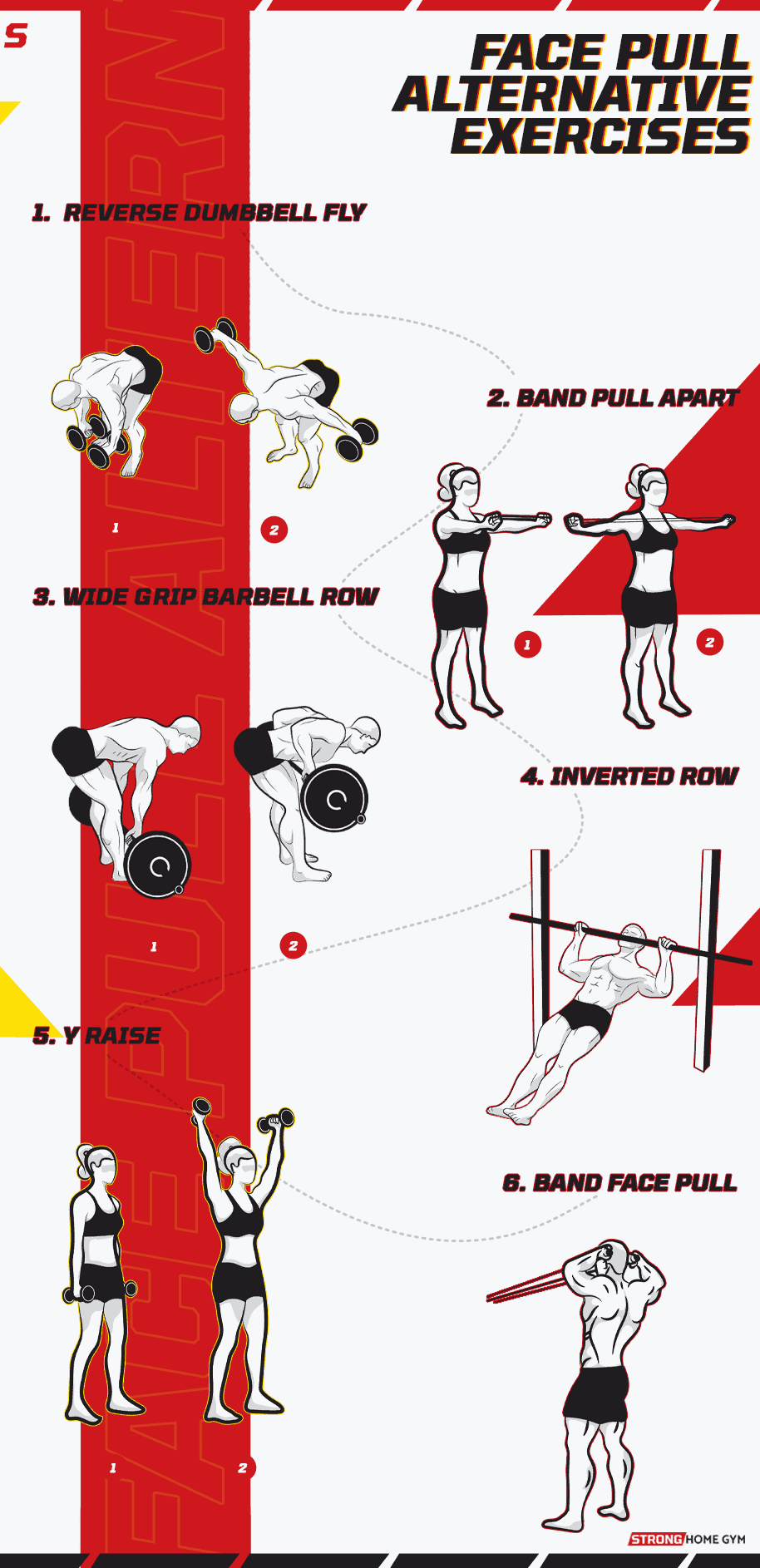
Reverse Dumbbell Flye
Equipment needed for the reverse dumbbell flye
How to do the reverse dumbbell flye
- Stand with your feet shoulder width apart and a pair of dumbbells in your hands.
- Maintaining a neutral spine position, hinge at your hips to bring your torso down until it is almost parallel to the floor. Your arms should be hanging down in front of your body with your shoulders slightly bent.
- Keeping your elbows locked, pivot from the shoulder joint to bring your arms up, simultaneously retracting your shoulder blades. Stop when your elbows are in line with your shoulders.
- Strongly squeeze the shoulder blades together then lower under control to the start position.
Reverse dumbbell flye muscles worked
- Rear deltoids
- Trapezius
- Rhomboids
- Rotator cuff muscles
Band Pull Apart
Equipment needed for the band pull apart
- Resistance band
How to do the band pull apart
- Stand with your feet shoulder width apart and a resistance band held in both hands (palms down grip) at arm’s length and at chest level. Your hands should be slightly closer than shoulder width apart and there should be tension in the band.
- Pull your arms apart, simultaneously retracting your scapula.
- Hold the furthest pull position for a couple of seconds as you strongly squeeze your shoulder blades together.
- Reverse the position under control.
Band pull apart muscles worked
- Rear deltoids
- Trapezius
- Rhomboids
- Rotator cuff muscles
Wide Grip Barbell Row
Wide grip barbell row needed for exercise:
How to do the wide grip barbell row
- Place a loaded barbell on the floor and stand behind it with feet shoulder width apart. Use a lighter weight than on standard width grip barbell rows as this version places more emphasis on the traps, rhomboids and rear delt than the lats.
- Maintaining a neutral spine position, hinge at the hips to bring your torso almost parallel to the floor. Grab the bar about six inches wider than shoulder width apart.
- Protract your shoulder and flare your lats while keeping a tight core. Now pull the bar up to your ribcage.
- Squeeze your shoulder blades together in the top position, holding for two seconds before lowering under control.
Looking for a complete beginner weight training program? We’ve got you covered - check out our beginner weight lifting routine.
Wide grip barbell row muscles worked
- Rear deltoids
- Rhomboids
- Trapezius
- Latissimus dorsi
- Core
Inverted row
Equipment needed for the inverted row
How to do the inverted row
- Position an unloaded barbell on supports so that it is sitting horizontally about four feet from the floor. Make sure that the supports are solid and the bar is secure.
- Lie face up on the floor so that your shoulders are directly below the bar.
- Reach up to grab the bar a little wider than shoulder width apart with an overhand grip.
- In this position, your torso should be at around a 45-degree angle.
- Depress your shoulder blades and flare your lats. Keeping your spine neutral, your core and quads engaged, pull yourself up to the bar to touch your chest to it.
- Lower under control and repeat.
Inverted row muscles worked
- Rhomboids
- Trapezius
- Rear Deltoids
- Latissimus dorsi
Y Raise
Equipment needed for Y Raise
- Dumbbells
- Adjustable weight bench
How to do the Y Raise
- Set an incline bench to a 45-degree angle. Lie face down on the bench with a light pair of dumbbells in your hands.Plant your feet firmly on the floor and hang your straightened arms down to your sides.
- Without bending your elbows, hinge at the shoulder joint to bring your arms up and out. In the top position your body should resemble a ‘Y’ shape.
- Squeeze the shoulder blades together in the fully contracted position and hold for two seconds.
- Lower under control.
Y Raise muscles worked
- Rear deltoids
- Trapezius
- Rhomboids
Band Face Pull
Equipment needed for the band face pull
- Resistance band
How to do the band face pull
- Secure a resistance band to a sturdy anchor, such as a door, at shoulder height. Stand about three feet from the anchor point, facing it and hold the band in both hands with a neutral grip. You want the band to be taut.
- Keeping your elbows parallel with the floor, pull your hands back to full contraction, simultaneously retracting the scapula.
- Hold the contracted position for two seconds as you squeeze the shoulder blades together.
- Return to an extended arm position under control.
Band face pull muscles worked
- Rear deltoids
- Trapezius
- Rhomboids
- Rotator cuff muscles
The versatility of these Face Pull alternatives
The beauty of these exercises is that they can do a number of jobs. Primarily they’re used to strengthen the target muscles already mentioned. They can also be used to warm up the shoulders ahead of any pressing training.
If you’re an athlete who performs a lot of explosive movements with the shoulders - I’m thinking people such as…
I’d be including a lot of these exercises in a specific workout each week, just to ensure the strength and stability of the shoulder joint. An ounce of preparation is worth a pound of cure and all that…
Face Pull Alternatives: The Bottom Line
The six face pull alternatives just described will allow you to bulletproof your shoulders in preparation for your heavy pressing moves. At the same time, they do a good job of isolating and developing the rear delta, traps and rhomboids.
Why not rotate through them, one workout at a time, to find the one that feels right for you?
Wanting to develop front delt power without overhead pressing? Check out our 9 favorite overhead press alternatives.