
The hanging leg raise is a classic exercise for developing the core. However, if your goal is to work the abs, this exercise may not represent the best use of your workout time.
As a personal trainer for over 30 years, I used to program the hanging leg raise. Many clients would report that they didn’t feel it in the abs.
That prompted me to do a deep dive into the biomechanics of the hanging leg to understand what muscle’s it’s actually working.
What I found led me to discard this exercise and replace it with other, more effective abdominal contracting moves.
In this article, I’ll explain why the hanging leg raise is not a good ab exercise and lay out 7 effective hanging leg raise alternative exercises that I now use with my personal training clients.
What’s wrong with the hanging leg raise
The hanging leg raise is considered an abdominal exercise. To do so, it would have to move the abs through their full range of motion. So, what do the abs do?
The function of the abdominals is to flex the spine, curling it forward to bring your torso towards your lower body.
Yet, when you do a hanging leg raise, your spine hardly moves; it remains in the same position!
There is no spinal flexion.
Some people may be able to achieve a little bit of flexion when their knees are raised on this exercise. However, 90% of that movement is hip flexion rather than spinal flexion.
The origin of the abs is on the pubic bone, the important point here is that it does not connect to the leg bone.
That means that your abs are not lifting your legs when you do the hanging leg raise. So what muscle is?
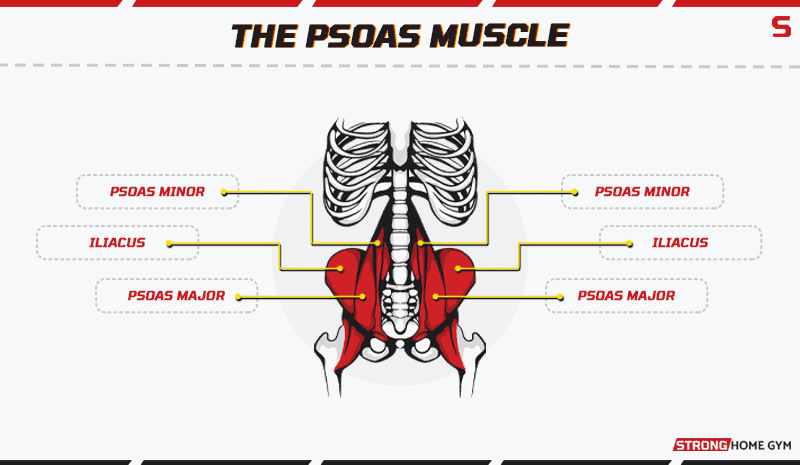
The psoas muscle is the muscle that connects your femur to your torso. This is the primary hip flexor muscle.
It originates on the lumbar spine, so when you pull forward on the legs, you are pulling on the lumbar spine. The psoas shortens and pulls forward, creating an arch in the spine.
This is the opposite of what you actually want to achieve with an abdominal exercise, which is spinal flexion.
When you add weight to the hanging leg raise by holding a dumbbell between your feet, you are further loading the femur.
This makes hip flexion more challenging, creating more lumbar spine arch. This interferes even more with abdominal contraction.
So, if the hanging leg raise is not an ab exercise, why do you feel a burning sensation in the abs. That burn is due to isometric rather than dynamic contraction.
Your abs will not get appreciably stronger with isometric exercise.
The bottom line here is that the hanging leg raise is an effective hip flexion exercise to work the psoas muscle. But it is not an effective spinal flexion exercise to work the abs.
Hanging leg raise muscles worked
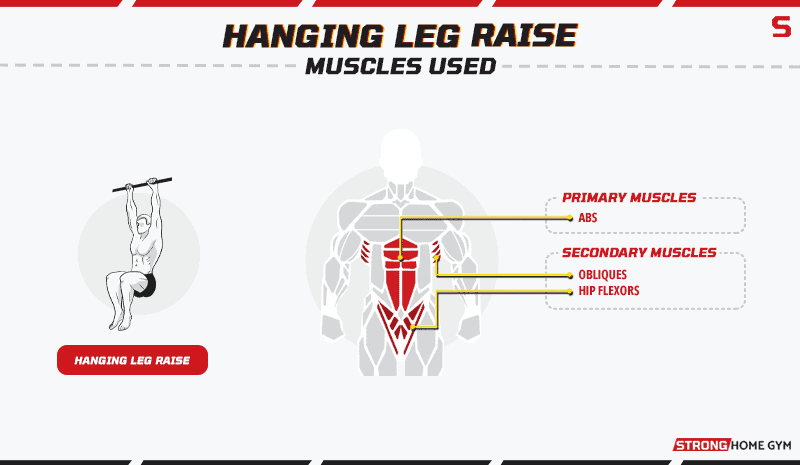
Primary:
- Abs
Secondary:
- Obliques
- Hip flexors
What an effective abdominal exercise must do
There are a lot of exercises, for all parts of the body, that are done without giving thought or analysis to whether they are effectively working the target muscle group.
This is arguably truer in the case of the abs than any other body part.
To make sure that you’re not wasting your ab workout time with ineffective movements, you need to critically evaluate any exercise you’re considering doing.
Here are 5 things that an effective abdominal exercise must do:
-
Target the abs: Exercises that target the abdominal muscles are more likely to be effective than exercises, such as the hanging leg raise, that target other muscle groups.
-
Progressive overload: The exercise should gradually become more difficult and resistant over time in order to notice improvements in strength and muscle size.
-
Range of motion: Effective abdominal workouts should move the abdominal muscles across their whole range of motion, from complete extension to complete contraction. This involves spinal flexion.
-
Functionally engage the muscles: As lifting and bending are daily activities that require core strength, a good abdominal workout should activate the muscles in a way that is appropriate for everyday motions.
-
Be scalable: Successful abdominal workouts should be scalable to various levels of fitness so that both beginners and seasoned athletes can benefit from the activity.
Equipment needed for these exercises
7 Hanging leg raise alternatives to work the abs
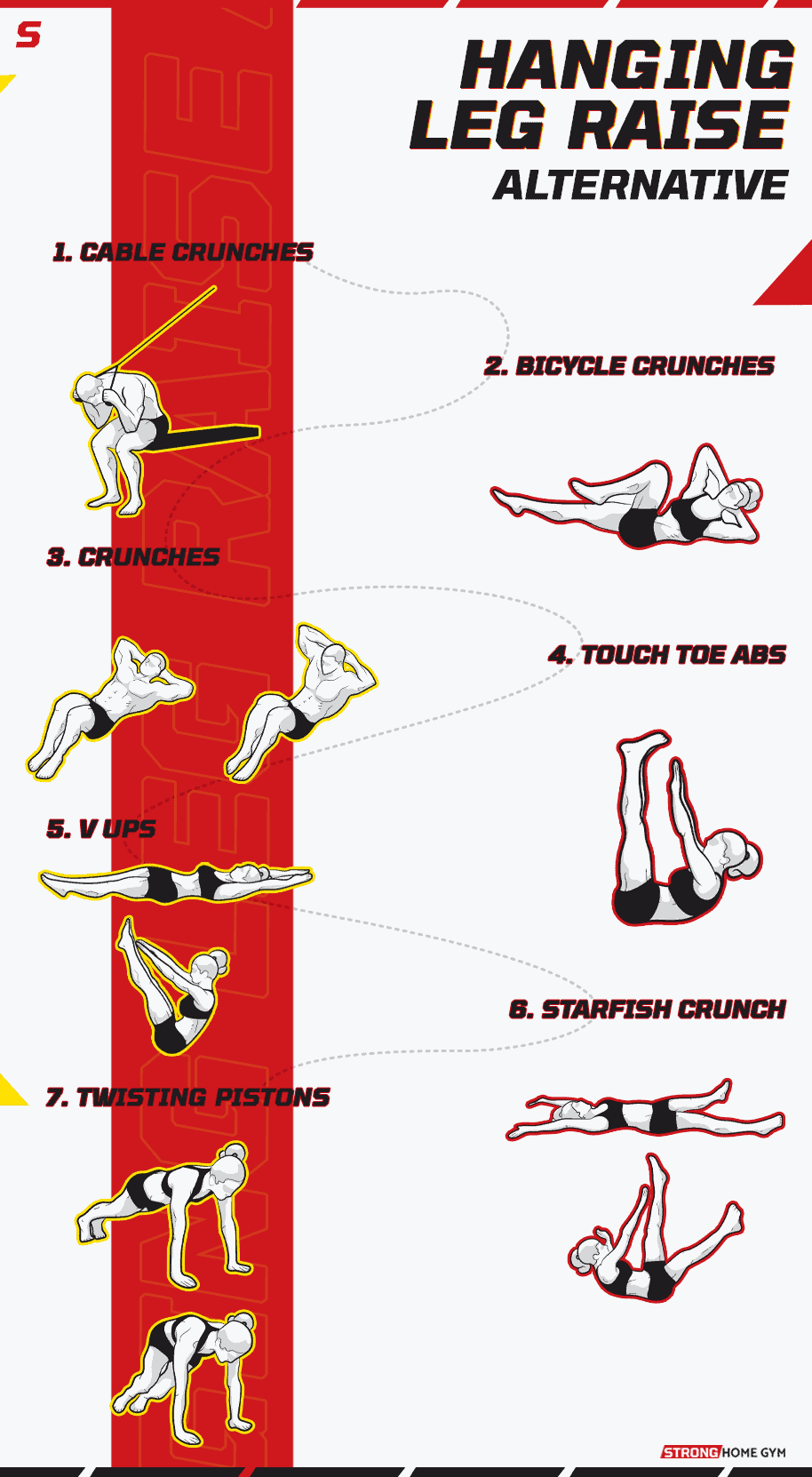
Cable crunches
Equipment needed for cable crunches
How to do cable crunches
- Set the pulley on a cable machine to hip level when you are seated and put a rope handle on the end of the pulley.
- Position a bench three feet in front of the cable machines and sit on it, facing away.
- Sit on the bench and grab the rope handle above your head.
- Crunch down to bring your chest toward your knees. Forcefully contract your abs. Reverse the action to return to the start position.
Cable crunches muscles worked
- Abdominals
- Obliques
Note: If you’re not a great fan of this exercise, check out our cable crunch alternatives and find a replacement for it.
Bicycle crunches
Equipment needed for bicycle crunches
- None
How to do bicycle crunches
- Lie on an exercise mat with your legs out straight and your hands alongside your ears (do not clasp your hands together).
- Lift your feet off the ground and lift your head and shoulders.
- Begin a cycling action with your legs, simultaneously bringing your elbows across to the opposite knee.
Bicycle crunches muscles worked
- Abdominals
- Lower back
Crunches
Equipment needed for crunches
- None
How to do crunches
- Lie on an exercise mat with your knees bent and your hands alongside your ears (do not clasp your hands together).
- Tense your abs as you push your back into the floor,
- crunch up with shoulders and head to contract the abs. Do not lift your mid spine off the floor.
Crunches muscles worked
- Abdominals
- Lower back
Want to build a home gym but not sure where to start? We’ve got you covered with our complete guide to building a home gym for any budget.
Touch toe abs
Equipment needed for touch toe abs
- None
How to do touch toe abs
- Lie on an exercise mat with your legs out straight and your arms extended beyond your head.
- Pivot at the hips and tense your core to bring your torso up and your hands to your toes.
- Lower and repeat. Maintain a neutral spine throughout this action.
Touch toe muscles worked
- Abdominals
- Lower back
V-ups
Equipment needed for V ups
- None
How to do V ups
- Lie on an exercise mat on your back with legs extended and arms by your side.
- Hinge at your hips to bring your straightened legs up until they are perpendicular with your torso.
- Straighten your arms up toward your legs.
- Begin pulsing up toward your toes by contracting your abdominals. Bring your head up on each pulse.
V ups muscles worked
- Abdominals
- Lower back
Starfish crunch
Equipment needed for the starfish crunch
- None
How to do the starfish crunch
- Lie spread eagled on the floor with your arms and legs stretched out starfish style.
- Without bending your knees, attempt to bring your right hand and left foot into contact with each other. You should only be lifting your shoulder blades from the floor. Feel a deep contraction in the abs in the top position.
- Return to the start position, controlling the movement, and repeat with the other side.
Starfish crunch muscles worked
- Abdominals
- Lower back
Twisting pistons
Equipment needed for twisting pistons
- None
How to do twisting pistons
- Get down into a plank position, resting on your elbows and your toes, with feet together.
- Keeping your butt down, bring both feet up to the left toward your left elbow.
- Immediately kick them back and then up toward the right knee.
- Continue this fluid piston-like motion until your prescribed number of reps has been achieved.
Twisting pistons muscles worked
- Abdominals
- Lower back
Hanging leg raise alternatives: The bottom line
The hanging leg raise is not an effective abdominal exercise.
The seven hanging leg raise alternatives I’ve laid out will do a much better job because they all involve spinal flexion.
Give each one a try to identify the ones that most effectively challenge your abs. Alternatively put them all together as a circuit, doing each move for 30 seconds.
Looking for a complete beginner’s weight training program you can do at home? Check out this comprehensive 12-week guide.
Keep strong!