

The overhead triceps extension is one of the most commonly performed triceps exercises. It is often done in the belief that it allows you to isolate the long head of the triceps, providing it with extra stretch that other exercises don’t provide.
However, this exercise has some problems. It causes strain on the shoulder joint and elbows, especially when excess weight is used, and can be uncomfortable to perform if you lack sufficient mobility.
As a personal trainer, I realized years ago that there are no real benefits to performing the overhead triceps extension that I can’t replicate in easier, more comfortable ways.
I’ve been programming overhead triceps extension alternatives to my clients for more than a decade.
In this article, I will lay out the eight best moves to optimally stimulate the triceps without any of the issues associated with the overhead extension.
Isolating The Long Head of the Triceps
Many people do the overhead triceps extension in the belief that it will isolate the long head of the triceps.
Yet, the whole idea of isolating different parts of a muscle is a falsehood (the only exception is the deltoids, with each head having separate origin and insertion points).
Even then, it’s super difficult to truly isolate each head.
The triceps is a single muscle with a single insertion, but with three heads. Each of the heads has a separate origin. The insertion point is on the elbow.
The elbow is a hinge joint, meaning that it only extends in one direction. When the triceps operate on the elbow joint to straighten the arm, all three triceps heads participate equally.
It is impossible to isolate any part of the muscle, regardless of what exercise you do.
For the separate heads of the triceps to be able to be isolated, the following would have to be the case:
- Each of the three heads would need a different insertion point.
- The elbow joint would need to be a ball and socket rather than a hinge.
Because these are not the case, you cannot isolate different parts of the triceps.
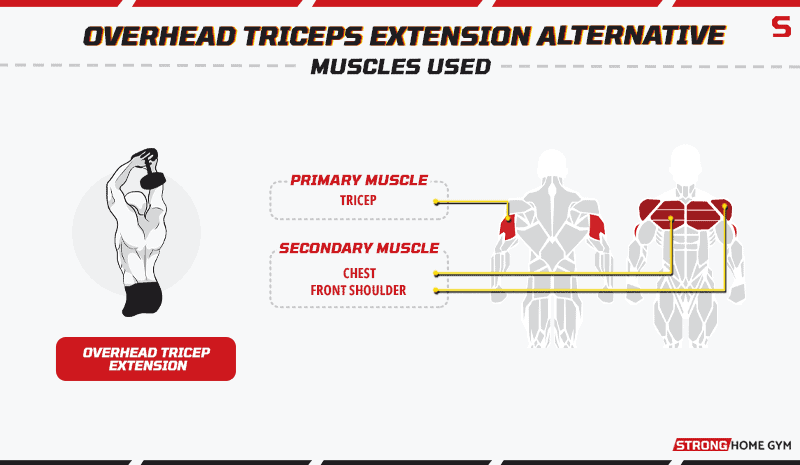
What’s Wrong with the Overhead Triceps Extension
The function of the triceps is to extend the elbow. When you do an overhead tricep extension, the elbow is extending just the same as it does when you are doing a triceps pushdown or a skullcrusher or any other tricep extension.
The fact that your arms are above your head does not work your triceps any differently.
You will hear ‘experts’ tell you that the overhead position provides extra stretch for the long head of the triceps. This is true, but there is no hypertrophy or development advantage to stretching a muscle more.
Of course, you do need full range of motion for the best results on muscle activation and hypertrophy. But you are already getting that with exercises like pull downs and skull crushers. There is no benefit to getting ‘extra’ stretch in the muscle.
It will not make you bigger or stronger!
The reality here is that there is no muscle growth benefit of doing the overhead tricep extension, But it does place strain on your shoulder joint.
To perform this exercise properly, you need to keep your elbows in a straight line rather than letting them flare out. This keeps the direction of movement aligned with the origin and insertion points of the muscle.
The closer you bring your elbows together, the greater the strain on your shoulder joint. Additionally, it is not possible to fully contract the triceps with the upper arm above your head.
If you don’t believe me, do an overhead tricep extension with a dumbbell and then try to flex the tricep in the top position. Now do a cable tricep pushdown and try flexing in the bottom position. You will feel a big difference in favor of the pushdown.
So far I’ve explained there are better exercises than the overhead triceps extension, but I want to address another point. Your shoulder mobility.
If you’re struggling to get your upper arms high into the position you’d need to perform an overhead triceps extension, you need to address your shoulder mobility.
An inability to get your elbows up (and perpendicular to your torso) is down to tight lats. By stretching your lats, you’ll correct this problem.
Having suffered from this previously, here’s how I recommend you solve the problem…
Finally, the overhead tricep extension does not put you in a natural or a comfortable position. The bottom line here is that there is no actual benefit to the exercise and a number of reasons not to do it.
Fortunately, there are plenty of much better exercises that will maximally work your triceps without the drawbacks that come with the overhead triceps extension…
Equipment Needed for These Exercises
- Cable Pulley Machine
- Dumbbells
- Weight Bench
- Resistance band
- Barbell
9 Best Overhead Triceps Extension Alternatives That Replicate the Same Movement Pattern
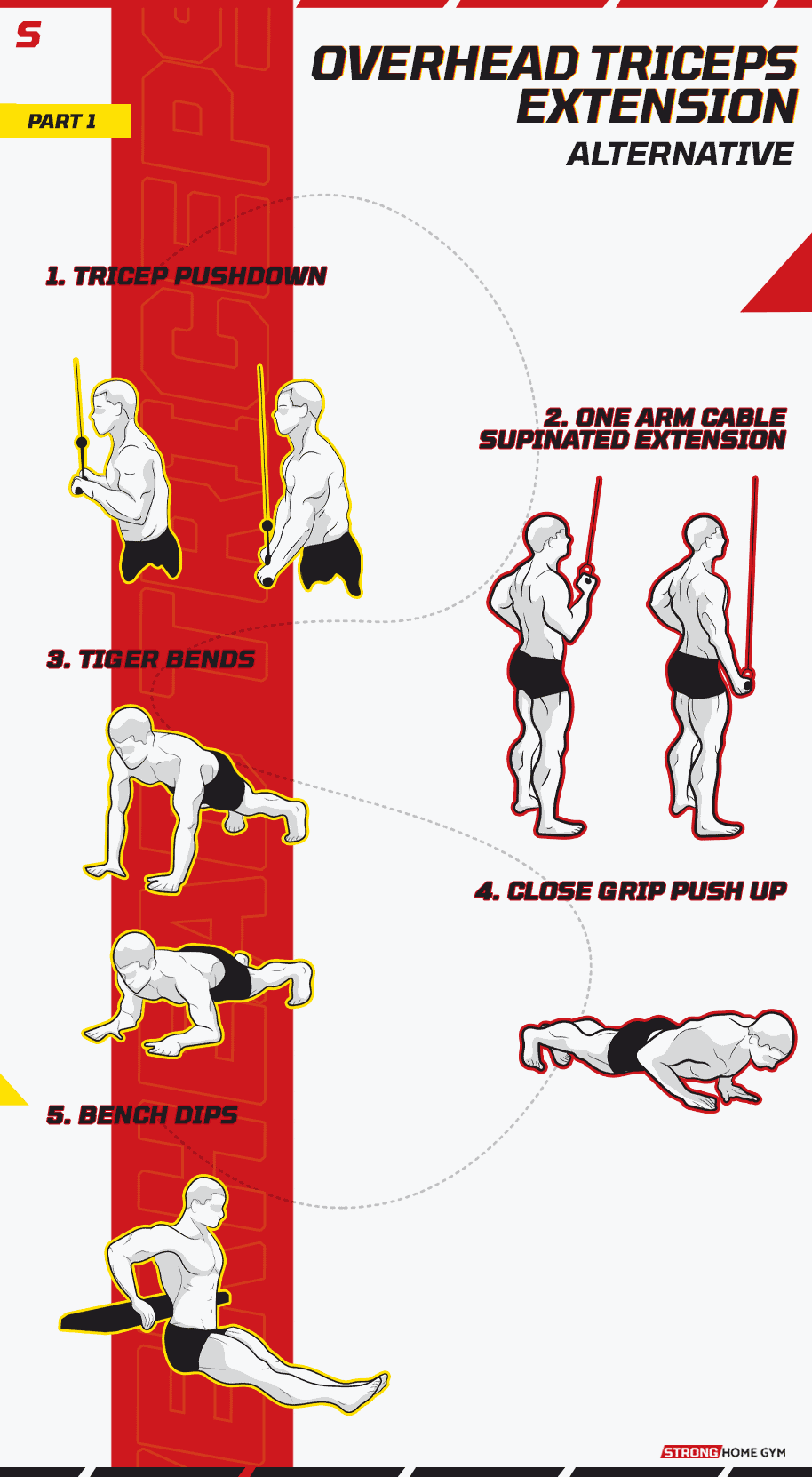
Tricep Pushdown
Equipment needed for the tricep pushdown
- Cable Pulley Machine
How to do the tricep pushdown
- Stand facing a high pulley machine and put either a rope or short bar handle on the cable. Set the handle height at mid chest level.
- Grab the handles with an overhand grip so that your thumbs are about six inches apart.
- Keeping your elbows in at your sides, extend your arms down. Stop a little short of full extension.
- Reverse the movement to return to the start position.
Tricep pushdown muscles worked
- Triceps
One Arm Cable Supinated Extension
Equipment needed for the one arm cable supinated extension
- Cable Pulley Machine
How to do the one arm cable supinated extension
- Face the weight stack and step laterally just enough that your working arm and forearm are directly in line with the handle.
- Reach up and grasp the handle with a supinated grip (palm up).
- Extend your shoulder to bring your elbow down to your side.
- Reverse under control and repeat for the required rep count.
One arm cable supinated extension muscles worked
- Triceps
Tiger Bends
Equipment needed for tiger bends
- None
How to do tiger bends
- Get down on your knees and place your forearms and palms on the ground shoulder-width apart and parallel to each other.
- Your hands should be just forward of your shoulders and elbows bent just above 90 degrees.
- Step back with one leg and drive your toes into the ground for stability. Do the same with the other leg.
- Press from the bottom position with a hard, upward drive to rise to the top push up position.
- Lower and repeat.
Tiger bends muscles worked
- Triceps
- Deltoids
- Pectorals
Close Grip Push Up
Equipment needed for the close grip pushdown
- None
How to do the close grip push up
- Get down in a push up position, with your feet together and your body forming a straight line from head to toe.
- Place your hands about 12 inches apart.
- From the top starting position, lower your body down toward the floor until your chest is about six inches off the ground.
- Push through the triceps to return to the start position.
Close grip push up muscles worked
- Triceps
Bench Dips
Equipment needed for bench dips
- Two benches
How to do bench dips
- Position yourself between benches that are about four feet apart. Place your pronated hands on the bench behind you. Put your feet on the second bench so that your legs are straight.
- From a straight arm position, bend the elbows to lower your butt toward the floor.
- Push through the triceps to return to the start position.
Bench dips muscles worked
- Triceps
- Deltoids
Want to get started with weight training but not sure where to start? Check out our complete 12-week beginner weight lifting routine featuring exercise videos.
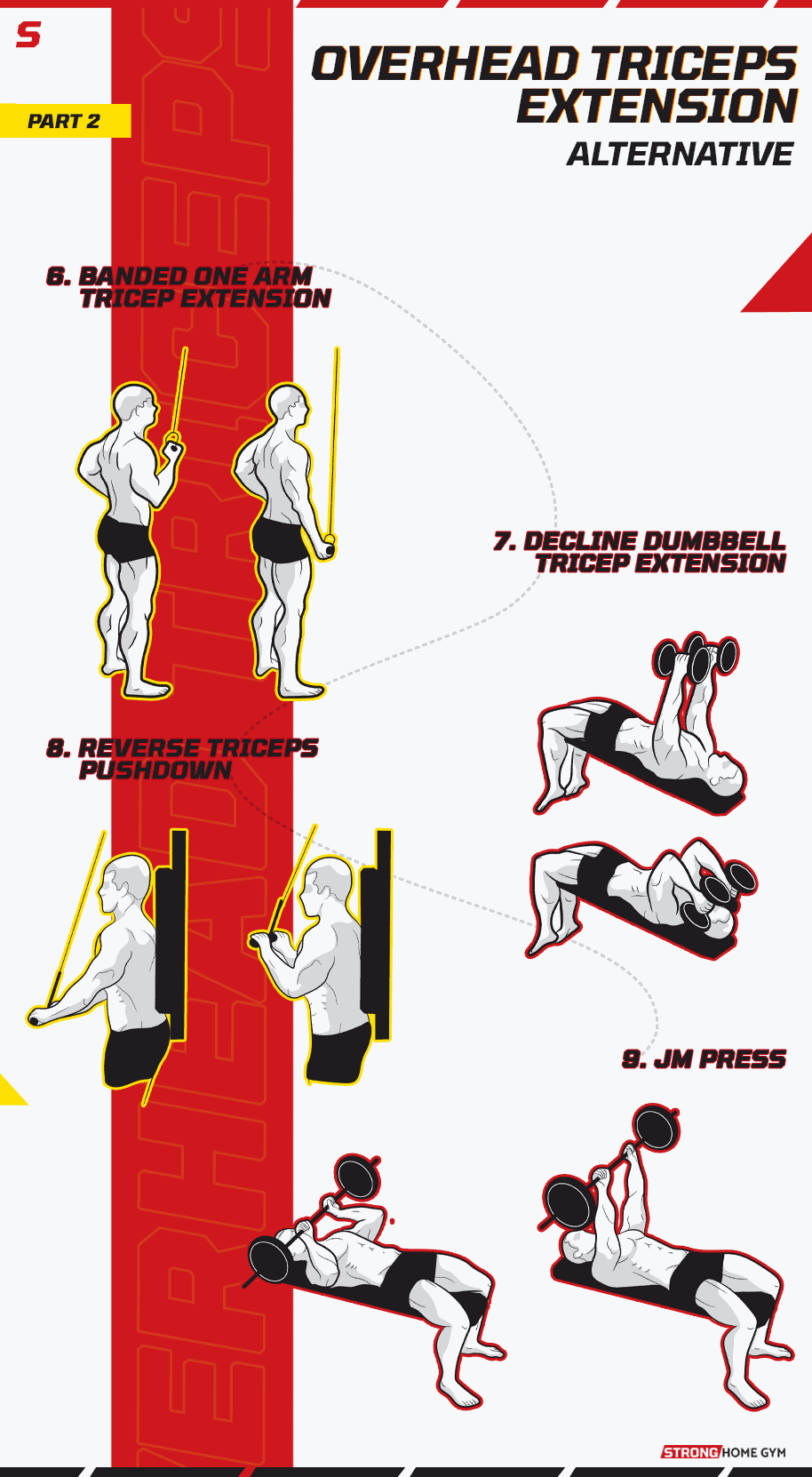
Banded One Arm Tricep Extension
Equipment needed for the banded one arm tricep extension
How to do the banded one arm tricep extension
- Stand with a resistance band looped under your left rear foot. Hold the other end of the band in your left hand, knuckles facing forward.
- Lift the arm to shoulder level. Now extend your arm to full extension.
- Keeping your arm in at the side of your head, bend at the elbow to bring your hand down behind your head.
- Extend your arm back up to the start position, squeezing the triceps tightly in the fully extended position.
Banded one arm tricep extension muscles worked
- Triceps
Decline Dumbbell Tricep Extension
Equipment needed for the decline dumbbell tricep extension
- Adjustable weight bench
- Dumbbells
How to do the decline dumbbell tricep extension
- Lie on a 40-degree decline bench with a pair of dumbbells in your hands, resting on your chest.
- Bring your arms up to full extension above your upper chest. Keep your elbows in at your sides.
- Lower the dumbbells to the sides of your head until the elbows are fully bent. This is the start position of the exercise.
- Push up until your arms are fully extended.
Decline dumbbell tricep extension muscles worked
- Triceps
Reverse Triceps Pushdown
Equipment needed for the reverse tricep pushdown
- Cable pulley machine
How to do the reverse tricep pushdown
- Position the pulleys on a dual pulley cable machine at their highest vertical position and then adjust horizontally so that they are in line with your shoulders.
- Stand about a foot in front of the machine facing away from it.
- Reach up to grab the cable handles and bring them down to the start position with your elbows in at your sides, and hands at mid-chest level. Your upper arms should be slightly angled rather than squarely in at your ribs.
- Press down and out slightly to fully extend the arms, strongly contracting the triceps in the bottom position.
- Reverse and repeat.
Reverse tricep pushdown muscles worked
- Triceps
JM Press
Equipment needed for the JM press
How to do the JM press
- Lie down on the bench press bench and take hold of a barbell. Your grip distance should be shoulder width.
- Unrack the bar and begin with it hovering over your shoulders and your arms extended.
- Flex the elbows to bring the bar down toward your chin. Your elbows should move outward at roughly a 45-degree angle from the midline of the body.
- As the bar comes down, flex, or cock, your wrists to create maximum tension at the bottom of the movement.
- Press back to the start position.
Note: make sure that you’ve got a spotter or are using safety bars on this exercise.
JM press muscles worked
- Triceps
- Deltoids
- Pectorals
Overhead Triceps Extension Alternatives: The Bottom Line
The overhead triceps extension is not an exercise that I recommend doing. When it comes to a cost benefits analysis, the negatives outweigh the positives of this exercise. Fortunately , there are plenty of much better triceps exercises.
Give each of the overhead triceps alternatives described above a try and then pick your favorite two or three and combine them into a 10 set workout, with a rep range of between 10 and 30 reps.
I recommend training your triceps twice per week for maximum gains.
Want to work the front deltoids but can’t do overhead presses? Check out our 9 shoulder joint friendly overhead press alternatives.