

Gallons.
That’s the answer if the question is “How much sweat did it take to complete this guide?”
I feel it was worth it, though…because we created a behemoth.
I honestly believe this page is home to THE most complete guide on rack attachments out there.
Who am I to speak?
My name is Steve Hoyles, I’m a personal trainer and a gym owner with over two decades of experience in the biz.
That’s 6000+ days in the gym.
Some of those days included choosing and buying rack attachments.
All days included using them.
My point is this - I know all there is to know about these things.
But enough about me…
Let’s talk about you for a sec
If you’re here, you probably belong to one of the following 4 groups:
- You already own a rack and want to figure out what attachments exist for it (and which of those you need).
- You already own a rack and have a specific attachment in mind but you’re unsure about compatibility, prices and brands.
- You’re just starting out your home-gym and want to create a plan that gets you a good rack and useful attachments without breaking the bank. In other words, you want clarity on what’s what before you spend a buck.
- You’re my wife and you want to see “why in the world do I need weeks to write about stuff that I’ve been doing forever.”
Unless you’re in group #4, you won’t be disappointed.
What gives us the bragging rights to say stuff like “most complete guide”
There are a few good pieces of content on rack attachments out there.
Here’s the problem…
Most of them focus on one side of the story:
- Listing attachments types.
- Listing specific attachments.
- Compatibility in general.
- Cross-compatibility between brands.
We did all that.
We then juiced it up and combined it into one guide.
Basically, we looked at more attachments, more racks, more brands…and organized it all better.
The numbers of this guide - what we did to get here
To create this guide, we looked at 450 power rack attachments and 100+ racks from 35 sources on the web - from Amazon to brand sites.
Combined, that’s like…a lot…
Math Numbers GIFfrom Math GIFs
We then sorted everything by type and rack-compatibility.
In a word - I wrote this guide to cover all angles (and a few blind spots)****.
Enough blabber, let’s dive in…
Click one of the buttons below to continue reading the part that interests you the most.
Understanding rack-attachment compatibility
Complete list of attachment types
Mega list of specific attachments (with rack-compatibility info)
FAQs and reference - benefits and cross-brand compatibility
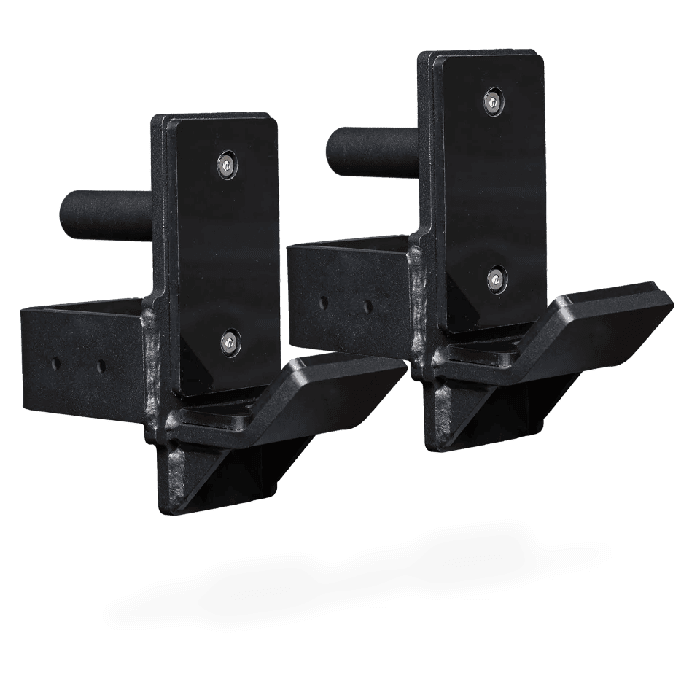
Power rack attachment types
Power rack attachments compatibility
Below is a list that was promised.
It’s a triple-distilled version of our complete database.
It includes every single attachment that’s worth your attention (and possibly your money), organized by dimensions of the uprights it fits and the diameter of the peg_(s)_.
Every table also contains columns that describe the “hug” (number of sides that are in contact with the rack and limit compatibility) and number of pegs used for mounting.
Take your time to click on stuff and understand what’s what
Also, bookmark this page because the table below is the only attachment-choosing tool you’ll ever need.
That’s a bold claim and I stand behind it.
Let’s get to it…
Below is a mega list of 500+ attachments sorted by two main factors - size and peg diameter.
Those two columns are followed by the type of mounting and number of holes used to do it. These two can be a limiting factor but don’t have to be.
Attachments for 3x3 profiles
[ninja_tables id=“12891”]
Attachments for 2.5x2.5 power-rack profiles
Attachments for 2 ⅜” x 2 ⅜ squat-rack profiles
Non-standard profiles
Attachments for 2x2 rack profiles
Power rack accessories and attachments for 2x3 profiles
Rack attachments for 2.36x2.36-inch profile (60x60 mm)
Other squat rack attachments (compatibility not limited by upright profile or flexible fit)
Power rack attachment compatibility - what’s what
Compatibility between a rack and an attachment is over-complicated in the home-gym space.
I’m not sure why…
It’s probably for the same reason that people complicate weight loss and fitness in general - because confusion sells.
Kid Lol GIFfrom Kid GIFs
Compatibility is actually pretty simple and intuitive.
It’s basically a game of Tetris with a few extra rules.
It comes down to 4 things:
- Profile - dimensions and shape.
- Diameter of the pin vs. the diameter of the holes.
- Number of pins used to secure the attachment.
- Some brand-specific stuff.
I’ll unpack that as simply as I can.
Profile - dimensions
This is about the dimensions of the uprights vs. the dimensions of the attachment.
The rule is intuitive - the attachment will fit if it’s the same size as the uprights, the holes line up and the pin fits.
It will all be much clearer in a minute…as I give examples.
Bonus tip: If you have an attachment in mind that’s bigger than the profile but the pin fits, you might still make it work by adding plastic adjusters/adapters or drilling extra holes.
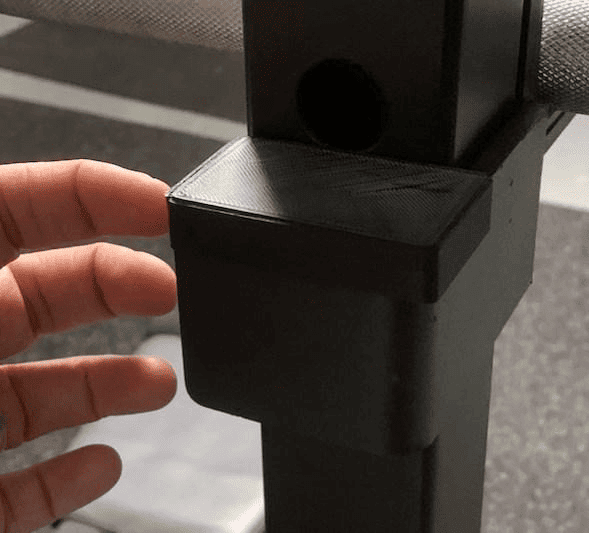 Image taken from here
Mounting (one vs. multiple sides) aka. “THE HUG”
What in the world is a hug of a rack attachment?
It’s a term I made up.
I came up with it to plasticly describe mounting compatibility.
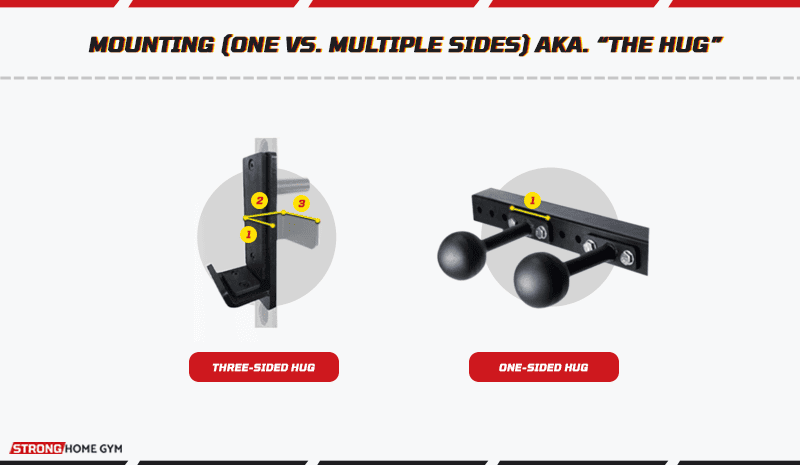
“Hug” is the number of sides on which there is a rigid limit between the upright and the attachment.
It sounds complicated and it’s anything but.
I’ll explain it here ‘cause I’ll be using it to describe stuff.
“Hug” explained simply…with examples and images
Let’s look at a simple j-hook - it encloses the upright on three sides, which is what I call a three-side hug.
On the other hand, most pull-up attachments (like the sphere below) have a one-sided hug.
Why is that important?
Because it’s a key part of the compatibility story.
Note these three things:
- You can mount that sphere on any rack as long as the screws line up and fit the holes.
- The j-hook is much less flexible but allows for a more stable connection without screws.
- I don’t include pegs as “rigid limits.”
Bottom line - One-sided hug sounds sad but it gives you more flexibility to mix and match.
Spongebob Hugging GIFfrom Spongebob GIFs
Diameters - pegs vs. holes
This is a basic one - the hole needs to be bigger for the pin to fit.
Ideally, the hole is made for the specific diameter, like in the image below.
_That’s in theory…_In theory, any pin that’s smaller than the hole fits (duh!) but will need to be secured with a bolt.
Hole spacing and number of pins
Another obvious point - if there are two pins, the rack holes will need to be at the same distance.
Most two-pin attachments and most racks have 2-inch spacing in the area where attachments go.
With a few exceptions…like spotter arms.
Spotter arms are mounted around the bench pressing area, and many racks feature 1-inch spacing there.
It’s a non-issue 90% of the time.
Why?
Because spotter arms are typically 1-peg attachments.
Keep these points in mind when browsing the list of specific attachments. Click here to skip directly to that list.
The bigger issue is build precision
Some attachments that should fit, don’t.
This is a caveat that shouldn’t exist but it surely does.
I’ve seen 3x3 attachments that aren’t really a fit for all 3x3 racks.
It happens for 3 reasons:
-
Quality issues of generic attachments.
This is basically Chinese stuff that’s not precision-cut so the tolerances are off.
What you can do about it
If you’re looking at an attachment on Amazon and don’t recognize the name, search the reviews for the word “compatibility.” If there’s an issue, someone likely already talked about it.
-
Conversion issues between metric and American sizes.
Some companies actually use the millimeters when making their stuff and then convert to inches in their listings.
Here’s a good example…
Some attachments are listed as 2.5, when they’re in fact 60 millimeters (2,36 inches).
If that sounds confusing, don’t worry - I’ve separated the two whenever possible and made special notes about it.
- Finally, sometimes it’s just intentional because the companies want you to buy their stuff….the rack, the attachments, all of it…
Whatever it is, I hate it…
I don’t care if it’s a unit thing or planned.
It comes off as a sneaky money-grab.
Titan’s attachments are a case in point - their spacing is slightly lesser and the pegs are slightly thicker.
We’ll talk more about the problem in the FAQs - click here to skip to that.
Bottom line - don’t fret about the outliers and the exceptions, understand the basics and take it from there. Let me worry about the anomalies and point them out.
Attachment types (what they are, who they’re for, and the budget “damage”)
In this section, I’ll go over ALL power rack attachments that deserve your attention.
If you’re unsure of what exists, don’t skip this part.
I’ll make it a quick-fire list that answers 4 questions:
- What’s the purpose of the power rack attachment?
- How to know if you need it.
- How it typically mounts.
- How much it costs (the whole range, from the generic to the top-tier stuff).
The endgame is giving you all the tools to plan your home gym budget smartly.
Let’s do it…
Popular rack-attachment brands and compatibility between them
Compatibility between major attachment brands is a needlessly convoluted topic (below this section you can find the FAQs).
Let’s untangle that…
Rogue rack attachments
We included 120 Rogue in our analysis
The number includes everything from simple j-hooks to robust trolley-system attachments which are basically a combo of a lever and monolift arm.
Below are a few bottom-line takeaways about Rogue rack attachments.
-
They make some of the best stuff in the industry, especially if you limit the search to non or semi-commercial rack accessories.
What’s better about their attachments?
The materials and coatings and precision of the build, which translates to overall coolness (as it tends to with the brand).
My personal favorite are Rogue cable attachments like the Slinger…they’re next-level.
Rogue cable attachments
Rogue cable attachments are my favorite section of their portfolio.
That goes especially for the Slinger and the Rhino belt-squat.
In terms of compatibility, you might be able to make the Slinger work with non-Rogue racks, but drop-in attachments will be a unique fit with Rogue racks.
REP rack attachments
About 105 of all attachments in our database come from REP - 46 to be exact.
They make some awesome stuff and are often the top value in their respective categories.
That’s especially true for sandwich J-hooks.
Why?
Because racks are the meat of their sales and they have to cater to the people who’re buying them.
Do REP attachment fit Rogue racks?
REP attachments theoretically fit ROGUE racks, but in practice, that’s not the case for all attachments.
REP J-cups, for example, are a fraction of an inch too small to comfortably fit a Rogue 3x3 upright.
In most cases, you can still make them work with minor modifications.
Titan attachments
Titan attachments are made with their racks in mind, the T3 above all else.
I’d even say that Titan goes out of their way to make their accessories non-compatible with other brands of racks.
The pegs are a bit bigger and the hole spacing is a bit off. I measured it at about 1.972” instead of 2 inches.
For one-peg attachments that’s not a big deal but it adds up.
Not a big problem…at least not as it used to be
Titan has made strides…you gotta give them that.
People used to buy their racks (mainly the T-2 and t-3) but not trust their attachments or have a hard time finding the accessory they need.
So they created hybrid, Frankenstein-style set-ups with Titan racks and Rogue attachments.
This required drilling extra holes and making extra trips to Home Depot for extra pins and screws.
That was like ten years ago.
Today, Titan still refuses to budge on the size and spacing, but their attachments are better than they used to be.
Ethos power rack attachments
What attachments are compatible with the famous Ethos racks from Dick’s?
It’s one of the more common questions in the space…
Most 3x3 attachments with 1-inch pegs and spacing that’s a multiple of 2 will fit the Ethos.
I say “most”…
That’s because the holes on the Ethos don’t go all the way up and they get smaller towards the top, which is a non-starter for attachments like pull-up bars and top pulleys.
Bottom line - there are plenty of cheap attachments on Amazon that will fit the Ethos.
Having said that, if you don’t already own it, I’d stay away from the Ethos rack - you can get much better racks for less (Titan’s T3 is the perfect example).
FAQs about squat rack attachments
Below you can find the FAQs about squat rack attachments…
Are power rack attachments universal?
No, power rack attachments are not universal.
Their compatibility with racks is defined by three main factors - profile size, peg diameter and hole spacing.
Are Rogue attachments compatible with Titan?
No, Rogue attachments are not strictly compatible with Titan.
Some of them might fit because the pegs are thinner than the holes on Titan racks (0.625” on Rogue attachments vs. 0.66” holes on Titan racks) but you’ll see some wobble.
If there’s more than one peg on a Rogue attachment, the holes won’t line up when mounted on a Titan rack - the greater the distance between the pegs, the more fudged the alignment will get.
Do Rogue attachments fit REP?
Yes, most Rogue attachments will be compatible with REP as long as the basic specs match.
For example, any one-peg accessory made for the Rogue Monster will fit on the REP PR500 rack.
The specs are compatible (3x3 profile, 2-inch spacing, 1-inch peg) and the attachments are precisely cut.
With that said, some of them, like the Mikolo LAT and Lift Pulley System, can universally fit any rack because it’s attached with a strap and carabiners.
Do Rogue attachments fit PRx?
Yes, Rogue attachments will fit PRx.
However, Rogue-PRx compatibility is a unique case because PRx’s most popular rack (the Profile PRO) has specific spacing and holes - 2–inch spacing with 1-inch hole son the front, and 6-inch spacing with ⅝ holes on the side.
This means the compatible Rogue attachments will be mostly from the Monster Series (for the front), and Monster Lite (for side-mounting).
Key takeaways on choosing squat rack accessories
I honestly think that this page is home to the most comprehensive guide on power rack attachments - in 4 ways:
- Attachment types that exist.
- The sheer number of attachments - specific products to choose from (400+).
- Compatibility information - both general and across brands.
- Outliers and exceptions to look out for.
Just as importantly, we update it all the time to make sure it stays fresh.
So, bookmarking it for future reference is a smart move.
Where to from here
If you wanna keep reading, click one of the links below to skip to a specific section:
- Compatibility - reference info (what’s what)
- Attachment types (what they are and do you need them)
- Specific attachments sorted by compatible rack profiles
If you’re not clear on which attachments to get, head over to our guide on the best power rack attachment here.